President’s Corner, January 2024
- Happy New Year! Scientists have proved that folks who celebrate more New Years tend to live longer! If you made it this far, then congratulations! What are your astronomical plans for this new year?
- Vera Rubin in the News: You do realize that January 1 is a pretty arbitrary point on our helical journey around the G-class star we call the Sun, as it travels around the super-massive black hole at Sagittarius A*. You may have seen a nifty (but not 100% accurate) animation (e.g. https://www.universetoday.com/107322/is-the-solar-system-really-a-vortex/ ) that shows how the Earth and all the other planets travel on a corkscrew path around the Sun as we all orbit the center of the Milky Way.
- Vera Rubin, an early member of NCA, and a long-time DC resident, was featured in the December 2023 issue of Astronomy ( https://www.astronomy.com/science/vera-rubin-found-a-lifetime-of-wonder-in-the-dark-skies/ ) magazine because (as you probably know) she found through careful research that the speeds of stars like ours, as they orbit around their galaxies, don’t make sense if you add up all the known mass and crank out the Newtonian formulas for gravity and their speeds. The stars near the edges of galaxies go just as fast as the ones near the middle, which is NOT true in, say, our solar system, where Mercury travels at 48 km/s, Earth goes 30 km/s, and Neptune’s speed is 5 km/s. So far, nobody has found the missing ‘dark matter’ that would make these speeds work on galactic scales, and no astrophysicist has (to my knowledge) come up with modifications to Newtonian dynamics that both satisfy all the other laws of physics and also solve the problem. We have a profoundly open question, thanks to this pioneering astronomer’s work!
- This interview with Rubin was quite revealing, especially regarding the sexist obstacles she faced: https://www.historicchevychasedc.org/oral-histories/vera-rubin/.
- While it is a shame that Vera was never awarded a Nobel prize for her work, NASA and others did rename the Large Synoptic Survey observatory in Chile after her in 2019, and it should be in full operation after we make one more turn around the Sun. (See https://rubinobservatory.org/ and also the December 2023 monthly talk for Northern Virginia Astronomy Club https://www.novac.com/wp/ ).
- The NCA website( https://capitalastronomers.org/ ) is up again, thanks to our fearless web wrangler, Elizabeth Warner!
- If you are not a member of the NCA email list-serve, and would like to join it, just send an email to capitalastronomers+subscribe@groups.io . It makes no difference what you put in the subject line or body of the email.
- Reminder thatJanuary’s meeting will be strictly virtual. The URL to log in can be found elsewhere in this month’s issue.
- You already know that on April 8, a total solar eclipse will make its way across the Pacific Ocean to Mexico, a highly-populated area of the central USA, and eastern Canada.
- If you have never seen a total eclipse, then I highly recommend you make plans to do so at least once it your lifetime. It’s the only time you can see the sun’s chromosphere and corona with your naked eyes. It inspires awe in me every time I see it, and I have seen no photo or video that does it justice. Partial eclipses are nice, but nothing beats totality for making you realize that we are only 8 light-minutes away from the incredibly massive thermonuclear reactor that is responsible for our very existence.
- If you are planning to go, but don’t already have lodging along the path of totality, a very brief online search suggests that hotels and motels in the zone of totality (e.g. Dallas) seem to have doubled or tripled their rates for the event (understandably). However, there are plenty of other motels that are located within 100 miles of that strip, at much lower prices. Given the great US interstate highway system, it should not be too hard to drive from such a motel to somewhere inside the zone of totality on the morning of the event, even if traffic is heavy.
- The lowest probability of clouds along the entire path is at Mazatlàn, but the crime situation today in Mexico is just too scary for me.
- My wife and I have arranged for an Airbnb somewhere in Austin and are probably driving from DC to that address, and probably staying put for the event unless a forecast for clouds impels us to drive somewhere else.
- I think I’ll bring my own Coronado PST and the 6” scope that I re-made as a travel scope for the 2017 eclipse.
- We are putting in an order for hundreds of NCA-branded, safe, solar eyeglasses for NCA members to give away at this and other events. The board has discussed the issue, and my decision as president is that these should be given away, not sold. Why?
- Jeff Norman, our assistant secretary-treasurer investigated, and found that while NCA is a non-profit, we would still be required to calculate and collect sales tax and give receipts for each one that we sold; we would need to then pay those funds to the District of Columbia. This is way too much trouble and work for Jim Simpson (our secretary-treasurer) and Jeff, for a relatively small amount of money.
- Fewer and fewer people even carry dollar bills or quarters in their pockets or purses, and we definitely don’t want to go through the hassle of doing electronic payments for a dollar or less.
- Cash donations from the public might need documentation.
- I think the best thing is to use any interaction with the public to recruit any interested person to sign up as a new NCA member at our website and to help out at similar events.
- No other astronomy club that I know of is charging the public for these, and we would appear to be less than generous.
- If a current NCA member would like to reimburse the club, at roughly the final cost ends up being, for a large quantity of them that you would like to give out at some event, that would be great, but not required.
- If you decide to stay in the DMV area for the event, you can help the public enjoy the partial eclipse at the National Air and Space Museum on April 8 with a variety of optical aids, including live feeds from totality. The NCA Hydrogen-alpha double-stack Solar Max telescope will be available for use.
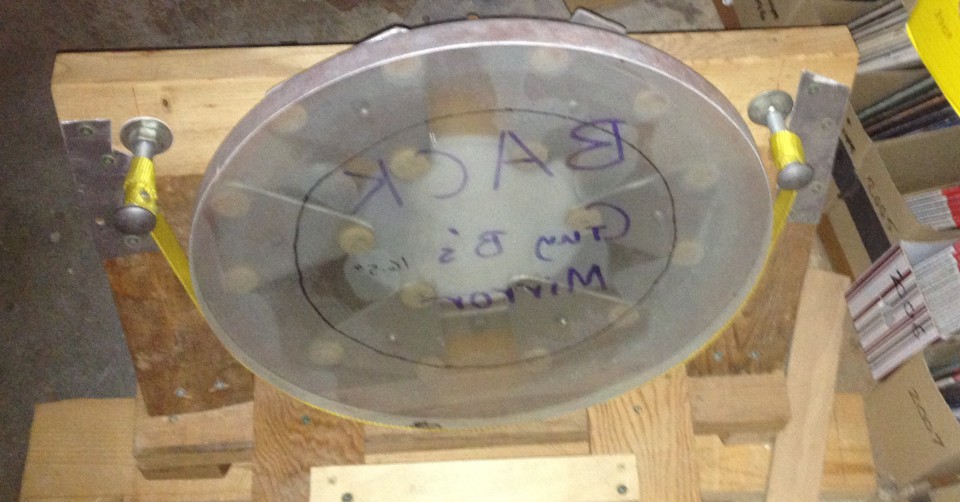
- If you are interested, there are several different designs for inexpensive, safe DIY solar viewers. Here is a fairly original one: https://richardsont.people.cofc.edu/safe_solar_folder/the_2-lens_SSV.html . I have made one of these with leftover floorboards, and I have purchased some extra lens sets from Surplus Shed so you can make your own out of wood or cardboard, either at the Chevy Chase Community Center or anywhere you like.
- However, it appears that the safe solar viewer in 8a works much better with an achromatic doublet than with the singlet lens in the original design, because the sunspots are not obscured by bluish tinges. I will try that soon.
- Sun funnels and solar projection ( https://eclipse2017.nasa.gov/make-sun-funnel or https://eclipse.aas.org/eye-safety/projection ) can work, but not all eyepieces can stand the heat.
- Please warn people not to look through any scope at the sun without proper solar filters at the front end of the scope!
- The sun is putting on quite a show so far this cycle; who knows what will happen in 2024?
- John Hornstein reminds us that we still need an NCA member (that is, one of you reading this) to volunteer to be our next vice-president starting in June. This person will be in charge of finding speakers for our monthly meetings, introducing those speakers, and finding candidates for our elected board for the next year. We have a wealth of top-notch astronomical entities in the area (Goddard, Carnegie, STSI, and the Naval Research Lab, to name just four), and many of their staff are more than happy to share their research with us, if we ask them nicely. Plus, we can have remote speakers from all over the world!
- Annual dues for regular members are increasing to $15 as of September 2024.
- Student dues will stay put for now at $5/year.
- In 2025, regular dues will go up again, to $20/year, and student dues will rise to $10/year.
- If you want to sign up for a three-year membership, that will also increase next year, to $35, but life memberships will stay at $200.
- Exploring the Sky will start up again on April 6, but with a new contact person and planetarium operator, since Ranger Renée Maher is moving to a new position in the NPS .
- Renée will be sorely missed. She was the person who came up with the idea of holding planetarium shows and telescope observing on the same evening, which worked out extremely well. She is a great planetarium operator and story teller, and has been great fun to work with as well. She emailed me that she has done many of the steps needed to make sure the joint NCA-NPS-EtS program continues as we did last year, but she doesn’t know who the new contact person will be will be, or even the new supervisor. Her last day at the Rock Creek Nature Center is January 13.
- Here is the tentative schedule for these events, as proposed by Jay Miller and me. All dates are on Saturdays, and all times are PM, local time for the DMV region. They are designed so as to not interfere with monthly NCA meetings or national holidays, and to begin somewhere between the end of civil and nautical twilights.
- Anybody bringing a telescope is advised to begin setting up earlier than the official starting times, if at all possible.
| Month | Day | Sunset | Civil Twilight | Nautical Twilight | Astro- nomical Twilight | Planetarium Show Starts | Exploring the Sky Starts |
| April | 6 | 7:37 | 8:04 | 8:36 | 9:09 | 7:30 | 8:30 |
| May | 4 | 8:15 | 8:44 | 9:20 | 9:58 | 8:00 | 9:00 |
| June | 1 | 8:28 | 8:59 | 9:38 | 10:23 | 8:00 | 9:00 |
| July | 13 | 8:33 | 9:04 | 9:43 | 10:27 | 8:00 | 9:00 |
| August | 10 | 8:08 | 8:37 | 9:12 | 9:49 | 7:30 | 8:30 |
| September | 7 | 7:28 | 7:55 | 8:27 | 8:59 | 7:00 | 8:00 |
| October | 5 | 6:43 | 7:10 | 7:41 | 8:12 | 6:30 | 7:30 |
| November | 2 | 6:05 | 6:33 | 7:05 | 7:36 | 6:00 | 7:00 |
- We always need folks who either have scopes or who have information they can share with the public. While Rock Creek Park no longer has the dark skies it did two centuries ago, this event may be the only chance that members of the public will have of seeing the Moon, the planets, and other bright objects with their own eyes, in real time, rather than in a photo.
- The planetarium shows occur rain or shine in the Nature Center. Obviously, the telescope observing part of the event will depend on the weather.
- I want to thank all of the folks who have brought their scopes to these events this year and during past years. I especially want to thank Jay Miller for organizing the NCA side of this for many years no2.
- In the next few months, local counties and cities in the DMV area will host science/STEM fairs. We appear to have sufficient NCA volunteers (thanks!) but we could aways use some more.
 Guy's Math & Astro Blog