• My series on making a Newtonian telescope
  • How Leon Foucault Made Telescopes

Guy's Math & Astro Blog

Guy's Math & Astro Blog

Category Archives: Uncategorized

A whole bunch of pix, combined with great skill, hardware, and software, equals what I saw during totality!

28 Monday Aug 2017

Posted by gfbrandenburg in Uncategorized

≈ Leave a comment

Jerry Rodrigues has actually managed to capture what I was able to see during the total eclipse of August 21, 2017. It’s a really great image, composed of many, many separate images captured between 2 seconds long to 1/4000 of a second. And then all those sub-images were combined together with great finesse, skill, and software.

Very remarkable.

This is what you missed, and it’s close to what I was trying to draw in my last post.

Here is the link:

http://www.astropix.com/2017_Total_Solar_Eclipse_Corona.html

Almost ready for the eclipse!

21 Monday Aug 2017

Posted by gfbrandenburg in Uncategorized

≈ Leave a comment

After spending most of the day making last minute modifications to my scope, it’s almost ready!

Among other things, I attached a shroud made of black 4 mil plastic sheeting and stabilized the mount so the OTA doesn’t fall out of the rocker box.

Just now, I was able to get both a white light image of the Sun thru a Baader filter (stopped down to f/24) as well as projection onto white paper. There is quite a display of major sun spots, all in a row, right near the center!

Yay! My work finally paid off!

(Photos will follow)

I’m featured in an NPR-WAMU piece on eclipse chasers

08 Tuesday Aug 2017

Posted by gfbrandenburg in Uncategorized

≈ Leave a comment

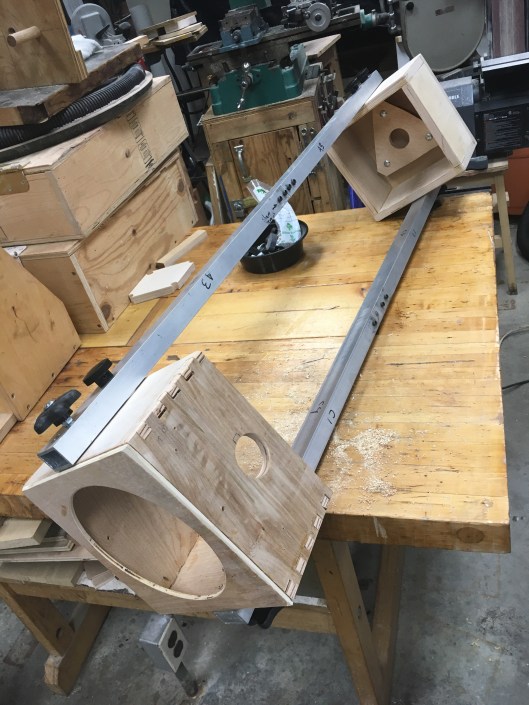
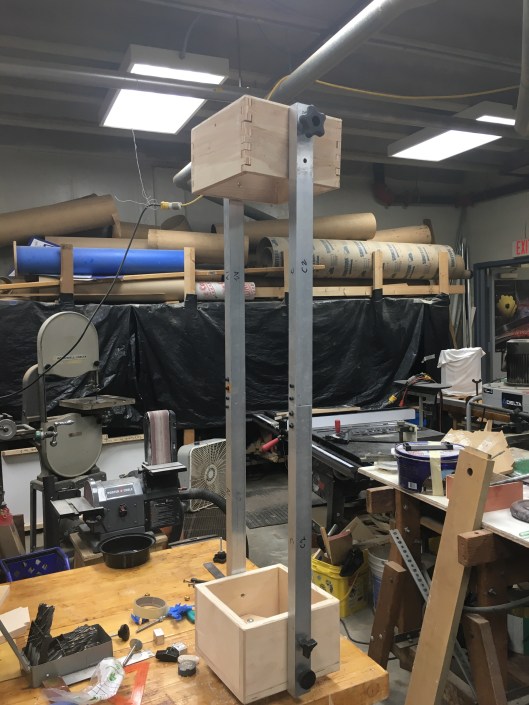
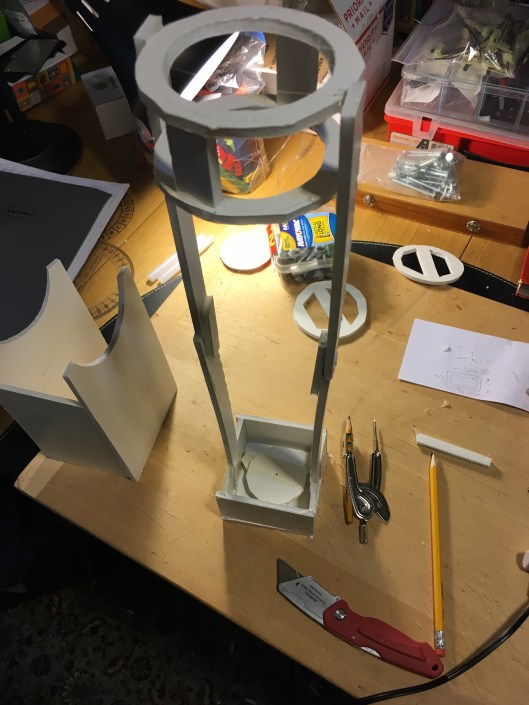
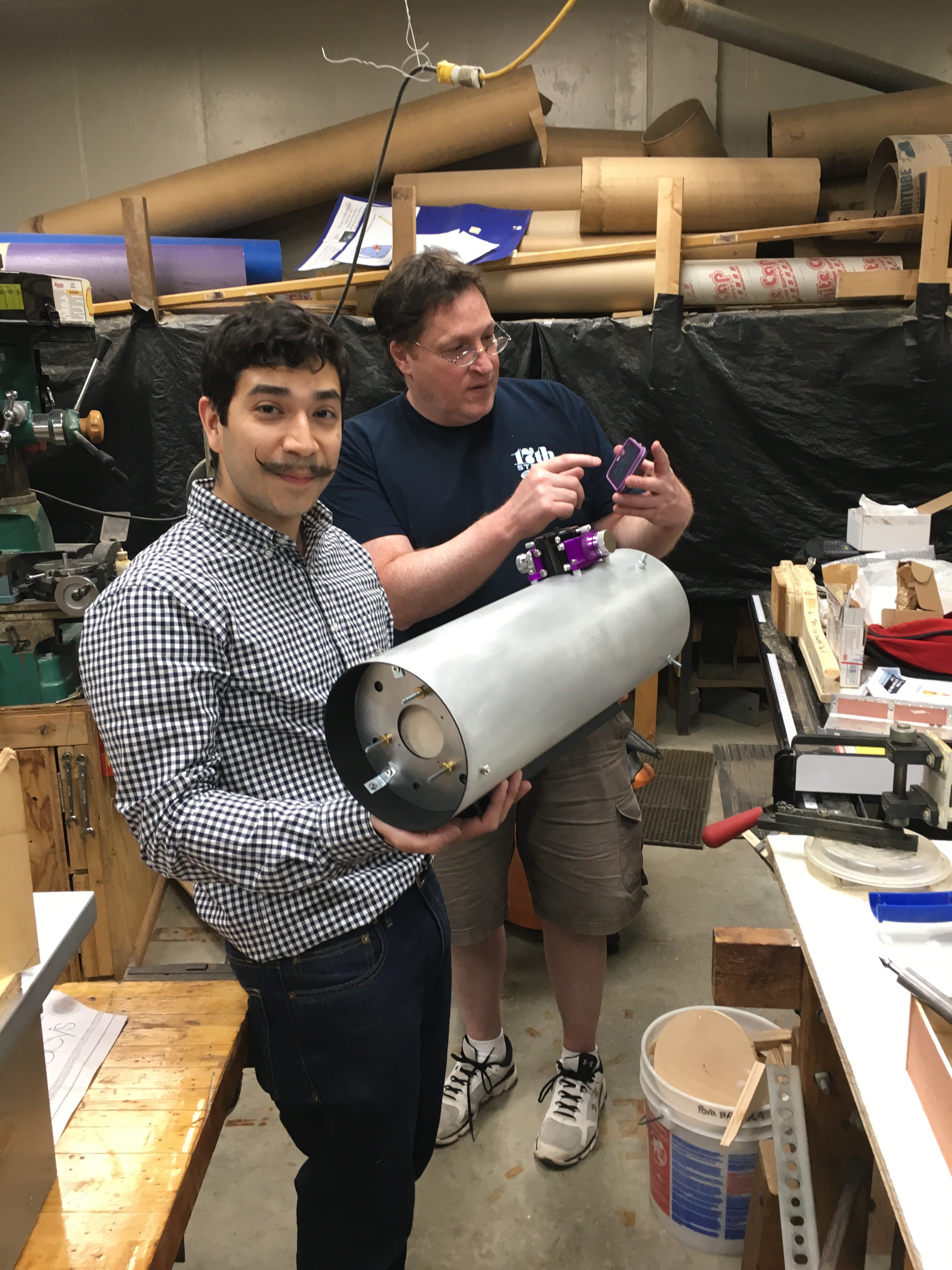
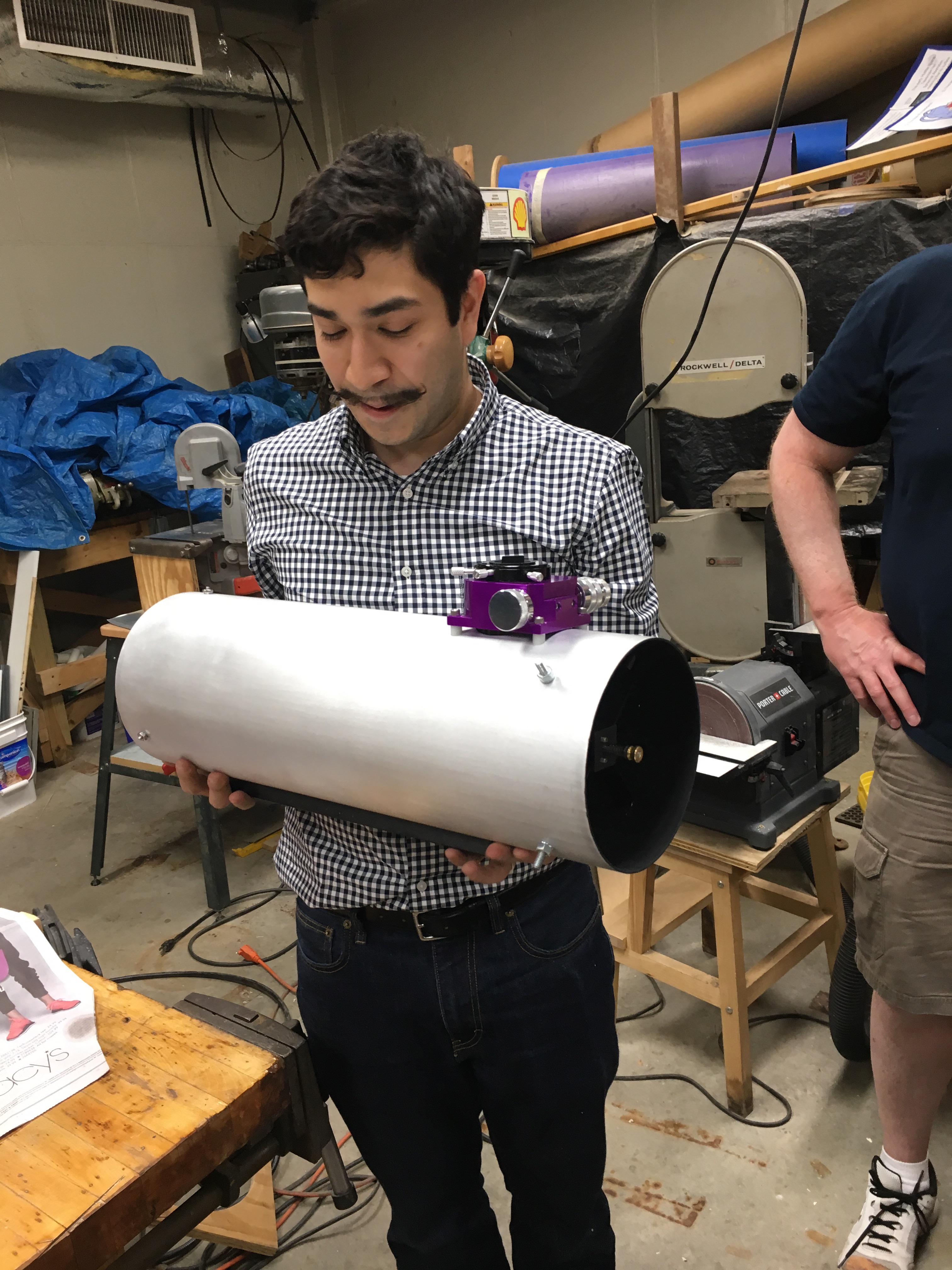
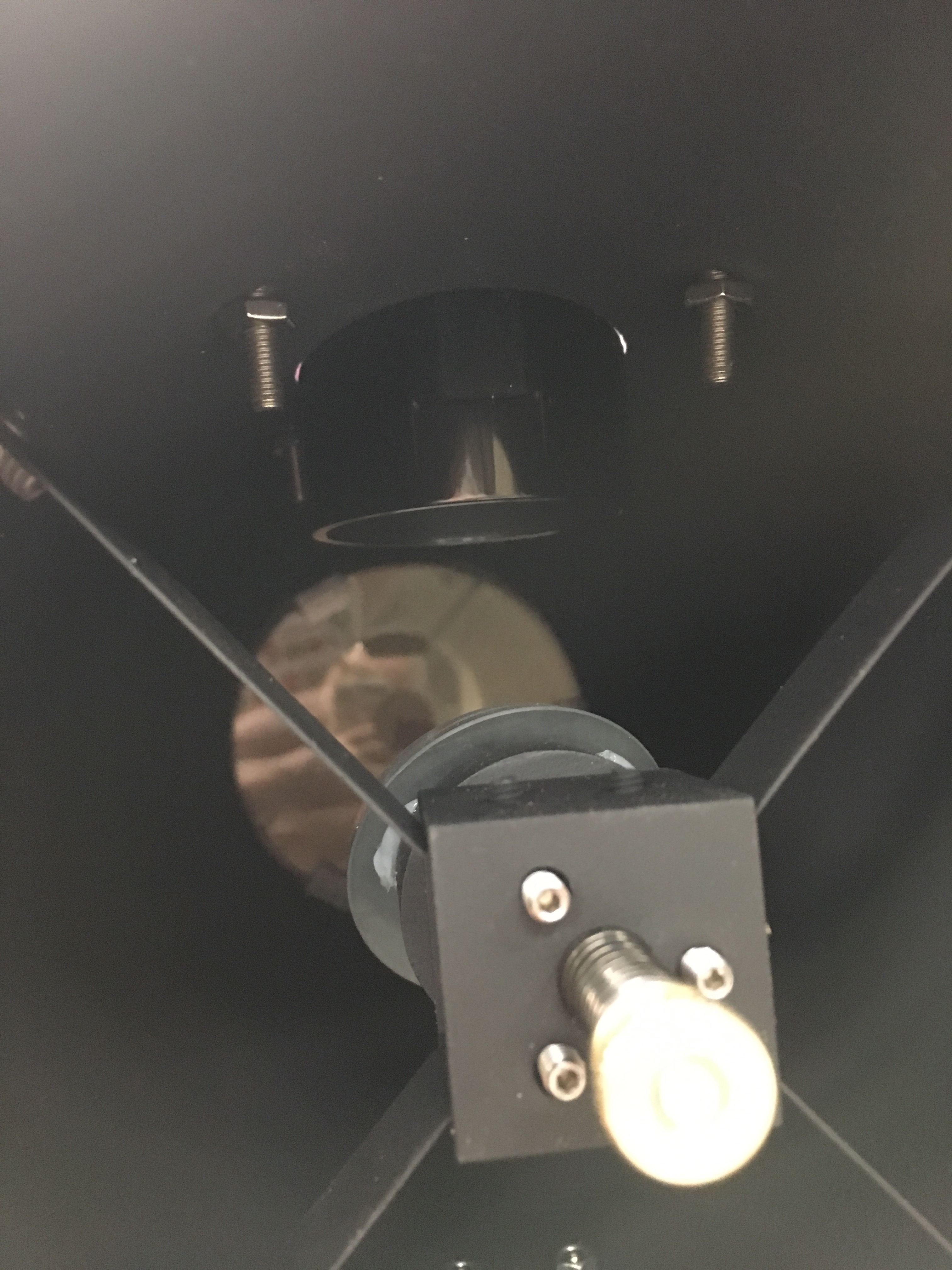
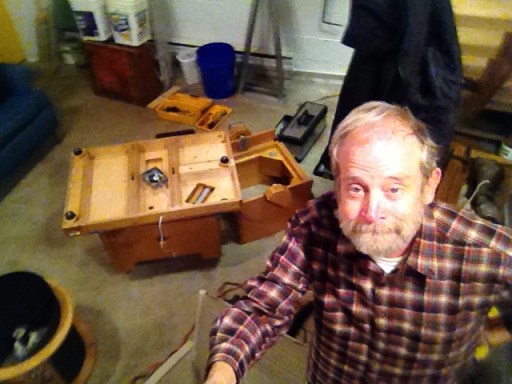
NPR-WAMU just ran a piece on eclipse chasers, featuring professional astronomers like Fred Espenak and Jay Pasachoff, as well as an amateur from Brookland (me) as I was working at the CCCC on building a collapsible scope to take to Wyoming for the event.

Here's a link:
http://wamu.org/story/17/08/08/meet-eclipse-chasers-following-moons-shadow-addiction/

And no, I'm not an addict. It's just the most amazing natural phenomenon I've ever experienced.

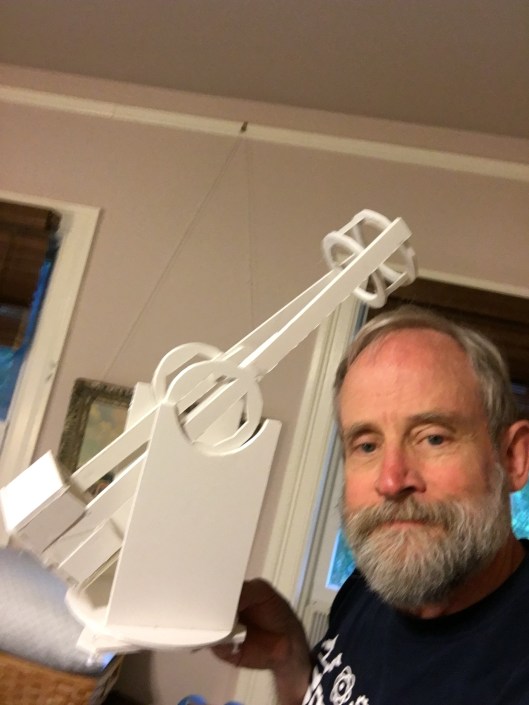
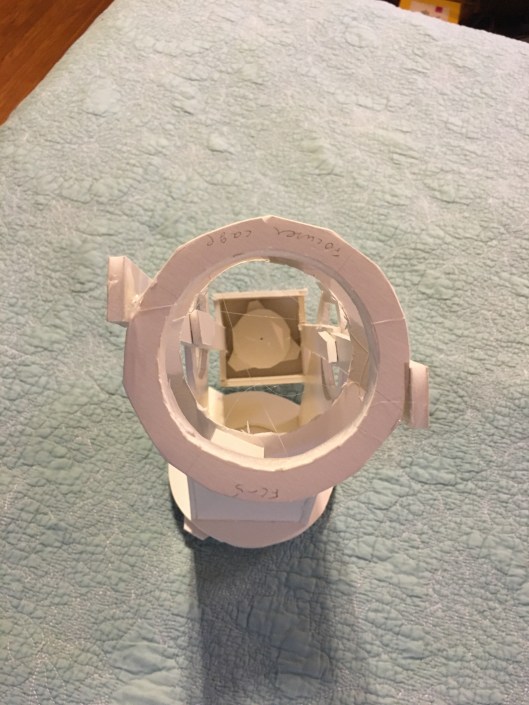
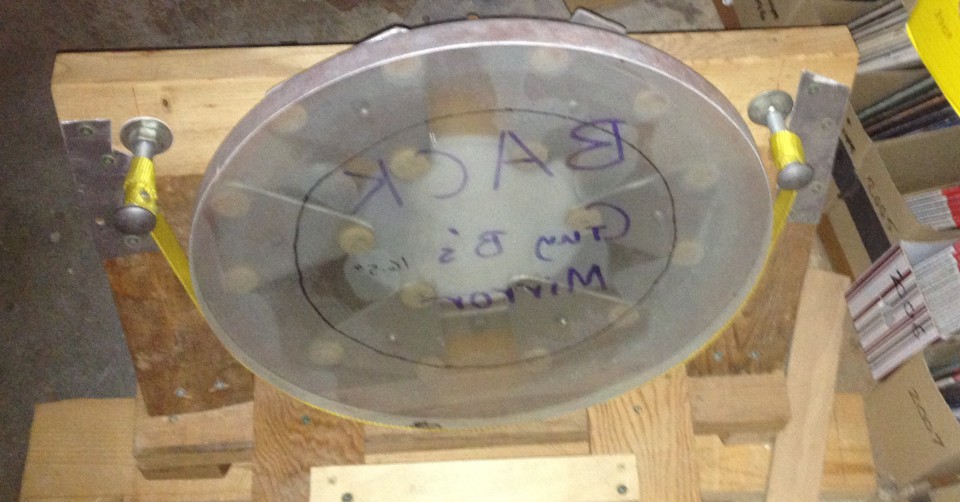
Here are some pix of my project, which is far from being finished:

American Science and the 1878 Eclipse

14 Friday Jul 2017

Posted by gfbrandenburg in Uncategorized

≈ Leave a comment

Thomas Edison, Maria Mitchell, Allan Clark and others are featured in a book about how they stumbled scientifically when trying to observe various aspects of the 1878 North American Total Solar Eclipse. A review in Science is here. 

Is this a fractal or a Fibonacci spiral?

04 Tuesday Jul 2017

Posted by gfbrandenburg in Uncategorized

≈ Leave a comment

“Easy” way to do calculus …

07 Sunday May 2017

Posted by gfbrandenburg in Uncategorized

≈ Leave a comment

… if you forgot why the derivative of y = 1/x is -1/(x^2), here’s all the “explanation” you need:

A Six-inch, f/3 hand made scope!

20 Thursday Apr 2017

Posted by gfbrandenburg in Uncategorized

≈ Leave a comment

Oscar Olmeda made just about everything in this scope. His optical work (like everything else) is superb!


The Mathematics of George Washington

24 Friday Feb 2017

Posted by gfbrandenburg in History, Math, Uncategorized

≈ 2 Comments

Tags

George Washington, History, Math, surveying

I recently learned some things about how the young George Washington did math, including surveying. Mathematician and historian V. Frederick  Rickey gave a talk 2 nights ago at the Mathematical Association of America here in DC, based on his study of GW’s “cypher books”, and I’d like to share a few things I learned.

(1) The young George appears to have used no trigonometry at all when finding areas of plots of land that he surveyed. Instead, he would ‘plat’ it very carefully, on paper, making an accurate scale drawing with the correct angles and lengths, and then would divide it up into triangles on the paper. To find the areas of those triangles, he would use some sort of a right-angle device, found and drew the altitude, and then multiplied half the base times the height (or altitude). No law of cosines or sines as we teach students today.

(2) He was given formulas for the volumes of spheroids and barrels, apparently without any derivation or justification that they were correct, to hold so many gallons of wine or of beer. (You probably wouldn’t guess that you had to leave extra room for the ‘head’ on the beer.) Rickey has not found the original source for those formulas, but using calculus and the identity pi = 22/7, he showed that they were absolutely correct.

(3) GW was a very early adopter of decimals in America.

(4 ) This last one puzzled me quite a bit. It’s supposed to be a protractor, but it only gives approximations to those angles. The results are within 1 degree, which I guess might be OK for some uses. I used the law of cosines to convince myself that they were almost all a little off. Here’s an accurate diagram, with angle measurements, that I made with Geometer’s Sketchpad.

His method was to lay out on paper a segment 60 units long (OB) and then to construct a sixth-of-a-circle with center B, passing through O and G (in green). Then he drew five more arcs, each with its center at O, going through the poitns marked as 10, 20, 30, 40, and 50 units from O. The claim is then that angle ABO would be 10 degrees. It’s not. It’s only 9.56 degrees.

george-washingtons-protractor

Telescope Fix, Scudding Clouds Over Moon, Tom Turkeys Hiding, and Successful Cloud Chamber!

12 Monday Dec 2016

Posted by gfbrandenburg in astronomy, astrophysics, science, Telescope Making, Uncategorized

≈ Leave a comment

Tags

cloud chamber, Digital Setting Circles, dry ice, Isopropanol, Moon, Sky Wizard, Turkeys

I had a productive 24 hours!

  • Night before last, I think I finally got Sky Wizard Digital Setting Circles installed on the 14″ alt-az telescope we were most generously donated by Alan Bromborsky. (That’s me, in the operations cabin  at Hopewell Observatory, taking a break and a picture, long before completion.)img_6169
  • So I went out to look at the sky at 1 AM. I saw no stars, but the 80% gibbous moon appeared to race dramatically through the clouds
  •  That afternoon, as I was driving out, I saw 5, maybe 6 tom turkeys playing hide-and-seek with me behind the trees. Believe me, they are REALLY GOOD at hiding behind little saplings, logs, and rocks! Or if you don’t believe me, ask anyone who’s tried to hunt them.
  •  Late that evening, I got a dry-ice-and-isopropanol particle detector working for the first time. (I had tried and failed, when I was a teenager, some 50 years ago, and failed several other times since then as well.) If you look at my little video, you can see the particles more easily than I could with your naked eye as I was filming it. Don’t ask me yet which ones are muons, which are alpha particles, and which are beta particles, because I don’t know yet. But you could look it up!

Productive 24 hours!

Sex and Math: The Zero to Two Percent of Our Actual Lives That Rules Our Lives

01 Thursday Sep 2016

Posted by gfbrandenburg in Math, science, Uncategorized

≈ 1 Comment

Tags

frequency, life, nookie, poisson curve, procreation, sex

Someone (probably Louis CK) pointed out that even though we all obsess about sex (and being attractive to the persons with whom we long to have sex), it’s actually a very, very tiny part of one’s actual (as opposed to our wishful) life.
[Of course, any species that survives needs to have a strong drive for procreation, or they won’t leave enough offspring behind to carry on. (Just ask pandas what happens when they seemingly couldn’t care less… They are, if you hadn’t noticed, nearly extinct in the wild. Rats, rabbits, ants and cockroaches survive by being unbelievably fertile — and sneaky.]
Let’s try to do some math on this.
Have you ever tried figuring out what percent of your entire life has consisted of you actually making love (having sex) with another person?
I am not counting masturbation here because
  • I don’t trust any data on this, even Masters and Johnson, so any guesses on my part would be just that
  • I’m only talking about having sex with another person, either Penis-In-Vagina or any other sort of sexual activity, which I am not about to list here —  use your own imagination if you want to. 
  • And no, I’m not going to tell you anything about my own habits or those of anybody else I know. However, if you want to tally up your OWN time doing ‘that’, feel free.
 
Let’s look at the high end of the spectrum of those having lots of sex first.
My guess is, based on observations of personal experience and what I’ve observed with people I knew well:  that only with the very horniest newly-weds or with a couple who have just entered a super-sensual, brand-new sexual relationship,  time would a couple be spending, say, as much as four hours a day actually’doing it’. Why? For one thing, sex is exhausting. Also, the tissues involved are delicate and can only take so much rubbing, no matter how well lubricated they might be. Plus the couple need to sleep, eat, wash, and most likely do something productive like going to school or work.
That very high figure for someone getting a HUGE amount of nookie is 4 hours  out of 24 hours in a day, or 1/6, which is about 17% of the time. Let me repeat: that’s extraordinarily high, and from my own observations (thin walls allow one to hear… and so on) only seems to last for the first few weeks, because then they get sore, exhausted, sated, and somewhat jaded.
After that, they’d be lucky to be ‘doing it’ for an hour or two a day, which is between about 4 and 8% of the time.
But let’s compare that to the rest of their lives for this remarkably horny and lucky couple… Let’s suppose that they are 20 years old, and let’s suppose that they each had sex a few times in high school and after (college, military, working, whatever, and I’m making no assumptions about whom they are doing this with). Maybe they got laid 2 – 3 times a week from age 16, at about an hour each time (girls, feel free to scoff at my suggestion that a typical male teenager can actually last that long) plus, now that they are not living at parents’ home any more, they have had several tumultuous, sexy relationships one after the next, each time spending an average of 2 hours actively ‘doing it’ each 24-hour period, for the last two full years.
So let’s make that say 6 hours a week for 2 years plus 28 hours a week for the last 2 years – and these people are those who are towards the very far right hand end of the frequency curve distribution. I don’t know whether the distribution of ‘nookie-hours’ if graphed, is ‘normal’ or ‘skewed’one way or the other. But in any case, most people ‘get’ a lot less sex than this. In fact, when I was in high school and college, the vast majority of my (male and female) friends my age or younger were virgins. No, I’m not going to tell you what age or to whom I lost my virginity. I will keep my fond memories to myself, and hope you will do likewise.
Here’s the arithmetic:
Denominator (total hours lived) for this very lucky pair of 20-year olds: 24 hours per day time 365. days per year times 20 years old equals 175,200 hours total that they have lived so far. (D)
 
Numerator ( total hours having sex with another person since they were born) Assuming this very sexually active couple who have sex 6 hours a week times 104 weeks (two years from ages 16 – 18) plus 28 hours a week times 104 weeks (two more years, aged 18 – 20) equals 3,536 hours having sex, grand total, (N)
 
I used a calculator to divide N by D and I get about .02, or two percent of their life so far. That’s tops.Two percent of their life.
I suppose it is theoretically possible that a married couple of 60 years, at age 75, has been actively having sex a full hour every single day of their married life (since age 15). Extremely rare, I know… But for this tiny handful of  extraordinarily horny, happy, healthy and lucky people, I get a grand total of 1/30 of their life, or a tad more than 3%. And I bet that you could probably hold a nice party for every single one of these lucky 75-year-old living couples — from all over the world — in the cafeteria of the elementary school nearest my house. Not sure how much standing room there would be, but this is out of our current world population of over 6 billion people. So they are outliers of outliers of outliers.
The vast majority of people would have much, much less sex than that, I predict with confidence.
Additionally: a good number of people die before losing their virginity. I have no idea what percentage do, but during the old days, it was probably well over half  of them, infant mortality rates being what they were — and I’m assuming that most of those babies and children who died at very early ages from disease, murder or accidents weren’t being sexually abused during their short, sad lives… Many soldiers die in combat having had sex perhaps 0 to 6 times in their entire lives, if I can trust various memoirs I’ve read by veterans of various wars…
So that’s the far left hand end of the ‘bell-shaped’ curve: 0%.
While there are a tiny handful or two-to-three percenters out there, I would bet (if we could test it somehow) that over 99.99% of the population has sex, on average, between ZERO and TWO percent of our entire lives.
But, oh, how we obsess over ‘it’!!
← Older posts
Newer posts →

Subscribe

  • Entries (RSS)
  • Comments (RSS)

Archives

  • February 2026
  • December 2025
  • November 2025
  • October 2025
  • September 2025
  • July 2025
  • January 2025
  • November 2024
  • October 2024
  • August 2024
  • July 2024
  • May 2024
  • April 2024
  • January 2024
  • December 2023
  • October 2023
  • August 2023
  • June 2023
  • May 2023
  • April 2023
  • November 2022
  • October 2022
  • August 2022
  • July 2022
  • June 2022
  • May 2022
  • April 2022
  • February 2022
  • January 2022
  • December 2021
  • October 2021
  • September 2021
  • August 2021
  • July 2021
  • June 2021
  • May 2021
  • March 2021
  • December 2020
  • October 2020
  • September 2020
  • August 2020
  • March 2020
  • February 2020
  • January 2020
  • December 2019
  • November 2019
  • September 2019
  • August 2019
  • June 2019
  • May 2019
  • January 2019
  • November 2018
  • October 2018
  • September 2018
  • August 2018
  • May 2018
  • March 2018
  • January 2018
  • November 2017
  • October 2017
  • September 2017
  • August 2017
  • July 2017
  • June 2017
  • May 2017
  • April 2017
  • February 2017
  • December 2016
  • September 2016
  • June 2016
  • May 2016
  • April 2016
  • March 2016
  • February 2016
  • January 2016
  • December 2015
  • November 2015
  • August 2015
  • July 2015
  • April 2015
  • March 2015
  • February 2015
  • January 2015
  • December 2014

Categories

  • astronomy
  • astrophysics
  • education
  • flat
  • History
  • Hopewell Observatorry
  • Math
  • monochromatic
  • nature
  • optical flat
  • Optics
  • Safety
  • science
  • teaching
  • Telescope Making
  • Uncategorized

Meta

  • Create account
  • Log in

Blog at WordPress.com.

  • Subscribe Subscribed
    • Guy's Math & Astro Blog
    • Join 54 other subscribers
    • Already have a WordPress.com account? Log in now.
    • Guy's Math & Astro Blog
    • Subscribe Subscribed
    • Sign up
    • Log in
    • Report this content
    • View site in Reader
    • Manage subscriptions
    • Collapse this bar
 

Loading Comments...