• My series on making a Newtonian telescope
  • How Leon Foucault Made Telescopes

Guy's Math & Astro Blog

Guy's Math & Astro Blog

Tag Archives: Aluminization

Aluminization

16 Tuesday Dec 2014

Posted by gfbrandenburg in Telescope Making

≈ Leave a comment

Tags

Aluminization

6. Aluminization

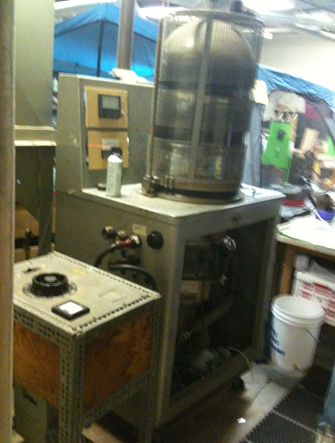
A. Once the mirror is done, you need to put a reflective coating on it. We have a device that does that: a military- and university-surplus vacuum chamber and aluminizer that we have been keeping alive for about 30 years or so, shown below. Briefly, this is what we do: essential atm steps aluminizer
B. We clean the mirror very, very thoroughly.

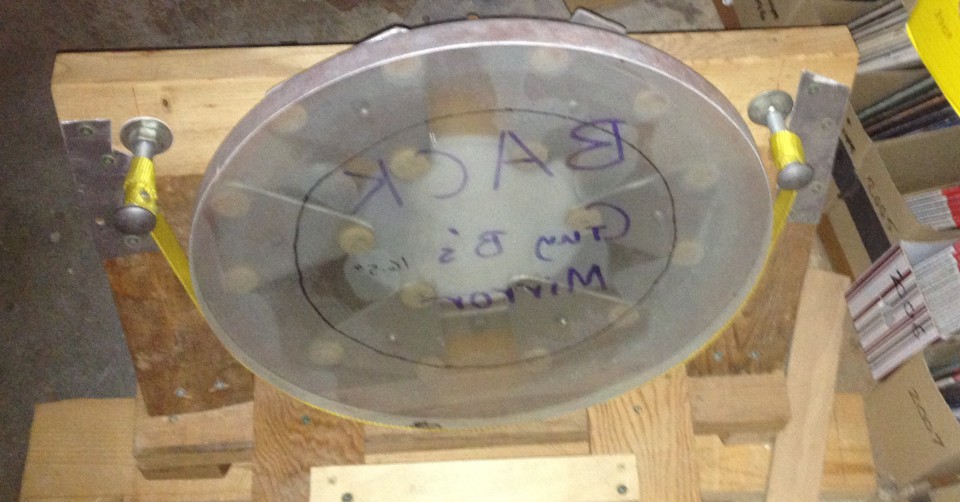
C. We put it into the vacuum bell jar in a special jig that holds it at the top, facing downwards;

D. Pump out almost all of the air with a mechanical pump. This gets the pressure from 760 mm of mercury (normal pressure, 760 Torr) down to about 0.1 mm of mercury (0.1 Torr).

E. While pumping, we zap the mirror surface with a high-voltage A/C plasma which further cleans and prepares the glass to accept the aluminum coating. This looks like the Aurora Borealis.

F. We then turn on the diffusion pump, which works by somehow capturing individual molecule of air in a condensing mist of expensive silicone oil that was boiled at very low pressure. It sounds like magic, but it works to get the pressure down from 0.1 mm of mercury all the way to 0.00008 mm of mercury, which is what we need for the last step.

G. Then we slowly heat up a special tungsten filament coil that has a slug of pure aluminum wire inside the coil. The coil melts the aluminum, which coats the tungsten coil and then boils off into the vacuum, in all directions. A small part of that aluminum vapor hits the mirror, and sticks to it in a very thin layer.

H. We then close down the diffusion pump, close and open various valves, and wait for the air inside the chamber to equalize with the air outside, so we can open up the chamber and remove your mirror.

I. You should be very gentle with the coating, especially at first. Resist the urge to wipe it clean if dust gets on it. It will be about 85-90% reflective, and will stay that way for years. If there were any nearly-invisible scratches left on your mirror after polishing and figuring, they will be highlighted by the shiny aluminum layer. They won’t have any optical effect, but they will make you feel bad. Keep the mirror protected from fingers, sneezes, dandruff, snot, and dust. Don’t let anything touch the surface, even soft cloths!

(Link forward to next section ==>)

(<== Link back to the previous section)

Subscribe

  • Entries (RSS)
  • Comments (RSS)

Archives

  • December 2025
  • November 2025
  • October 2025
  • September 2025
  • July 2025
  • January 2025
  • November 2024
  • October 2024
  • August 2024
  • July 2024
  • May 2024
  • April 2024
  • January 2024
  • December 2023
  • October 2023
  • August 2023
  • June 2023
  • May 2023
  • April 2023
  • November 2022
  • October 2022
  • August 2022
  • July 2022
  • June 2022
  • May 2022
  • April 2022
  • February 2022
  • January 2022
  • December 2021
  • October 2021
  • September 2021
  • August 2021
  • July 2021
  • June 2021
  • May 2021
  • March 2021
  • December 2020
  • October 2020
  • September 2020
  • August 2020
  • March 2020
  • February 2020
  • January 2020
  • December 2019
  • November 2019
  • September 2019
  • August 2019
  • June 2019
  • May 2019
  • January 2019
  • November 2018
  • October 2018
  • September 2018
  • August 2018
  • May 2018
  • March 2018
  • January 2018
  • November 2017
  • October 2017
  • September 2017
  • August 2017
  • July 2017
  • June 2017
  • May 2017
  • April 2017
  • February 2017
  • December 2016
  • September 2016
  • June 2016
  • May 2016
  • April 2016
  • March 2016
  • February 2016
  • January 2016
  • December 2015
  • November 2015
  • August 2015
  • July 2015
  • April 2015
  • March 2015
  • February 2015
  • January 2015
  • December 2014

Categories

  • astronomy
  • astrophysics
  • education
  • flat
  • History
  • Hopewell Observatorry
  • Math
  • monochromatic
  • nature
  • optical flat
  • Optics
  • Safety
  • science
  • teaching
  • Telescope Making
  • Uncategorized

Meta

  • Create account
  • Log in

Blog at WordPress.com.

  • Subscribe Subscribed
    • Guy's Math & Astro Blog
    • Join 53 other subscribers
    • Already have a WordPress.com account? Log in now.
    • Guy's Math & Astro Blog
    • Subscribe Subscribed
    • Sign up
    • Log in
    • Report this content
    • View site in Reader
    • Manage subscriptions
    • Collapse this bar
 

Loading Comments...