• My series on making a Newtonian telescope
  • How Leon Foucault Made Telescopes

Guy's Math & Astro Blog

Guy's Math & Astro Blog

Author Archives: gfbrandenburg

“Easy” way to do calculus …

07 Sunday May 2017

Posted by gfbrandenburg in Uncategorized

≈ Leave a comment

… if you forgot why the derivative of y = 1/x is -1/(x^2), here’s all the “explanation” you need:

Two Simultaneous ‘First Lights’ at the NCA-CCCC Telescope Making Workshop

29 Saturday Apr 2017

Posted by gfbrandenburg in astronomy, monochromatic, optical flat, Telescope Making

≈ 1 Comment

Tags

First Light

Oscar Olmedo and Jeff Dunn both took the opportunity of a clear night last night to achieve first light with the telescopes that they have been working so hard on. The target was Jupiter. The location is right outside the Chevy Chase Community Center, and time was just about 10:00 pm. The fact that you can see so much in this iphone image shows that light pollution is a real problem there.

IMG_7246

We also managed to do a star test using an artificial star on Oscar’s 6″ f/3. I made the testing rig with considerable help from Alan Tarica and Bill Rohrer. We reflected the light off of a known optical flat so as to double the testing distance. We had everybody in attendance at the telescope=making workshop examine the inside- and outside-of-focus images, and we all agreed that using the images in Richard Suiter’s book, it’s a bit overcorrected, probably somewhere near 1/4 wave of green light, which was what we were using — a green laser pointer attenuated and stopped down to about 100 micron hole. But good enough.

Next step for Oscar is to aluminize his mirror in our vacuum chamber.

Congratulations to both gentlemen!

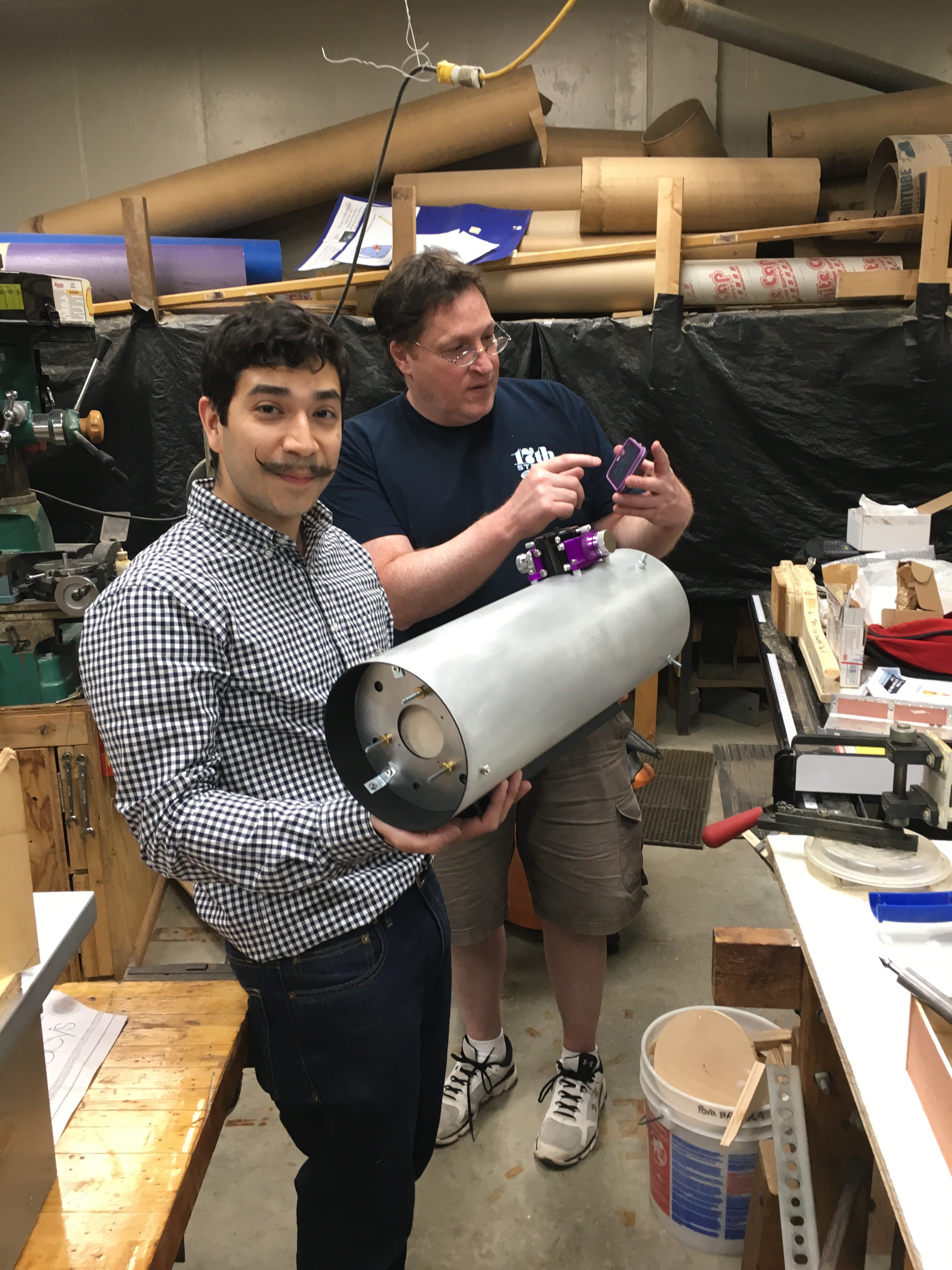
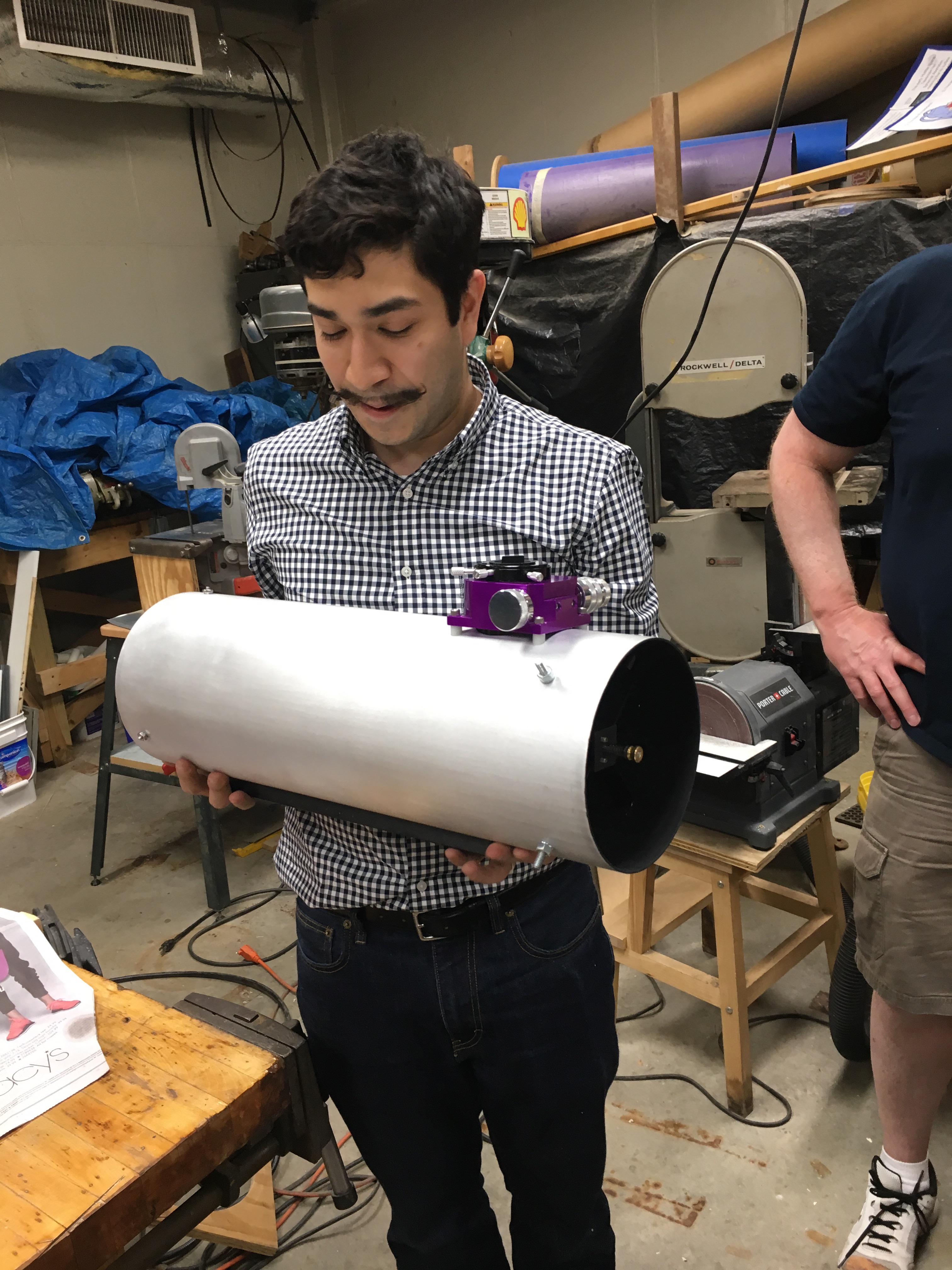
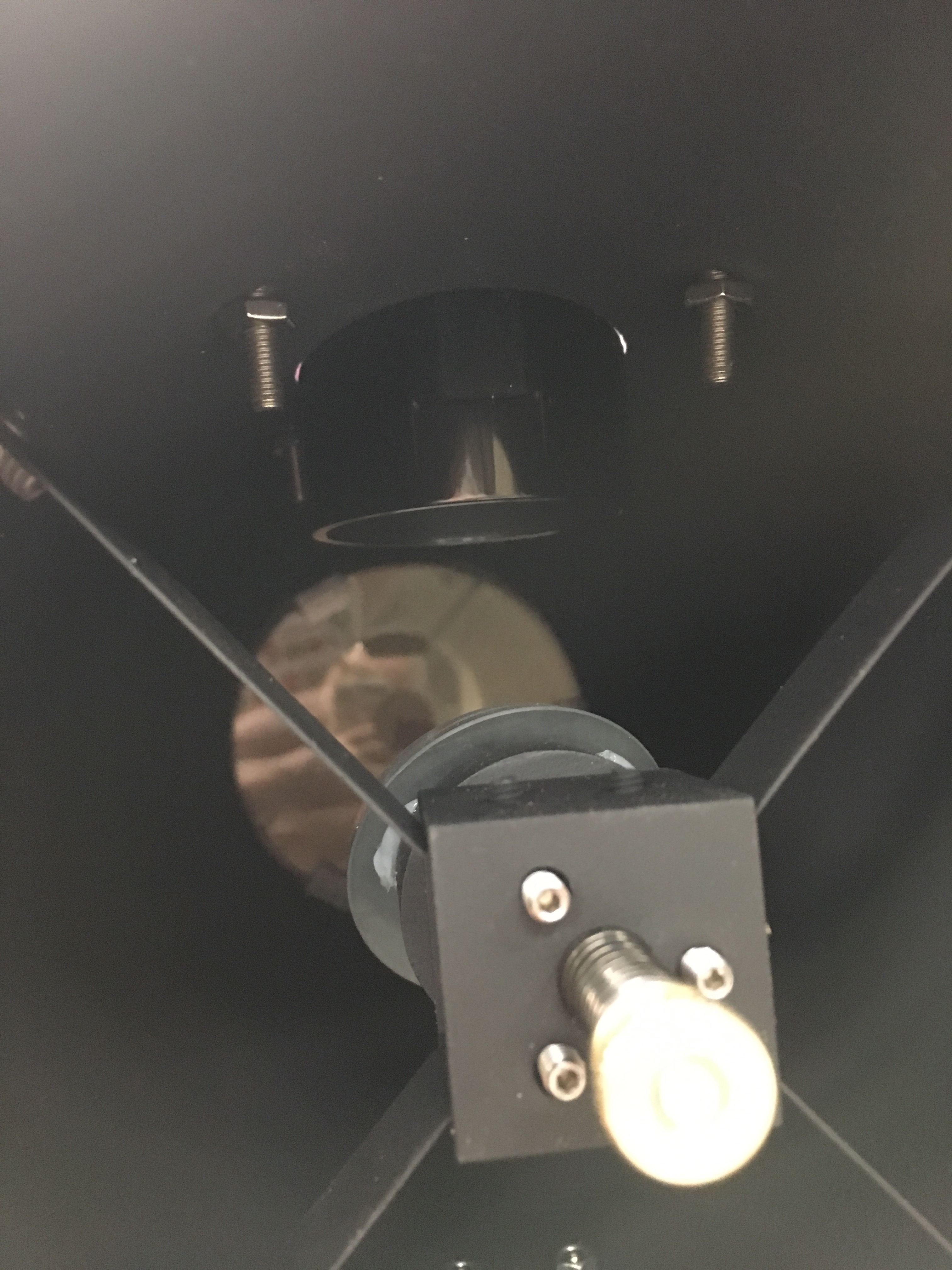
A Six-inch, f/3 hand made scope!

20 Thursday Apr 2017

Posted by gfbrandenburg in Uncategorized

≈ Leave a comment

Oscar Olmeda made just about everything in this scope. His optical work (like everything else) is superb!


Religions based on … well … myths, or alternative facts. Or lies.

14 Friday Apr 2017

Posted by gfbrandenburg in History, nature, science

≈ Leave a comment

Tags

buddha, christ, evidence, gods, jesus, krishna, lies, mohammed, prophecy, religion

Every single religion that I can think of seems to be based on totally unreliable witnesses and stories that are mis-remembered (at best) or deliberately distorted.

Judaism just celebrated one of its most important rituals, the Passover seder, in which I have participated about six times. If you’ve forgotten, the story is supposedly recorded in the Old Testament (or Tanakh) and the event celebrates the freeing of a large group of Hebrew people from Egypt. They then wandered the Sinai desert (a very, very hot and dry place – I lived next to it for about 9 months).

The problem is, there is absolutely nothing in the historical record that corroborates any of this story. The Egyptians kept a lot of records, and much of it is still readable — no mention of any such tribe fleeing, no first-borns murdered, no special heavenly plagues, yadda, yadda. No archaeological evidence whatsoever of any tribe of Hebrews wandering in the Sinai desert for any such expedition.

(Stuff like that gets preserved there! In fact, at the famous fort and palace known as Masada, near the Dead Sea, you can clearly see the streets and walls of the camp built by the legions of the Roman Army that besieged and eventually captured the fort, from roughly 2000 years ago! Now THAT incident and war is definitely mentioned — in Josephus, among other places…)

That story of Abraham getting ready to slit his son’s throat and god providing a lamb instead? Really? Inscribed tablets from Mount Sinai – really? How do we know any of this? We don’t. And in any case, if God tells you to commit genocide (it’s spelled out in Genesis / BeReshit), is that a wonderful thing? I don’t think so.

If we get to Jesus, well, again, the evidence that he produced any miracles or was somehow resurrected and became one with God (or didn’t) is pretty darned thin. Today is supposedly the day that he got crucified (the Romans were NOT nice people!!!), which was a shame. The Romans killed and tortured and enslaved a LOT of people. I’m not so sure that they should be held in such high esteem…

But I can think of many ways that a body can be taken out of a tomb, and none of them involve miracles or angels. Then, if you read all of the various Gospels, canonical or not, you realize that their outlooks and details are all profoundly at odds with each other.

If you come to Mohammed, I can think of many ways that somebody could appear to be possessed and to recite various lines of poetry (see Mormons, below) — although that would certainly explain why he would have prophecies that justified what he wanted to do (such as marry little girls) or needed to be amended (see Satanic Verses…)

Now both Jesus and Mohammed said some stuff about equality and supporting the poor, nonetheless the leaders of both religions (Popes, Kings, Emperors, Califs and so on) ended up being wealthy beyond anybody’s dreams, while the majority of people lived in pretty base poverty….

If you go back to the founding of Buddhism, what does that mean that someone is ‘enlightened’? How do we know if someone is in fact in that state? Is it even a good thing to attempt to achieve it? It seems to me that it’s more worth while to try to be good to other people (without endangering your own welfare unless absolutely necessary) and to try to leave the entire planet (and solar system) a better place for your descendants — by not driving species to extinction, not raising the global temperature if at all possible, and by helping so many billions of our kin to avoid lives of infernal poverty and oppression.

Hinduism seems to blame the poor and lowest classes for having been wicked people in a past life, and therefore should be not permitted equality with the upper castes. Sounds great if you are a Brahmin, but what an oppressive religion, really! And how can anybody with an ounce of skepticism believe any of those stories?

Going back to 2000+ years ago — All those stories that the Romans, the Greeksm the Babylonians, Persians and Egyptians made up about their gods — are you serious? They actually believed that? Well, you may as well believe in the Tooth Fairy or the Easter Bunny or the Flying Spaghetti Monster!

Oh, can’t leave out the Mormons. Golden plates buried in upstate New York but only viewable and translatable by someone talking through his hat, writing pseudo-king-James-English and talking about lots of animals and plants and metals that supposedly were used by warring tribes of American Indians — and nobody has ever found figs, wheat, camels, sheep, goats, or horses, or the use of iron or wheeled vehicles of any sort anywhere in the Americas for the entire period of say 500 BC to 1491. So that’s all a lie, too.

Sorry if I offend you, but while I know I’m not perfect (far from it) I don’t need fairy tales to try to be a better human being. I prefer to know things that are true and verifiable. And I really don’t like it when people try to kill each other to support ideas that are really just hoaxes.
 

How Britain Became an Island

06 Thursday Apr 2017

Posted by gfbrandenburg in History, science

≈ Leave a comment

Tags

Britain, Calais, Cap Gris-Nez, Chalk, cliffs, Dover, England, Island

Interesting report with pretty geological maps indicate that the Island we call Britain got cut off from what we know as France and Belgium by a catastrophic waterfall and flood that broke through what we now call the Straits of Dover as the ice that covered Northern Europe was beginning to melt, and sea levels were much lower than today.

Gupta_NCOMMS-16-16909A_Fig2_rev2

Here is the link. 

By the way, if the weather is fairly clear, it’s easy to see the famous White Cliffs of Dover from the French side (for example, at Cap Gris-Nez).

The Mathematics of George Washington

24 Friday Feb 2017

Posted by gfbrandenburg in History, Math, Uncategorized

≈ 2 Comments

Tags

George Washington, History, Math, surveying

I recently learned some things about how the young George Washington did math, including surveying. Mathematician and historian V. Frederick  Rickey gave a talk 2 nights ago at the Mathematical Association of America here in DC, based on his study of GW’s “cypher books”, and I’d like to share a few things I learned.

(1) The young George appears to have used no trigonometry at all when finding areas of plots of land that he surveyed. Instead, he would ‘plat’ it very carefully, on paper, making an accurate scale drawing with the correct angles and lengths, and then would divide it up into triangles on the paper. To find the areas of those triangles, he would use some sort of a right-angle device, found and drew the altitude, and then multiplied half the base times the height (or altitude). No law of cosines or sines as we teach students today.

(2) He was given formulas for the volumes of spheroids and barrels, apparently without any derivation or justification that they were correct, to hold so many gallons of wine or of beer. (You probably wouldn’t guess that you had to leave extra room for the ‘head’ on the beer.) Rickey has not found the original source for those formulas, but using calculus and the identity pi = 22/7, he showed that they were absolutely correct.

(3) GW was a very early adopter of decimals in America.

(4 ) This last one puzzled me quite a bit. It’s supposed to be a protractor, but it only gives approximations to those angles. The results are within 1 degree, which I guess might be OK for some uses. I used the law of cosines to convince myself that they were almost all a little off. Here’s an accurate diagram, with angle measurements, that I made with Geometer’s Sketchpad.

His method was to lay out on paper a segment 60 units long (OB) and then to construct a sixth-of-a-circle with center B, passing through O and G (in green). Then he drew five more arcs, each with its center at O, going through the poitns marked as 10, 20, 30, 40, and 50 units from O. The claim is then that angle ABO would be 10 degrees. It’s not. It’s only 9.56 degrees.

george-washingtons-protractor

Telescope Fix, Scudding Clouds Over Moon, Tom Turkeys Hiding, and Successful Cloud Chamber!

12 Monday Dec 2016

Posted by gfbrandenburg in astronomy, astrophysics, science, Telescope Making, Uncategorized

≈ Leave a comment

Tags

cloud chamber, Digital Setting Circles, dry ice, Isopropanol, Moon, Sky Wizard, Turkeys

I had a productive 24 hours!

  • Night before last, I think I finally got Sky Wizard Digital Setting Circles installed on the 14″ alt-az telescope we were most generously donated by Alan Bromborsky. (That’s me, in the operations cabin  at Hopewell Observatory, taking a break and a picture, long before completion.)img_6169
  • So I went out to look at the sky at 1 AM. I saw no stars, but the 80% gibbous moon appeared to race dramatically through the clouds
  •  That afternoon, as I was driving out, I saw 5, maybe 6 tom turkeys playing hide-and-seek with me behind the trees. Believe me, they are REALLY GOOD at hiding behind little saplings, logs, and rocks! Or if you don’t believe me, ask anyone who’s tried to hunt them.
  •  Late that evening, I got a dry-ice-and-isopropanol particle detector working for the first time. (I had tried and failed, when I was a teenager, some 50 years ago, and failed several other times since then as well.) If you look at my little video, you can see the particles more easily than I could with your naked eye as I was filming it. Don’t ask me yet which ones are muons, which are alpha particles, and which are beta particles, because I don’t know yet. But you could look it up!

Productive 24 hours!

A Talk at AHSP on Telescope Making

16 Friday Sep 2016

Posted by gfbrandenburg in astronomy, History, Telescope Making

≈ Leave a comment

Tags

AHSP, Almost Heaven Star Party, Charles Messier, Messier Objects, NOVAC, Spruce Knob, West Virginia

Two weeks ago was the Almost Heaven Star Party on the slopes of Spruce Knob, West Virginia, sponsored and organized by the Northern Virginia Astronomy Club (NOVAC). The weather was wonderful, and we could see the Milky Way and lots of Messier objects with our naked eyes, every single night for four nights. This is by far the longest stretch of good weather I’ve ever experienced up there at The Mountain Institute.

(Friday and Saturday, it was only clear for a few hours, but Sunday and Monday nights were clear all night, AND there was NO DEW to speak of!! Wow!!)

During the daytime, there were lots of talks and also activities and expeditions such as hiking, spelunking, visiting the National Radio Astronomy Observatory at Green Bank, canoeing, and Phun With Physics and arts & crafts for kids. I particularly enjoyed the talks on Russell Porter (the founder of amateur telescope making in the US and one of the major designers of the 200-inch telescope at Palomar), LIGO (detection of gravity waves), and Rod Molisse’s talk on 50 years of mostly-commercial telescopes as seen in the pages of various astronomy regime.

I was one of the speakers and gave a little talk on telescope-making. If you care to sit through it, you can find it along with all of the other talks (many of which I missed for various reasons) at this web-page.

I brought my home-made 12.5″ Dob-Newt [shown to the left in the picture below] and added about a dozen items to my formal list of Messier objects. (I had already seen all 100+ objects, but hadn’t recorded enough details on them to be able to earn one of the ‘merit badge’ pins from the Astronomical League, so I’m going through the list again

.img_0198

(If you didn’t know: Charles Messier loved hunting comets about 220 years ago, with what we would consider today to be a fairly small (4″ diameter) refractor that he used from downtown Paris, not far from where I lived back in 1959. Comets look like fuzzy patches in the sky, and so do galaxies, star clusters, and illuminated clouds of gas, all of which are MUCH farther away and MUCH larger. Comets are part of our own solar system, and move noticeably from one night to the next against the apparently fixed background of stars. Messier is credited with discovering 13 comets. But when he discovered a fuzzy item in the sky that did NOT move, he would record its location and its appearance, so as to avoid looking at it again. He published and updated this list a few times before he died, 199 years ago. Nowadays, his list of things-to-be-avoided are some of the most amazing and beautiful things you can see in the night sky. I’ve tried imaging a few of them, but am very, very far from being proficient at it. I attach my best one so far, of something called the Dumbbell Nebula. No, it’s not named after me. And thanks to Mike Laugherty for helping with the color balance!)

dumbbell-processed-november-1-2015

Different Ways to Teach Math

16 Friday Sep 2016

Posted by gfbrandenburg in education, Math, teaching

≈ Leave a comment

Tags

discovery, education, Math, school, teaching

I recommend looking at different ways to teach mathematics. Here is one take on the topic, from our friends up north. I reprinted this on my mostly-education blog, here.

‘Discovery Math’ is Weird but a Good Idea Nonetheless

Sex and Math: The Zero to Two Percent of Our Actual Lives That Rules Our Lives

01 Thursday Sep 2016

Posted by gfbrandenburg in Math, science, Uncategorized

≈ 1 Comment

Tags

frequency, life, nookie, poisson curve, procreation, sex

Someone (probably Louis CK) pointed out that even though we all obsess about sex (and being attractive to the persons with whom we long to have sex), it’s actually a very, very tiny part of one’s actual (as opposed to our wishful) life.
[Of course, any species that survives needs to have a strong drive for procreation, or they won’t leave enough offspring behind to carry on. (Just ask pandas what happens when they seemingly couldn’t care less… They are, if you hadn’t noticed, nearly extinct in the wild. Rats, rabbits, ants and cockroaches survive by being unbelievably fertile — and sneaky.]
Let’s try to do some math on this.
Have you ever tried figuring out what percent of your entire life has consisted of you actually making love (having sex) with another person?
I am not counting masturbation here because
  • I don’t trust any data on this, even Masters and Johnson, so any guesses on my part would be just that
  • I’m only talking about having sex with another person, either Penis-In-Vagina or any other sort of sexual activity, which I am not about to list here —  use your own imagination if you want to. 
  • And no, I’m not going to tell you anything about my own habits or those of anybody else I know. However, if you want to tally up your OWN time doing ‘that’, feel free.
 
Let’s look at the high end of the spectrum of those having lots of sex first.
My guess is, based on observations of personal experience and what I’ve observed with people I knew well:  that only with the very horniest newly-weds or with a couple who have just entered a super-sensual, brand-new sexual relationship,  time would a couple be spending, say, as much as four hours a day actually’doing it’. Why? For one thing, sex is exhausting. Also, the tissues involved are delicate and can only take so much rubbing, no matter how well lubricated they might be. Plus the couple need to sleep, eat, wash, and most likely do something productive like going to school or work.
That very high figure for someone getting a HUGE amount of nookie is 4 hours  out of 24 hours in a day, or 1/6, which is about 17% of the time. Let me repeat: that’s extraordinarily high, and from my own observations (thin walls allow one to hear… and so on) only seems to last for the first few weeks, because then they get sore, exhausted, sated, and somewhat jaded.
After that, they’d be lucky to be ‘doing it’ for an hour or two a day, which is between about 4 and 8% of the time.
But let’s compare that to the rest of their lives for this remarkably horny and lucky couple… Let’s suppose that they are 20 years old, and let’s suppose that they each had sex a few times in high school and after (college, military, working, whatever, and I’m making no assumptions about whom they are doing this with). Maybe they got laid 2 – 3 times a week from age 16, at about an hour each time (girls, feel free to scoff at my suggestion that a typical male teenager can actually last that long) plus, now that they are not living at parents’ home any more, they have had several tumultuous, sexy relationships one after the next, each time spending an average of 2 hours actively ‘doing it’ each 24-hour period, for the last two full years.
So let’s make that say 6 hours a week for 2 years plus 28 hours a week for the last 2 years – and these people are those who are towards the very far right hand end of the frequency curve distribution. I don’t know whether the distribution of ‘nookie-hours’ if graphed, is ‘normal’ or ‘skewed’one way or the other. But in any case, most people ‘get’ a lot less sex than this. In fact, when I was in high school and college, the vast majority of my (male and female) friends my age or younger were virgins. No, I’m not going to tell you what age or to whom I lost my virginity. I will keep my fond memories to myself, and hope you will do likewise.
Here’s the arithmetic:
Denominator (total hours lived) for this very lucky pair of 20-year olds: 24 hours per day time 365. days per year times 20 years old equals 175,200 hours total that they have lived so far. (D)
 
Numerator ( total hours having sex with another person since they were born) Assuming this very sexually active couple who have sex 6 hours a week times 104 weeks (two years from ages 16 – 18) plus 28 hours a week times 104 weeks (two more years, aged 18 – 20) equals 3,536 hours having sex, grand total, (N)
 
I used a calculator to divide N by D and I get about .02, or two percent of their life so far. That’s tops.Two percent of their life.
I suppose it is theoretically possible that a married couple of 60 years, at age 75, has been actively having sex a full hour every single day of their married life (since age 15). Extremely rare, I know… But for this tiny handful of  extraordinarily horny, happy, healthy and lucky people, I get a grand total of 1/30 of their life, or a tad more than 3%. And I bet that you could probably hold a nice party for every single one of these lucky 75-year-old living couples — from all over the world — in the cafeteria of the elementary school nearest my house. Not sure how much standing room there would be, but this is out of our current world population of over 6 billion people. So they are outliers of outliers of outliers.
The vast majority of people would have much, much less sex than that, I predict with confidence.
Additionally: a good number of people die before losing their virginity. I have no idea what percentage do, but during the old days, it was probably well over half  of them, infant mortality rates being what they were — and I’m assuming that most of those babies and children who died at very early ages from disease, murder or accidents weren’t being sexually abused during their short, sad lives… Many soldiers die in combat having had sex perhaps 0 to 6 times in their entire lives, if I can trust various memoirs I’ve read by veterans of various wars…
So that’s the far left hand end of the ‘bell-shaped’ curve: 0%.
While there are a tiny handful or two-to-three percenters out there, I would bet (if we could test it somehow) that over 99.99% of the population has sex, on average, between ZERO and TWO percent of our entire lives.
But, oh, how we obsess over ‘it’!!
← Older posts
Newer posts →

Subscribe

  • Entries (RSS)
  • Comments (RSS)

Archives

  • December 2025
  • November 2025
  • October 2025
  • September 2025
  • July 2025
  • January 2025
  • November 2024
  • October 2024
  • August 2024
  • July 2024
  • May 2024
  • April 2024
  • January 2024
  • December 2023
  • October 2023
  • August 2023
  • June 2023
  • May 2023
  • April 2023
  • November 2022
  • October 2022
  • August 2022
  • July 2022
  • June 2022
  • May 2022
  • April 2022
  • February 2022
  • January 2022
  • December 2021
  • October 2021
  • September 2021
  • August 2021
  • July 2021
  • June 2021
  • May 2021
  • March 2021
  • December 2020
  • October 2020
  • September 2020
  • August 2020
  • March 2020
  • February 2020
  • January 2020
  • December 2019
  • November 2019
  • September 2019
  • August 2019
  • June 2019
  • May 2019
  • January 2019
  • November 2018
  • October 2018
  • September 2018
  • August 2018
  • May 2018
  • March 2018
  • January 2018
  • November 2017
  • October 2017
  • September 2017
  • August 2017
  • July 2017
  • June 2017
  • May 2017
  • April 2017
  • February 2017
  • December 2016
  • September 2016
  • June 2016
  • May 2016
  • April 2016
  • March 2016
  • February 2016
  • January 2016
  • December 2015
  • November 2015
  • August 2015
  • July 2015
  • April 2015
  • March 2015
  • February 2015
  • January 2015
  • December 2014

Categories

  • astronomy
  • astrophysics
  • education
  • flat
  • History
  • Hopewell Observatorry
  • Math
  • monochromatic
  • nature
  • optical flat
  • Optics
  • Safety
  • science
  • teaching
  • Telescope Making
  • Uncategorized

Meta

  • Create account
  • Log in

Blog at WordPress.com.

  • Subscribe Subscribed
    • Guy's Math & Astro Blog
    • Join 53 other subscribers
    • Already have a WordPress.com account? Log in now.
    • Guy's Math & Astro Blog
    • Subscribe Subscribed
    • Sign up
    • Log in
    • Report this content
    • View site in Reader
    • Manage subscriptions
    • Collapse this bar
 

Loading Comments...