• My series on making a Newtonian telescope
  • How Leon Foucault Made Telescopes

Guy's Math & Astro Blog

Guy's Math & Astro Blog

Author Archives: gfbrandenburg

Some GIFs (Animations) That Demonstrate Deep Mathematical Truths

21 Thursday Nov 2019

Posted by gfbrandenburg in Uncategorized

≈ Leave a comment

You can find them here:

https://medium.com/however-mathematics/essential-mathematical-gifs-that-will-make-mathematics-finally-make-sense-4873573f5883

Problems Solved with the Old 6″ Refractor?

23 Monday Sep 2019

Posted by gfbrandenburg in astronomy, Hopewell Observatorry, Optics, science, Telescope Making

≈ 3 Comments

Tags

crown, figuring, flint, Kiess, lens cell, lenses, refractor, symmetry, testing

I found a few things that may have been causing problems:

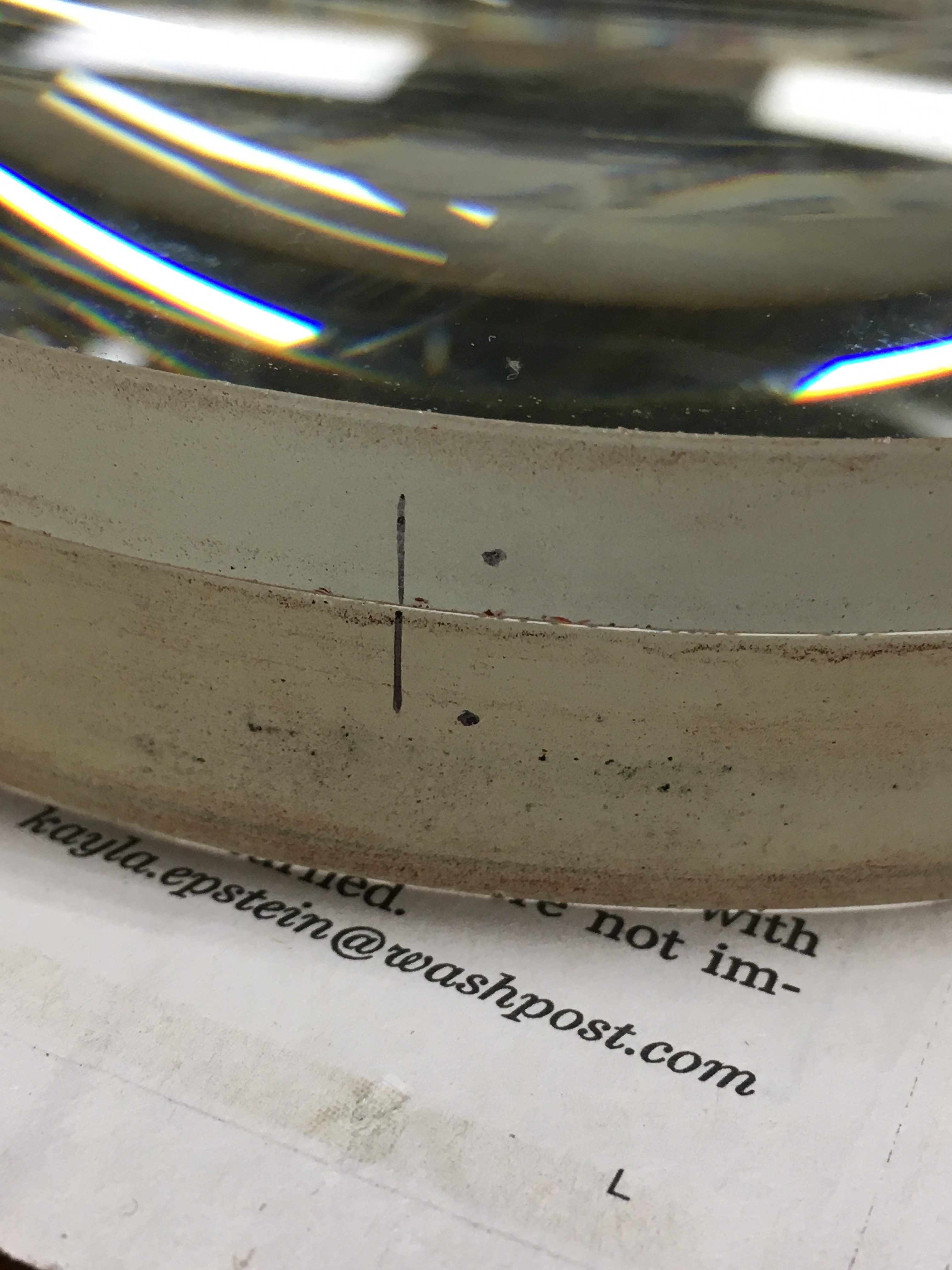
(1) Whoever put the lens cell together last didn’t pay any attention at all to the little registration marks that the maker had carefully placed on the edges of the lenses, to show how they were supposed to be aligned with each other. I fixed that, as you see in the photo below. The reason this is probably important is that the lenses are probably not completely symmetrical around their central axes, and the maker ‘figured’ (polished away small amounts of glass) them so that if you lined them up the way he planned it, the images would be good; otherwise, they would probably not work well at all and could very well be causing the poor star test images we saw.

IMG_5310

2. The previous assembler also put eleven little tape spacers around the edges, between the two pieces of glass. More is apparently not better; experts say you should have three spacers, each 120 degrees apart from the other two. Done.

3. The bottom (or ‘flint’) element is slightly smaller than the other one (the ‘crown’), so it probably shifted sideways. That alone would be enough to mess up the star tests in the way that we saw. So I wrapped two thicknesses of blue painter’s tape around the outside of the flint, and put some three cardboard shims between the edges of the ‘crown’ and the aluminum cell.

4. There were no shims at all between the flint and the aluminum ring that holds it in place underneath. This caused some small scratches on the glass, and might have been warping the glass. I put in three small shims of the same type of blue painter’s tape, lined up with the other spacers.

We will see if these improvements help. I really don’t want to haul this all the way out to Hopewell Observatory and struggle with putting it back on the mount for a star test. That was just way too much work, much more than I expected! The next test will be with an optical flat placed in front of the lenses, and a Ronchi grating.

I would like to thank Bart Fried, Dave Groski, and several other people on the Antique Telescope Society website for their advice.

————————————-

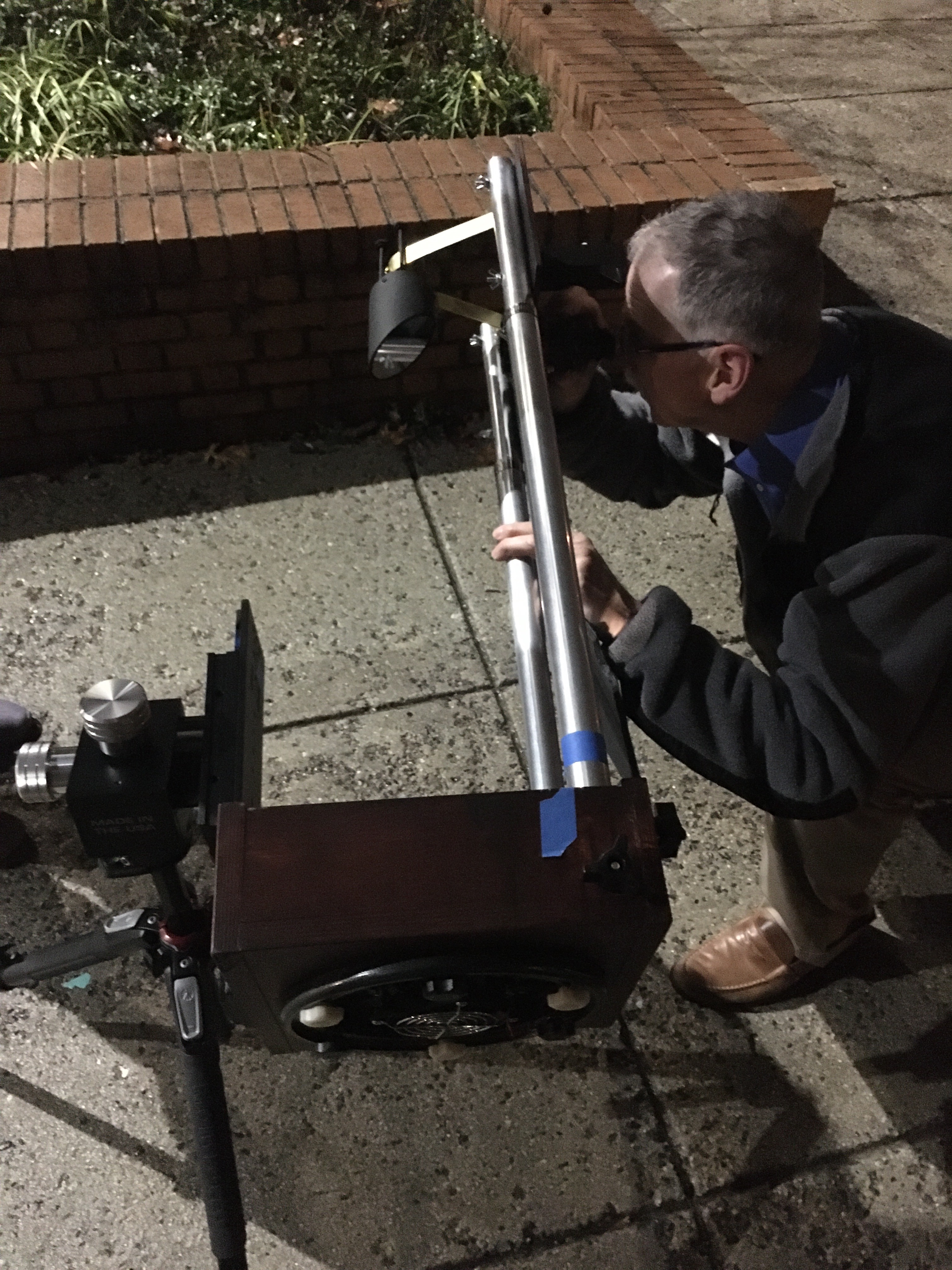
By the way, these photos show how we held the refractor on the mounting plate for the Ealing mount at Hopewell Observatory.

IMG_5197
IMG_5200
IMG_5233
IMG_5239
IMG_5241

Trying to Figure Out Problems With a Century-Old Refractor

22 Sunday Sep 2019

Posted by gfbrandenburg in astronomy, History, Optics, Telescope Making, Uncategorized

≈ Leave a comment

Tags

antique, crown, flint, glass, Kiess, refractor, Telescope, testing

I am disassembling the lens cell of the >100 year old 6” f/14 Kiess refractor that produces horrible results on star tests.

There is absolutely no information inscribed anywhere inside the cell, inside the tube or outside it, nor on the edges of the lens elements. I can only guess as to what type of glass they used, and figuring it out won’t be easy. The least destructive method I can think of beginning to do this is by weighing them and calculating out their precise volumes, and from that calculating their densities. A graduate gemologist could probably calculate their indices of refraction, but not me.

Tomorrow I plan to measure the curvatures of the lens elements; perhaps someone familiar with old telescopes will then have clues as to who might have made this particular type of optical prescription.

The shims seem to me to be intact, so I think I can rule out astigmatism from lens elements put in crooked. [OTOH, someone on the Antique Telescopes Facebook group says that the large number of small black spacers in between the lenses may itself be causing the massive astigmatism problem that we found in the star test. I don’t have enough experience to be able to tell whether that’s correct or not.]

The small chips on the edge of the second (meniscus? Flint?) lens element were already there when I got it. I was also surprised to find that the first (biconvex, crown?) lens element has a small bubble very close to the center. It’s probably not significant, but I will check for strain as well.


Gently tapping off the lens cell from the tube
Note that the retaining ring holding the front of the first lens merely slides into the cell; it’s held in place by four screws. The threading is on the inside of the ring, and the outside is smooth
You can see the black tape and tan cardboard spacers
Me looking puzzled
Me looking puzzled
The cardboard spacers around the edges
The two lenses together; note the multiple, small black tape spacers between the pieces of glass
The original chips on the second lens element
The empty lens cell. Note that they didn't make it black
The empty lens cell. Note that they didn’t make it black

12-inch Ealing-Made Ritchey-Chretien Telescope is Sold [EDIT]

20 Friday Sep 2019

Posted by gfbrandenburg in flat, Hopewell Observatorry, optical flat, Optics, Telescope Making

≈ 3 Comments

Tags

cassegrain, convex, figuring, for sale, primary mirror, richey-chretien, secondary mirror, Telescope

EDIT: It has now been sold to an ambitious telescope maker in Italy. 

We had a 12-inch Casssegrain optical telescope assembly for sale at an extremely attractive price: just two hundred dollars (or any reasonable offer). You pay for shipping.

The full-thickness primary mirror alone is worth much more than that as a raw piece of unfinished Pyrex! (United Lens charges $450 for an equivalent, 12.5″ diameter, roughly 2″ thick, raw, unfigured, disk of Borofloat!)

The telescope was part of a package (mount-cum-telescope) that was purchased from the Ealing company back in the 1960s by the University of Maryland. The scope itself never gave satisfactory images, so the UMd observatory sold it off in the early 1990s, and it ended up at the Hopewell Observatory about a decade before I became a member. Hopewell kept the mount, which still works quite well, but removed the telescope and replaced it with a 14-inch Celestron Schmidt-Cassegrain.

I recently examined the telescope itself (the one we are selling) and found that it indeed has a hyperbolic primary with a focal length of about 4 feet (so it’s f/4). Presumably, the convex secondary is also a matching hyperboloid, to create a Ritchey-Chretien design, but I don’t feel like perforating a large spherical mirror to create a Hindle sphere to test it properly. In any case, using a 12-inch flat, I was unable to produce decent Ronchi images.

As you may know, figuring and collimating a Richey-Chretien require a LOT of patience, more than I have. My suggestion would be to refigure the primary into a paraboloid, procure a standard flat, elliptical diagonal, and repurpose this as a Newtonian. Refiguring this mirror a task that I don’t feel like taking on, since our observatory already has a 14″ Newtonian, a 14″ SCT, and I already have built a 12.5″ Newtonian of my own. Plus, I am finding that figuring a 16.5″ thin mirror is plenty of work already.

So, our loss could be your gain! Make an offer!

I attach a bunch of photos of the OTA from several viewpoints, including a ronchigram. The mirror has been cleaned off since these picture were made; the little electronic motor was for remote focusing of the secondary.

IMG_0699
IMG_0702
IMG_0703
IMG_8151
IMG_8153
IMG_8160
IMG_0699
IMG_0702
IMG_0703
IMG_8151
IMG_8153
IMG_8160
IMG_0700
IMG_0711
IMG_8230
IMG_8233

A Weekend at Almost Heaven

06 Friday Sep 2019

Posted by gfbrandenburg in astronomy, Optics, science, Telescope Making, Uncategorized

≈ Leave a comment

Tags

Almost Heaven Star Party, binocular mount, dobsonian, NOVAC, Spruce Knob, star party

I spent Labor Day weekend at the Almost Heaven Star Party very close to Spruce Knob, the highest ridge in West Virginia. When the skies cleared at night, the stars and Milky Way were magnificent, but that only happened about 1 night out of three. My 12.5″ home-made Dobsonian telescope performed very well; in fact, because its primary and secondary mirror are almost fully enclosed by the light shrouds and upper cage, I was able to keep observing long after all the other refractors and Schmidt-Cassegrains were closed down by the heavy dew. (To keep the dew off of my finder scope and Telrad, I used large rubber bands to wrap chemical hand warmer packs around them, and that crude and cheap arrangement worked very well!)

Here are three photos taken by me:

Exploring the geology of Spruce Knob Mountain Center: Lyle Mars in blue shirt and white hat is in front of the entrance to a cave carved in limestone
Selfie with me in front of three others on the geology hike
This lovely sunset did not portend clear skies

All but the photo with the sextant were taken by Oscar.

Alan Goldberg teaching someone how to use a sextant
Me studying my charts, in front of parallelogram binocular mount
Oscar Olmedo and me at our campsite
Mike Laugherty and me
Me fiddling with my 12.5" home-made dob in the daytime
Me fiddling with my 12.5″ home-made dob in the daytime
Me fiddling with the parallelogram binocular mount in the daytime
Mike Laugherty and me fiddling with binocular mount
Left to right: Mike Laugherty, Oscar Olmedo, me
The lottery drawing for a whole bunch of neat prizes. None of us 3 won anything.

Cleaning Up a Century-Old Refractor

18 Sunday Aug 2019

Posted by gfbrandenburg in astronomy, History, Hopewell Observatorry, Optics, Telescope Making

≈ 5 Comments

Tags

antique, Carl Kiess, Hopewell, refractor, Telescope

Last week, I was helping staff and students at the University of Maryland’s Observatory to clean out a storage trailer.

We noticed a seven-foot-long, 6-inch diameter telescope that had been sitting in a corner there, unused, ever since it was donated to the National Capital Astronomers (NCA) club nearly ten years earlier by the son of the original owner, Carl Kiess,  who had worked at the Lick Observatory in California and the National Bureau of Standards in or near DC, but who had passed away nearly fifty years earlier. I figured I could put it on a motorized telescope mount at Hopewell Observatory and at a minimum test the optics to see if they were any good. The current officers and trustees of NCA all said they thought this was a good idea.

One thing that caught my eye was how filthy and flaky the coating was on the tube itself, although the lens appeared to be in good shape.

IMG_5043
IMG_5044

IMG_5027

The drive, while impressive, does not have a motor, requires a pier, and is extremely heavy. I decided not to mess with the drive and to put it temporarily on our existing, venerable, sturdy, motorized, electronic drive we have at Hopewell Observatory.

So I experimented with various abrasives and solvents to clean off the nasty green coating; a fine wire wheel inserted in an electric drill did the best job. Here it is partly cleaned off:

GHCW2253
IMG_5059

I then used Brasso for a final polish, followed by a final cleaning with acetone, and then applied several coats of polyurethane to keep it looking shiny for a number of years. (The lenses stayed covered for all of this!) So this is how it looks now:

IMG_5060
IMG_5061

The next task is to make a temporary holder and then put it on the mount, and then test the optics.

Bath Interferometer at Stellafane

06 Tuesday Aug 2019

Posted by gfbrandenburg in astronomy, flat, monochromatic, optical flat, Optics, Telescope Making

≈ Leave a comment

Tags

Bath interferometry

I am posting some photos and videos of the demonstration of a Bath interferometer on Saturday at the 2019 Stellafane convention.

IMG_4951

IMG_4951

IMG_4952

IMG_4953

IMG_4953

IMG_4955

IMG_4956

IMG_4956

IMG_4957

IMG_4957

IMG_4958IMG_4959

IMG_4960

IMG_4960

IMG_4961IMG_4962

IMG_4963

IMG_4963

IMG_4964

IMG_4964

Silvering Mirrors, and More, at Stellafane

05 Monday Aug 2019

Posted by gfbrandenburg in astronomy, flat, History, Math, monochromatic, optical flat, Optics, science, teaching, Telescope Making, Uncategorized

≈ 3 Comments

For me, these were the two most significant demos at the 2019 Stellafane Convention in Springfield, Vermont:

(1) Silvering large mirrors, no vacuum needed

We had a demonstration by Peter Pekurar on how to apply a layer of Silver (metallic Ag, not aluminum) onto a telescope mirror, accurately, with a protective, non-tarnishing overcoat, that works well. I looked through such a scope; the view was quite good, and I was told that interferograms are great also.

What’s more, the process involves overcoating a mirror with spray bottles of the reagents, without any vacuum apparatus needed at all. Note: Silver coated, not aluminum coated. This is big for me because the upper limit at our club’s aluminizer is 12.5″, but some of us are working on larger mirrors than that; commercial coaters currently charge many hundreds of dollars to coat them.

You can find information on some of these materials at Angel Gilding. Peter P said he will have an article out in not too long. Here are a few photos and videos of the process:

IMG_4972

Finished mirror; notice it’s a little blotchy


IMG_4978

IMG_4978


IMG_4981

IMG_4981

IMG_4985IMG_4987

(2) Demo and links for Bath Interferometer (see http://gr5.org/bath )

How to set up and use a Bath interferometer to produce highly accurate interferograms of any mirror for many orders of magnitude less cash than a Zygo interferometer. As I wrote earlier, Alan Tarica had taken the lead on fabricating one at the CCCC – NCA ATM workshop, and we eventually got it to work, but found it rather frustrating and fiddly to use.

The presenter is a HS teacher, and it shows: he explains things very clearly! On his website ( http://gr5.org/bath ) you can get plans for 3-D printing the parts for the Bath device, if you have any access to a 3-D printer, so you can print the parts out for yourself. He also has links to vendors that are selling parts for it, such as certain small lenses, mirrors and beam splitters. He shows you where you can get them for very little money from Surplus Shed and such places. Or you can purchase his really inexpensive kits that he’s already 3-D printed for you. Plus parts for an XYZ stage, which you will need for fine focus. The whole setup (not counting mirror stand and two tripods, which he assumes you have access to already) is under $130.

I will need to look carefully at our setup as built almost completely by Alan, and see how it differs and what we would need to do to make it better. The problem is that there are lots of little, tiny parts, and many of them need to be adjustable. We saw him doing LOTS of little adjustments!

Before his talk, I had absolutely no idea how this (or similar interformeters) really worked. Now I understand: the interference fringes that we see are really contour lines – like we see on on a USGS topo map, only with the mirror tilted in one direction or the other. A big difference with the USGS topo map is that there, the contour lines (isohypses – a new word for me today) are often 10 feet to 100 meters apart. In interferometry, the contour intervals are either one or one-half lambda (wavelength of light) apart – a really tiny amount! We need that level of accuracy because the surface we are studying is sooooooo flat that no other measuring system can work. His explanation of this whole thing now makes perfect sense to me. And the purpose of the software (free!) is to un-slant the mirror and re-draw it using the countour-line information.

Beautifully clear explanation!

Caution: a friend who works professionally in optics told me his team had made three Bath interferometers, using cheap but good quality ebay xyz stages, and found that they were just too much trouble; so they borrowed a very expensive commercial interferometer (costing many tens of kilobucks) from another department and are using that instead. I’m not selling my house to get a Zygo interferometer!!! But I will try the Bath interferometer instead.


Stellafane 2019 So Far

03 Saturday Aug 2019

Posted by gfbrandenburg in Uncategorized

≈ Leave a comment

It’s been quite interesting up here at Stellafane. I’ve seen demos of a really nice DOuble pass autocollimation test.

A fellow whose email is Moonward had a much cuter, quieter, and lighter aluminizer / vacuum chamber than ours but only 7 years younger; obtained the same way as ours, via surplus giveaways from some agency discarding it.

He uses ferric chloride instead of HCl. He’d never heard of Alconox. Uses calcium carbonate slurry or else … I forget what; hope I wrote it down

I got to follow along with the optical judges. Those guys are really sharp on Star tests. The eight scopes entered had optics that were either very good or excellent. Contrary to what some folks have told me, the judges are not heartless. One of them, Francis O’Reilly, who is also Stellafane Vice President, and who had visited our telescope making workshop to see what we were up to there (at the Former woodshop of the Chevy Chase Community) and had some mirrors aluminized, asked me specifically to come up and see how they judge projects optically.

I am so glad that Francis did!

Too bad I didn’t get to look at cruddy mirrors as well. But no junk got submitted this year to us judges. I thought the images inside & out of focus looked very similar to what I’ve read in Souter and in Piekiel. I hope I can remember well enough what these looked like so that when I star test a poor mirror, then I can recall how they differ. This being my first time attempting to make a judgement, I put down no numbers. (They gave scores on a scale of 0.0 to 5.0 (best) on five criteria: contrast, symmetry, edge, and two more. I didn’t get to keep any of the papers.

No mirrors over 8″, and only one entry in the complex optical category – a schiefspueglet. I didn’t get the opportunity to look thru it. I spent a lot of time just waiting in line to look thru a scope, which is not exactly efficient. Plus, so did the contestants: they had to spend a lot of time waiting in the dark for us to show up. Fixable with a little better planning I think.

I’m not going to post pix because I’m out in the woods of VT; cell reception is 1/4 (low bandwidth) the nearest town, Springfield, is small, and actually produces a very small light dome. The Milky Way was great! Right overhead most of the night (I finally got a lift part way back to my tent around 2am.) but some high clouds as a part of a slow warm front did start coming in. Almost no dew; I wore shorts, sandals, T-shirt, and sometimes sweatshirt. Very comfy esp compared to New Mexico or DC.

So later with pix. This is off top of head in a quiet moment while it’s still fresh.

So all I got to look at last night was the bright Star Altair, rolling the focus inside and outside, with really short focal length eyepieces. In a grand total of six telescopes. out of ten submitted.

Looking at the rings of the Airy disks and rings around the star as you roll the focus of the eyepiece away from the perfect image point and then back inside. So, no, I didn’t get to view anything else in the Sky. I shoulda brought some binoculars; the sky was nice. But I was busy a good fraction of the time. If it were me, I would not have us go out in teams of 4-5, but maybe of two.

This sort of a test is the most objective one of the entire telescope. But it’s hard to do. The setup can take an incredibly long time, and the weather conditions have to be excellent: clear, steady skies, no or very little wind. And we had all of those conditions last night, which was very lucky. summer evenings in Vermont can be so beautiful, as I remember from my own long-ago years of school and work in New England.

It’s so sad to see all the empty factories just below downtown Springfield, in what was called Precision Valley in my time as a Dartmouth undergrad (1967-71). I joined SDS when I was there because they were the ones fighting against what we saw as the immoral and imperialist American war in Vietnam, and we were looking for allies in a general struggle for a more just and democratic socity, against exploitation, racism, unjust wars,m. But the War in Vietnam really focused our attention, especially since we were likely to be drafted to go fight in a war we considered unjust, and that we didn’t want to fight. (I certainly would have volunteered in WW2 and to defend the Union; but the US has also fought a lot of wars that were just plain wrong.)

we made some steps towards doing just that with blue-collar workers like the ones here at Jones & Lampson, Bryant Chucking Grinder; they were represented by the United Electrical Workers Union, which was NOT corrupt, and had leftists of some sort in its leadership. So when those workers went on strike, we in SDS did what we could to help, raising some money and walking on picket lines. It’s pretty cold striking in winter in Vermont!

This Stellafane organization is huge. I read that attendance is around 1,000 people, which makes it pretty crowded. Food isn’t nearly as good as AHSP; it’s all a la carte (hamburgers, cheese steaks, fries, scrambled eggs, etc) except for a lobster and steamer clam dinner ordered in advance (it was really, really good!). But it sure beats cooking and all the mess that entails. Lots and lots of people up here have made one or more scopes, or parts of one, or had a relative who did. At least a fraction of women and girls and other young people camping out and observing, but 8 of the judging staff were older white guys like me; two women.

Too bad I didn’t get to look at cruddy mirrors as well. There will be time for that later! Need to set that up in our shop. Just wish it didn’t take an hour and a half to set up, with help!

Today going to talks / demos of well-functioning bath interferometer and spray silvering!!!! Alan T took the lead in setting up a Bath interferometer at our lab, but we ended up not being really happy with it. Hopefully this demo will make sense.

I have already talked a bit with Peter Pekurar, who is going to be doing the spray-on silvering (NOT aluminizing!!!). He also says he has figured out how to prevent the silver from tarnishing! Amazing! And it’s cheap! (How cheap I’ll discover later)

He had a regular $2.99 mirror that he FRONT- silvered and put back into its frame, some time ago, as a demo. Completely untarnished. Unlike the few pieces of silver we have in our family, and which require constant polishing to keep shiny, this was shinier than the average bathroom mirror, because the light doesn’t have to pass through the glass twice. Amazing. The demo is 3-5 pm today.

I asked about how the procedure affects the figure of the mirror; he said they do interferograms AFTER the silvering, and they all pass with flying colors. Again, amazing.

I heard some criticism of Gary Seronik — the said that when he writes up telescopes in S&T, he never actually looks through them himself. He relies entirely on the builder. Seems to me that should always be required for that

Gotta go to bath! Not shower! Bath Ingram!

Commercial Sites for Astronomy Viewing Near New Mexico

29 Saturday Jun 2019

Posted by gfbrandenburg in astronomy, education

≈ Leave a comment

Tags

Astronomical observations, Astronomy Inns, commercial providers, dark skies, telescopes

I thought I would share the URLs of a number of commercial establishments that offer astronomical viewing with very dark skies. Most of these are located in or near New Mexico.

http://www.casitasdegila.com/stargazing.html

https://sites.google.com/site/cosmiccampgroundinformation/

https://www.airbnb.com/rooms/7697447

http://www.astronomyadventures.com/

http://skycenter.arizona.edu/

http://www.lowell.edu/ 

http://www.noao.edu/outreach/kpoutreach.html

http://mcdonaldobservatory.org/visitors

https://www.facebook.com/SunglowRanchAZ

http://www.canyonoftheeagles.com/eagle-eye-observatory

http://www.csspdarkskyfund.org/home/stargazing_information  [Cherry Springs PA]

https://lennox-addington.on.ca/explore/dark-sky-viewing-area  [Ontario Canada]

And in Chile: http://www.haciendalosandes.com/en/astronomy.html

Source: Lynn Rice of New Mexico Skies, which now (sadly) only does remote hosting — in other words, people far away use the telescopes at NMS via fast internet connections, for a fee.

New Mexico Skies, Inc.
9 Contentment Crest #182
Mayhill NM 88339


← Older posts
Newer posts →

Subscribe

  • Entries (RSS)
  • Comments (RSS)

Archives

  • May 2026
  • April 2026
  • February 2026
  • December 2025
  • November 2025
  • October 2025
  • September 2025
  • July 2025
  • January 2025
  • November 2024
  • October 2024
  • August 2024
  • July 2024
  • May 2024
  • April 2024
  • January 2024
  • December 2023
  • October 2023
  • August 2023
  • June 2023
  • May 2023
  • April 2023
  • November 2022
  • October 2022
  • August 2022
  • July 2022
  • June 2022
  • May 2022
  • April 2022
  • February 2022
  • January 2022
  • December 2021
  • October 2021
  • September 2021
  • August 2021
  • July 2021
  • June 2021
  • May 2021
  • March 2021
  • December 2020
  • October 2020
  • September 2020
  • August 2020
  • March 2020
  • February 2020
  • January 2020
  • December 2019
  • November 2019
  • September 2019
  • August 2019
  • June 2019
  • May 2019
  • January 2019
  • November 2018
  • October 2018
  • September 2018
  • August 2018
  • May 2018
  • March 2018
  • January 2018
  • November 2017
  • October 2017
  • September 2017
  • August 2017
  • July 2017
  • June 2017
  • May 2017
  • April 2017
  • February 2017
  • December 2016
  • September 2016
  • June 2016
  • May 2016
  • April 2016
  • March 2016
  • February 2016
  • January 2016
  • December 2015
  • November 2015
  • August 2015
  • July 2015
  • April 2015
  • March 2015
  • February 2015
  • January 2015
  • December 2014

Categories

  • astronomy
  • astrophysics
  • education
  • flat
  • History
  • Hopewell Observatorry
  • Math
  • monochromatic
  • nature
  • optical flat
  • Optics
  • Safety
  • science
  • teaching
  • Telescope Making
  • Uncategorized

Meta

  • Create account
  • Log in

Blog at WordPress.com.

  • Subscribe Subscribed
    • Guy's Math & Astro Blog
    • Join 54 other subscribers
    • Already have a WordPress.com account? Log in now.
    • Guy's Math & Astro Blog
    • Subscribe Subscribed
    • Sign up
    • Log in
    • Report this content
    • View site in Reader
    • Manage subscriptions
    • Collapse this bar

Loading Comments...