• My series on making a Newtonian telescope
  • How Leon Foucault Made Telescopes

Guy's Math & Astro Blog

Guy's Math & Astro Blog

Category Archives: Uncategorized

Evolution is SLOW

26 Tuesday Apr 2016

Posted by gfbrandenburg in Uncategorized

≈ Leave a comment

A long time ago I had a course by Prof Jim Sandeful of Georgetown U and Dr Monica Neagoy on teaching with “discrete math” — very useful and interesting stuff that often does not get discussed in the standard American curriculum. I enjoyed it a lot.

Among other topics, I decided to write a little computer program that would model exponential random decay of radioactive elements. (Iirc I did this in Pascal and in BASIC, on the C-64, IBM-PC, Apple II, and Commodore Amiga. That was fun.)

One subtopic that came up, but which I never figured out how to model, was how to describe the frequency of some trait (eg red hair, striped tail, or growing a third eye…) in a population. I had long thought about how to do that but not until today did I begin to make some progress, so please allow me to share.

I’m going to make up a very-much simplified example using a Punnett square, something like this:


If you have no idea what this means, let this non-biologist try to explain as best I can:

Upper-case B and lower-case b in this diagram stand for two different versions of a particular (but mostly imaginary) gene that controls whether a person has blue eyes or brown. In this hypothetica example, the upper-case B gene causes brown eyes and is dominant, where the lower-case “b” causes eyes to be blue and is recessive. Thanks to the magic of sexual reproduction, you get two copies of each gene, 1 from Mom and one from Dad, whether they stick around and raise you or not. (You have two similar-but-not-identical copies of each chromosome except for the X and Y chromosomes; your two versions of each gene are carries in corresponding locations on each of the two chromosomes. If I got this right.)

If you have brown eyes, then your genes might be BB or they might be Bb or bB (same thing). If you have blue eyes, then you have bb genes for sure — again, in this hypothetical scenario.

This Punnett square shows the probability of what will happe if two parents who carry Bb genes have sex and produce offspring. It reminds me very much of how we use an area model to show that (X + Y)*(X + Y) equals X^2 + 2*X*Y + Y^2.

In any case, each of those parents carries Bb genes, and when the eggs and the sperm cells are manufactured inside the parent’s ovaries and testes, one or the other version of the gene is put inside, but not both. And it’s random. So since each parent has a Bb gene, its probability of passing along upper case B (brown) is 1/2 or 50%, as is the probability of passing along lower case b (blue eyes).

You can now find the probability of all of the outcomes shown in the interior of the diagram. The upper left hand corner is BB, pure brown eyes, with probability 1/4 because 1/2*1/2=1/4 and also in this case all of the sections really do have equal areas.

The upper right hand and lower left hand corners represent the Bb cross; the child will have brown eyes. The probability of a Bb cross is 1/4 plus 1/4, or 1/2.

The lower right hand corner is the region representing the probability of pure bb offspring  which have (recessive) blue eyes. The probability of bb is 1/4.

Now let us add a couple of features.

1. This is not just a single mom-dad pairing: this is a representation of an entire reproducing population where genes B and b are present, each 50% of the time.

2. Let us also pretend that the bb combination is fatal: not a single one of them survive to adulthood and to leave offspring. (This is a very extreme hypothetical example of how evolution operates. Normally Deleterious genes aren’t so uniformly fatal!) or alternatively, a breeder of plants or animals might decide to not permit any of the blue-eyed bb offspring to reproduce. Eugenicists used to advocate sterilizing anyone who exhibited harmful, recessive genes,in order to improve the remainder of the human race.

At first glance, You would think that this sort of genetic selection, either by artificial or natural means, would work very quickly, and that after just a few generations, the proportion of the population that was blue-eyed would vanish.

Jim Sandefur said no, it would take a really long time. I forgot the details, and just worked them out today. I’ll work out the details for you later when I have a larger screen. But:

Bottom line: even with this 100% culling of recessive genes, the proportion of blue eyes goes down as the harmonic series (1/X), where X is 4, then 5, 6, 7, 8, etc

So if the first generation has 1/4 (25%) blue eyes, and if every single individual with blue eyes is somehow prevented from reproducing, then the next generation will still carry the lower-case b gene 1/5 (20%) of the time.

And if children with blue eyes (bb) are still prevented from reproducing, the third generation will still pass on  the lower-case b gene one-sixth, or 16.67% of the time, and the next generation will pass on the lower-case b gene one-seventh (14.29%) of the time. The next generation passes on b genes one-eighth (12.50%) of the time, then one-ninth of the time (11.11%), then one-tenth of the time (10.00%) and so on. At first the decrease is pretty rapid, but after that it slows to a craw, and the world would never be entirely free of the pure bb. After 100 generations, there still would be 1/103 (almost 1%) of the population carrying genes that can pass on blue eyes.

At 25-30 years for a human population to reproduce, you are talking about 2,500 to 3,000 years!

However, the fraction of the population that actually is born with blue eyes apparent to everybody will fall much faster.  The proportions would be 1/4 in the initial generation, followed by 1/9, then 1/16, then 1/25, then 1/36, then 1/49, then 1/64, and so on, with the ratio being 1/X^2 (one over x-squared) rather than 1/x.

So, by 10 generations, under this hypothetical, 100%-effective sterilization or extermination regime, the proportion of the population with visible blue eyes would have fallen to 1/169, about six-tenths of a percent. However, the fraction of the population that still carries the genes for blue eyes would remain at 1/13 of the population, about 7.7% of the total.

However, perhaps conditions might flip-flop. In my hypothetical problem here, perhaps the conditions making blue eyes fatal would disappear after a number of generations. (Even if Hitler’s nasty 1000-year Reich would not have been enough to eradicate whatever enemy genes!) In fact, perhaps the reverse would be true: having brown eyes would be a fatal handicap under some conditions. Then the prevalence of blue eyes would rise to the fore in their place, but there would be an enormous die-off of all those who had brown eyes, which would mean the vast majority of the population. So all that would be left would be those formerly recessive genes, and the formerly dominant genes would be wiped out completely.

More realistically: recessive genes that make people susceptible to die from some particular disease or parasite or environmental factor do definitely get reduced in frequency over time, as I hope I have shown. However, they do not disappear completely for a very long, long time (if ever!) unless the entire population is reduced to just a handful of individuals, none of whom carry that gene, just by chance.

Evolution does work on those time scales. Human societies and any proposed eugenics program do not. Evolution has no direction, and is essentially blind, like a mathematical algorithm.

People often say that everything happens for a reason. Often, that reason is simply the laws of probability, which are extremely hard for most people to handle. Myself included.


Some student-made telescopes

07 Monday Mar 2016

Posted by gfbrandenburg in Uncategorized

≈ Leave a comment

I’ve been helping students at the First Light Saturday science school at the Carnegie Institution for Science for several years now. We’ve done a variety of activities, from making small generators and exploring water power; building and programming robots; measuring the chemical content of foods; growing plants under various conditions (including simulated zero-gravity); and this year, experimenting with light, including building their own small telescopes.

They so far have made three such telescopes: a Galilean, a Keplerian, and a more modern achromatic refractor. Here is what they used to make them. The lenses, all from Surplus Shed, cost a grand total of Five dollars per set. The PVC was a bit less, I think.

galilelan and keplerian telescope

Because of bad weather, our winter term was somewhat shortened. Here is one example of what they will finish – a small refractor on a tripod! (They’ll need to supply their own cat, though…)

IMG_4269

The world’s blackest material

07 Monday Mar 2016

Posted by gfbrandenburg in Uncategorized

≈ Leave a comment

VANTA black is apparently the blackest material in the world – so far. Made out of vertically-oriented arrays of carbon nanotubes grown in situ, reflects only something like 0.035% of the light that hits it. Imagine that coating the inside of a telescope tube! No more stray reflections!

https://en.wikipedia.org/wiki/Vantablack

Possible ‘You’ve been noticed’ card to give to science fair participants?

07 Monday Mar 2016

Posted by gfbrandenburg in Uncategorized

≈ Leave a comment

NCA-business-card

Shoveling Snow

23 Saturday Jan 2016

Posted by gfbrandenburg in Uncategorized

≈ Leave a comment

If you have ever cleared a sidewalk after a snowstorm (like I did this morning), you’ve probably noticed that shoveling snow is a lot of hard work.

I wondered just how hard I was working to shovel our porch and sidewalk, so I did some rough calculations. 

Not knowing the weights or masses of snow or water in American customary units I did it all in metric units because it’s so much easier.

Using a construction tool, I measured the snow as being about 13″ deep, or about 33 cm (1/3 of a meter). I shoveled a path that was roughly a meter or so wide, and a grand total of about 21 long paces (roughly a meter each) in length.

Which means I had shoveled a volume of 1/3 *21*1 or 7 cubic meters. If that was all liquid or solid water, that would be exactly 7 metric tons. But snow is about 90%air, so if we divide that by 10, we get 700 kilograms instead, or about 1500 pounds of fluff.

 Huff, huff, puff indeed.

By the way, my son Josef Brandenburg, a DC-area fitness expert and personal trainer, has a nice interview with Bruce Depuyt on the right way to shovel so that you don’t throw your back out and end up in the emergency room along with many thousands of other folks. (I didn’t.)

Another Puzzle: An F/3, very thin Pyrex mirror that seems to have a plastic layer on top of the glass!

18 Wednesday Nov 2015

Posted by gfbrandenburg in Uncategorized

≈ Leave a comment

Got another puzzle for you: an f/3 8″ mirror that appears to have been made by laying a plastic layer on an unfinished thin mirror blank! I’ve never seen anything like it!

Anybody got any ideas?

Some background: Some weeks ago, Al P brought in to the DC-area ATM workshop the optics for a telescope that someone gave him a decade or so earlier. The telescope originally had some sort of thin, full-sized window that we determined was almost perfectly flat, so it had no corrective power that we could determine. He thought that the diagonal mirror had been attached to the window, but the rest of the telescope had long since disappeared. The aluminum layer on the mirror was in fairly decent shape considering how old the mirror was.

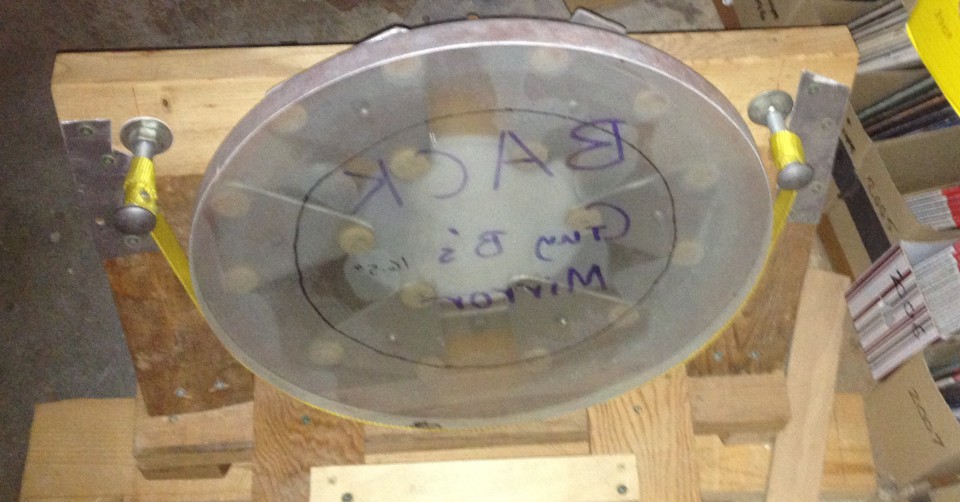
The mirror was very thin: 8″ across (20 cm) and only about 1 cm thick, so about 20:1 instead of the 6:1 diameter-to-thickness ration that used to be recommended in the 1930s through 1990s. The back of the mirror blank had circular grooves impressed into it, so many that at first glance it looked like an old-time glass LP record (rather than a vinyl one).

It was also very ‘fast’, with an focal ratio of almost exactly three (3)!

Unfortunately, the mirror was seriously undercorrected, and thus unusable if put into a telescope as is, even though a Ronchi test showed no signs of turned-down edge or of unwanted roughness or weird zones. A numerical Foucault test with Couder-style zones, repeated several times, revealed the lack of correction.

Eventually Al decided to try to refigure the mirror with an ordinary pitch lap, so he removed the aluminum layer with muriatic acid (HCl), and we remade a burgundy pitch lap and tried to get the lap into contact. It seemed to Al that the original bevel had pretty much vanished, so he used a fairly coarse sharpening stone to bring it back. We noticed a funny texture around the end of his bevel but weren’t sure what it was.

When we pressed the mirror against the lap, we immediately discovered that there was a huge amount of bumpiness and jerkiness – something was catching the lap, much like riding a Big Wheel trike on a cobblestone street. Plus, the pitch tended to stick to the mirror and had to be repeatedly removed with fingernails, turpentine, and paint thinner.

We tried rewarming and re-pressing the lap, with no improvement. When we ran our fingers around the edge of the glass, near the bevel, it seemed like there was a raised rim, almost like on a saucer. So Al got out a finer sharpening stone and increased the bevel all the way around, to about 3 or 4 mm wide. Still no improvement in the bumpiness, and the weird texture around the edge of the glass got even worse.

Then we tried removing all traces of upward-facing lip around the edge of the glass by taking a large sort-of-flat piece of 1/4″ glass, sprinkling some 220 grit and water on it, and stroking the mirror, face down, against the grit and piece of glass.

That also did not do anything to improve the bumpiness. Plus, it began to look to us more and more like this mirror had been made in a totally weird manner: a fairly rough piece of glass was hogged out to the correct curvature, then somehow coated with a smooth layer of plastic, then aluminized. If they did any figuring on it, they clearly did not use a pitch lap!

I attach a few photos that are badly out of focus because iphones don’t like to take close ups. The bright bars are LED fluorescent lights in the ceiling; the concentric rings or grooves are on the back of the mirror. Pay attention to the irregularly-shaped non-shiny areas, where we think the original plastic coating came off.

IMG_3679
IMG_3680
IMG_3682


I am also going to link to a youtube video that I took through a cheap 60X – 100X LED microscope.

A few more clues: the plastic layer (if that’s what it is) does not seem to be removed with either HCl or turpentine or mineral spirits.

If anybody has any thoughts on this mysterious mirror, Al and I will be all ears.

Meanwhile he plans to create a new tool from dental plaster and porcelain tiles and regrind it to f/5.


Some Photos from Almost Heaven Star Party

18 Tuesday Aug 2015

Posted by gfbrandenburg in Uncategorized

≈ Leave a comment

A wonderful astronomical weekend near Spruce Knob WV, at the Almost Heaven Star Party.

The fields at The Mountain Institute where it’s held remind me of the farm I grew up on, near Clarksburg MD, and the farm I lived in with Susan Greenthal Hurd in East Ryegate VT about 44 years ago.

The altitude here in WV does mimic the climate in VT. I have never gotten bitten here at TMI or AHSP or anywhere else I’ve hiked or canoed in West Virginia by any ticks or chiggers – which bedeviled me and my siblings 50-60 years ago in Clarksburg MD and continue to bite me at the Hopewell Observatory in Northern VA near Haymarket.

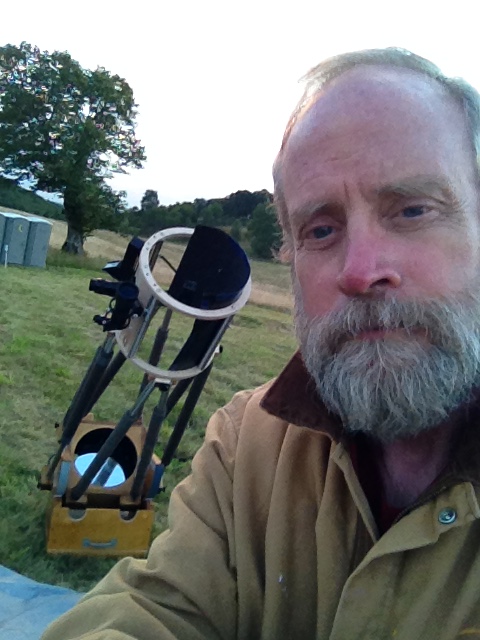
I brought my 12.5″ truss-tube dob, which you can see in one picture. I had just re-made the secondary cage and spider and secondary adjustment mechanism. I had to perform emergency surgery to cut off the truss tubes by exactly one inch so that all of the eypieces would actually come to a focus.

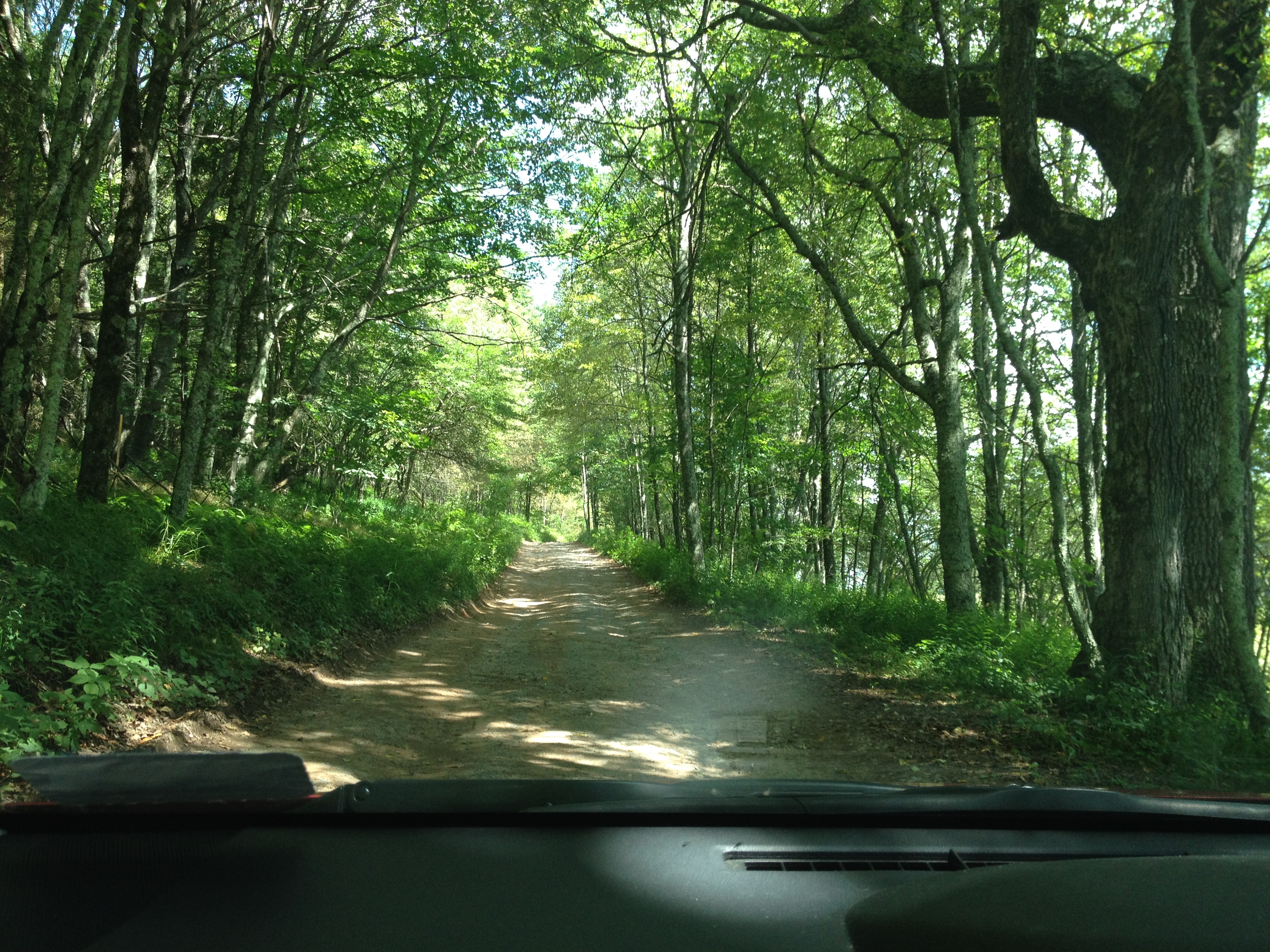
Part of the road up to TMI and AHSP

Part of the road up to TMI and AHSP

Baling hay in fields right next to TMI / AHSP

Baling hay in fields right next to TMI / AHSP

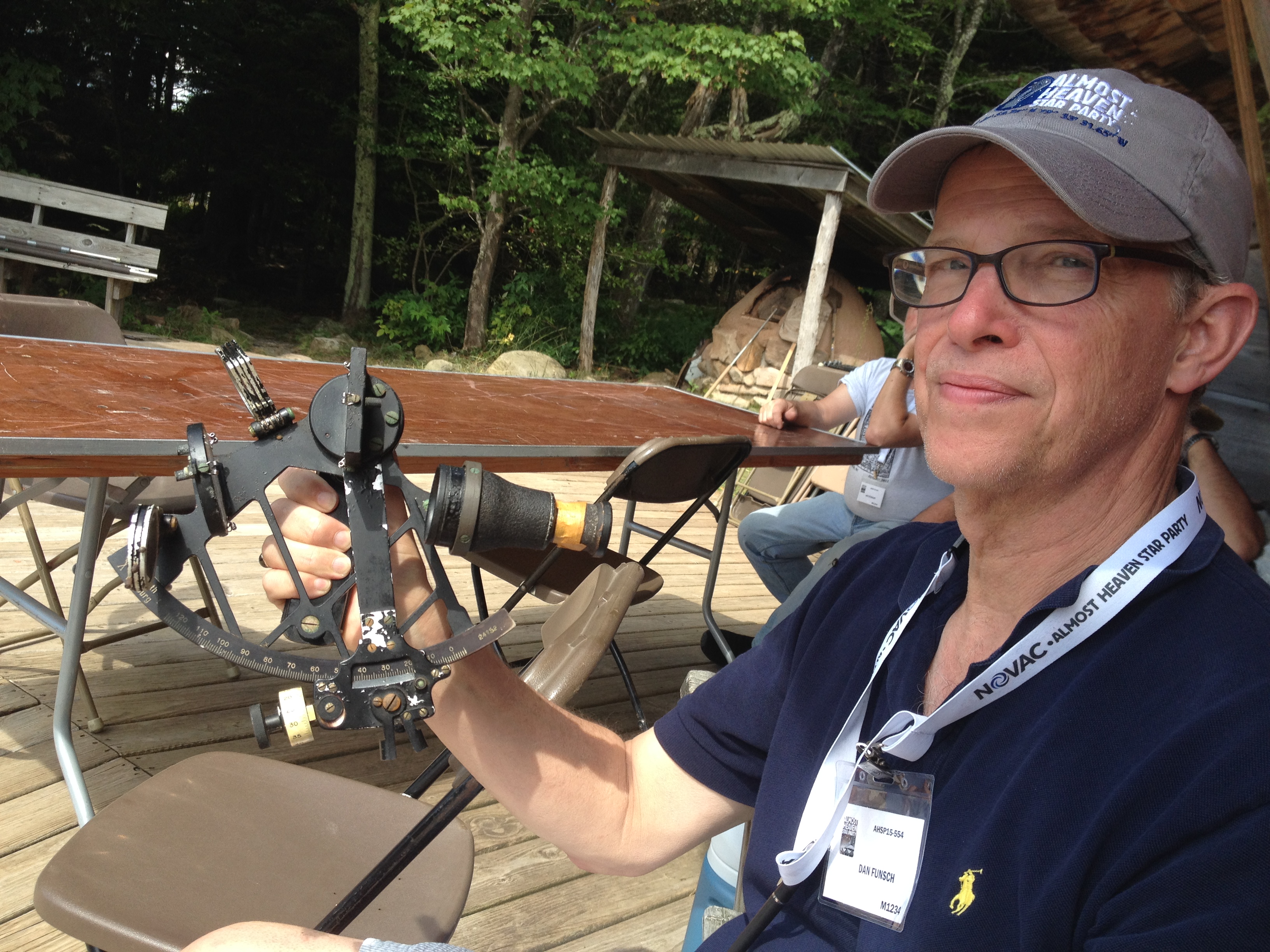
Learning how to use a sextant; if you know the exact time, you can use this to calculate your location to within 100 meters or so.

Learning how to use a sextant; if you know the exact time, you can use this to calculate your location to within 100 meters or so.

Beautiful but slightly threatening clouds the first night ended up dissipating. We had three beautiful nights of observing!

Beautiful but slightly threatening clouds the first night ended up dissipating. We had three beautiful nights of observing!

Me and my 12.5" truss-tube dob that I built,

Me and my 12.5″ truss-tube dob that I built,

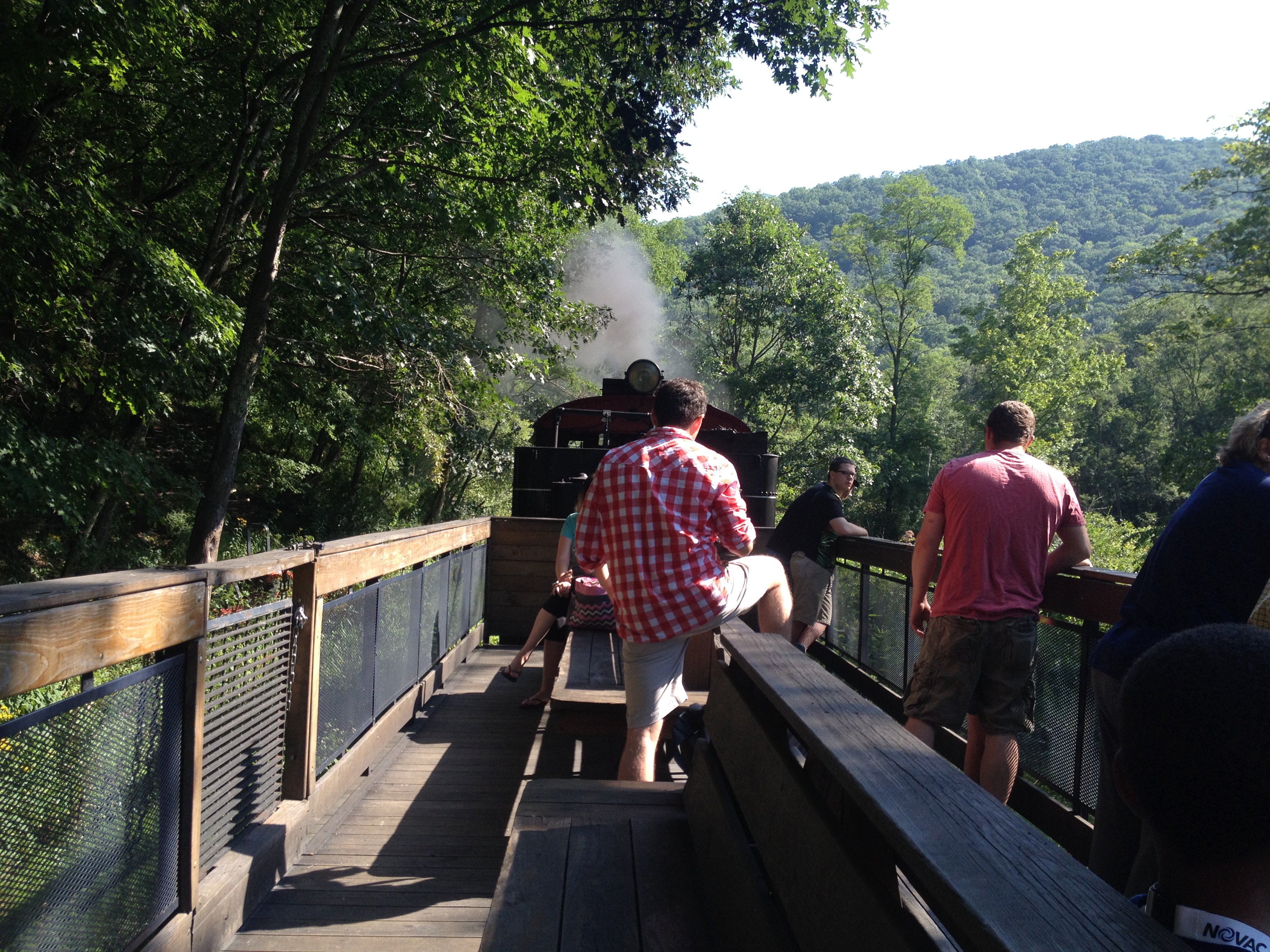
This is the Durbin Rocket railroad - a small and slow coal-burning locomotive designed to carry heavy loads of lumber. If you sit behind the engine, you WILL be coated with coal dust and cinders.

This is the Durbin Rocket railroad – a small and slow coal-burning locomotive designed to carry heavy loads of lumber. If you sit behind the engine, you WILL be coated with coal dust and cinders.

A friend's minimalist, ultra-light dobsonian telescope, either 18 or 20 inch diameter. Note the lack of mirror box!

A friend’s minimalist, ultra-light dobsonian telescope, either 18 or 20 inch diameter. Note the lack of mirror box! It also tracks and has both Argo Navis and a go-to capability.

One of the many excellent talks. In this one, Jan Wisniewski (Vish - NYEV-ski) is showing how to make an IR on-axis autoguider.

One of the many excellent talks. In this one, Jan Wisniewski (Vish – NYEV-ski) is showing how to make an IR on-axis autoguider.

Here I demonstrate how light and insubstantial are the famous Seneca Rocks that I passed on the way back from the star party.

Here I demonstrate how light and insubstantial are the famous Seneca Rocks that I passed on the way back from the star party.

Felling Some Trees at Hopewell Observatory So We Can View Polaris Again

20 Monday Apr 2015

Posted by gfbrandenburg in Uncategorized

≈ Leave a comment

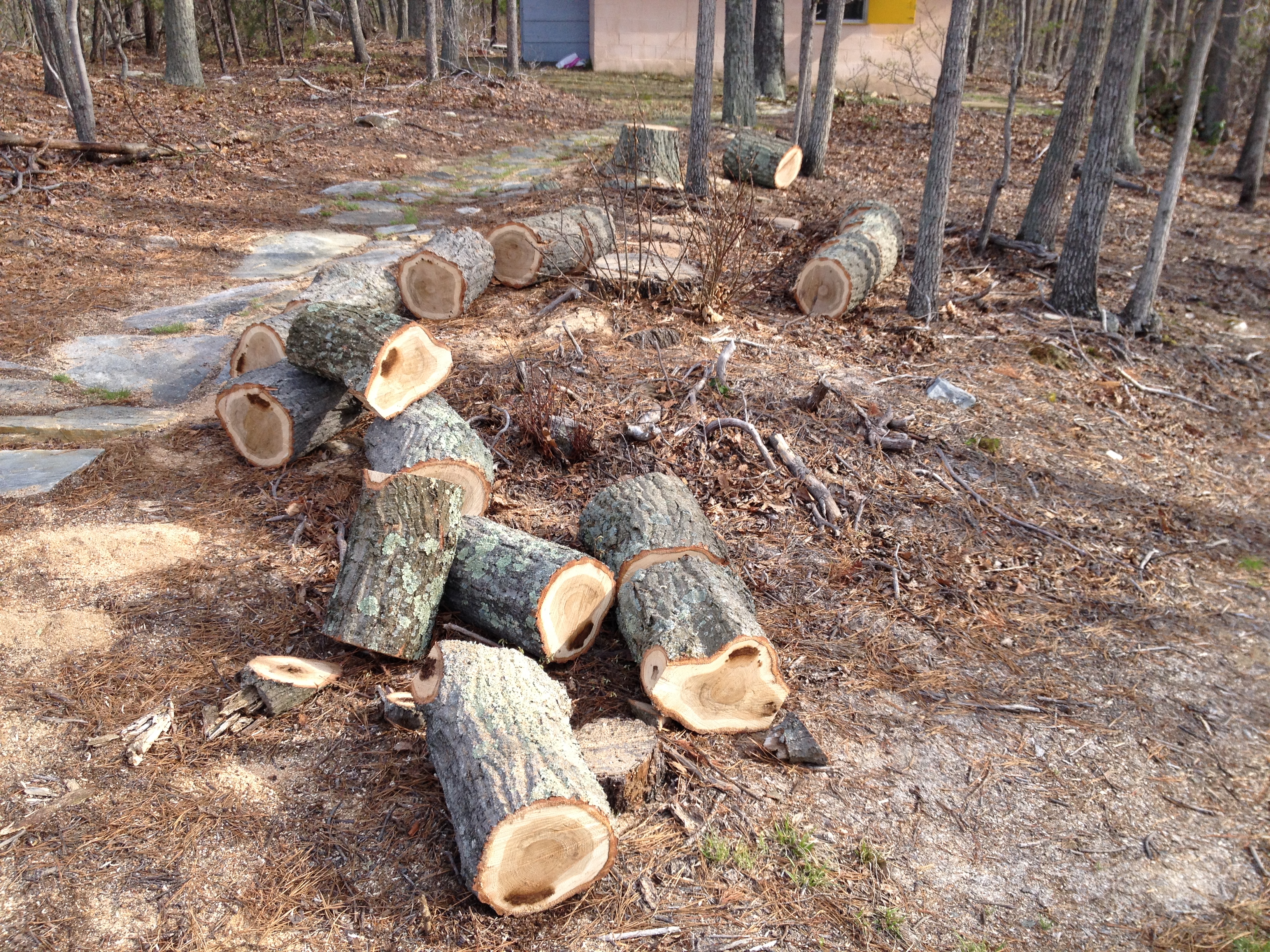
Yesterday, we felled a large red oak tree that was blocking our view of Polaris from the outside pier. (If you can’t see the North Star then it becomes very, very difficult to align your telescope for imaging.) Since the observatory was built in the 1970s and 1980s a lot of trees have grown a lot taller, and we’ve had to cut or trim several of them. This one apparently sprouted in 1940, by my count. Fortunately, one of our members heats his house with wood, and burned about 7 cords last winter. This tree is not even one cord.

The very first picture was taken just as the tree began toppling. I have a video of the tree falling and crashing, but WordPress doesn’t allow movies.

003

Timber!!!

008 007 006 005

Where I disagree with Francis S Collins

25 Wednesday Mar 2015

Posted by gfbrandenburg in Uncategorized

≈ Leave a comment

Collins is a scientific big shot (head of the Human Genome Project) and is famous for also being very religious.

I’m not. I am in awe of the incredible wonders of this planet, not to mention the wonders of the universe. I am awed even watching my 20-month-old granddaughter learn new skills and new words, but I have no idea what CAUSED all those wonders to come into being.

In the copy of Mationsl Geographic that I just opened, Collins is quoted thusly:

“At the most fundament level, it’s a miracle that there’s a universe at all.”

I agree! 

He continues:

“It’s a miracle that it [the universe] has order, fine-tuning that allows the possibility of complexity, and laws that follow precise mathematical formulas.”

Perhaps miracle isn’t the word I would use, but it is indeed amazing that the universe has those properties. Why is it that neutrons and electrons have the properties that the do, and hydrogen and oxygen and all the rest behave the way they do? I have no idea. Physicists and chemists and biologists can describe those properties, and explain why more complex phenomena occur as a result of the fundamental properties, but we have no frigging idea what caused the Big Bang or why atoms and subatomic particles behave the way they do. Its a mystery that I think we will never discover. But Collins continues:

“Contemplating this, an open-minded observer is almost forced to conclude that there must be a ‘mind’ behind all this.”

Here I disagree. I haveno idea what caused the universe to occur starting 14.7 billion years ago, but for a “mind” of some sort to be In charge of setting the values of all those physical constants raises even more questions. And provides even fewer explanations. For example, one might ask: ok, where did this “mind” come from? Why did it set the mass of a neutrino at such and such? Can this “mind” change its mind if it gets bored? If yes, what happens? If not, why not?

He concludes that “to me that qualifies as amiracle, a profound truth that lies outside of scientific explanation.”

Here I might agree. I doubt we will ever discover a cause for the Big Bang or why the various physical properties of the universe are what they are and are uniform in all places and for all time. (Or why dark energy may be an exception)

It does not force me to conclude there is a “mind@ controlling all that. No particular evidence would leave me to conclude that the human sky deities and inventions called Zeus, Legba, Thor, Cronis, Allah, Atman, or YHVH are responsible for any of those mysteries.

A good night at the DC NCA CCCC telescope-making workshop

25 Wednesday Mar 2015

Posted by gfbrandenburg in Uncategorized

≈ Leave a comment

Two major accomplishments tonight:

1. David C finally Aluminized his mirror in our vacuum chamber. Long story with mishaps that included pyrolized Sharpie marks on a previous quick and dirty aluminizationsfor attempt, and a Varian high-vacuum gauge that got stuck for a while. But he was persistent and diligent and forgiving as well.

2. Rich K appears to have finished parabolizing his 10″ f/7 mirror, which he had started about 20 years ago under the guidance of my predecessor, Jerry Schnall. If my Foucault knife-edge measurements are correct then it’s 1/15 lambda which is great.

← Older posts
Newer posts →

Subscribe

  • Entries (RSS)
  • Comments (RSS)

Archives

  • February 2026
  • December 2025
  • November 2025
  • October 2025
  • September 2025
  • July 2025
  • January 2025
  • November 2024
  • October 2024
  • August 2024
  • July 2024
  • May 2024
  • April 2024
  • January 2024
  • December 2023
  • October 2023
  • August 2023
  • June 2023
  • May 2023
  • April 2023
  • November 2022
  • October 2022
  • August 2022
  • July 2022
  • June 2022
  • May 2022
  • April 2022
  • February 2022
  • January 2022
  • December 2021
  • October 2021
  • September 2021
  • August 2021
  • July 2021
  • June 2021
  • May 2021
  • March 2021
  • December 2020
  • October 2020
  • September 2020
  • August 2020
  • March 2020
  • February 2020
  • January 2020
  • December 2019
  • November 2019
  • September 2019
  • August 2019
  • June 2019
  • May 2019
  • January 2019
  • November 2018
  • October 2018
  • September 2018
  • August 2018
  • May 2018
  • March 2018
  • January 2018
  • November 2017
  • October 2017
  • September 2017
  • August 2017
  • July 2017
  • June 2017
  • May 2017
  • April 2017
  • February 2017
  • December 2016
  • September 2016
  • June 2016
  • May 2016
  • April 2016
  • March 2016
  • February 2016
  • January 2016
  • December 2015
  • November 2015
  • August 2015
  • July 2015
  • April 2015
  • March 2015
  • February 2015
  • January 2015
  • December 2014

Categories

  • astronomy
  • astrophysics
  • education
  • flat
  • History
  • Hopewell Observatorry
  • Math
  • monochromatic
  • nature
  • optical flat
  • Optics
  • Safety
  • science
  • teaching
  • Telescope Making
  • Uncategorized

Meta

  • Create account
  • Log in

Blog at WordPress.com.

  • Subscribe Subscribed
    • Guy's Math & Astro Blog
    • Join 54 other subscribers
    • Already have a WordPress.com account? Log in now.
    • Guy's Math & Astro Blog
    • Subscribe Subscribed
    • Sign up
    • Log in
    • Report this content
    • View site in Reader
    • Manage subscriptions
    • Collapse this bar
 

Loading Comments...