
Tags
AP1600, ASTAP, Astro-Physics, AstroImageJ, Canon 6D, CMOS, DSLR, exoplanet, Hopewell, NINA, Telescope, transit
As you probably have guessed, detecting exoplanets is not easy.
So far I am about zero detections for 12 attempts.
My equipment has been a Seestar S50, and either a ZWO CMOS camera on an Explore Scientific 5″ f/7 triplet refractor, and a Canon 6D DSLR affixed to a venerable C-14 mounted on an Astrophysics 1600 GTO mount.
The Seestar is able to detect brightness changes in other variable stars like RRLyrae, but so far the small changes in flux from exoplanet transits gets drowned in the noise. The DSLR on the C-14 has much less noise, but I still haven’t seen any clear and obvious signs of a transit.
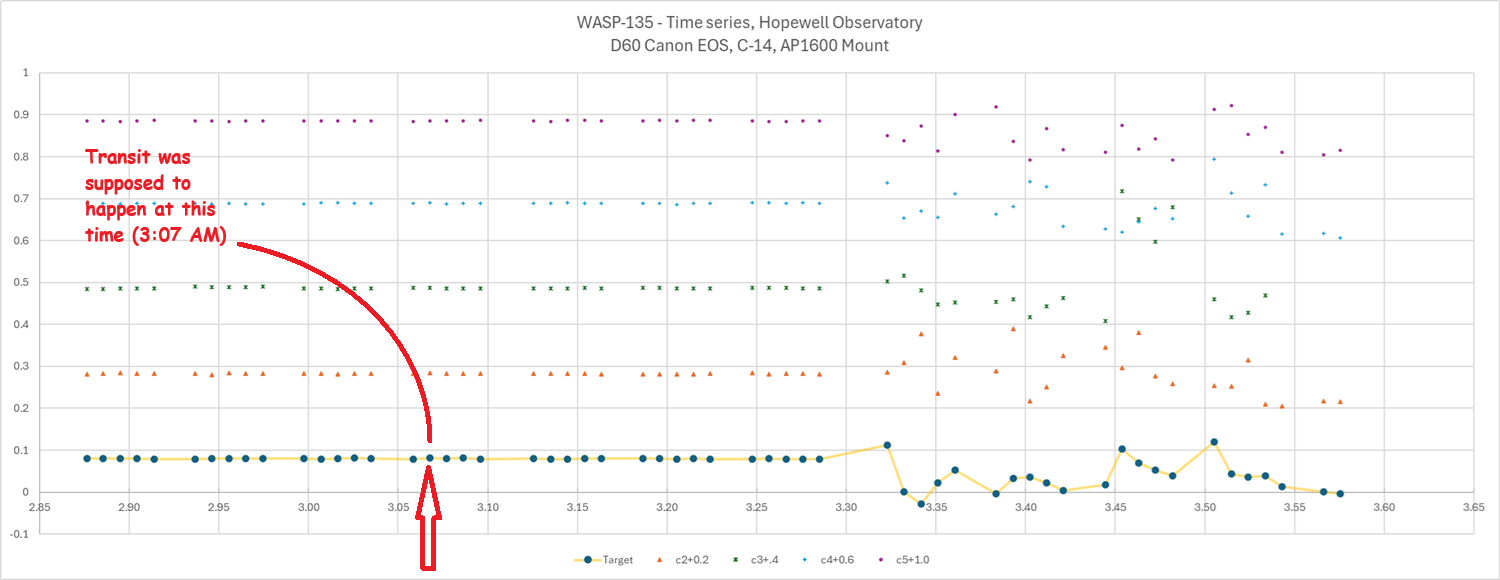
Here are graphs from my latest attempt at detecting WASP-135-b. In the first one, I plotted the fluxes of that star against four of the comparison stars. I added a fixed number to the fluxes of the other stars so you could see trends more clearly. Shortly after 3:30 AM, measurements became very strange for every single star. I was asleep at that time. I’m guessing that there were clouds. Do you see any noticeable dip in brightness of the target star at 3:07? I sure don’t.
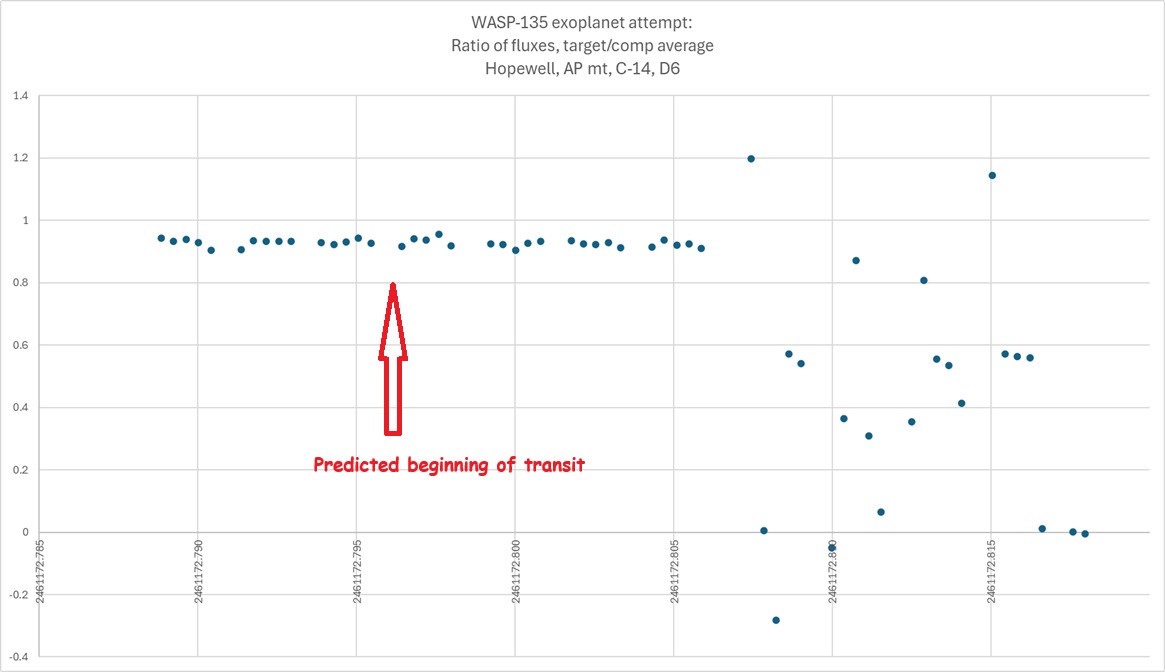
In the second graph, I asked Excel to take the average of the fluxes of several of the comparison stars, and then divide the flux from WASP-135 by that average. Again, I see no dip at the appropriate time (Julian Day).
I used NINA to program my cameras and the Hopewell Observatory’s AP mount to take these images. I used ASTAP and AstroimageJ to load all of the images from my various cameras, figure out exactly where the cameras were pointing (aka plate solving), find a bunch of comparison stars, and then measure the fluxes of each of those stars, on each and every single 30-second frame. That set of software — all free!!!– has made all of this work much easier. Thank you to all the incredibly smart and generous people who wrote, and then made freely available, all those complicated computer programs!
I will try TOI-1811 tonight, with some different settings.

