
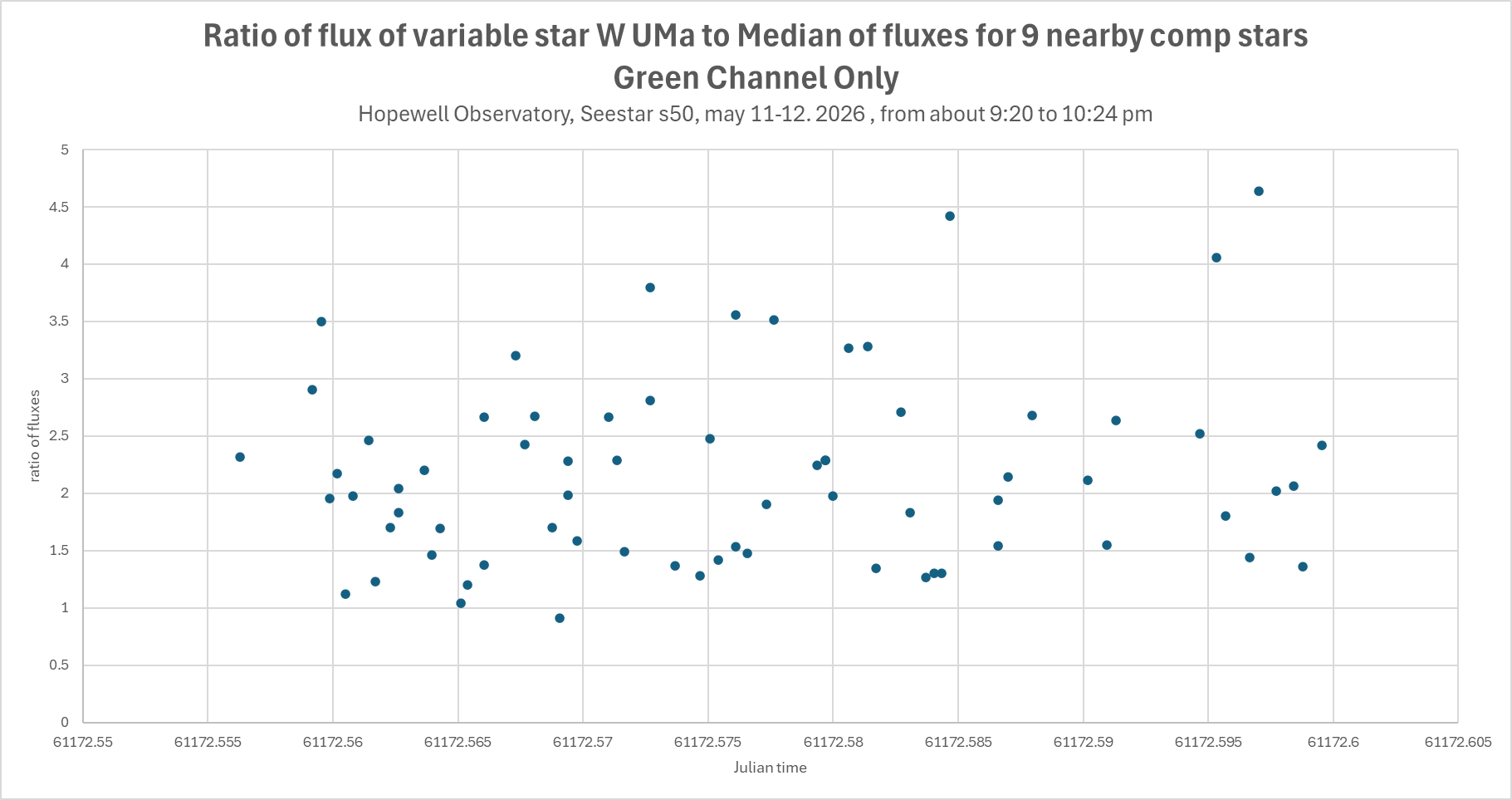
Latest results on a known variable star, W Ursae Majoris with my Seestar S50 during a very nice night: complete garbage. The graph below shows the flux of my star, WUMa, compared to the median of 9 comparison stars in the same frame, chosen by AstroImageJ.
As you can see, there is no real pattern.
If this data were real, then this star would be changing its brightness by a factor of three or for in less than a minute, with no discernable pattern. While a candle flame will flicker like that, it is simply not possible for something as large as a star to vary as quickly as that. In fact, this star is actually a contact-binary (double star) with a rotational period of about 8 hours. Even with the noise, I see no sign of a trend over these two hours.
The weather was very good, there was very little light pollution, and this star was quite high up in the sky the entire time, and none of the stars were saturated. But this data is just so, so noisy.
(I used ASTAP and AstroImageJ to do the plate solving and comparison of brightnesses. AIJ is an absolutely amazing program that automates so much of the tedium of this sort of process. For this graph, I had AIJ extract the green channel from the GRGB Bayer pattern, hoping that eliminating the blue channel would reduce atmospheric problems, but no luck so far. Combining all channels was no better.)
Other people claim success, but so far I’m zero for 12 in detecting exoplanet transits, and only 1 out of a dozen or so variable star measurements. Not sure what I am doing wrong or how I can reduce the errors. Yes, it’s true that this is only 2 hours out of an 8-hour period, but this data does not make any sense!


I’m leading the AAVSO’s Smart Telescope Working Group, and I’d very much like to follow up with you on this topic. We are working on tools to make this process easier, and I’d (selfishly) like to lay my hands on your raw images to see what happens when we run them through our processing pipeline.
— Mark MunkacsyYou can DM me directly from the AAVSO forums — try starting at https://forums.aavso.org/t/status-update-from-the-aavso-smart-telescope-working-group/3073/68
LikeLike
Hi, Mark Munkacsy,
Good to hear from you! I don’t see how to contact you at the AAVSO forum. Would love to share my data!
Guy Brandenburg
gfbrandenburg@gmail.com
LikeLike