• My series on making a Newtonian telescope
  • How Leon Foucault Made Telescopes

Guy's Math & Astro Blog

Guy's Math & Astro Blog

Tag Archives: astronomy

More August 2026 Astro Events!

19 Wednesday Aug 2026

Posted by gfbrandenburg in astronomy, astrophysics, education, Optics, Safety, science

≈ Leave a comment

Tags

Astronomical Society of the Pacific, astronomy, Camp Riverview, Dark Sky International, DC DPR, Nancy Grace Roman Space Telescope, Optics, Partial Lunar Eclipse, Rhizome DC, Star Dust, Telescope, The Astro Society

1.This evening (8-19), NCA trustee Zack Gleiberman is giving a talk at Rhizome DC on astronomy in DC. Admission is free. The talk will start at 7 pm. 

2. This Saturday (8-22), NCA members will help the DC Dark Sky International staff a table at the National Book Festival, which will be held from 9 am to 8 pm at the Walter Washington Convention Center.

3. This Sunday (8-23) National Capital Astronomers will have its required annual board meeting to plan events, examine the budget, and so on. All officers and committee heads are expected, and any member of NCA is welcome, but there will be no public lecture or slide show. The physical location is my house, 1316 Randolph St NE, WDC 20017, starting at 3 pm, with light refreshments, or you can attend remotely at https://umd.zoom.us/j/95619565617?pwd=uqwxzZ39zgVfgOypmcp8cy6xFaCcRb.1

4. Next Wednesday (8-26), some NCA members will bring telescopes to another overnight event at the DC Department of Parks and Recreation program at Camp Riverview, MD. The camp (free; enrollment by lottery) is very close to Point Lookout, MD., which is a pretty long drive from DC. This event will be for senior citizens.

5. On the night of Thursday/Friday, August 26/27, the Earth’s shadow will cover almost all (96%) of the Moon. For us in the DMV region, the partial phase will begin at 10:33 pm, maximum eclipse will happen at 12:12 am (ie after midnight), and the partial phase will end at 1:51 am. No particular optics are required, and there is no chance of actual danger from viewing the event with either a camera, a telescope, binoculars, or your unaided vision.

6. The next day, August 27, the Astronomy@250 conference of the Astronomical Society of the Pacific (now known as the Astro Society) begins with a public panel on Dr. Nancy Grace Roman, who as you probably know was the first chief of science at NASA, shepherded the Hubble Space Telescope into eing, and was a member and officer of NCA for many years. The link to join this session is www.youtube.com/@astrosocietydotorg

7. Saturday, August 29 is the deadline for any articles or photos you would like to include in the September 2026 Star Dust newsletter.

8. On Sunday, August 30, around 8 AM, the Nancy Grace Roman Space Telescope is scheduled to lift off from Cape Canaveral on a Falcon Heavy rocket. It is expected to revolutionize astrophysics with its unprecedented wide-field infrared observations. Does anybody want to hold a watch party for the event?
August 20026: Eclipses, Meteor Shower, ATMing, and NGRST Space Telescope Liftoff!

08 Saturday Aug 2026

Posted by gfbrandenburg in astronomy, astrophysics, Optics, Safety, Telescope Making

≈ Leave a comment

Tags

astronomy, ATM, eclipse, light pollution, lunar eclipse, meteor shower, Nancy Grace Roman Space Telescope, solar eclipse, Space Telescope, Telescope

August 2026 is a very busy astronomical month!

1. Venus is VERY bright in the western sky at sunset right now, and it’s only half lit up! Any telescope or binocular will show this.

2. On August 12 we in the northeastern part of North America will get to witness a partial eclipse of the sun with safe solar telescopes or straw hats or colanders. The maximum bite will taken from sun around 2 pm EDT. Some parts of Europe and Africa will get a total eclipse, but for Washington DC only about 4% of the sun will be covered, so it won’t be noticeable without help. DO NOT LOOK DIRECTLY AT THE SUN!!!

3. Later on that very same night, especially after midnight, will be the annual Perseid meteor shower! The moon will not interfere at all! (see #2) Best to get to a big open field away from city lights. Wear insect repellent, bring something comfortable to lie down on, turn your phone off completely, and invite a few friends. Bring snacks and drinks, if you like, and pray for clear skies. Leave any telescope or other optics at home unless you already know how to take wide-field time-lapse photos. Make sure you cover or turn off your camera’s display or your eyes won’t be able to adjust to the night sky. I bet that a lot of people will end up at Big Meadows in Shenandoah National Park if it’s clear.

4. On the night August 27, everybody in the Americas will get to see a nearly-full (96%) lunar eclipse! You can view this event by going outside and looking up, from anywhere. A time-lapse photo will work well here as well.

5. At about 7:45 AM, EDT on August 30, the Nancy Grace Roman Space Telescope is scheduled to take off from Cape Canaveral. Ahead of schedule and under budget! This telescope will be a really big deal. My best wishes (which are worth exactly nothing) for a successful operation!

6. The Northern Virginia Astronomy Club (NOVAC) is having their monthly meeting tomorrow afternoon (8/9/26) regarding gamma- and x-ray astronomy, which I was lucky enough to work on a bit as a summer teacher intern 30 years ago at the Naval Research Lab. Go to NOVAC.com to find details for logging on or attending in person.

7. NOVAC is also organizing the Almost Heaven Star Party at the Spruce Knob Mountain Institute next weekend. That’s a great gathering at a very dark site with amazing skies, high-quality original talks and great West Virginia nature walks and so on. Unfortunately, Spruce Knob often suffers from amazing amounts of dew even on clear nights. It’s probably sold out. You can try again next year.

8. Thursday-Sunday, August 13-16, will be the annual Stellafane telescope making convention, held near Springfield, Vermont. It’s been going on for over a century. If you go, you can expect quite a crowd. You can hear lots of fascinating talks about telescope-making during the day, and look through a variety of telescopes at night. This location is where Russell Porter in 1920 recruited a dozen or so factory workers in the town and showed them how to make their own, excellent telescopes all by hand.

Another Attempt at Exoplanet Transit Detection

23 Tuesday Jun 2026

Posted by gfbrandenburg in astronomy, astrophysics, Math, Hopewell Observatorry, science, Optics

≈ Leave a comment

Tags

astronomy, C-14, Canon 6D, exoplanet, Hopewell Observatory, Optics, Seestar, Telescope

This time I attempted to detect a different transit of another star using two different setups on the grounds of Hopewell Observatory in northern Virginia.

  1. A Canon 6D DSLR mounted on a big, heavy 14-inch Schmidt-Cassegrain telescope on a very sturdy AP1600GTO equatorial mount
  2. An alt-az Seestar S50 all-in-one astro camera

Can you spot where the exoplanet TOI-1259-b dimmed the light from its host star?

(Hint: this is a trick question!)

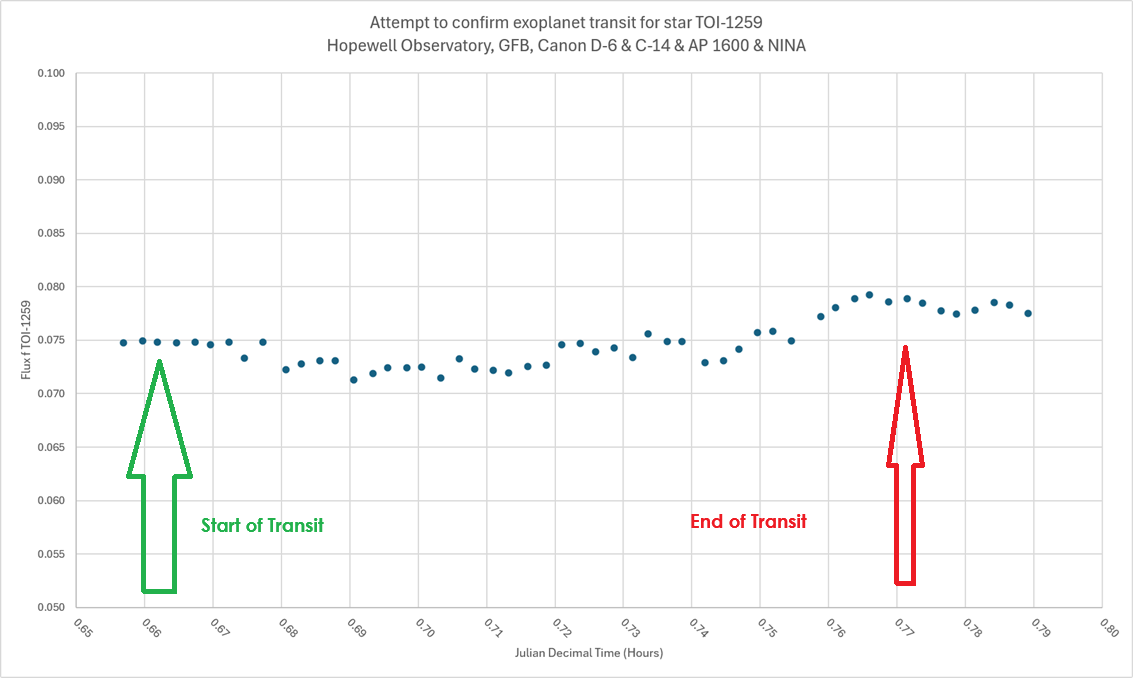
Here are the graphs I made from the data I collected:

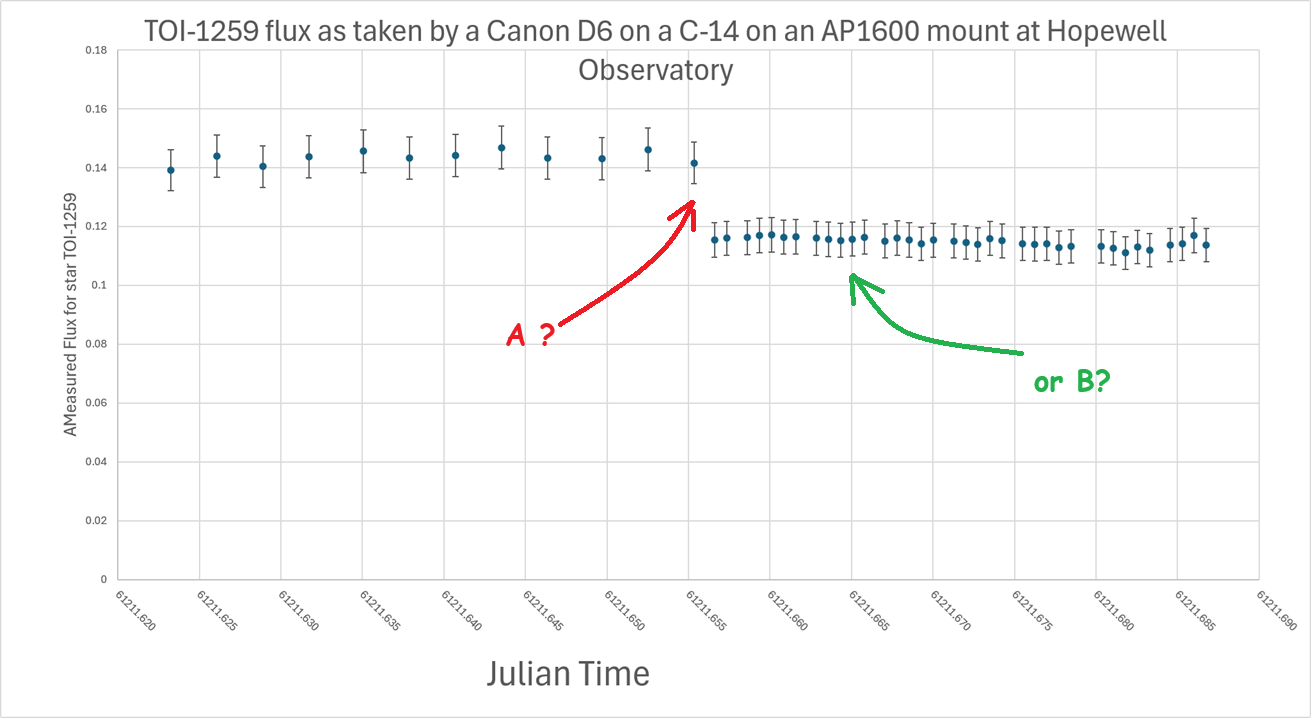
Was it at A? Or did it happen at B? (Trick question!)

And this graph is what I got from my SeestarS50:

Psst:

Point A in the first graph was when I reduced the exposure time on the camera from 2 minutes to 30 seconds. That caused all of the fluxes to decrease, because cutting the time by 4 reduces the number of photons captured. Arrow B points to where the transit was supposed to happen, with a 2.7% decrease in brightness.

Do you see it?

Me neither.

In the second graph, done by the Seestar at the same location on the same night, smoothed as much as I can by averaging successive images, I again don’t see much evidence of a 2.7% dip in total flux.

Conclusion: chasing exoplanet transits looks like it could be easy, but it’s not.

===============

This graph here is no better.

And here is where I extracted just the two green channels:

No, I am not at all convinced that my measurements captured anything.

Another Exoplanet Transit Attempt: COROT-2

19 Friday Jun 2026

Posted by gfbrandenburg in astronomy, astrophysics, Hopewell Observatorry, Math, Optics, science

≈ Leave a comment

Tags

Telescope, astronomy, Math, Hopewell Observatory, variable stars, Seestar, Seestar s50, exoplanet, transit

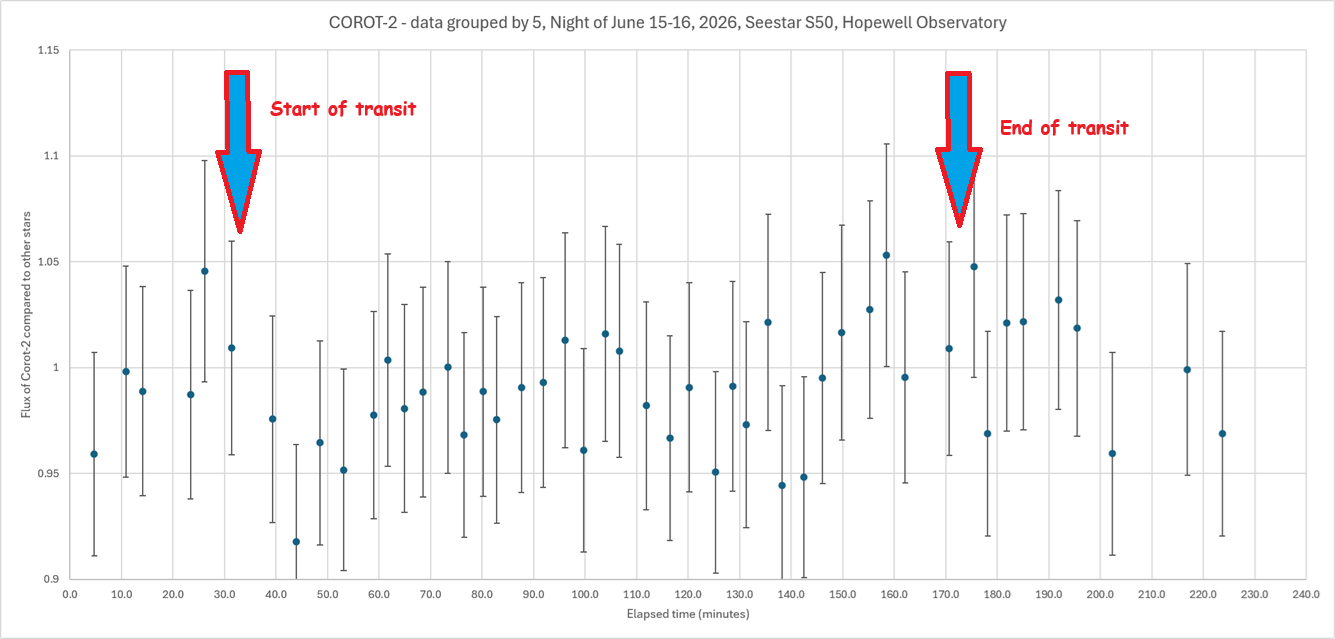
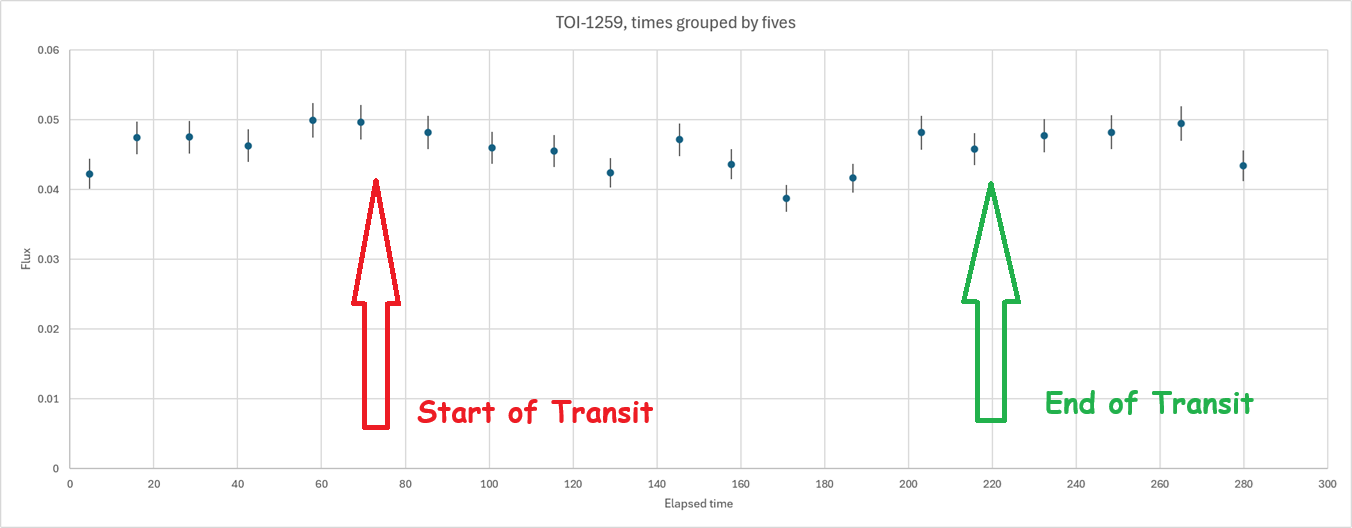
Do you see a transit in this data? I would say, “Maybe”.

Since the Seestar has quite a bit of error, caused in part by its Bayer array of green, red, and blue pixels, I grouped my original measurements (processed in AstroImageJ) in groups of 5, using Excel to do so.

Science with Seestar S50? Not so far!

27 Wednesday May 2026

Posted by gfbrandenburg in astronomy, astrophysics, Hopewell Observatorry, Math, monochromatic, science

≈ 2 Comments

Tags

astronomy, contact binary, Hopewell Observatory, Seestar s50, Telescope, variable star

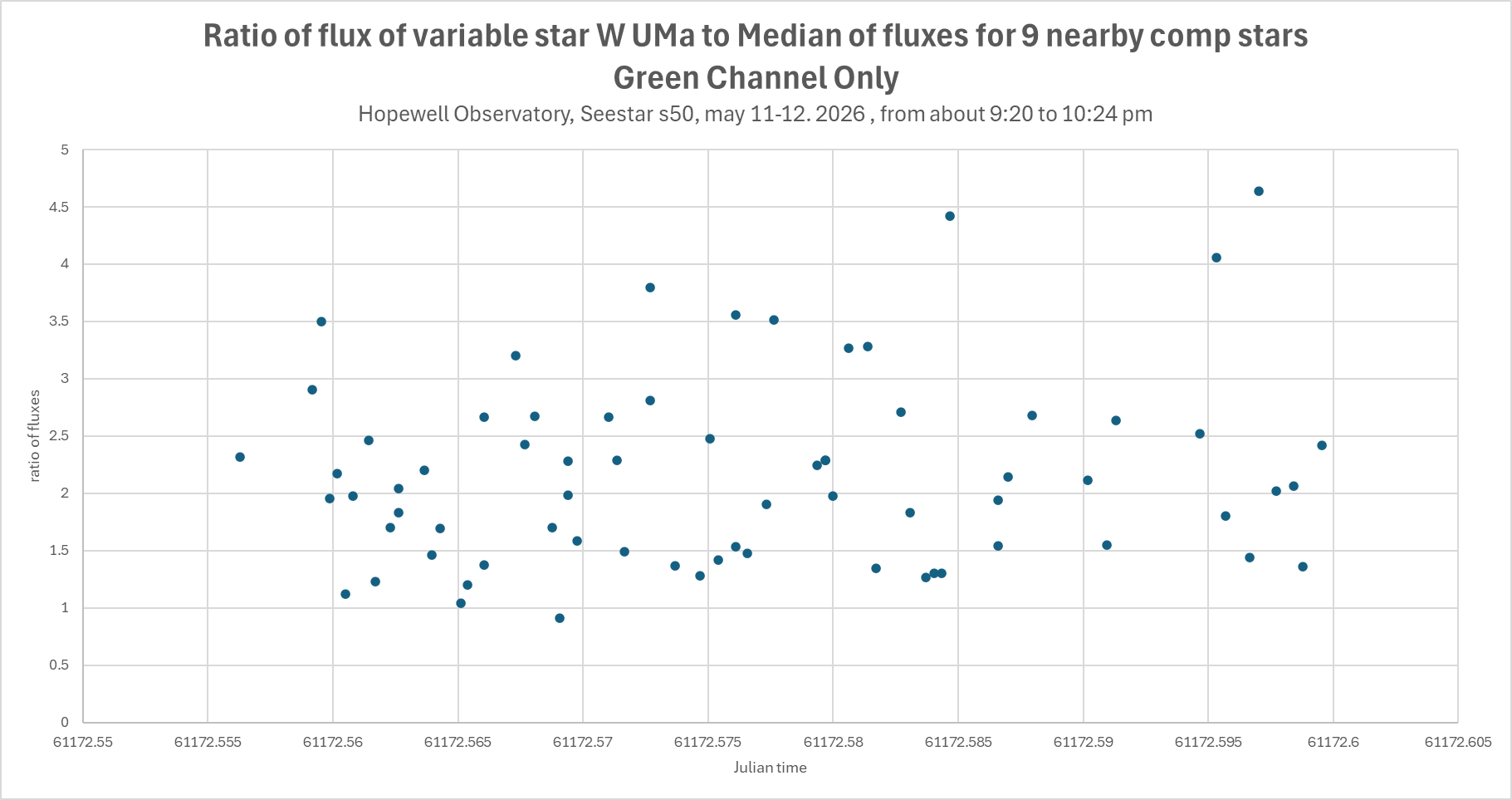
Latest results on a known variable star, W Ursae Majoris with my Seestar S50 during a very nice night: complete garbage. The graph below shows the flux of my star, WUMa, compared to the median of 9 comparison stars in the same frame, chosen by AstroImageJ.

As you can see, there is no real pattern.

If this data were real, then this star would be changing its brightness by a factor of three or for in less than a minute, with no discernable pattern. While a candle flame will flicker like that, it is simply not possible for something as large as a star to vary as quickly as that. In fact, this star is actually a contact-binary (double star) with a rotational period of about 8 hours. Even with the noise, I see no sign of a trend over these two hours.

The weather was very good, there was very little light pollution, and this star was quite high up in the sky the entire time, and none of the stars were saturated. But this data is just so, so noisy.

(I used ASTAP and AstroImageJ to do the plate solving and comparison of brightnesses. AIJ is an absolutely amazing program that automates so much of the tedium of this sort of process. For this graph, I had AIJ extract the green channel from the GRGB Bayer pattern, hoping that eliminating the blue channel would reduce atmospheric problems, but no luck so far. Combining all channels was no better.)

Other people claim success, but so far I’m zero for 12 in detecting exoplanet transits, and only 1 out of a dozen or so variable star measurements. Not sure what I am doing wrong or how I can reduce the errors. Yes, it’s true that this is only 2 hours out of an 8-hour period, but this data does not make any sense!

Is NASA PUNCHing at solar storms?

10 Friday Apr 2026

Posted by gfbrandenburg in astronomy, astrophysics, education, History, Optics, Safety, science

≈ Leave a comment

Tags

Artemis, astronomy, aurorae, crewed mission, eclipse, education, GSFC, heliosphere, LRO, Lunar Reconnaissance Orbiter, Michael Kirk, nasa, National Capital Astronomers, NCA, observatory, Optics, planet, PUNCH, robotic mission, solar, Solar corona, solar system, space, Telescope, totality

Are you worried about solar storms?


We can perhaps defend against them with a high-flying scientific PUNCH!

(Pun intended. Sorry.)


NASA’s PUNCH mission is flying and is beginning to take polarized 3D images of the interaction between the Sun’s Corona and the heliosphere – to help us predict when our closest star is about to ‘go crazy’ and send so much energy our way as to cripple our power grids or our global networks of communications satellites. 


We will hear about the mission during the monthly April National Capital Astronomers meeting this Saturday, 4-11-2026, starting at 7:30 sharp. 


There will be a bit of club business first, then a talk about PUNCH by Dr Michael Kirk, a NASA – Goddard Space Flight Center scientist, followed by telescope observing at and around the University of Maryland’s observatory under what is predicted to be nice clear skies.  


Michael S. F. Kirk – Sciences and Exploration Directorate

If you like, you may bring your own telescope to set up on the pads outside on the observatory grounds, to share views with others. I plan to bring one of the scopes that I made, and I hope we can draft somebody to keep an eye on them during the meeting.


To drive to the meeting in person, aim your GPS at “UMD Observatory” or type in 3255 Metzerott Road, College Park, MD 20740. The inconspicuous entrance sign is on the south side of the road. Public transportation to the location is unfortunately not reliable. 


If you want to join us remotely, here is the link:
UMD-NCA-Zoom-Link
or you can try 

https://umd.zoom.us/j/95619565617pwd=uqwxzZ39zgVfgOypmcp8cy6xFaCcRb.1 (no spaces)

Log in well before 7:30 if possible.

Are you one of the lucky ones who have seen the enormous solar corona during a total eclipse?

Have you seen the Northern or Southern Lights?

These gigantic structures change like our own weather. If you fly near the Arctic or Antarctic circles at night you can see the aurorae just about any time, but the solar corona itself only becomes visible to us on Earth for a few fleeting minutes during a total solar eclipse.


There is a lot that is still unknown about the solar corona — and how it affects the solar winds and the heliopause that protects us from most nasty interstellar radiation. As you probably know, all these connected phenomena influence the Northern lights, can play havoc with radio communications and satellites, and have in the past occasionally knocked out all electricity to large parts of North America and other locations. Larger solar outbursts could conceivably disable every single global communications satellite system, without which modern civilization would largely crash to a halt.

(See List of solar storms – Wikipedia for examples.)


NASA science missions like PUNCH don’t get nearly as much publicity as crewed missions like Artemis. But they also cost a whole lot less, and when they work as planned, they get better data.  


(Compare the photos of the backside of the Moon made just now by the Artemis crew (with their cell phones) with those made by the unsung Lunar Reconnaissance Orbiter, LRO, which has been orbiting the Moon ever since 2009 and taking very high-resolution photos in lots of wavelengths. LRO not only has detected all sorts of chemical variation on the Moon’s surface, including signs of water ice, and has even sent back images with very clear tracks and rocket blast marks left behind by the Apollo astronauts over 50 years ago!)

These two images are of the same location, Vavilov Crater.


 LRO: https://upload.wikimedia.org/wikipedia/commons/thumb/b/b6/Vavilov_crater_LRO_WAC.jpg/960px-Vavilov_crater_LRO_WAC.jpg

Artemis: Finally, Artemis delivers some exceptional, high-quality photos of the Moon – Ars Technica

The photo from the LRO is incomparably more detailed.

Our speaker, Dr. Michael S. Kirk, is a Research Scientist in the Heliophysics Science Division at NASA’s Goddard Space Flight Center. He plans to explain to us the status and goals of NASA’s PUNCH constellation of four small satellites in low Earth orbit.

Using polarimeters, the craft are supposed to be making global, 3D observations of the entire inner heliosphere to learn how the Sun’s corona becomes the solar wind that comes our way.


PUNCH stands for Polarimeter to UNify the Corona and Heliosphere.

NCA is a 501c3 educational and charitable non-profit, and all of our meetings are free and open to the public. Our website is capitalastronomers.org

Guy Brandenburg,

President, National Capital Astronomers

DIY Spectroheliograph by Prasad Agrahar

06 Saturday Dec 2025

Posted by gfbrandenburg in astronomy, astrophysics, education, monochromatic, Optics, Safety, science, Telescope Making

≈ Leave a comment

Tags

angstroms, astronomy, ATM, h-alpha, h-beta, hydrogen alpha, Mirror, nanometers, National Capital Astronomers, Optics, refractor, solar, solar imaging, solar system, spectroheliograph, spectrum, sun, Telescope, Telescope Making

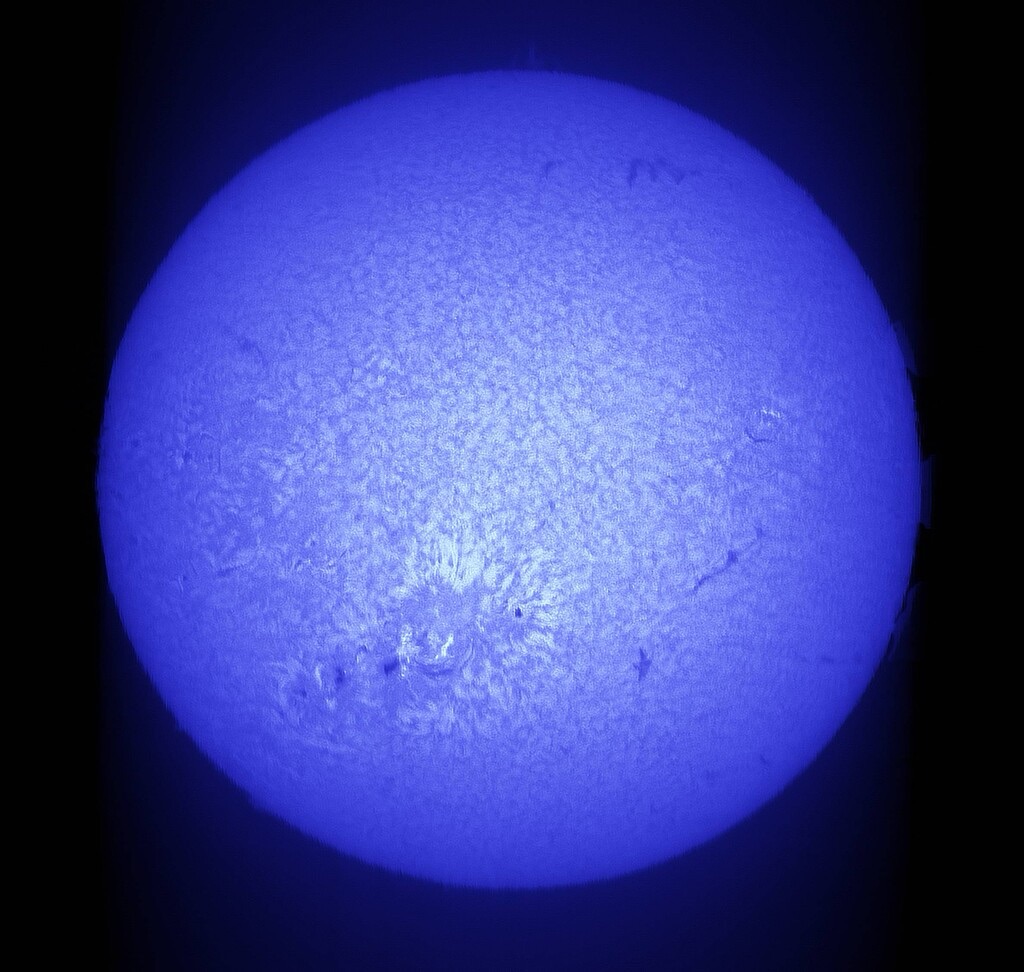
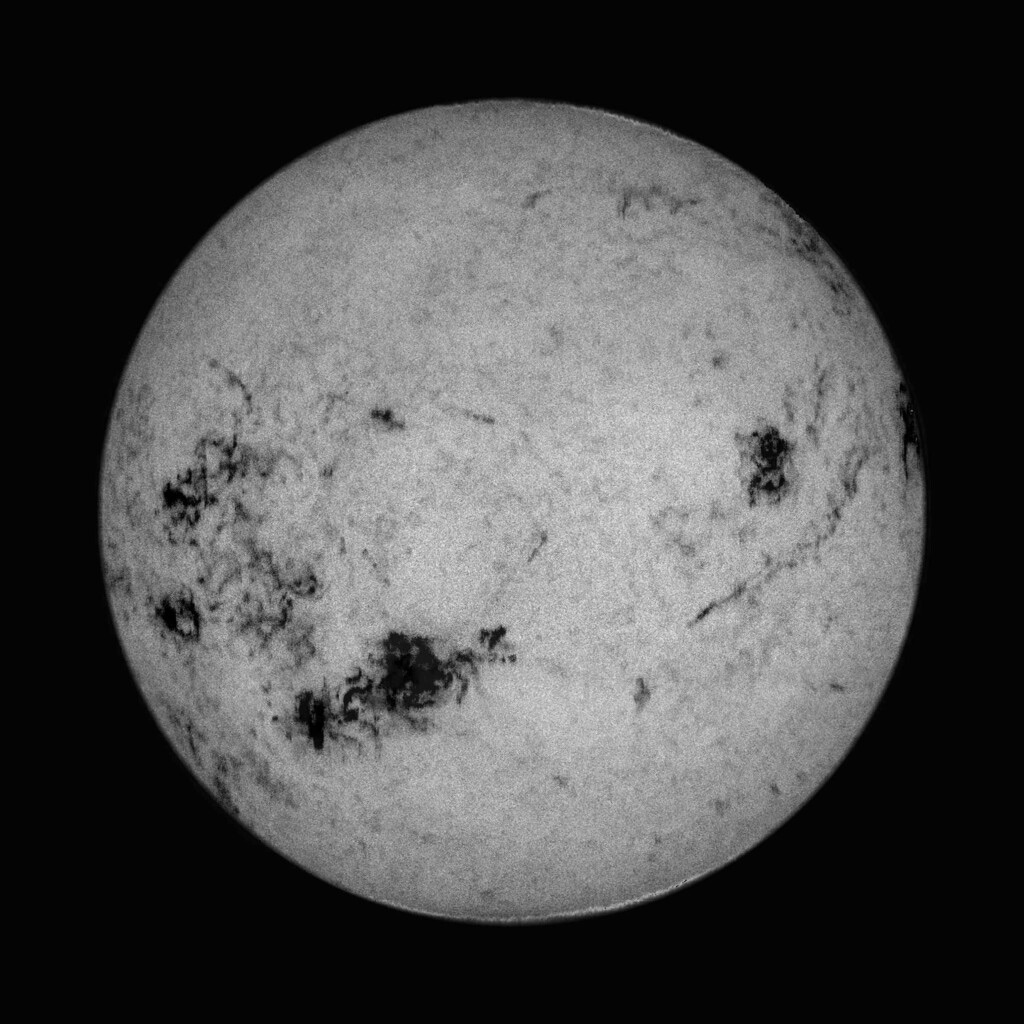
I’d like to share these spectacular images of our Sun, taken by Prasad Agrahar with his home-made spectroheliograph. 

His first image is at H-alpha (656 nm), second is at H-beta (486 nm), and the third is at Helium D3 (585 nm).

With this device, IIUC, he can make an image at just about any wavelength that makes it through the front lens of the optics. He posted this to the NCA email list.

DIY!!

Guy Brandenburg

Prasad wrote:

Here are three images of our Sun, taken on Thursday morning with my DIY spectroheliograph. The weather was quite windy, and the seeing was poor. 

The above is H-alpha with [sunspot groups] AR 4294 and 4296 dazzling. 

This is H-beta

And finally, 

The above image is (…) Helium-D3, the emission line at 5875A.

Thank you all.

Prasad

_._,_._,_


Variable star measurements with a Seestar

02 Tuesday Dec 2025

Posted by gfbrandenburg in astronomy, Math, Optics, science

≈ Leave a comment

Tags

astronomy, Math, Optics, RRLyrae, Seestar, space, Telescope, variable stars

Most (but not all) of the variable stars I tried over the past month or so were simply too bright for this sensor. The target stars were saturated (ie some of the pixels’ electron wells simply  overflowed) despite using the shortest available exposure, adding the light pollution filter and refocusing. Seestar won’t let your change the ISO nor open the shutter for less than 10 seconds.

I did get some believable light curves on BE Lyncis (aka HD67390)and U Cephii (aka HD 5679). I attack some graphs I made.

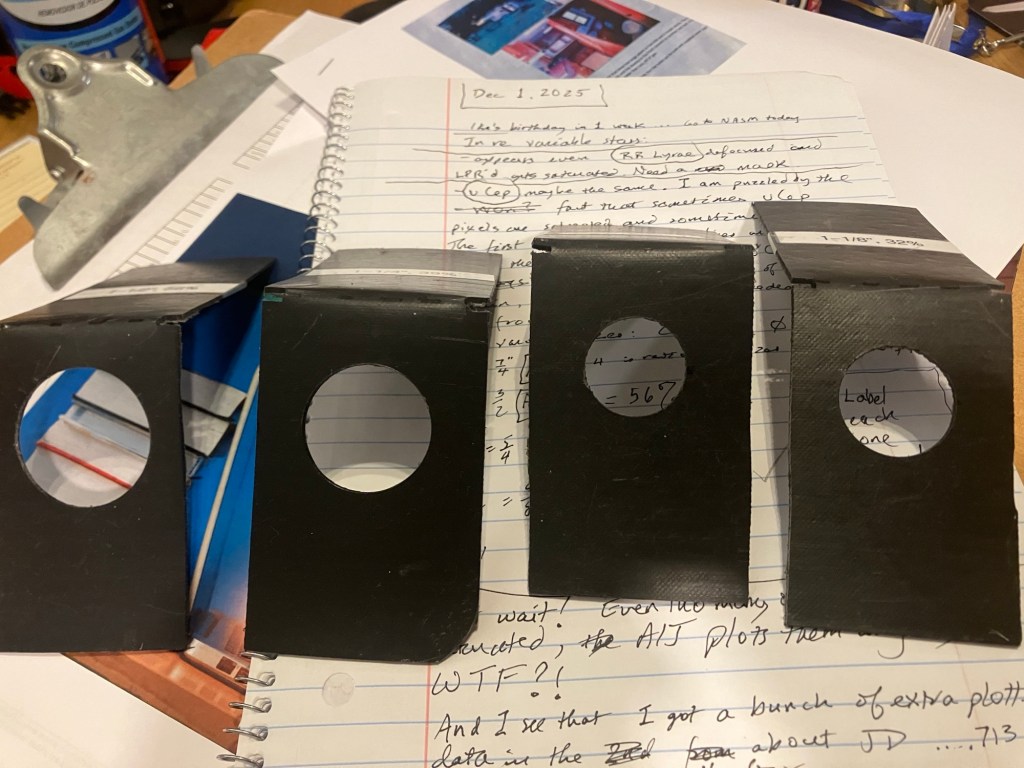
I used some black plastic I had,and my set of Forster bits, to make holes of sizes 1”, 1-1/8”, 1-1/4”, and 1-1/2”, in case I want to try brighter variable stars again like RR Lyrae. 

I very impressed that Seestar absolutely nails the locations of every single one of these targets! I’m also pleased that AstroImageJ allows quick and easy plate-solving! 

Still Overexposed, and No Auroras for Me

14 Friday Nov 2025

Posted by gfbrandenburg in astronomy, astrophysics, Hopewell Observatorry, Optics, science

≈ Leave a comment

Tags

astronomy, Aurora, cold, Hopewell Observatory, norothern lights, Optics, RR Lyrae, RRLyr, RRLyrae, Seestar, Telescope, variable star

I went up to Hopewell on Wednesday night, and practiced once again taking images of RRLyrae with my Seestar S50, but this time with the built-in light-pollution rejection filter in place. I figured that would reduce the number of photons by a lot, and maybe by enough to stop overwhelming the pixels.

Unfortunately, it was not sufficient, so, since I cannot reduce the number of seconds of exposure for each sub-image (or ‘slice’ as AstroImageJ calls them) below 10, and I cannot change the ISO or gain for the chip, the only choices left are, in order of ease of implementation:

  1. De-focus the images to spread the photons into a wider range of pixels, hopefully not causing any of them to become saturated, but not so much as to confuse the plate-solving app;
  2. Make a black, circular mask smaller than 50 mm in diameter and put it in front of the lens, reducing the total number of photons;
  3. Persuade the engineers and programmers at ZWO to change the software to allow users to reduce the length of exposures, and to allow time lapse photography with what they call Star-Gazing but everybody else calls deep-space observing.

Number 1 I will do next time.

By the way, the exact mechanism by which this variable star dims and brightens is still not fully understood, though its timing cycle is extremely regular and quite well known.

No Auroras for me:

It was very cold and windy so I couldn’t stand being outside up on the Bull Run Mountain ridge for very long at a time. The sky was almost perfectly clear the entire night, and the beautiful winter constellations were extremely bright, and it was fun watching them make that apparent great pivot around us.

I saw no auroras; since I was was groggy (from forgetting my meds) and quite cold, so I spent most of the night inside napping and trying to get warm, but went out from time to time to look around and to check on the progress of my little Seestar. So when the peak happened I was probably dozing. Not too many other folks saw it, apparently, and the images I’ve seen were not nearly as impressive as for other aurorae on other dates. Oh, well.

Overexposed!

12 Wednesday Nov 2025

Posted by gfbrandenburg in astronomy, astrophysics, Hopewell Observatorry, monochromatic, Optics, science

≈ Leave a comment

Tags

astronomy, ATM, filter, Hopewell Observatory, light pollution, Optics, photometry, RR Lyrae, RRLyrae, Seestar, Seestar s50, Telescope

As described in my last post, I got a light curve for a known variable star in my little Seestar S50 a few weeks ago that showed absolutely no variability whatsoever over a roughly 4 hour period. Since this star’s variation occurs extremely regularly, there is a known formula that will give you the precise location in its cycle if you feed in the Julian day (JD). I plugged the start and end times for my run, and got the following:

And was confused

So RRLyrae should have dropped from something near 7.3 magnitude to around 7.6 magnitude, which is a LOT for this sort of thing. But my graph of brightness of RRLyae, compared to a nearby star of roughly the same magnitude, looks like this:

Which is barely any change at all. The few pairs of dots below the blue blob line are glitchy data that should be ignored; notice that it happens for both stars. In fact, I see more variability in the pink comparison star’s brightness than I do with RRRLyrae.

Was the scope indeed pointed at the correct star? Well, I had plate solving on each and every frame, and they all agreed, so, yes.

I did notice a problem with saturation, but didn’t know exactly by how much. Nikolaos Bafitis suggested that I use my mouse to look more closely at the centers of the star images themselves in AstroImageJ. I did so, and at last noticed that one of the boxes held the number of pixel counts right under my mouse pointer. Duh! Sure enough, my target star, RR Lyrae, had a count of 65,533, which is 2^16, and (I looked it up) that is precisely the maximum for these pixels on these CMOS cameras. So that’s why RR Lyrae’s brightness was so steady: it was always OVERFLOWING.

So I have to figure out a way to gather fewer photons per pixel around the target and comparison stars. There are several possible ways of doing so without changing the electronics or trying to mess with the operating system or user interface.

  1. Reduce the ISO setting from the current default value.
  2. Shorten the exposure time.
  3. Change the focal ratio by placing a circular mask over the lens aperture.
  4. De-focus the images so that the light is spread out over a larger area.
  5. Add some sort of filter.

Unfortunately right now, the Seestar doesn’t allow you to do either number 1 or number 2. It would be nice if ZWO engineers would add those capabilities in the ‘advanced’ menu,

Number 3 is quite doable. I happen to have on hand a large roll of black Kydex plastic and a set of Forstner bits to make nice holes with. But it this would require a fair amount of time and effort. It would also reduce the resolution of an already rather small 50mm lens.

Number 4 is more easily doable: turn off the autofocus feature and do some experimentation to find a good fixed de-focus point. However, if the stars are too fuzzy, then plate-solving becomes much harder and slower.

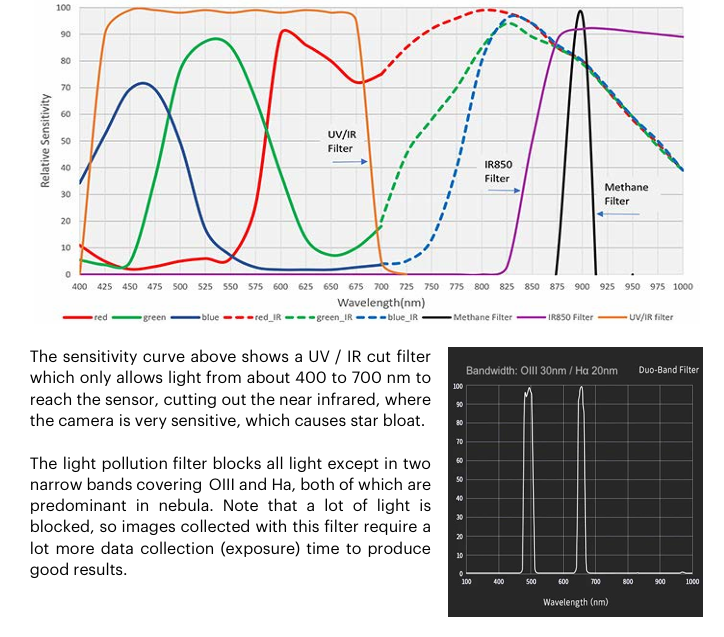
Number 5 can be done by using the built-in light pollution filter, whose transmission bandwidth is very small. It’s the bottom graphic below.

The graphics above come from an excellent Unofficial Seestar handbook written by Tom Harnish. He has a number of suggestions that I hope the engineers at ZWO pay attention to and follow.

The option that seems easiest is number 5, using the light pollution filter. If I couple that with the built-in time-lapse feature, I won’t fill the Seestar’s entire memory with a zillion FITS images.

I hope to try this tonight up at Hopewell Observatory, where I can set this up, have it run all night connected to mains power, and I can sleep in a nice warm cabin.

And maybe get lucky and see Northern Lights!

← Older posts

Subscribe

  • Entries (RSS)
  • Comments (RSS)

Archives

  • August 2026
  • July 2026
  • June 2026
  • May 2026
  • April 2026
  • February 2026
  • December 2025
  • November 2025
  • October 2025
  • September 2025
  • July 2025
  • January 2025
  • November 2024
  • October 2024
  • August 2024
  • July 2024
  • May 2024
  • April 2024
  • January 2024
  • December 2023
  • October 2023
  • August 2023
  • June 2023
  • May 2023
  • April 2023
  • November 2022
  • October 2022
  • August 2022
  • July 2022
  • June 2022
  • May 2022
  • April 2022
  • February 2022
  • January 2022
  • December 2021
  • October 2021
  • September 2021
  • August 2021
  • July 2021
  • June 2021
  • May 2021
  • March 2021
  • December 2020
  • October 2020
  • September 2020
  • August 2020
  • March 2020
  • February 2020
  • January 2020
  • December 2019
  • November 2019
  • September 2019
  • August 2019
  • June 2019
  • May 2019
  • January 2019
  • November 2018
  • October 2018
  • September 2018
  • August 2018
  • May 2018
  • March 2018
  • January 2018
  • November 2017
  • October 2017
  • September 2017
  • August 2017
  • July 2017
  • June 2017
  • May 2017
  • April 2017
  • February 2017
  • December 2016
  • September 2016
  • June 2016
  • May 2016
  • April 2016
  • March 2016
  • February 2016
  • January 2016
  • December 2015
  • November 2015
  • August 2015
  • July 2015
  • April 2015
  • March 2015
  • February 2015
  • January 2015
  • December 2014

Categories

  • astronomy
  • astrophysics
  • education
  • flat
  • History
  • Hopewell Observatorry
  • Math
  • monochromatic
  • nature
  • optical flat
  • Optics
  • Safety
  • science
  • teaching
  • Telescope Making
  • Uncategorized

Meta

  • Create account
  • Log in

Blog at WordPress.com.

  • Subscribe Subscribed
    • Guy's Math & Astro Blog
    • Join 54 other subscribers
    • Already have a WordPress.com account? Log in now.
    • Guy's Math & Astro Blog
    • Subscribe Subscribed
    • Sign up
    • Log in
    • Report this content
    • View site in Reader
    • Manage subscriptions
    • Collapse this bar
Loading Comments...