• My series on making a Newtonian telescope
  • How Leon Foucault Made Telescopes

Guy's Math & Astro Blog

Guy's Math & Astro Blog

Tag Archives: astronomy

Amazing Astrophotos by 19-year-old Venezuelan Immigrant at Art All Night – Mt Pleasant (DC)

13 Saturday Sep 2025

Posted by gfbrandenburg in astronomy, education, science, teaching, Telescope Making

≈ Leave a comment

Tags

astronomy, DC, District of Columbia, DIY, dobsonian, Mount Pleasant, National Capital Astronomers, NCA, Optics, Telescope, Telescope Making

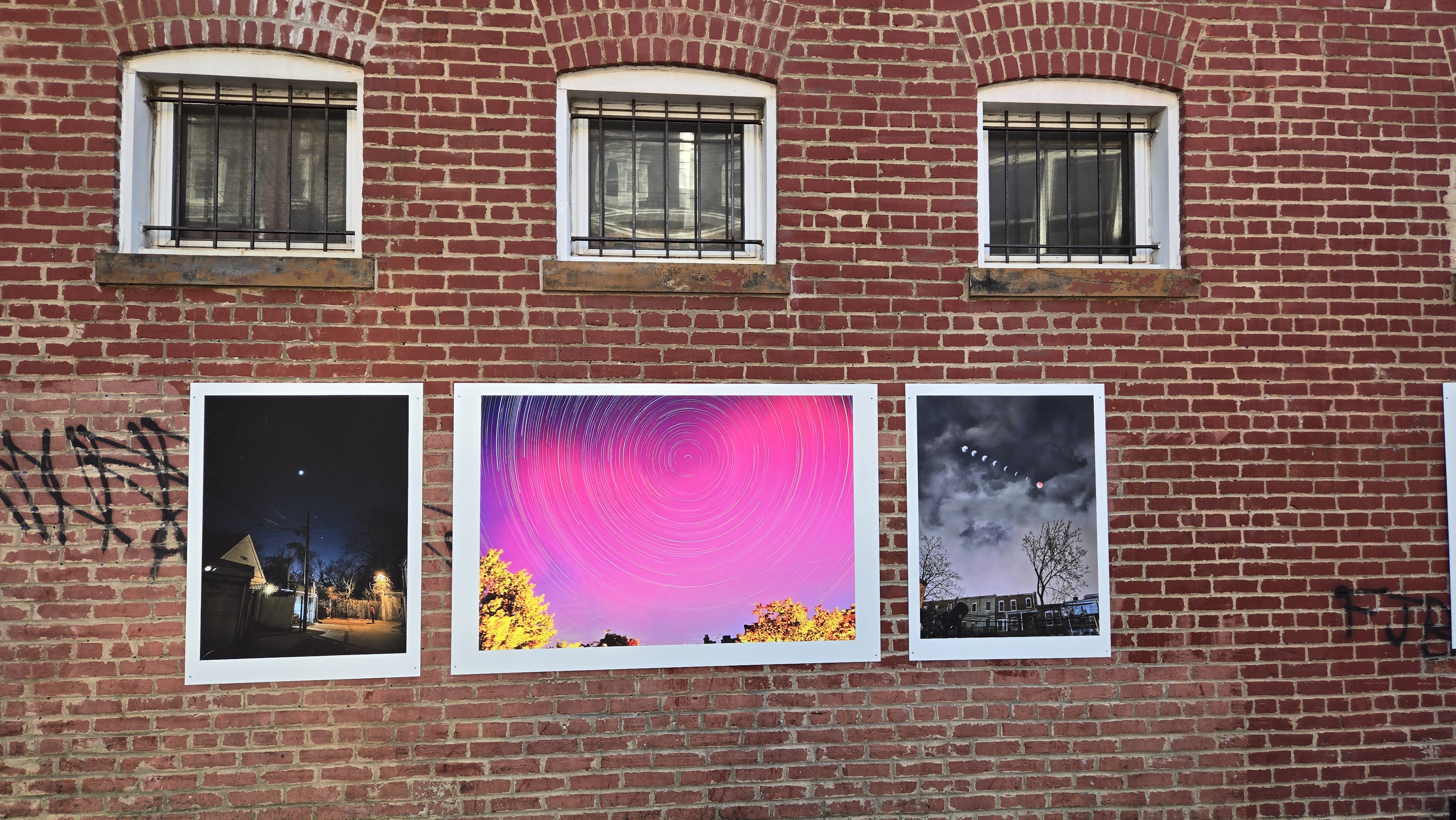
Last night was the opening of an exhibit called Second Sunset in an alley off Mt Pleasant Triangle in NW DC. Great astrophotos by 19-year old Gael Gomez, his neighbor Adam Green, and NCA VP Bryan Vandrovec! The images are huge – four to six feet across, and printed on durable sandwiches of aluminum and plastic, so they will survive outside for months. They were printed by Jason Hamacher of Lost Origins Gallery, located about a block away, aided in part by the Smithsonian’s Folk Life Festival.

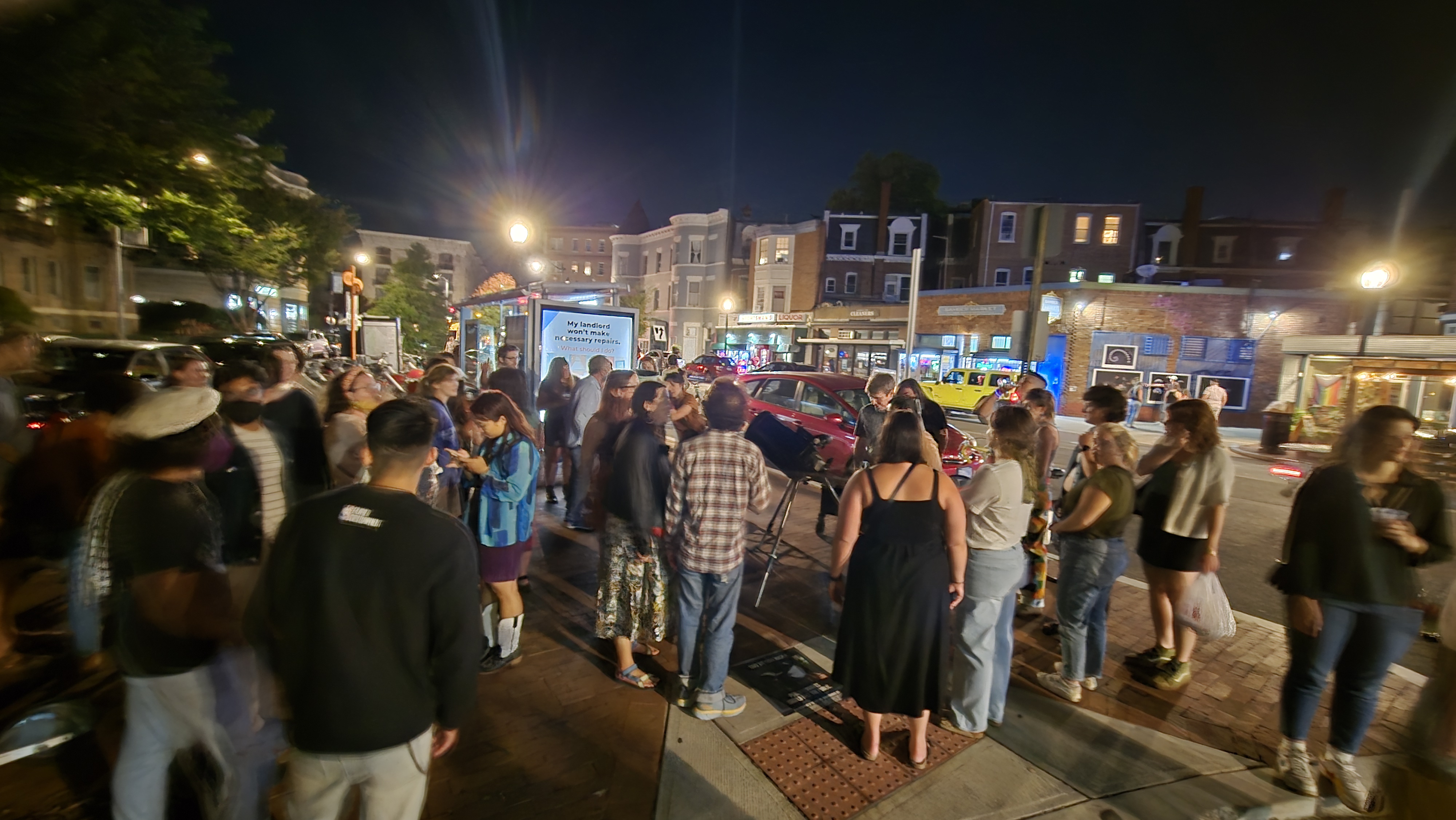
It coincided with the 3rd annual Art All Night – Mount Pleasant, so a LOT of people were out having a good time, listening to a live Colombian band and visiting dozens of vendors and exhibits under tent covers on the Triangle.

So when Gael and Guy Brandenburg (NCA president) brought out their telescopes on the other side of Mt Pleasant Street, once we could actually see a few stars, we had long lines of people waiting patiently to look at double stars, Saturn, the ISS, and the Moon, and then discussing what they had seen, right up until 11:30 PM. We all had a blast!

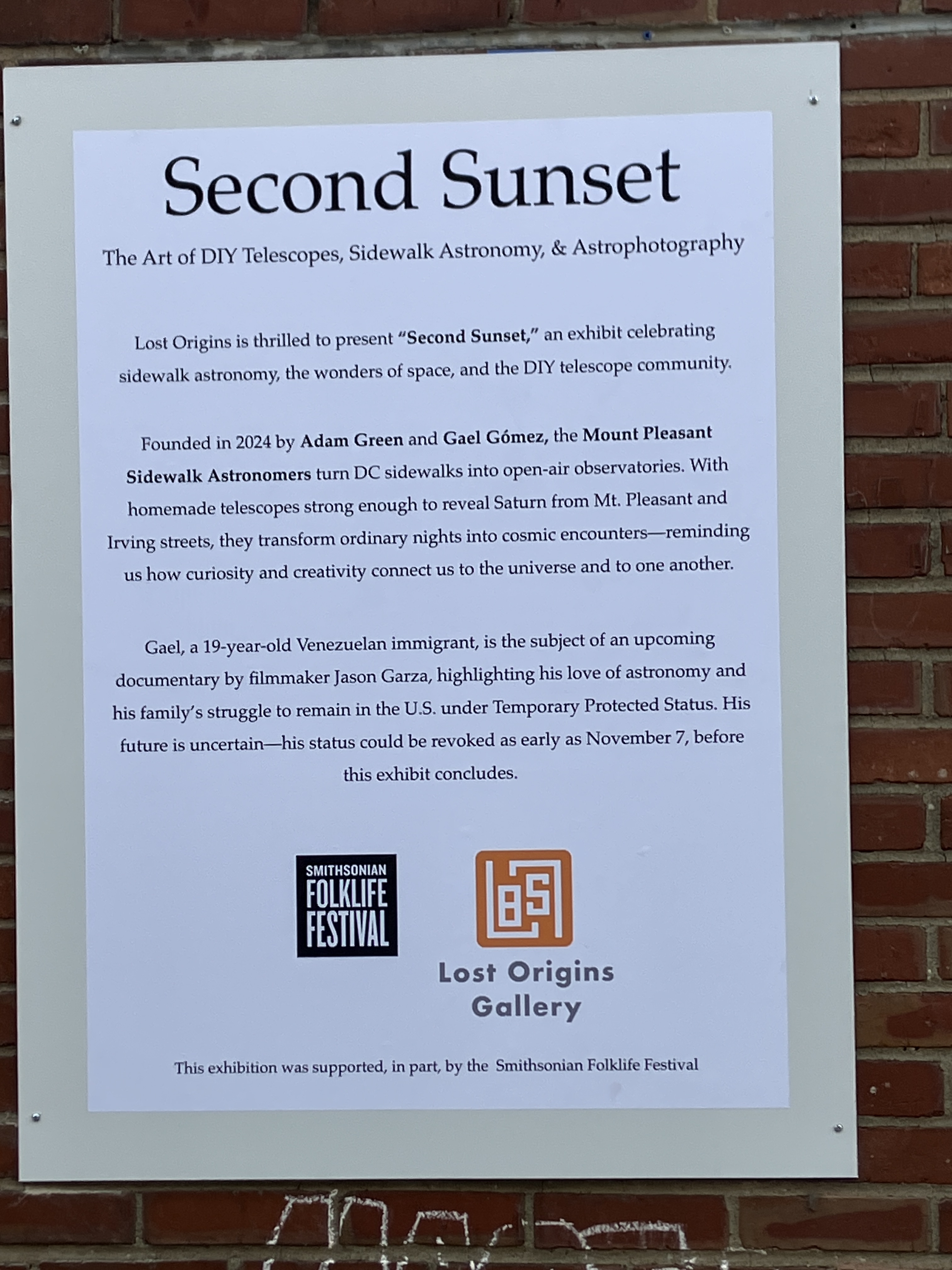
If you can’t read the text, it says, “The Art of DIY Telescopes, Sidewalk Astronomy, and Astrophotography: The Debut Exhibit of the Mt Pleasant Sidewalk Astronomers”. As well as “Lost Origins Outside” and “November 12 to November 9, 2025.”

Captions are coming for all of the photos, explaining how they were made and what they depict, as well as a sign explaining the National Capital Astronomers which has been running the DC DIY telescope workshop since World War 2, in which both Guy and Gael made their first telescopes.

Some surprises with new astro gizmos

24 Friday Jan 2025

Posted by gfbrandenburg in astronomy, education, Optics, Telescope Making

≈ 1 Comment

Tags

astronomy, Astrophotography, ATM, celestron, dobsonian, Optics, science, space, StarSense, Telescope, testing

Astronomy is moving so fast, it’s amazing.

We only truly discovered the nature of galaxies, of nuclear fusion, and of the scale of the universe a mere century ago.

Dark matter was discovered by Vera Rubin just over 40 years ago and dark energy a few years later, just before the time that both professional and amateur astronomers began switching over to CCD and later CMOS sensors instead of film

The first exoplanet was discovered only 30 years ago, and the count is now up to almost six thousand of them (as of 1/21/2024).

While multi-billion dollar space telescopes and giant observatories at places like Mauna Kea and the Atacama produce the big discoveries, amateur astronomers with a not-outrageous budget can now afford to purchase relatively small rigs armed with excellent optics and complete computer control, and lots of patience and hard work, can and so produce amazing images like the ones here https://www.novac.com/wp/observing/member-images/ or this one https://www.instagram.com/gaelsastroportrait?igsh=cjMzYWlqYjNzaDlw, by one of the interns on this project. Gael’s patience, cleverness, dedication and follow-through are all praiseworthy.

However, it is getting harder and harder every year for people to see anything other than the brightest planets, because of ever-increasing light pollution; the vast majority of the people in any of the major population centers on any continent have no hope of seeing the Milky Way from their homes unless there is a wide-spread power outage. Here in the US, such power outages are rare, which means that if you want to go out and find a Messier object, you pretty much cannot star-hop, because you can only see four to ten stars in the entire sky!

One choice is to buy a completely computer-controlled SCT like the ones sold by Celestron. They aren’t cheap, but they will find objects for you.

But what if you don’t want another telescope, but instead want to give nice big Dobsonian telescope the ability to find things easily, using the capabilities inside one’s cell phone?

Some very smart folks have been working on this, and have come up with some interesting solutions. When they work, they are wonderful, but they sometimes fail for reasons not fully understood. I guess it has something to do with the settings in the cell phone being used.

The rest of this will be on one such solution, a commercial one called StarSense from Celestron that holds your phone in a fixed position above a little mirror, and you aim the telescope and your cell phone’s camera at something like the top of a tower far away. Then it uses both the interior sensors on your cell phone and images of the sky to figure out where in the sky your scope is pointing, and tells you which way to push it to get to your desired target.

When it works, it’s great. But it sometimes fails.

You have to buy an entire set from Celestron – one of their telescopes (which has the gizmo built in) along with the license code to unlock the software.

You supply the cell phone.

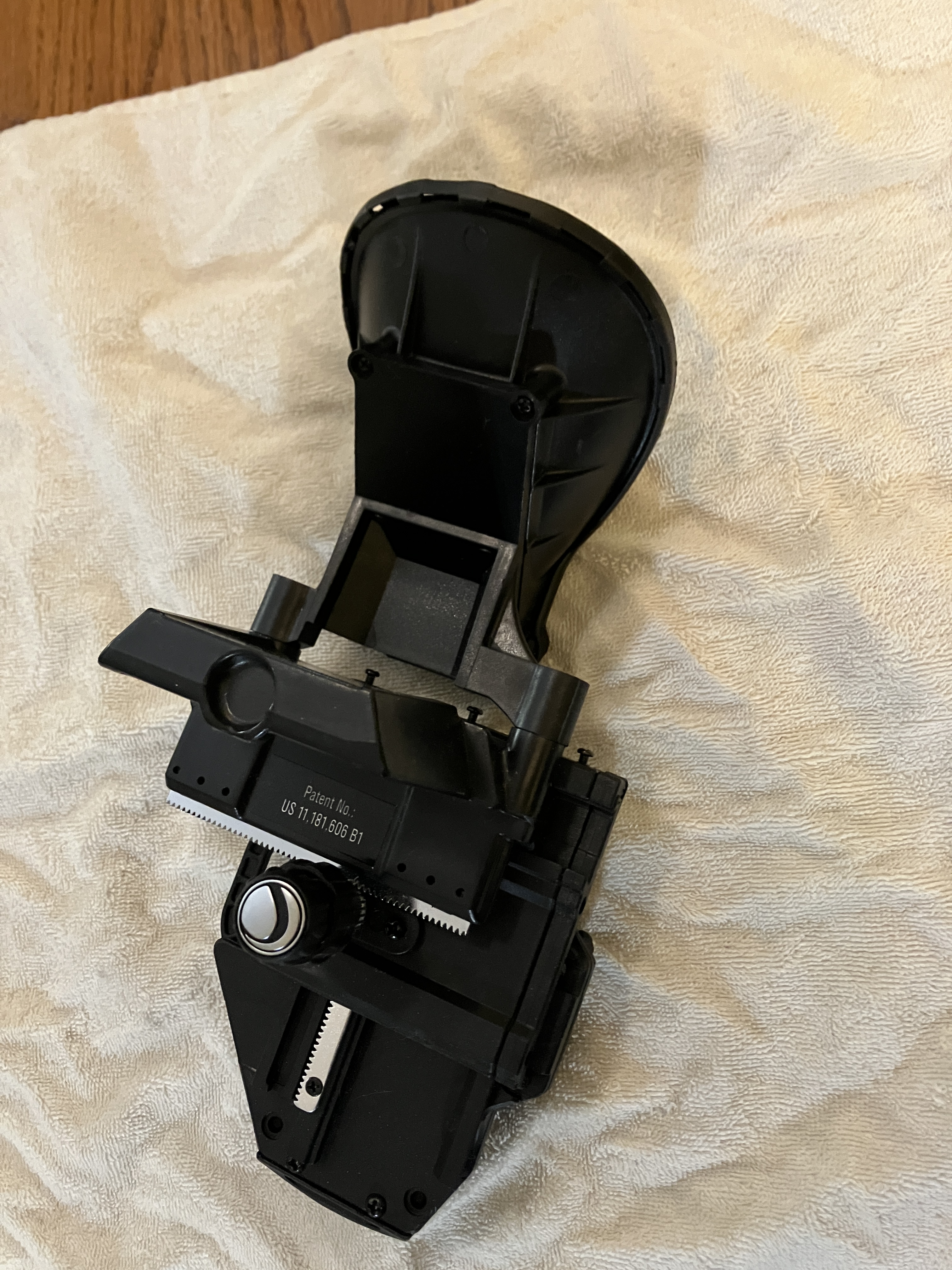
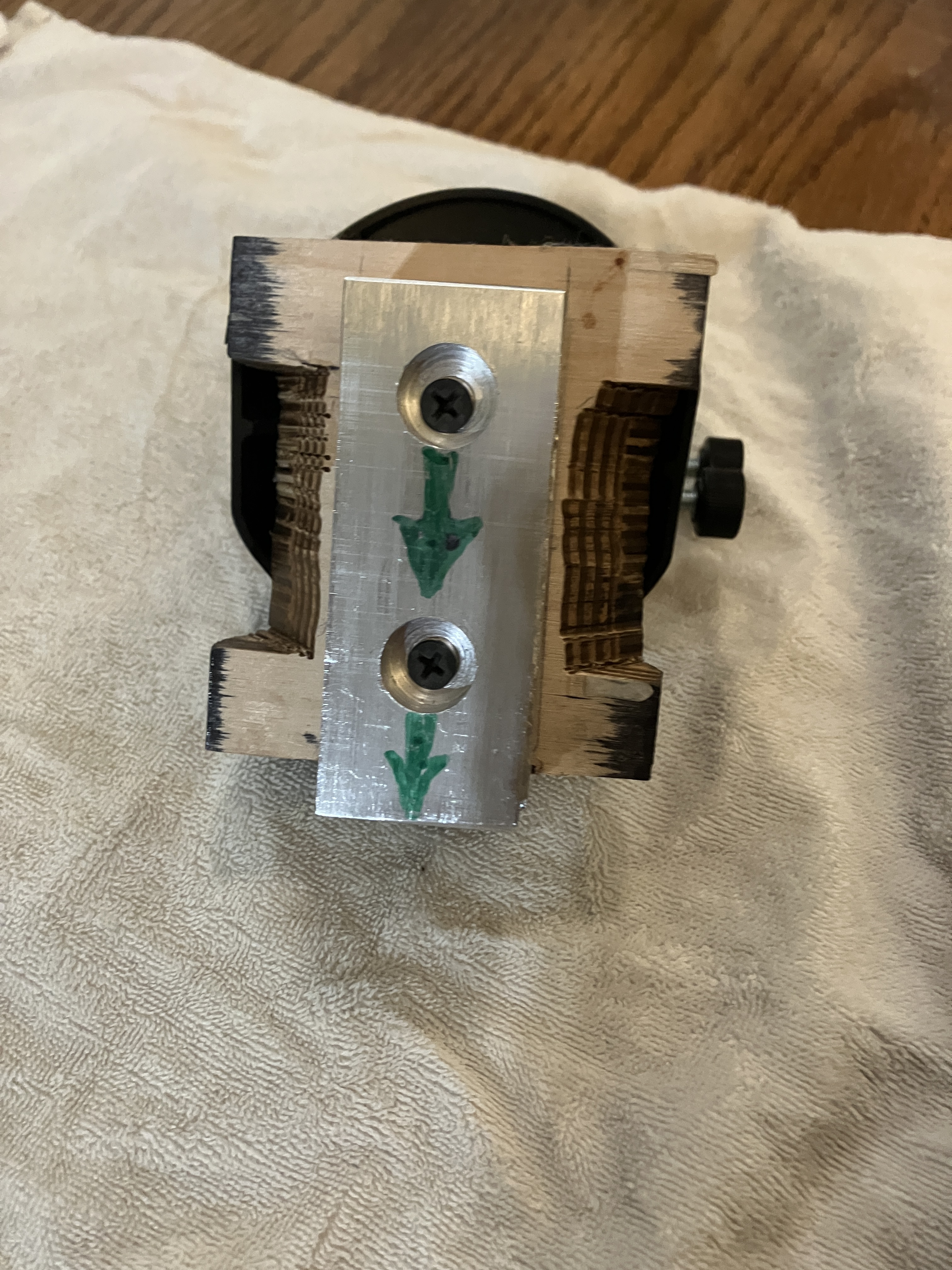
The entire setup ranges in price from about $200 to about $2,000. You cannot just buy the holder and the code from them; you must buy a telescope too. I already had decent telescopes, which I had made, so I bought the lowest-priced one. I then unscrewed the plastic gizmo, and carved and machined connection to a male dovetail slide for it. I also fastened a corresponding female dovetail to each of my scopes. The idea was to then slip this device off or onto whichever one of my telescopes is going to get used that night, as long as I that has a vixen dovetail saddle, and put inexpensive saddles on several scopes I have access to.

Here are some photos of the gizmo:

NCA’s current interns (Nabek Ababiya and Gael Gomez) and I were wondering about the geometry of the angles at which StarSense would aim at the sky in front of the scope. My guess had been that Celestron’s engineers would make the angles of their device so that the center of the optical pencil hitting the lens dead-on at 90 degrees, and hence coning to a focus at the central pixel of the CMOS sensor, would be parallel to the axis of the telescope tube.

We didn’t want to touch the mirror, because it’s quite delicate. But as a former geometry teacher, I couldn’t leave this one alone, so along with Gael and Nabek I made some diagrams and figured out what the angles had to be if the axis of the StarSense app’s image were designed to be precisely parallel to the axis of the telescope.

In my diagram below, L is the location of the Lens, and IJCK is the cell phone lying snug in its holder. The user can slide the cell phone left and right along that line JD as we see it here, or into out of the plane of the page, but it is not possible to change angle D aka <CDE – it’s fixed by the factory molds to be some fixed angle that we measured with various devices to be 19.0 degrees.

Here is a version of the diagrams we made that showed what we predicted all the angles would be so that optical axis OH will be parallel to the tube axis EBD, and that lens angle ILH is a right angle. We predicted that the mirror’s axis would need to be tilted upwards by an angle of 35.5 degrees (anle HBD).

To our surprise, our guesses and calculations were all wrong!

After careful measurements we found that Celestron’s engineers apparently decided that the optical axis of the SS gizmo should instead aim the cell phone’s camera up by 15.0 degrees (angle BGH below). The only parallel lines are the sides of the telescope tube!

We used a variety of devices to measure angle FBD and MNC to an accuracy of about half a degree; all angles turned out to be whole numbers.

Be that as it may, sometimes it works well and sometimes it does not.

Zach Gleiberman and I tested it on an open field in Rock Creek Park here in DC back in the fall of 2024, using the Hechinger-blue 8 inch dob I made 30 years ago and still use. We found that SS worked quite well, pointing us quite accurately to all sorts of targets using my iPhone SE. The sky was about as good as it gets inside the Beltway, and the device worked flawlessly.

Not too long afterwards, I decided to try out an Android-style phone (a REVVL 6 Pro) so that I wouldn’t have to give up my cell phone for the entire evening at Hopewell Observatory. I was unpleasantly surprised to find that it didn’t work well at all: the directions were very far off. I thought it might be because the scope in question had a rather wide plywood ring around the front of its very long tube, and that perhaps too much of the field of view was being cut off?

Why it fails was not originally clear. I thought nearly every modern phone would work, since for Androids, it just needs to be later than 2016 and have a camera, an accelerometer, and gyros, which is a pretty low bar these days. However, my REVVL 6 Pro from T-Mobile is not on the list of phones that have been tested to work!

Part of my assumption that the axis of the SS gizmo would be parallel to the axis of the scope was an explanation that StarSense on had such a large obstruction in front of the SS holder, in the form of a wide wooden disk reinforcing the front of a 10″ f/9 Newtonian, that the SS was missing part of the sky. We now know that’s not correct. It’s an interface problem (ie software) problem.

We think.

Success with digital measurement of parabolic telescope mirrors

02 Saturday Nov 2024

Posted by gfbrandenburg in astronomy, astrophysics, Math, Optics, science, Telescope Making

≈ Leave a comment

Tags

astronomy, ATM, data, FigureXP, foucault, measurement, millies-lacroix, paraboloid, Telescope

Alan Tarica, Pratik Tambe, Tom Crone and I have been pulling our hair out for a couple of years, trying to use cameras and software to measure the ‘figure’ of the telescope mirrors that we and others produce in our telescope-making class.

There has been progress, and there has been frustration.

I think we finally succeeded!

Some of the difficulties have been described in previous posts. In brief, we want our mirrors to be really, really close to a perfect paraboloid. There are many ways of doing those measurements and seeing whether one is close enough, but none of those methods are easy!

(By the way, one needs the entire mirror to be within one-tenth of a wave-length of green light of that ideal paraboloid! That’s extremely tiny, and equivalent to the thickness of a pencil over a ten-mile diameter!)

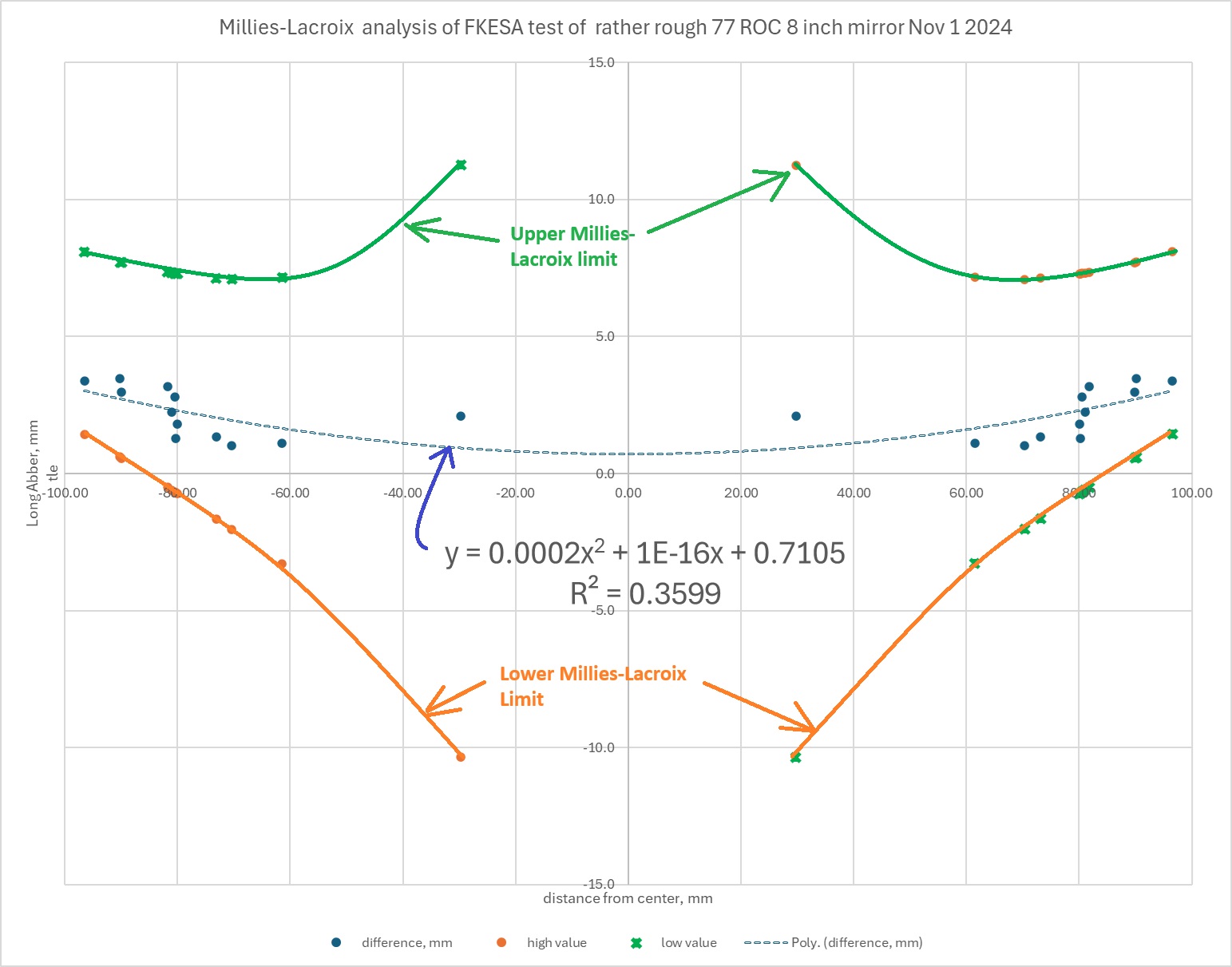
I think I can finally report a victory. My evidence is this graph that I made just now, using data that Alan and I gathered last night with our setup, which consists of a surveillance camera coupled to an old 35mm SLR film camera lens, which is mounted on a linear actuator screw connected to a stepper motor controlled by an Arduino and a Python app developed by Pratik.

Something seemed to be always a bit — or a lot — ‘off’.

Until today, when I converted everything to millimeters and used the criterion set out by Adrien Millies-Lacroix in an article he wrote in Sky & Telescope back in 1976.

The blue dots just above the x-axis are the measurements for this one particular mirror with a diameter of 8″ and a radius of curvature of 77 inches.

The dotted blue curve in the middle of the image is the best-fit parabola for those dots. Notice that the R-squared value (variance) for that curve is not great: 0.3599.

But that variance isn’t important. What is important is the green and orange blobs and curves above and below the blue ones.

The green and orange curves are the upper and lower allowable limits for the measurements of this particular mirror, using the

Clearly, the blue dots are all well within the green and orange curves.

Which means that this mirror is sufficiently parabolized.

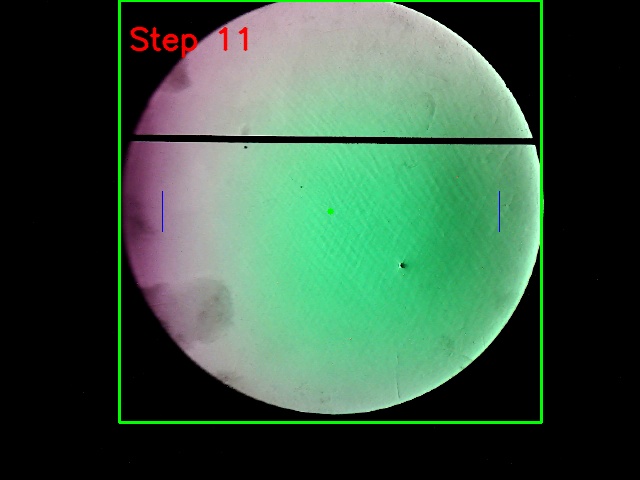
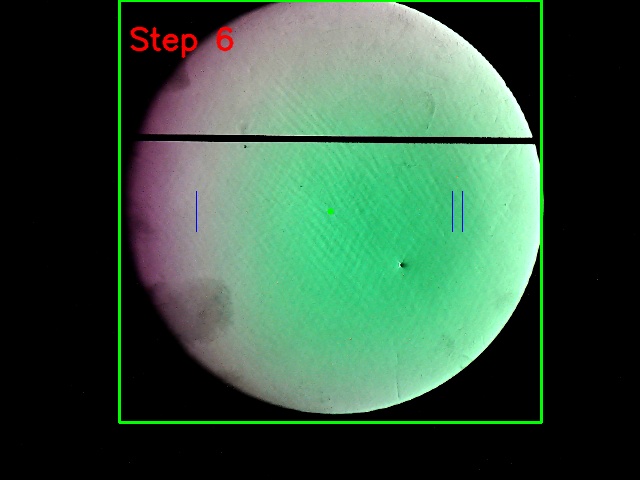
The fact that the blue dots don’t fit the dotted line perfectly, and behave pretty oddly at positive or negative 80 millimeters, both agree with the fact that we can see on the photos that the surface of this mirror is rather rough, as you can see in the images below. Note also that the image labeled ‘Step 6’ found not one, but two null zones on the right, indicated by two vertical blue lines.

So, finally, we have an algorithm that gives good measurements! What I still want to do is to automate all the spreadsheet calculations that I just did today. Perhaps we can upload them to something like FigureXP by Dave Rowe and James Lerch.

Thanks very much to all those who have helped, whom I should look up and name here.

Caveat: This method can give really ridiculous measurements close to the center and close to the edge.

PS: if anybody wants the raw data, just email me at gfbrandenburg at gmail dot com.

Free Open House at Hopewell Observatory in Northern Virginia, October 26 or 27

16 Wednesday Oct 2024

Posted by gfbrandenburg in astronomy, Hopewell Observatorry, Optics, Safety, science, Telescope Making

≈ Leave a comment

Tags

astronomy, dobsonian, Hopewell Observatory, observatory, OnStep, space, Telescope

Come to Bull Run Mountain for a free night under the stars looking at a variety of targets using the telescopes at the Hopewell Observatory on Saturday, October 26, 2024. If it’s cloudy, we will try again on the next evening, Sunday the 27th.

You are invited, but will need to RSVP and, in this litigious age, must agree to a waiver of liability for anything that might happen up there, like tripping over rocks and trees. The waiver also includes detailed driving directions.

Click here for the RSVP form: 

But if you take the risk you can view, for free, Venus, Saturn and its rings, Jupiter and its moons, Uranus, Neptune, the current comet Atlas, the Milky Way, and a whole bunch of nebulae, galaxies, Messier objects, and beautiful double stars.

We suggest arriving near sundown, which will happen near 6:15 PM. It will get truly dark about an hour later. You can stay until midnight, if you like.

There are no street lights near our observatory, other than some dimly illuminated temporary signs we put along the path, so you will probably want to bring a flashlight of some sort. In the operations cabin we have a supply of red translucent plastic film and tape and rubber bands so that you can filter out everything but red wavelengths on your flashlight. This will help preserve everybody’s night vision.

Hopewell is located on the first ridge of the Appalachian mountain chain that you see as you drive west from the DC beltway, near Haymarket. Our elevation is about 1100 feet, and we have much less of a problem with dew than other observing spots in northern Virginia. The last two miles of road are dirt and gravel, and you will need to walk about 200 meters/yards from where you park. Some parts of the road are pretty rough, so don’t drive anything with low clearance underneath. Our parking spaces are pretty limited, so consider car-pooling if possible. Handicapped persons or telescopes can be dropped off at the observatory.

We do have electricity, and a heated cabin, but since we have no running water, we use bottled water, hand sanitizer, and a pretty nice outhouse. We will have the makings for tea, coffee, and hot cocoa in that cabin.

If you like, you can bring a picnic dinner and a blanket or folding chairs, and/or your own telescope or binoculars, if you own one and feel like bringing them. We have outside 120VAC power, if you need it for your telescope drive.

At this time of year, the bothersome insects have mostly gone dormant, but feel free to use your favorite bug repellent, (we have some). Remember to check yourself for ticks after you get home.

We have a variety of permanently-mounted and portable telescopes of different designs, some commercial and some made by us. Two of our telescope mounts are permanently installed in the observatory under a roll-off roof. One of the mounts is a high-end Astro-Physics mount with a 14” Schmidt-Cassegrain and a 5” triplet refractor. The other mount was manufactured about 50 years ago by a firm called Ealing, but the motors and guidance system were recently completely re-done by us with modern electronics using a system called OnStep. We didn’t spend much cash on it, but it took us almost a year to solve a bunch of mysteries of involving integrated circuits, soldering, torque, gearing, currents, voltages, resistors, transistors, stepper drivers, and much else. We could not have completed this build without a lot of help from Arlen Raasch, Prasad Agrahar, Ken Hunter, and the online “OnStep” community.

We also have two home-made Dobsonian telescopes (10″ and 14″ apertures) that we roll out onto our lawn, and have been lent a pair of big binoculars on a parallelogram mount.

The location of the observatory is approximately latitude 38°52’12″N, longitude 77°41’54″W.

Click here for the RSVP form to get detailed directions. You must sign the waiver to visit. If we cancel on Saturday the 26th because of bad weather, we will notify you by email and will try again on Sunday the 27th.

An amazing little telescope

06 Tuesday Aug 2024

Posted by gfbrandenburg in astronomy, astrophysics, Optics, science

≈ Leave a comment

Tags

alt-az, astronomy, electronics, focus, Hopewell Observatory, light pollution, optical tube assembly, Optics, refractor, solar system, Telescope, Washington

Look what this little thing can do that I’ve always failed at myself, even with an entire observatory at my disposal: take decent astrophotos.

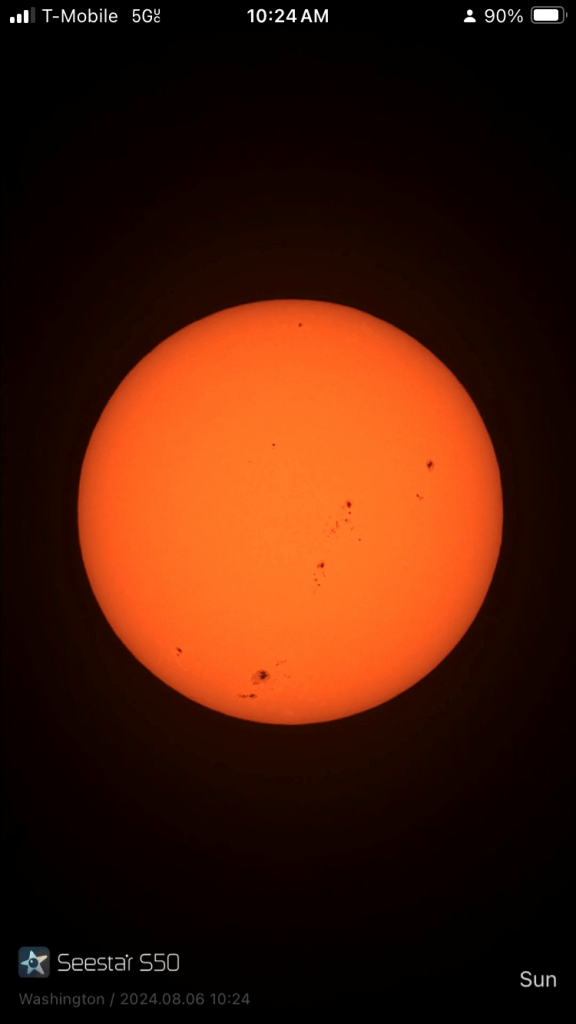
Here it is on a home made tripod, taking photos of the sun. Notice the reflective solar filter. Here are two images:

The device woke up, and after less than a minute of self’s-calibration, it pointed very accurately at the sun and focused itself perfectly. It produces a continuous feed; I even did 100 frames of a time-lapse. It’s all stored on my cell phone but I can share the photos or even live views with folks nearby.

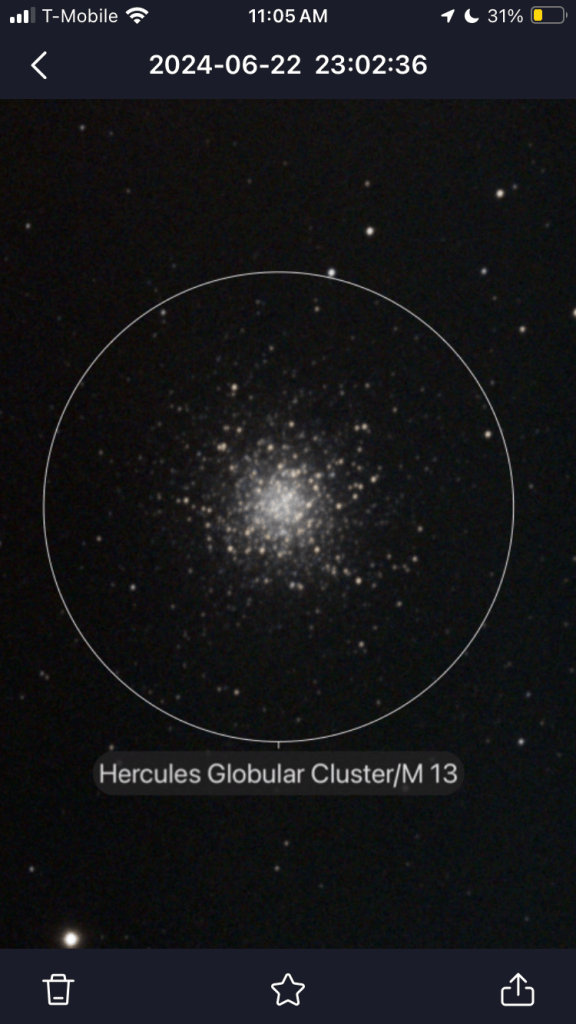
And from night time spots here in DC and NOVA:

This can take tolerable astrophotos even when surrounded by streetlights!

.

Recent Photos at Hopewell

04 Thursday Jul 2024

Posted by gfbrandenburg in astronomy, Hopewell Observatorry

≈ Leave a comment

Tags

astronomy, ealing, Ealing mount, Hopewell, Hopewell Observatory, Moon, planet, solar system, Telescope

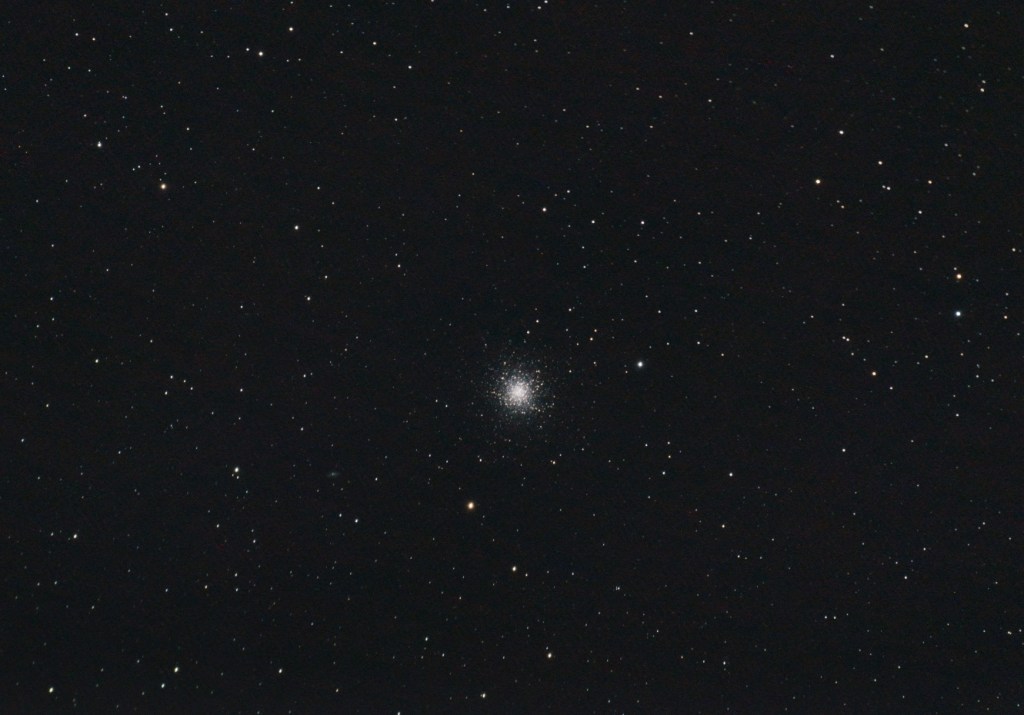
These were made by Gael Gomez, a recent HS grad who visited on Monday, July 1.

The Ealing mount, looking south
The Milky Way — which doesn’t look this great to the naked eye
Dumbbell Nebula
Waning crescent Moon
M13, great Hercules globular cluster
Saturn, seen edge-on

Our OnStep re-build is at last working!

05 Thursday May 2022

Posted by gfbrandenburg in astronomy, Hopewell Observatorry, Telescope Making

≈ 1 Comment

Tags

astronomy, ATM, ealing, Hopewell Observatory, OnStep, stepper motor, Telescope, Telescope Making, testing

For many months, we members of The Hopewell Observatory have been doing our best to repair the 50 year-old clock drive on our university-grade Ealing telescope mount.

Yesterday, after a lot of help from others, I finally got it to work — at least in the day time. With no telescopes mounted on it. And 100% cloud cover. So I really don’t know for sure.

We still need to test it out on a clear night, to see how well it tracks and finds targets.

I think I will re-configure the wiring so that it fits in a box outside the mount, instead of using the weirdly-shaped compartments inside: one needs to do occasional maintenance on the OnStep hardware and software, and none of that is easy to access right now.

A short video is attached.

Disturbing Racist Clauses Found in Early NCA Constitutions & Bylaws

29 Wednesday Sep 2021

Posted by gfbrandenburg in astronomy, History, science, Telescope Making

≈ Leave a comment

Tags

Albert Einstein, amateur, astronomy, Black people, by-laws, Carnegie Institution of Washington, Caucasian, CIW, constitution, DC, ERO, Eugenics, Eugenics Records Office, Fairfax, George Carruthers, High Schools, History, Hitler, Montgomery County, National Capital Astronomer, Nazis, NCA, Prince George's County, Racism, science, Segregation, Star Dust, Washington

By Guy Brandenburg

Recently, while preparing to give a talk at this year’s Stellafane telescope-makers’ convention, I was disappointed to discover that the National Capital Astronomers (NCA), which I’ve belonged to for about 30 years, specifically excluded Black members for nearly 3 decades: from about 1940 all the way up to1969.

But NCA didn’t start out being overtly racist. Our original 1937 founding document has no such language. It reads, in part,

“The particular business and objects of [the NCA] shall be the education and mutual improvement of its members in the science of Astronomy and the encouragement of an interest in this science among others. (…) The activities of this Association are designed for the enjoyment and cultural profit of all interested in astronomy, whether the member be a beginner, an advanced student, or one whose pursuit of the science is necessarily desultory.”

And today’s NCA home page reads, “All are welcome to join. Everyone who looks up to the sky with wonder is an astronomer and welcomed by NCA. You do not have to own a telescope, but if you do own one that is fine, too. You do not have to be deeply knowledgeable in astronomy, but if you are knowledgeable in astronomy that is fine, too. You do not have to have a degree, but if you do that is fine, too. WE ARE THE MOST DIVERSE local ASTRONOMY CLUB anywhere. Come to our meetings and you will find this out. WE REALLY MEAN THIS!”

But in the 1940’s, the original open-minded and scientific NCA membership policy changed. The January 1946 Star Dust listed a number of changes to be voted on by the membership in the club’s founding documents. (See https://capitalastronomers.org/SD_year/1946/StarDust_1946_01.pdf ) The organization voted to change article III of its constitution as follows:

From:

“only Caucasians over 16 years old are eligible for membership.”

To this:

“to include all ages (see by-laws), exclude only the Black race.”

While it may be shocking that a scientific organization like NCA had such a policy, people often forget how racist a nation the USA used to be, and for how long. If you look up actual pages of DC area newspapers from the 1950s, you will note that the classified advertisements were largely segregated both by race and by gender – want ads would very often specify male or female, single or married, White-only or Colored-only jobs, apartments, and so on.

Schools in DC, MD, and Virginia were mostly segregated, either by law or in practice, up until the late 1960s or early 1970s. The 1954 Brown v Board decision had very little real impact in most areas until much, much later. Queens (NYC), PG County (MD) and Boston (MA) had violent movements against integrating schools in the 1970s. I know because I attended demonstrations against those racists and have some scars to prove it.

While the Federal and DC governments offices were integrated immediately after the Civil War, that changed for the worse when Woodrow Wilson was elected President in 1912.

Many scientists in the USA and in Europe believed the pseudo-scientific ideas of racial superiority and eugenics that arose around 1900 and were still widespread 50 years ago – and even today, as recent events have sadly shown.

In The War Against the Weak: Eugenics and America’s Campaign to Create a Master Race, Edwin Black explains how august scientific institutions like the Carnegie Institution of Washington (CIW), the American Natural History Museum in New York, and a number of eminent statisticians and biologists for many decades supported the Eugenics Records Office (ERO) at Cold Spring Harbor. So did the fabulously wealthy Rockefeller and Harriman Foundations.

The ERO pushed the concept of the genetic superiority of the ‘Nordic’ race and helped to pass State laws sterilizing the ‘weak’ and forbidding interracial marriage. They were also successful in passing the 1924 Federal immigration law that severely cut back immigration from parts of the world where supposedly ‘inferior’ people lived – e.g. Eastern and Southern Europe. As a result, many Jews who would have loved to escape Hitler’s ovens by crossing the Atlantic never made it.  

Hitler and his acolytes always acknowledged their ideological and procedural debt to American eugenical laws, literature, and propaganda. As we all know, Germany’s Nazis put those ideas to work murdering millions of Jews, Gypsies, Slavs and others.

It took more than three decades for the CIW to withdraw their support of the ERO. A CIW committee concluded in 1935 “that the Eugenics Record Office was a worthless endeavor from top to bottom, yielding no real data, and that eugenics itself was not a science but rather a social propaganda campaign with no discernable value to the science of either genetics or human heredity.” (Black, p. 390) The members pointedly compared the work of the ERO to the excesses of Nazi Germany. However, it took four more years for CIW to cut all their ties – shortly after Hitler invaded Poland in 1939, starting World War Two.

I don’t know exactly when the ‘Caucasian’-only policy became part of the NCA rules, but it seems to have been between the club founding in 1937, and October 1943 when volume 1, number 1 of Star Dust was printed. At one point, perhaps around 1940, NCA decided that only ‘Caucasians’ over 16 could join. But as indicated above, in 1946, the racial exclusion policy was narrowed to only exclude Black people. Apparently Jews, Italians, young people, Latin Americans, and Asians were eligible to join NCA from 1946 to 1969. But not African-Americans.

While researching my talk, I found that the NCA held amateur telescope-making classes at a number of all-white DC, MD, and VA high schools, from the 1940s through about 1970, both during the days of de jure segregation and the merely de-facto type: McKinley, Roosevelt, Central, Bladensburg, Falls Church, and McLean high schools are listed. While Star Dust mentions a telescope-making course at (the largely-Black) Howard University in 1946, there is no mention of any assistance for that course from NCA.

I also found no evidence in any issue of Star Dust from that era that anybody at the time raised any vocal objections to racial exclusion. Not in 1946, nor 23 years later when the rule prohibiting Black members was quietly dropped (in 1969) when a new constitution was adopted.

A few current or past NCA members confirmed to me that at some point, they noticed that racist language and privately wondered about it. One person told me that they definitely recalled some now-deceased NCA members who were openly racist and not shy about expressing those views. Others told me that they had never heard any discussion of the subject at all.

 (As one who grew up in DC and Montgomery County, and attended essentially-segregated public schools there, I am sorry that neither I nor my family actively spoke up at the time, even though a farm adjacent to ours in Clarksburg was owned by a Black family [with no school-age children at the time]. Amazing how blind one can be! The racists of those days were not shy about committing violence to achieve their ends. Fear might be one reason for silence.)

One possibility is that some of the early NCA meetings might have been held at private residences; perhaps some of the racist members insisted in preventing non-‘Caucasian’ or ‘Black’ people from attending. It is too bad the other NCA members didn’t take the other route and stay true to the original ideas of the club, and tell the racist members to get lost.

Very ironic: the late George Carruthers, a celebrated Naval Research Labs and NASA scientist, and an instrument-maker for numerous astronomical probes and satellites, gave a talk to the NCA in September of 1970 – not too long after the NCA apparently dropped its racist membership rules (April, 1969). So, a mere year and a half before he gave his talk, he could not have legally joined the organization. Nor could he have done so when he was making his own telescopes from scratch as a teenager in the 1940s. See https://en.wikipedia.org/wiki/George_Robert_Carruthers on the life and work of this great African-American scientist and inventor.

To NCA’s credit, we have done better in the past few decades at encouraging participation in telescope viewing parties, telescope making, and lectures by members of all races and ethnic groups. However, I often find that not very many NCA members bring telescopes to viewing events, or show up to judge science fairs, in mostly-minority neighborhoods. Often, it’s just me. That needs to change. We need to encourage an interest in science, astronomy, and the universe in children and the public no matter their skin color or national origin, and we need to combat the racist twaddle that passes for eugenics.

I anticipate that NCA will have a formal vote repudiating the club’s former unscientific and racist policies and behavior. I hope we will redouble our efforts to promote the study of astronomy to members of all ethnic groups, especially those historically under-represented in science.

We could do well to note the words that Albert Einstein wrote in 1946, after he had been living in the US for a decade, and the same year that NCA confirmed that Black people could not join:

“a somber point in the social outlook of Americans. Their sense of equality and human dignity is mainly limited to men of white skins. Even among these there are prejudices of which I as a Jew am clearly conscious; but they are unimportant in comparison with the attitude of the “Whites” toward their fellow-citizens of darker complexion, particularly toward Negroes.

The more I feel an American, the more this situation pains me. I can escape the feeling of complicity in it only by speaking out.

Many a sincere person will answer: “Our attitude towards Negroes is the result of unfavorable experiences which we have had by living side by side with Negroes in this country. They are not our equals in intelligence, sense of responsibility, reliability.”

I am firmly convinced that whoever believes this suffers from a fatal misconception. Your ancestors dragged these black people from their homes by force; and in the white man’s quest for wealth and an easy life they have been ruthlessly suppressed and exploited, degraded into slavery. The modern prejudice against Negroes is the result of the desire to maintain this unworthy condition.

The ancient Greeks also had slaves. They were not Negroes but white men who had been taken captive in war. There could be no talk of racial differences. And yet Aristotle, one of the great Greek philosophers, declared slaves inferior beings who were justly subdued and deprived of their liberty. It is clear that he was enmeshed in a traditional prejudice from which, despite his extraordinary intellect, he could not free himself.

What, however, can the man of good will do to combat this deeply rooted prejudice? He must have the courage to set an example by word and deed, and must watch lest his children become influenced by this racial bias.

I do not believe there is a way in which this deeply entrenched evil can be quickly healed. But until this goal is reached there is no greater satisfaction for a just and well-meaning person than the knowledge that he has devoted his best energies to the service of the good cause.”

Source: http://www.kganu.net/sitebuildercontent/sitebuilderfiles/alberteinsteinonthenegroquestion-1946.pdf

I am indebted to Morgan Aronson, Nancy Byrd, Richard Byrd, Geoff Chester, Jeff Guerber, Jay Miller, Jeffrey Norman, Rachel Poe, Todd Supple, Wayne Warren, Elizabeth Warner, and Harold Williams for documents, memories, and/or technical support.


Easy ways to show the earth is not flat

18 Friday Dec 2020

Posted by gfbrandenburg in Uncategorized

≈ Leave a comment

Tags

astronomy, earth, flat, flat earth, foucault, Leon Foucault, mathematics, planet, solar system

Sharing Steve Ruis’ handy methods anybody can use to show that the earth is in fact round. Very clever!

An Open Letter to the Many Flat Earthers Now in Existence

by Steve Ruis

Dear Flat Earthers,
Many people have been derogatory of your belief that the Earth is flat. Please note that they are belittling your belief, not you per se. You, personally, are an idiot, but that is probably not your fault.

Here are any number of accessible approaches for discovering the shape of our beloved planet. Enjoy!

* * *

Use Your Phone!
On Christmas Day, here in Chicago, I expect there to be snow on the ground because, well, it is winter. On Christmas Day I can pick up my phone and dial up anyone in Australia and ask them “What season is it?” They will tell you that it is summer in Australia. You might want to ask your flat Earth mentors how it could be winter and summer simultaneously on a flat Earth.

Use Your Phone!
Go to a globe and pick a spot half way around the Earth (I know it is a false representation in your belief, but humor me.) In the middle of the day, phone somebody at or near that spot. Call a hotel, they are always open. Ask whoever responds “Is it light or dark outside?” They will tell you that it is dark where they are. You might want to ask your flat Earth mentors how it could be light and dark simultaneously on a flat Earth.

Look Up What Local Time Was
In the US there was this concept of “local time” which was that “noon” was when the sun was at its highest point in its arc. You could call up people on the telephone who were not that far away and ask them what time it was and they would tell you something different from what your clock was telling you. The farther away they were, the greater the difference would be. On a flat Earth the time would be the same everywhere.

Look Up What Time Zones Are
I am writing this in the central time zone in the U.S. These zones were created at the behest of the railroad industry whose dispatchers were going crazy making up schedules for trains when every place had their own times. By creating these “zones” everything would be exactly one hour off from those in neighboring zones, two hours off for the next over zones, and so on. If you don’t believe me . .  pick up your phone and dial up a friend who lives a considerable distance (east-west) away from you and ask them what time it is. The time they state will be a whole number of hours away from your time. Heck, even the NFL knows this. When I lived on the left coast, the games started at 10 AM and 1 PM. Now that I live in the central time zone, the games start at 12 Noon and 3 PM. Over New York way the games start at 1PM and 4 PM. Do you think those games are replayed in one hour increments? Nope, time zones!. You might want to ask your flat earth mentors how it could be that simultaneous games start at different times on a flat Earth.

Watch the Video
Astronauts in the International Space Station (ISS) have made continuous videos of an entire orbit of the Earth. It takes only about an hour and a half about the length of a typical Hollywood movie. During the whole movie the earth appears round, and yet it is clear that different continents are passing in our view.

Now you may argue that NASA made this movie as propaganda for the Round Earth Conspiracy. It is certainly within our CGI abilities at this point, but you may want to ask why NASA would want to do such a thing? Plus, many astronauts have taken their own cameras aboard and taken pictures for themselves and they show the same thing. How could the Round Earth Conspiracy have allowed that to happen? It must be incompetence! Conspiracies aren’t what they used to be!

Da Balloon, Boss, Da Balloon
Many amateurs, unaffiliated with the government, have launched rockets and balloons high up into the atmosphere to take pictures. Every damned one of those pictures shows that the Earth is round. How come all of those cameras ended up pointed at the curved edge of your round and flat disk Earth? Such a coincidence!

An Oldie But Goodie #1
Occasionally, during a lunar eclipse, you can see the shadow of the earth falling upon the Moon. The shadow is always circular. This would be true if the flat earth were always dead on to the Moon, but the Moon orbits the Earth and wouldn’t a flat Earth be edgewise, often as not, and wouldn’t that create a non-round shadow on the Moon? Inquiring minds want to know.

An Oldie But Goodie #2
It was claimed that one of the first demonstrations of the earth being round was the observation of ships sailing west from Europe/England could be observed for a while but the ship itself was lost to sight while the mast was still visible. This would not happen on a flat Earth. The whole ship would just get smaller and smaller as it sailed west.

For pity’s sake, I live 22 stories up and the shores of Lake Michigan and I cannot see anything directly opposite me in Michigan. All I can see is water, with any kind of magnification I can muster. And I am not looking across the widest part of this lake! If the earth were flat, the lake would be flat and I could see the Michigan shore.

And Finally . . .

All of the fricking satellites! Do the math. What kind of orbit is stable around a flat disk earth? Answer none! And there are hundreds of the danged things in orbit.

Also, just for giggles. Look up what a Foucault pendulum is, And explain its behavior based upon a flat Earth.

PS You may be getting good vibes in your special knowledge that you know something other people do not. However, would not that special feeling be more worthwhile were you to volunteer at a food bank or a day care center or senior center? Wouldn’t doing something worthwhile be more rewarding that making a statement about how those pointy-headed intellectuals aren’t so smart?

PPS I have seen the cute models with the Sun and Moon on sticks rotating around (see photo above). If that were the case, everyone could see the Sun and Moon all day, every day. (There is straight line access to both objects in that model from everywhere on the flat disk.) Do you see the Sun and Moon all day, every day? No? Maybe someone who had more creativity than knowledge came up with those models. They do sell well, I must admit, so maybe their interest is commercial.

PPPS Regarding the 200 foot wall of ice that supposedly exists at the “edge of the disk,” supposedly so all the water doesn’t flow off and be lost into space. By now don’t you think someone would have sailed next to that wall all of the way? That distance would be somewhere in the neighborhood of a 28,000 mile trip. Has anyone ever report such a thing? Hmm, I wonder why not

When was the last time you spent a night under the stars?

29 Wednesday Jun 2016

Posted by gfbrandenburg in astronomy, astrophysics, Hopewell Observatorry, Telescope Making

≈ 1 Comment

Tags

astronomy, Hopewell Observatory, open house, Telescope

If it’s been a while since you spent time looking up at the heavens with your naked eyes, binoculars and telescopes, looking at planets, stars and galaxies, then this Saturday might be your night.

The Hopewell Observatory is having an open house on Saturday, July 2, 2016, and we have a variety of scopes to look through. Some of the scopes will be under our roll-off roof and some will be rolled out onto the small lawn outside the observatory itself.

Mars, Jupiter and Saturn will be very conveniently placed for viewing right at sundown, and if it’s dry and clear enough, we should be able to see the Milky Way. Many nebulae, open and globular clusters, galaxies, and double or triple stars will be visible as well.

You are invited!  And it’s free!

The location is about an hour due west of Washington DC by way of I-66, near the town of Haymarket, VA. For detailed directions, follow this link, which I posted for one of the dates which got canceled because of bad weather. Ignore the date, but do pay attention to the fact that we have no running water! We have bottled water and a composting toilet and hand sanitizer. Plus makings for coffee, tea, and hot chocolate – all gratis.

picture of hopewell

The picture above is of one of our telescope mounts, which carries several telescopes and was set up to take astrophotographs at the time. Below is a picture of the outside of the observatory shortly after a snowstorm.. Notice that there is no dome – instead, the galvanized steel roof rolls back on the rails and columns to the right of the picture when the scopes are in use.

showA13

If you have your own telescope, feel free to bring it. If it needs electricity, we have an outdoor 120VAC outlet, but you should bring your own extension cord and plug strip.  If you want to stay all night, that will be fine, too! If you feel like bringing a cot or a tarpaulin and a sleeping bag, that’s equally OK by us! Show up at or near sunset, and stay until the sun comes up, if you like!

Warning: the area definitely has insects, such as ticks and chiggers, which appear to avoid everybody else and to do their best to attack me. I strongly recommend long pants, shoes/boots, and socks that you can tuck the pants into. Tuck your shirt into your pants as well, and use bug spray, too. I have personally seen plenty of deer, cicadas, moths, wild turkeys, squirrels, and birds, and I have heard from a neighbor that a bear tried to eat his chickens, but other than the insect pests, the wildlife stays out of your way.

Again – for detailed directions, look at this link.

← Older posts
Newer posts →

Subscribe

  • Entries (RSS)
  • Comments (RSS)

Archives

  • June 2026
  • May 2026
  • April 2026
  • February 2026
  • December 2025
  • November 2025
  • October 2025
  • September 2025
  • July 2025
  • January 2025
  • November 2024
  • October 2024
  • August 2024
  • July 2024
  • May 2024
  • April 2024
  • January 2024
  • December 2023
  • October 2023
  • August 2023
  • June 2023
  • May 2023
  • April 2023
  • November 2022
  • October 2022
  • August 2022
  • July 2022
  • June 2022
  • May 2022
  • April 2022
  • February 2022
  • January 2022
  • December 2021
  • October 2021
  • September 2021
  • August 2021
  • July 2021
  • June 2021
  • May 2021
  • March 2021
  • December 2020
  • October 2020
  • September 2020
  • August 2020
  • March 2020
  • February 2020
  • January 2020
  • December 2019
  • November 2019
  • September 2019
  • August 2019
  • June 2019
  • May 2019
  • January 2019
  • November 2018
  • October 2018
  • September 2018
  • August 2018
  • May 2018
  • March 2018
  • January 2018
  • November 2017
  • October 2017
  • September 2017
  • August 2017
  • July 2017
  • June 2017
  • May 2017
  • April 2017
  • February 2017
  • December 2016
  • September 2016
  • June 2016
  • May 2016
  • April 2016
  • March 2016
  • February 2016
  • January 2016
  • December 2015
  • November 2015
  • August 2015
  • July 2015
  • April 2015
  • March 2015
  • February 2015
  • January 2015
  • December 2014

Categories

  • astronomy
  • astrophysics
  • education
  • flat
  • History
  • Hopewell Observatorry
  • Math
  • monochromatic
  • nature
  • optical flat
  • Optics
  • Safety
  • science
  • teaching
  • Telescope Making
  • Uncategorized

Meta

  • Create account
  • Log in

Blog at WordPress.com.

  • Subscribe Subscribed
    • Guy's Math & Astro Blog
    • Join 54 other subscribers
    • Already have a WordPress.com account? Log in now.
    • Guy's Math & Astro Blog
    • Subscribe Subscribed
    • Sign up
    • Log in
    • Report this content
    • View site in Reader
    • Manage subscriptions
    • Collapse this bar

Loading Comments...