• My series on making a Newtonian telescope
  • How Leon Foucault Made Telescopes

Guy's Math & Astro Blog

Guy's Math & Astro Blog

Category Archives: astrophysics

Telescope Fix, Scudding Clouds Over Moon, Tom Turkeys Hiding, and Successful Cloud Chamber!

12 Monday Dec 2016

Posted by gfbrandenburg in astronomy, astrophysics, science, Telescope Making, Uncategorized

≈ Leave a comment

Tags

cloud chamber, Digital Setting Circles, dry ice, Isopropanol, Moon, Sky Wizard, Turkeys

I had a productive 24 hours!

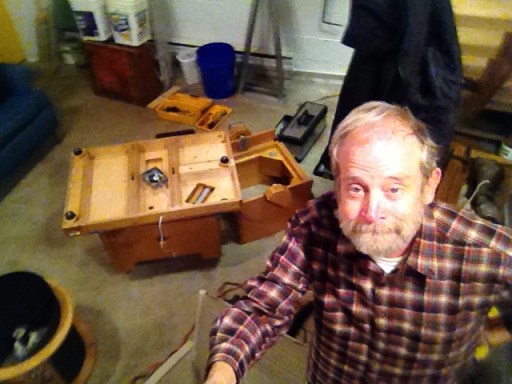
  • Night before last, I think I finally got Sky Wizard Digital Setting Circles installed on the 14″ alt-az telescope we were most generously donated by Alan Bromborsky. (That’s me, in the operations cabin  at Hopewell Observatory, taking a break and a picture, long before completion.)img_6169
  • So I went out to look at the sky at 1 AM. I saw no stars, but the 80% gibbous moon appeared to race dramatically through the clouds
  •  That afternoon, as I was driving out, I saw 5, maybe 6 tom turkeys playing hide-and-seek with me behind the trees. Believe me, they are REALLY GOOD at hiding behind little saplings, logs, and rocks! Or if you don’t believe me, ask anyone who’s tried to hunt them.
  •  Late that evening, I got a dry-ice-and-isopropanol particle detector working for the first time. (I had tried and failed, when I was a teenager, some 50 years ago, and failed several other times since then as well.) If you look at my little video, you can see the particles more easily than I could with your naked eye as I was filming it. Don’t ask me yet which ones are muons, which are alpha particles, and which are beta particles, because I don’t know yet. But you could look it up!

Productive 24 hours!

When was the last time you spent a night under the stars?

29 Wednesday Jun 2016

Posted by gfbrandenburg in astronomy, astrophysics, Hopewell Observatorry, Telescope Making

≈ Leave a comment

Tags

astronomy, Hopewell Observatory, open house, Telescope

If it’s been a while since you spent time looking up at the heavens with your naked eyes, binoculars and telescopes, looking at planets, stars and galaxies, then this Saturday might be your night.

The Hopewell Observatory is having an open house on Saturday, July 2, 2016, and we have a variety of scopes to look through. Some of the scopes will be under our roll-off roof and some will be rolled out onto the small lawn outside the observatory itself.

Mars, Jupiter and Saturn will be very conveniently placed for viewing right at sundown, and if it’s dry and clear enough, we should be able to see the Milky Way. Many nebulae, open and globular clusters, galaxies, and double or triple stars will be visible as well.

You are invited!  And it’s free!

The location is about an hour due west of Washington DC by way of I-66, near the town of Haymarket, VA. For detailed directions, follow this link, which I posted for one of the dates which got canceled because of bad weather. Ignore the date, but do pay attention to the fact that we have no running water! We have bottled water and a composting toilet and hand sanitizer. Plus makings for coffee, tea, and hot chocolate – all gratis.
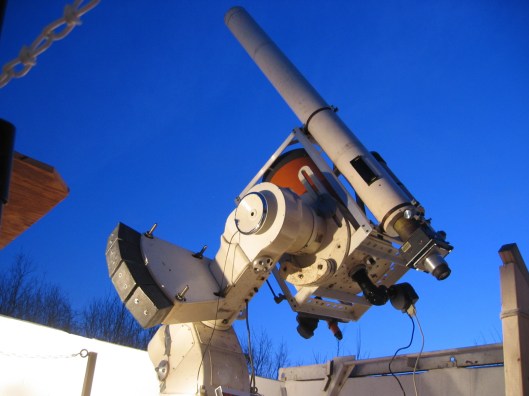
picture of hopewell

The picture above is of one of our telescope mounts, which carries several telescopes and was set up to take astrophotographs at the time. Below is a picture of the outside of the observatory shortly after a snowstorm.. Notice that there is no dome – instead, the galvanized steel roof rolls back on the rails and columns to the right of the picture when the scopes are in use.
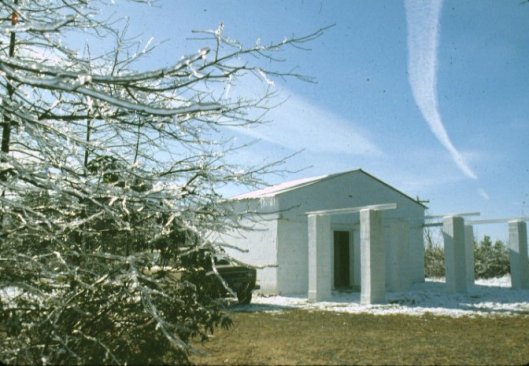
showA13

If you have your own telescope, feel free to bring it. If it needs electricity, we have an outdoor 120VAC outlet, but you should bring your own extension cord and plug strip.  If you want to stay all night, that will be fine, too! If you feel like bringing a cot or a tarpaulin and a sleeping bag, that’s equally OK by us! Show up at or near sunset, and stay until the sun comes up, if you like!

Warning: the area definitely has insects, such as ticks and chiggers, which appear to avoid everybody else and to do their best to attack me. I strongly recommend long pants, shoes/boots, and socks that you can tuck the pants into. Tuck your shirt into your pants as well, and use bug spray, too. I have personally seen plenty of deer, cicadas, moths, wild turkeys, squirrels, and birds, and I have heard from a neighbor that a bear tried to eat his chickens, but other than the insect pests, the wildlife stays out of your way.

Again – for detailed directions, look at this link.
Charon (NOT Pluto) with a huge crater that may have bashed it out of round

14 Tuesday Jul 2015

Posted by gfbrandenburg in astronomy, astrophysics

≈ Leave a comment

Tags

astronomy, comet, crater, impact, minor planet, New Horizons, planet, pluto, solar system

Here’s a very recent (7-12-2015) picture of Pluto Charon that shows a bright circular feature near 1 o’clock with a long white streak heading down and to the right for a very long way – possibly even as much as half the diameter of the entire planet. If you look near the top of the image, you can see that it’s partly in shadow, and the low angle of the light from the Sun exaggerates vertical elevation changes much as they do here on earth just after dawn and before sunset. So we can see that the upper portion of the surface of Charon Pluto appears to be very irregular and not precisely spherical.

pluto w large crater

Which should be no huge surprise, given how small Charon Pluto really is (only 1200 2300 km across, or about 750 1400 miles, which is much smaller than our own Moon (Luna or Selene), in fact less than the distance from my town (Washington DC) to Miami. In this image the ‘top’ of the planet looks almost like a somewhat-rounded 7-sided heptagon rather than a sphere.

It appears to me that the object (asteroid or comet or whatever) which smacked Charon Pluto and formed that large crater came not along a radius, but at some other angle — I’d have to do some experiments to see whether the object came, so to speak, from somewhere off to our right and from our back as we view the image, or from the exact opposite direction, from above and in front of us, perhaps a bit to our left. I just don’t know if the debris from such an impact would fly back in the direction from which the impactor came, or whether it would continue going forward in the direction of the impactor. It’s fun to do experiments with sandboxes and lofting various projectiles, but you never know how well your set up will match reality. Sand and water at room temperature probably don’t act the same way as the surface of Pluto (various types of frozen ices, at its insanely cold temperatures), being hit by something that vaporizes and melts solid rocks by the tremendous force of impact!

I got the image from here. And thought this was a picture of Pluto. But it’s not.

Here is a treasury of talks by Neal DeGrasse Tyson

16 Monday Feb 2015

Posted by gfbrandenburg in astronomy, astrophysics

≈ Leave a comment

Tags

Neal DeGrasse Tyson

Here’s the link: 

or use this:

http://www.sciencedump.com/content/storytelling-science-neil-degrasse-tyson

And here is a screen shot of what part of the page looks like:

neal d tyson science talks

Newer posts →

Subscribe

  • Entries (RSS)
  • Comments (RSS)

Archives

  • December 2025
  • November 2025
  • October 2025
  • September 2025
  • July 2025
  • January 2025
  • November 2024
  • October 2024
  • August 2024
  • July 2024
  • May 2024
  • April 2024
  • January 2024
  • December 2023
  • October 2023
  • August 2023
  • June 2023
  • May 2023
  • April 2023
  • November 2022
  • October 2022
  • August 2022
  • July 2022
  • June 2022
  • May 2022
  • April 2022
  • February 2022
  • January 2022
  • December 2021
  • October 2021
  • September 2021
  • August 2021
  • July 2021
  • June 2021
  • May 2021
  • March 2021
  • December 2020
  • October 2020
  • September 2020
  • August 2020
  • March 2020
  • February 2020
  • January 2020
  • December 2019
  • November 2019
  • September 2019
  • August 2019
  • June 2019
  • May 2019
  • January 2019
  • November 2018
  • October 2018
  • September 2018
  • August 2018
  • May 2018
  • March 2018
  • January 2018
  • November 2017
  • October 2017
  • September 2017
  • August 2017
  • July 2017
  • June 2017
  • May 2017
  • April 2017
  • February 2017
  • December 2016
  • September 2016
  • June 2016
  • May 2016
  • April 2016
  • March 2016
  • February 2016
  • January 2016
  • December 2015
  • November 2015
  • August 2015
  • July 2015
  • April 2015
  • March 2015
  • February 2015
  • January 2015
  • December 2014

Categories

  • astronomy
  • astrophysics
  • education
  • flat
  • History
  • Hopewell Observatorry
  • Math
  • monochromatic
  • nature
  • optical flat
  • Optics
  • Safety
  • science
  • teaching
  • Telescope Making
  • Uncategorized

Meta

  • Create account
  • Log in

Blog at WordPress.com.

  • Subscribe Subscribed
    • Guy's Math & Astro Blog
    • Join 53 other subscribers
    • Already have a WordPress.com account? Log in now.
    • Guy's Math & Astro Blog
    • Subscribe Subscribed
    • Sign up
    • Log in
    • Report this content
    • View site in Reader
    • Manage subscriptions
    • Collapse this bar
 

Loading Comments...