• My series on making a Newtonian telescope
  • How Leon Foucault Made Telescopes

Guy's Math & Astro Blog

Guy's Math & Astro Blog

Category Archives: flat

Trying to Test a 50-year-old Cassegran Telescope

07 Thursday Sep 2017

Posted by gfbrandenburg in astronomy, flat, Hopewell Observatorry, Math, science, Telescope Making

≈ Leave a comment

Tags

artificial star, celestron, classical cassegrain, couder, double pass autocollimation test, ealing, FigureXP, focus, foucault, hyperbolic, optical tube assembly, parabolic, primary, refurbishing, ritchey-chretien, Ronchi, schmidt-cassegrain, secondary, spherical, Telescope

We at the Hopewell Observatory have had a classical 12″ Cassegrain optical tube and optics that were manufactured about 50 years ago.; They were originally mounted on an Ealing mount for the University of Maryland, but UMd at some point discarded it, and the whole setup eventually made its way to us (long before my time with the observatory).


The optics were seen by my predecessors as being very disappointing. At one point, a cardboard mask was made to reduce the optics to about a 10″ diameter, but that apparently didn’t help much. The OTA was replaced with an orange-tube Celestron 14″ Schmidt-Cassegrain telescope on the same extremely-beefy Ealing mount, and it all works reasonably well.


Recently, I was asked to check out the optics on this original classical Cassegrain telescope, which is supposed to have a parabolic primary and a hyperbolic secondary. I did Ronchi testing, Couder-Foucault zonal testing, and double-pass autocollimation testing, and I found that the primary is way over-corrected, veering into hyperbolic territory. In fact, Figure XP claims that the conic section of best fit has a Schwartzschild constant of about -1.1, but if it is supposed to be parabolic, then it has a wavefront error of about 5/9, which is not good at all.

Here are the results of the testing, if you care to look. The first graph was produced by a program called FigureXP from my six sets of readings:
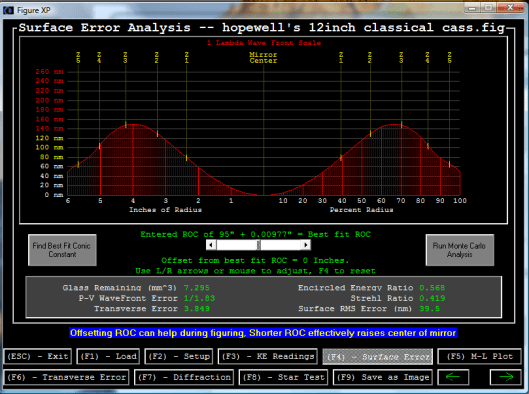
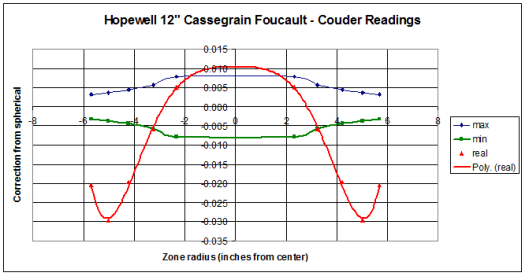
figure xp on the 12 inch cass

my graph of 12 inch cass readings

I have not yet tested the secondary or been successful at running a test of the whole telescope with an artificial star. For the indoor star test, it appears that it only comes to a focus maybe a meter or two behind the primary! Unfortunately, the Chevy Chase Community Center where we have our workshop closes up tight by 10 pm on weekdays and the staff starts reminding us of that at about 9:15 pm. Setting up the entire indoor star-testing rig, which involves both red and green lasers bouncing off known optical flat mirrors seven times across a 60-foot-long room in order to get sufficient separation for a valid star test, and moving two very heavy tables into said room, and then putting it all away when we are done, because all sorts of other activities take place in that room. So we ran out of time on Tuesday the 5th.

A couple of people (including Michael Chesnes and Dave Groski) have suggested that this might not be a ‘classical Cassegrain’ – which is a telescope that has a concave, parabolic primary mirror and a convex, hyperbolic secondary. Instead, it might be intended to be a Ritchey-Chretien, which has both mirrors hyperbolic. We have not tried removing the secondary yet, and testing it involves finding a known spherical mirror and cutting a hole in its center, and aligning both mirrors so that the hyperboloid and the sphere have the exact same center. (You may recall that hyperboloids have two focal points, much like ellipses do.)

Here is a diagram and explanation of that test, by Vladimir Sacek at http://www.telescope-optics.net/hindle_sphere_test.htm

hindle sphere test

FIGURE 56: The Hindle sphere test setup: light source is at the far focus (FF) of the convex surface of the radius of curvature RC and eccentricity ε, and Hindle sphere center of curvature coincides with its near focus (NF). Far focus is at a distance A=RC/(1-ε) from convex surface, and the radius of curvature (RS) of the Hindle sphere is a sum of the mirror separation and near focus (NF) distance (absolute values), with the latter given by B=RC/(1+ε). Thus, the mirrorseparation equals RS-B. The only requirement for the sphere radius of curvature RS is to be sufficiently smaller than the sum of near and far focus distance to make the final focus accessible. Needed minimum sphere diameter is larger than the effective test surface diameter by a factor of RS/B. Clearly, Hindle test is limited to surfaces with usable far focus, which eliminates sphere (ε=0, near and far focus coinciding), prolate ellipsoids (1>ε>0, near and far foci on the same, concave side of the surface), paraboloid (ε=1, far focus at infinity) and hyperboloids close enough to a paraboloid to result in an impractically distant far focus.

We discovered that the telescope had a very interesting DC motor – cum – potentiometer assembly to help in moving the secondary mirror in and out, for focusing and such. We know that it’s a 12-volt DC motor, but have not yet had luck tracking down any specifications on that motor from the company that is the legatee of the original manufacturer.

Here are some images of that part:

IMG_8207
IMG_8210
IMG_8224

Puzzlement when Trying to Figure a Convex Surface Through the Back

14 Saturday Nov 2015

Posted by gfbrandenburg in astronomy, flat, optical flat, Telescope Making

≈ Leave a comment

Tags

ATM, convex, figuring, polarizing filters, Ronchi, strain

Have you ever tried to make a convex optical surface?

If so, you know that it’s much more challenging than a concave one, since the rays of light do not come to a focus at all.

Some of us* at the Amateur Telescope Making workshop here in Washington DC have made several attempts at doing this, pretty much without success. I would like to show you some weird images that we got when we tried to ‘figure’ the convex surface by performing a Ronchi test from the back side, looking through what was supposed to be a flat.

What we find is that even though the glass itself is very clear and free of visible strain when seen by the naked eye or when using crossed polarized filters, it looks like we are looking through an extremely murky and totally un-annealed piece of ancient Venetian glass, causing all sorts of weird striations in what should otherwise be nice, smooth Ronchi lines.

These pictures go in order from outside the radius of curvature to inside the ROC.

IMG_3656 IMG_3660 IMG_3663 IMG_3665 IMG_3667 IMG_3668

You might well think that the glass itself has lots of strain left in it, causing the very weird patterns that you see here. I can prove that this is not the case by showing you a short video that we made with crossed polarizing filters of the 5-inch diameter blank itself and two pieces of plastic (the protective covers for one of the filters). Judge for yourself.

This is not the first time that this strange phenomenon has occurred.

Any suggestions from those with actual experience would be extremely welcome.

===================

* Me, Nagesh K, and Oscar O.

Adventures in Making a Glass Surface Optically Flat

13 Friday Feb 2015

Posted by gfbrandenburg in flat, monochromatic, optical flat, Telescope Making

≈ Leave a comment

Tags

ATM, CCCC, flat, interference testing, mercury vapor, monochromatic, optical flat

I’ve been trying to make an optical flat for some time now. It’s not easy, even if you are starting with a piece of ‘float’ glass – modern 3/4″ thick window sheet glass that is manufactured by floating a layer of molten glass on a bath of molten tin.

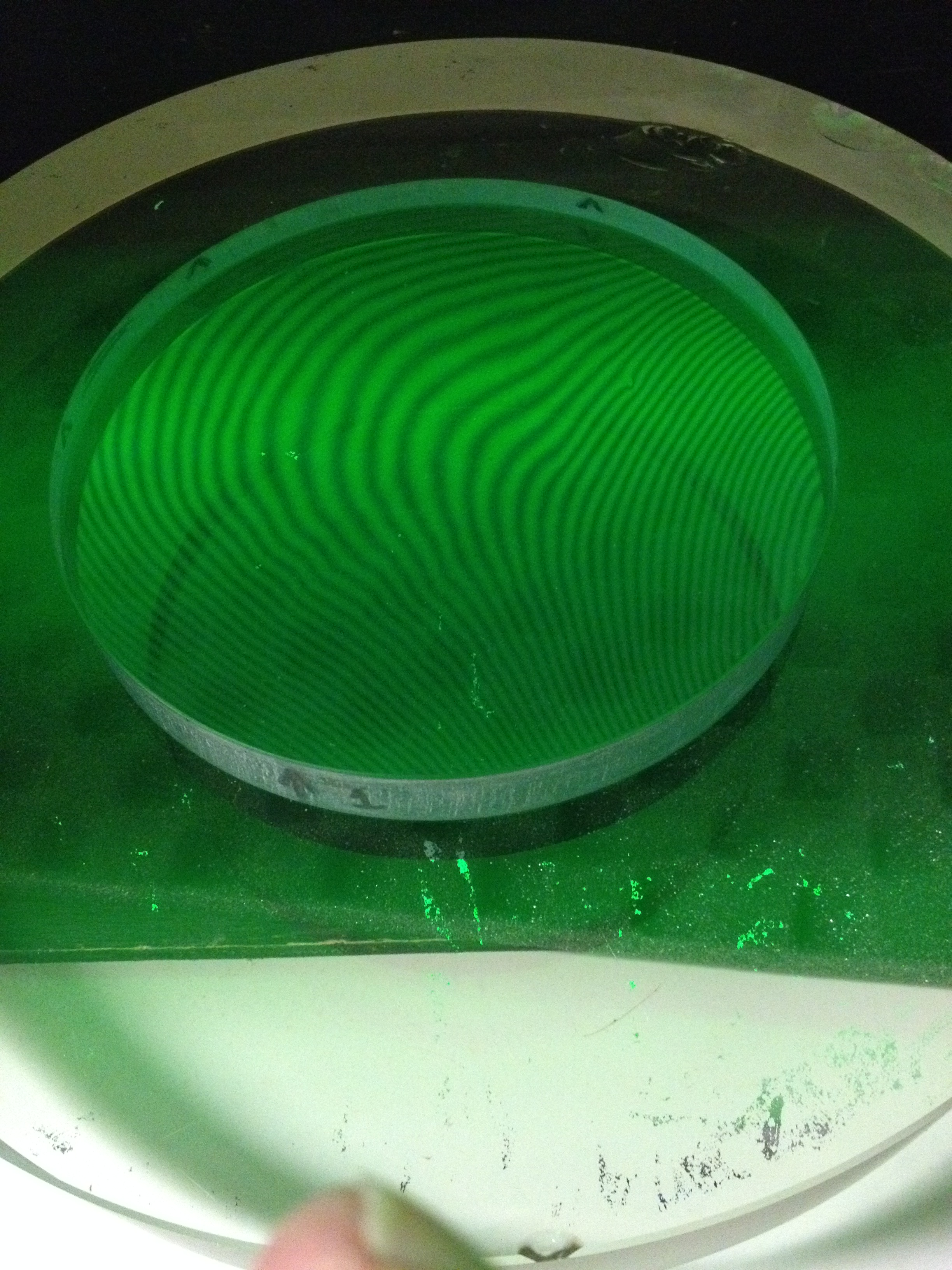
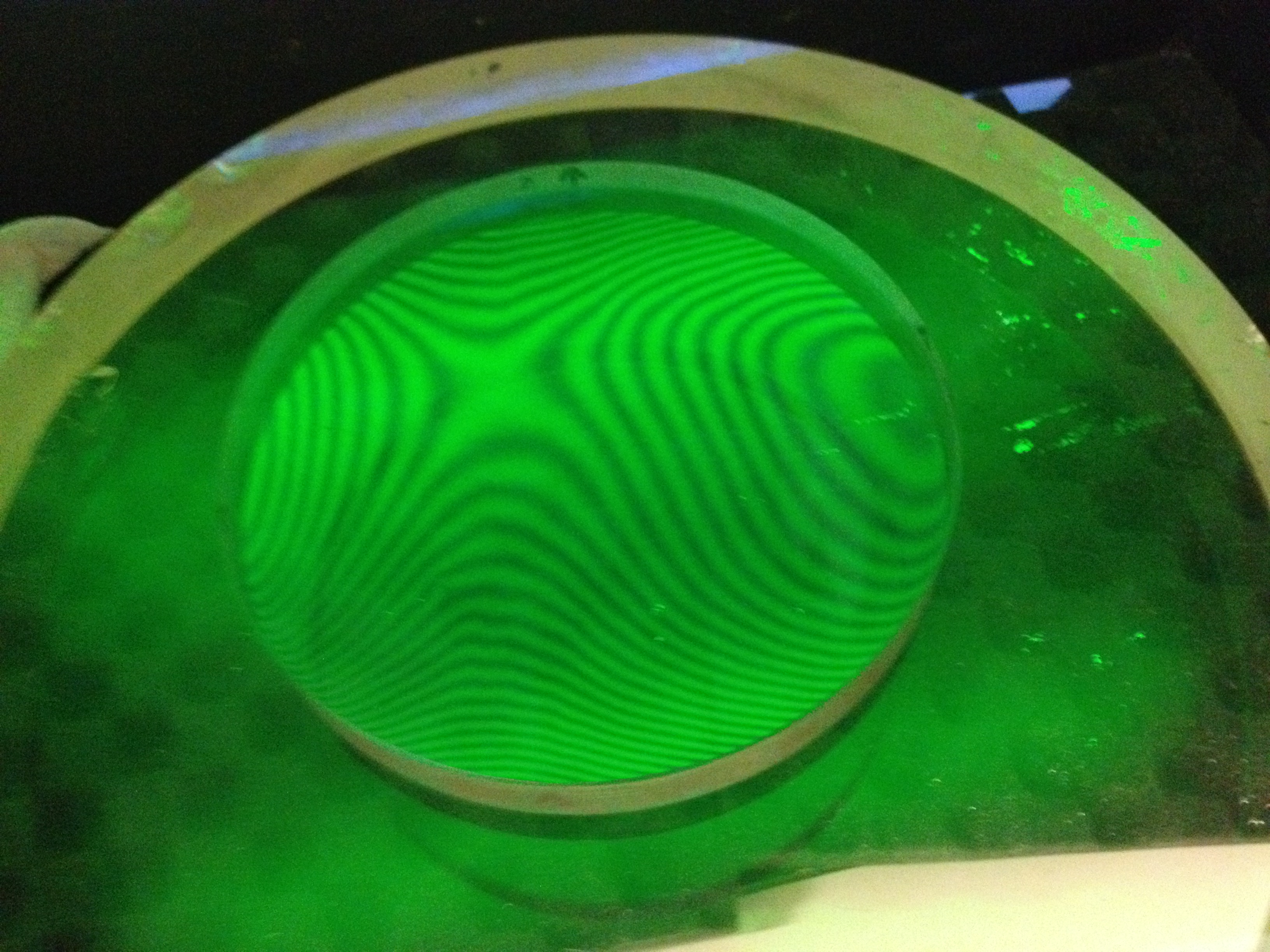
The test apparatus consists of a supposedly-flat 12-inch diameter and a monochromatic light box, and my own gradually-increasing understanding of what the interference lines actually mean. Essentially, they are like contour lines on a topographic map, but the trick is to figure out which sections represent valleys and which ones represent hills. It’s taken help from other amateur telescope makers (particularly Philip P) and sections of Malacara’s book on Optical Testing and http://www.lapping.com .

It’s pretty amazing how we can measure stuff that is soooooo small!

Here are some photos in chronological order of my working on them. I would paste some videos but WordPress won’t allow them and I don’t feel like uploading them to YouTube. BTW: I am not done!!!

022

006

008

009

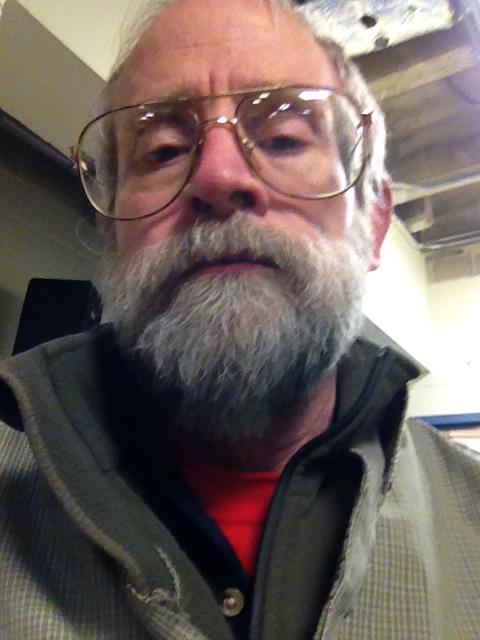
That’s me looking skeptically at my cell phone, pretending to look skeptically at the glass.010

001

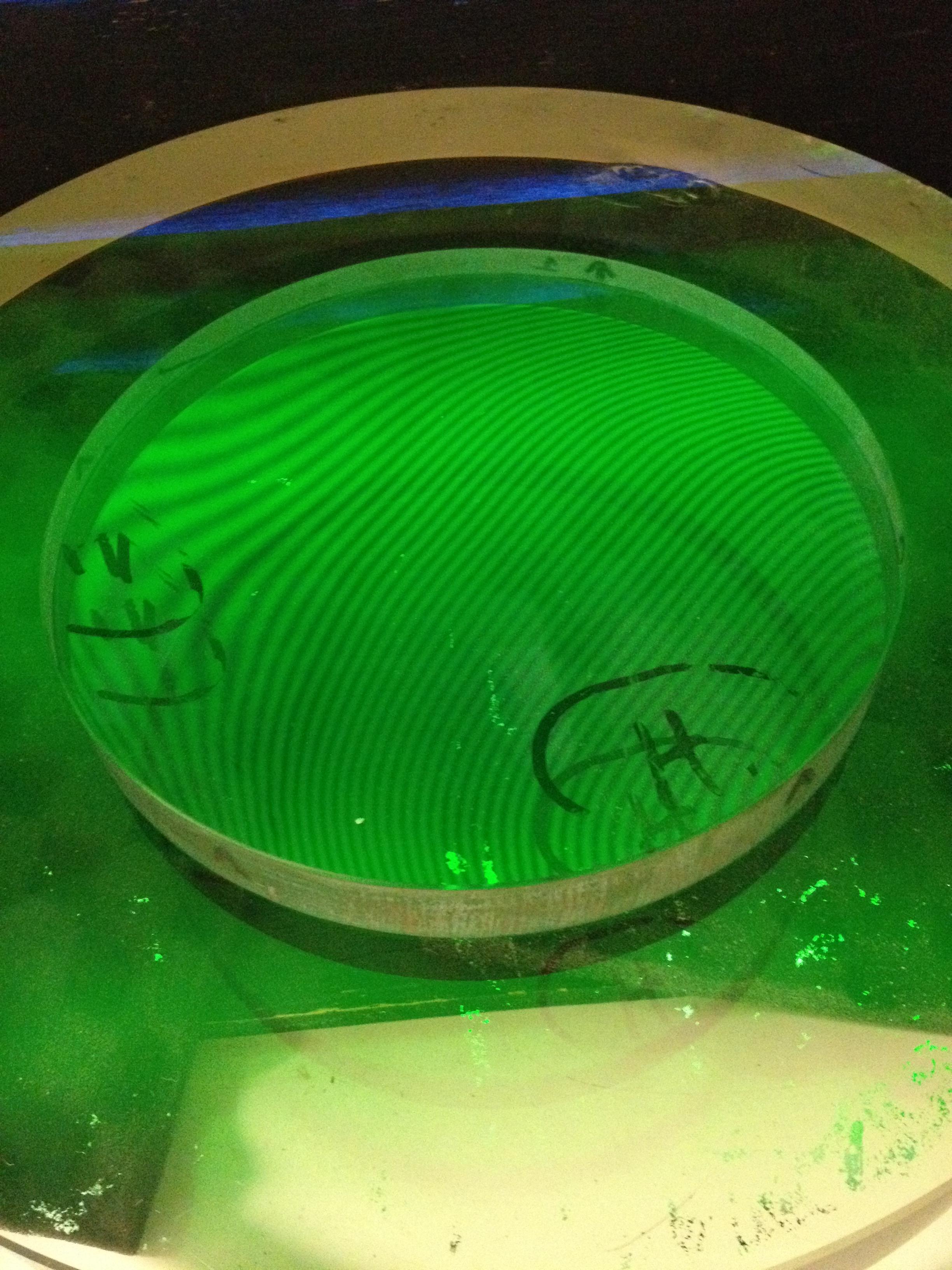
Up until this point I was trying to make the flat more perfect by using a hard Gugolz lap of full size (6 inches in diameter), much as we do with parabolizing concave mirrors. I don’t think I made a whole lot of progress. Then I read some of the papers that Philip P sent me, and re-read the Malacara, and decided to think of the contour lines in terms of measures of height, and decided to use a two-inch-diameter lap only on the parts that appeared to be “high”. I marked the back of those regions with a Sharpie permanent marker (which comes off easily with isopropyl alcohol when needed) so I could see where to work and could see if what I did made any difference.flats i guess 001The places that I marked with the letter H were High spots, kind of like you see on a weather map that is plotting isobars (lines connecting places with the same barometric pressure). The lower right-hand corner was one of those places, as was the smudged region at about 9 o’clock.

BTW I got the green color by using ordinary fluorescent lamps and two carefully-selected theatrical lighting gels to filter out all the light with wavelengths either longer than or shorter than the green Mercury vapor line of 5461 Angstroms.

By the way: I’ve discovered that the 12-inch-diameter optical flat that is underneath my 6 inch test flat isn’t as flat as I thought. Boo.

Will work on this some more this afternoon.

Newer posts →

Subscribe

  • Entries (RSS)
  • Comments (RSS)

Archives

  • September 2026
  • August 2026
  • July 2026
  • June 2026
  • May 2026
  • April 2026
  • February 2026
  • December 2025
  • November 2025
  • October 2025
  • September 2025
  • July 2025
  • January 2025
  • November 2024
  • October 2024
  • August 2024
  • July 2024
  • May 2024
  • April 2024
  • January 2024
  • December 2023
  • October 2023
  • August 2023
  • June 2023
  • May 2023
  • April 2023
  • November 2022
  • October 2022
  • August 2022
  • July 2022
  • June 2022
  • May 2022
  • April 2022
  • February 2022
  • January 2022
  • December 2021
  • October 2021
  • September 2021
  • August 2021
  • July 2021
  • June 2021
  • May 2021
  • March 2021
  • December 2020
  • October 2020
  • September 2020
  • August 2020
  • March 2020
  • February 2020
  • January 2020
  • December 2019
  • November 2019
  • September 2019
  • August 2019
  • June 2019
  • May 2019
  • January 2019
  • November 2018
  • October 2018
  • September 2018
  • August 2018
  • May 2018
  • March 2018
  • January 2018
  • November 2017
  • October 2017
  • September 2017
  • August 2017
  • July 2017
  • June 2017
  • May 2017
  • April 2017
  • February 2017
  • December 2016
  • September 2016
  • June 2016
  • May 2016
  • April 2016
  • March 2016
  • February 2016
  • January 2016
  • December 2015
  • November 2015
  • August 2015
  • July 2015
  • April 2015
  • March 2015
  • February 2015
  • January 2015
  • December 2014

Categories

  • astronomy
  • astrophysics
  • education
  • flat
  • History
  • Hopewell Observatorry
  • Math
  • monochromatic
  • nature
  • optical flat
  • Optics
  • Safety
  • science
  • teaching
  • Telescope Making
  • Uncategorized

Meta

  • Create account
  • Log in

Blog at WordPress.com.

  • Subscribe Subscribed
    • Guy's Math & Astro Blog
    • Join 54 other subscribers
    • Already have a WordPress.com account? Log in now.
    • Guy's Math & Astro Blog
    • Subscribe Subscribed
    • Sign up
    • Log in
    • Report this content
    • View site in Reader
    • Manage subscriptions
    • Collapse this bar
Loading Comments...