• My series on making a Newtonian telescope
  • How Leon Foucault Made Telescopes

Guy's Math & Astro Blog

Guy's Math & Astro Blog

Tag Archives: science

Are we alone – 2?

14 Tuesday Oct 2025

Posted by gfbrandenburg in astronomy, astrophysics, History, Math, nature, science, Uncategorized

≈ Leave a comment

Tags

aliens, civilization, evolution, exoplanets, life, philosophy, science, science-fiction, space travel, Speed of light

Someone else’s take on this topic.

If aliens could travel at a fraction of the speed of light, why haven’t they colonized our Galaxy by now?

We’ve all been brainwashed by years of Star Wars, Star Trek, Marvel Universe, Avatar, etc, to think that space should be teeming with intelligent civilizations, most of them vaguely like ourselves, working with and against each other to carve up the galaxy. As a result, it’s easy to overlook the huge assumptions embedded in your question.

  • Habitable worlds exist. Do they? It seems overwhelmingly likely, given that there are probably a trillion planets in the Milky Way alone, but for now we don’t know. Perhaps there are many near-miss planets like Venus and Mars, but extremely few true Earth analogs. For instance, life might require a particular rock/ice ratio, a large moon, and a specific style of plate tectonics. That level of specificity seems unlikely to me, but that’s just my random opinion. Until we find another planet with truly Earthlike conditions, we cannot say for sure that this is true.
  • Alien life exists. Does it? Honestly, we have no idea. There are many strong arguments suggesting that the fundamental biochemistry of self-replication is practically inevitable given the right conditions. But we don’t know how common those conditions are (see above), and even then we don’t know if there is some extremely low-probability gap that hinders the emergence of even simple microbial life.
  • Intelligent life exists. Does it? This one is a complete unknown. Keep in mind that there was no intelligent, self-aware life on Earth for 99.999% of its existence. Maybe the emergence of intelligence here was a rare fluke, unlikely to be reproduced anywhere else. Rat-level intelligence seems to have existed for at least 200 million years without any indication that higher level intelligence would confer a big evolutionary advantage. (There are all kinds of speculations about why intelligent life could not emerge until now on Earth, but these are just-so stories, trying to paint an explanation on top of a truth that we already know.)
  • Intelligent species want to “colonize” the galaxy. Do they? Life does have a tendency to explore every available ecological niche, and humans sure do like to spread out. From our example of one Earth, it seems likely that this is a general tendency of life everywhere, but we are doing an awful lot of extrapolating here. Maybe other types of intelligence have other motivations that have nothing to do with expansion.
  • Intelligent species become technological species. Do they? It’s certainly true for humans, but dolphins have a high level of intelligence and they are not trying to build spaceships. Crows, chimps, and bonobos are also capable of simple tool use, but they don’t appear to have experienced any evolutionary pressure to become true technological species.
  • Technological species can travel a significant fraction of the speed of light. (I assume you mean something like more than 1% of light speed.) Can they? Extrapolating from human technology, that seems extremely likely. Then again, the fastest spacecraft we have ever built would take about 300,000 years to reach the next star. Nobody is going to be colonizing the galaxy at that rate. You have to accept that speculative but unproven technologies are both feasible and practical for more advanced technological civilizations. Maybe intelligent life is out there, but in isolated pockets.
  • Intelligent, technological, space-faring species survive for a long time. Do they? Oh boy, we have no idea at all if this is true. Earth is 4.5 billion years old. Life has been around 4 billion years. Land species have been around 400 million years. Rat-level intelligence has maybe been around 200 million years. Our species has been around for about 100 thousand years. We have been capable of spaceflight for less than 100 years. It may seem inconceivable that humans could go extinct—but even if we last another 100,000 years, that may not be nearly enough time to spread across the galaxy, even if we develop the means to do it and maintain the will to do it. If intelligent species typically last less than 100,000 years, thousands of them could have come and gone in our galaxy without us ever knowing.

So there’s not one answer, but a whole set of overlapping possible answers why we don’t see evidence of any alien civilizations around us. And that doesn’t even consider more exotic possibilities, such as the idea that they might be here but just undetectable to us or deliberately hidden from our primitive eyes.

Are We Alone?

16 Tuesday Sep 2025

Posted by gfbrandenburg in astronomy, astrophysics, education, History, science

≈ Leave a comment

Tags

astronomy, exoplanets, life, nasa, National Capital Astronomers, NCA, Rob Zellem, science, solar systems, space, UMCP, Universe, University of Maryland

Dr Rob Zellem posed this question last night (9-13-2025) to NCA members and visitors at their monthly meeting at the University of Maryland Observatory.

Are we alone in the universe, or are there exoplanets with life of some sort, and even some advanced civilizations out there?

Dr Zellem said the correct answer right now is, maybe. We just don’t have enough data to tell.

He reminded us that Giordano Bruno and Isaac Newton both correctly predicted that other stars would have planets around them. We now know that just about every single star is born with a retinue of planets, asteroids, dust, and comets, so there are at least as many planets as there are stars in our galaxy and all the others as well. Previous speakers to NCA have noted that many of these objects end up getting flung out into the vast frozen emptiness of interstellar space in a giant random game of ‘crack the whip’. No life can exist out there.

My calculations here: It is estimated that there are literally trillions (10^12) of galaxies, each with millions (10^6) or billions (10^9) of stars. Let’s start with our own galaxy, the Milky Way, with maybe 200 billion stars (maybe more). I will assume that life needs a nice, calm, long-lived G class yellow star, which only make up 7.6% of all stars. Roughly 50% to 70% of those stars are in binary systems, which I fear will reduce the chances of having a planet survive in the Goldilocks zone. Perhaps one-third to two-thirds of those G stars have a planet in their habitable zone. We have no idea how likely life is to get started, but after reading Nick Lane’s The Vital Question it sounds pretty complicated to me, so I’ll use a range of estimates: somewhere between 10% and 80% of them develop some form of life. We know that on Earth, the only form of life that existed during the vast majority of the existence of the Earth was unicellular microbes. Four-footed tetrapods like ourselves have only occupied about 1% of the life of our planet, and we humans have only had the telescope for just over 400 years, out of the 400,000,000 years since four-footed animals evolved, which is one in a million. Low estimate:

If my low-end estimates are correct, then there are about five or so exo-planets somewhere in our galaxy with a civilization formed by some sort of animal that can look out into outer space. High estimate:

In that case, there are well over a hundred civilizations in our galaxy — but the Milky Way is huge, hundreds of thousands of light-years across! Most of our exoplanet detections have been within the nearest 100 light years, and we have no way of detecting most exoplanets at all because the planes of their orbits point the wrong way.

NOTE: Jim Kaiser pointed out that I made a dumb mistake: a hundred billion is ten to the 11th power, not ten to the 14th power. Fixed now.

Even so, Zellem pointed out that thanks to incredible advances in sensitivity of telescopes and cameras, we are now closer than ever to being able to answer the title question: Are We Alone.

Plus, any amateur astronomer can take useful measurements of exoplanet transits with any telescope, and any digital camera. Following the directions on NASA’s Planet Watch webpage, you can take your data, in your back yard or from a remote observatory, process it the best you can, send it in, and be credited as a co-author on any papers that are published about that particular exoplanet. Then, later, a massive space telescope can be aimed at the most promising exoplanets during their transits. Astronomers can use their extremely sensitive spectroscopes to detect the atmospheres of those bodies and look for signs of life. They do not want to waste extremely valuable telescope time waiting for a transit that doesn’t recur!

Some day we will be in a situation where scientists will be able to say that based on their measurements, the signal indicates a very good chance of life at least a bit like ours, with similar chemistry on some planet. They will also state what the chances are that they are wrong, and indicate what further steps could be made to disprove or confirm their claim.

Zellem noted that both the Doppler-shift method and the transit methods are quite biased in favor of large exoplanets that are close to their suns.

I asked the speaker how likely it would be for observers from some exoplanet to detect the planet Mercury, but couldn’t do the math in my head and didn’t have paper and pencil to write anything down at the time. But now I do.

The closer Mercury is to the Sun, the larger the possible viewing angle.

Using a calculator to find the arc-tangent of that ratio (865,000 miles solar diameter, divided by the smallest and also by the largest distances between them, namely 28,500,000 and 43,500,000 miles) gave me an angle between 2 and 3 degrees, depending. So there is a circular wedge of our galaxy where observers on some other planet might view a transit of our innermost planet. Where is that wedge in our galaxy?

The following sky diagram has the Ecliptic in pink. Only observers within a degree or so of that curvy line could detect that Sol has planets.

So what fraction of the sky can ever hope to catch a transit of Mercury? Only about 1% or 2% of the sky — not much.

Turning things around, this means that we can ourselves only detect, via transits, a very small portion of all extra-solar planetary systems – those whose planes are pointing almost directly at us, and those with large planets that are very close to their stars. (Any planet so close to a star is not a very good candidate for life, in my opinion.)

The biggest obstacle is the sheer distances between stars. At the speed of our very fastest space craft (the Parker Solar Probe), which only goes 0.064% of the speed of light, it would take about 6250 years to reach our closest stellar neighbors near Proxima Centauri. One way. Which probably explains why, if all these other civilizations do exist, we do not appear so far to have been visited by any other extraterrestrial civilization.

At the meeting, someone in the audience was pretty sure that yes, we have already been visited by aliens. I talked with him outside after the meeting. His main evidence was a 2020 New York Times article concerning the upcoming release of classified data about mysterious flying objects (now called UAPs rather than UFOs). In the article, one Eric Davis claimed (without producing any evidence) that some items have been retrieved from various places by the US military that couldn’t be made here on earth. That is of course true of every single asteroid or meteorite ever discovered, since we can’t reproduce the conditions in which they were formed, so his claim is not very helpful. No technological devices clearly of alien manufacture have ever been publicly produced by him or anybody else for testing.

(It’s pretty obvious that American and other military forces spend a lot of money producing objects that go very fast and are highly maneuverable — and which they want to keep secret.)

There are in fact many, many unsolved mysteries in science (eg, the nature of dark matter and dark energy, and exactly how the nucleus arose in eukaryotes). Many of the unidentified sky or water phenomena that have been witnessed do not have clear explanations so far, but the simplest explanation is usually the correct one. Reputable scientists require a lot more than hearsay evidence before they make bold claims.

Thank you for a great talk, Rob Zellem!

Some surprises with new astro gizmos

24 Friday Jan 2025

Posted by gfbrandenburg in astronomy, education, Optics, Telescope Making

≈ 1 Comment

Tags

astronomy, Astrophotography, ATM, celestron, dobsonian, Optics, science, space, StarSense, Telescope, testing

Astronomy is moving so fast, it’s amazing.

We only truly discovered the nature of galaxies, of nuclear fusion, and of the scale of the universe a mere century ago.

Dark matter was discovered by Vera Rubin just over 40 years ago and dark energy a few years later, just before the time that both professional and amateur astronomers began switching over to CCD and later CMOS sensors instead of film

The first exoplanet was discovered only 30 years ago, and the count is now up to almost six thousand of them (as of 1/21/2024).

While multi-billion dollar space telescopes and giant observatories at places like Mauna Kea and the Atacama produce the big discoveries, amateur astronomers with a not-outrageous budget can now afford to purchase relatively small rigs armed with excellent optics and complete computer control, and lots of patience and hard work, can and so produce amazing images like the ones here https://www.novac.com/wp/observing/member-images/ or this one https://www.instagram.com/gaelsastroportrait?igsh=cjMzYWlqYjNzaDlw, by one of the interns on this project. Gael’s patience, cleverness, dedication and follow-through are all praiseworthy.

However, it is getting harder and harder every year for people to see anything other than the brightest planets, because of ever-increasing light pollution; the vast majority of the people in any of the major population centers on any continent have no hope of seeing the Milky Way from their homes unless there is a wide-spread power outage. Here in the US, such power outages are rare, which means that if you want to go out and find a Messier object, you pretty much cannot star-hop, because you can only see four to ten stars in the entire sky!

One choice is to buy a completely computer-controlled SCT like the ones sold by Celestron. They aren’t cheap, but they will find objects for you.

But what if you don’t want another telescope, but instead want to give nice big Dobsonian telescope the ability to find things easily, using the capabilities inside one’s cell phone?

Some very smart folks have been working on this, and have come up with some interesting solutions. When they work, they are wonderful, but they sometimes fail for reasons not fully understood. I guess it has something to do with the settings in the cell phone being used.

The rest of this will be on one such solution, a commercial one called StarSense from Celestron that holds your phone in a fixed position above a little mirror, and you aim the telescope and your cell phone’s camera at something like the top of a tower far away. Then it uses both the interior sensors on your cell phone and images of the sky to figure out where in the sky your scope is pointing, and tells you which way to push it to get to your desired target.

When it works, it’s great. But it sometimes fails.

You have to buy an entire set from Celestron – one of their telescopes (which has the gizmo built in) along with the license code to unlock the software.

You supply the cell phone.

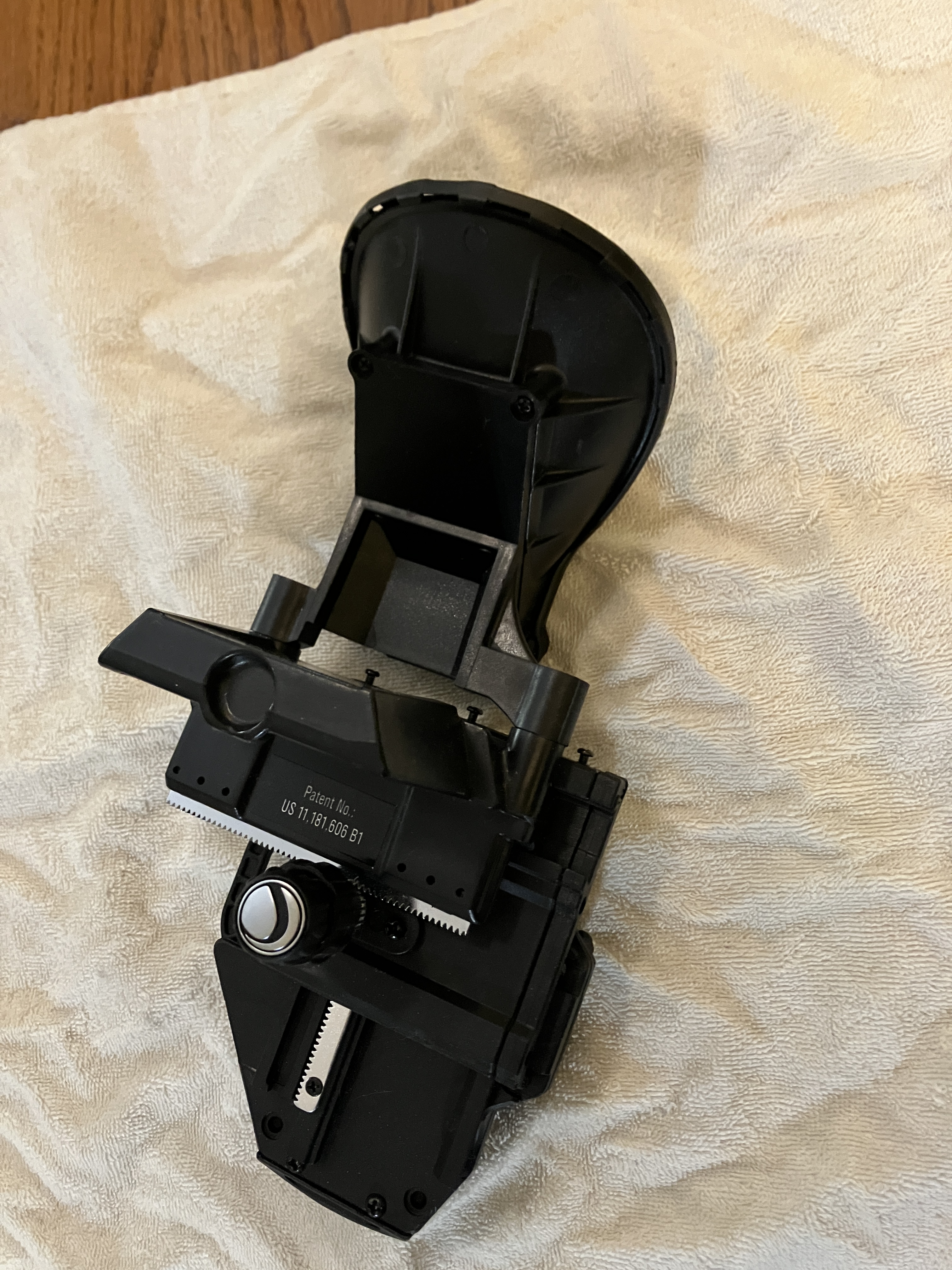
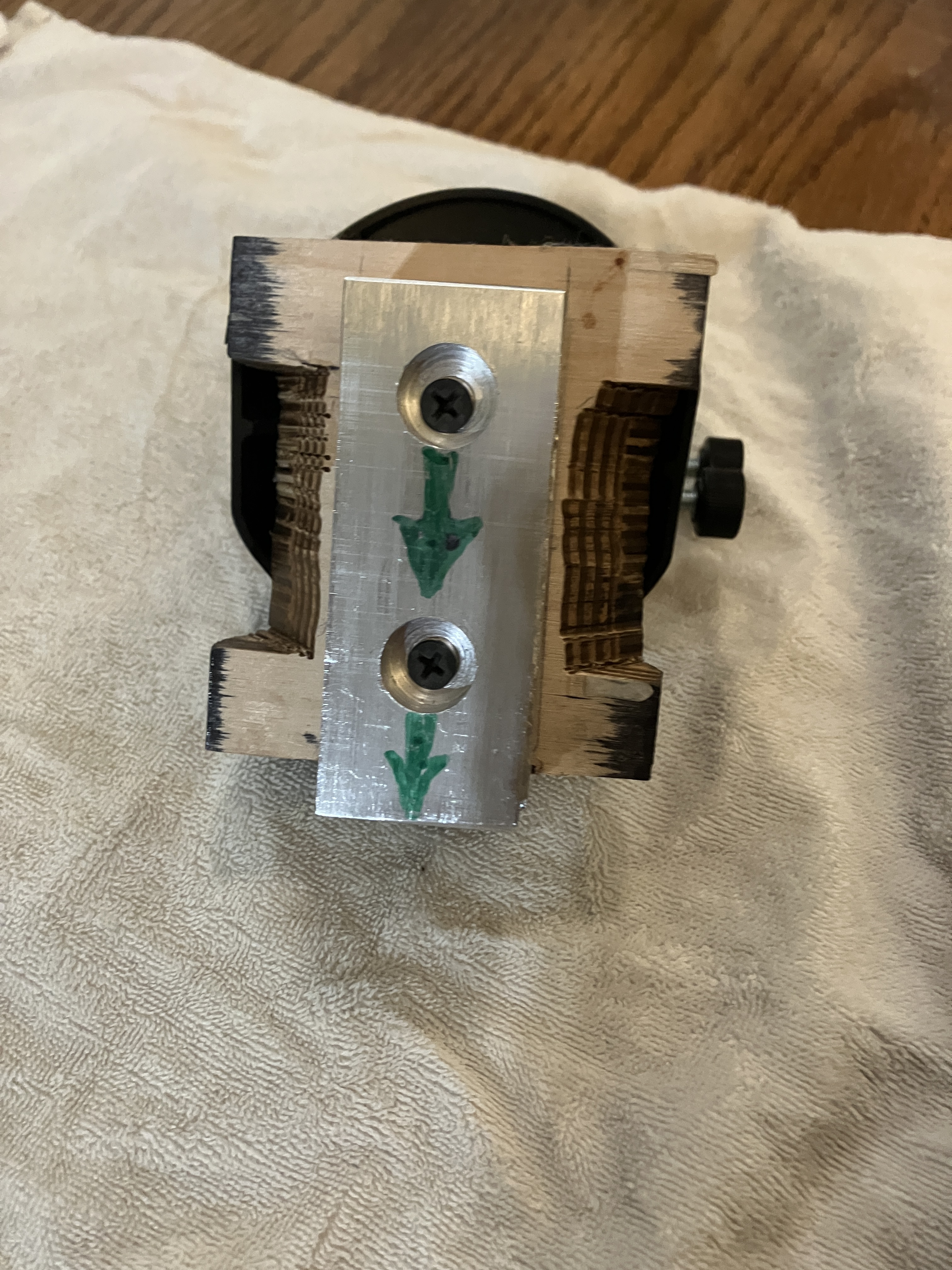
The entire setup ranges in price from about $200 to about $2,000. You cannot just buy the holder and the code from them; you must buy a telescope too. I already had decent telescopes, which I had made, so I bought the lowest-priced one. I then unscrewed the plastic gizmo, and carved and machined connection to a male dovetail slide for it. I also fastened a corresponding female dovetail to each of my scopes. The idea was to then slip this device off or onto whichever one of my telescopes is going to get used that night, as long as I that has a vixen dovetail saddle, and put inexpensive saddles on several scopes I have access to.

Here are some photos of the gizmo:

NCA’s current interns (Nabek Ababiya and Gael Gomez) and I were wondering about the geometry of the angles at which StarSense would aim at the sky in front of the scope. My guess had been that Celestron’s engineers would make the angles of their device so that the center of the optical pencil hitting the lens dead-on at 90 degrees, and hence coning to a focus at the central pixel of the CMOS sensor, would be parallel to the axis of the telescope tube.

We didn’t want to touch the mirror, because it’s quite delicate. But as a former geometry teacher, I couldn’t leave this one alone, so along with Gael and Nabek I made some diagrams and figured out what the angles had to be if the axis of the StarSense app’s image were designed to be precisely parallel to the axis of the telescope.

In my diagram below, L is the location of the Lens, and IJCK is the cell phone lying snug in its holder. The user can slide the cell phone left and right along that line JD as we see it here, or into out of the plane of the page, but it is not possible to change angle D aka <CDE – it’s fixed by the factory molds to be some fixed angle that we measured with various devices to be 19.0 degrees.

Here is a version of the diagrams we made that showed what we predicted all the angles would be so that optical axis OH will be parallel to the tube axis EBD, and that lens angle ILH is a right angle. We predicted that the mirror’s axis would need to be tilted upwards by an angle of 35.5 degrees (anle HBD).

To our surprise, our guesses and calculations were all wrong!

After careful measurements we found that Celestron’s engineers apparently decided that the optical axis of the SS gizmo should instead aim the cell phone’s camera up by 15.0 degrees (angle BGH below). The only parallel lines are the sides of the telescope tube!

We used a variety of devices to measure angle FBD and MNC to an accuracy of about half a degree; all angles turned out to be whole numbers.

Be that as it may, sometimes it works well and sometimes it does not.

Zach Gleiberman and I tested it on an open field in Rock Creek Park here in DC back in the fall of 2024, using the Hechinger-blue 8 inch dob I made 30 years ago and still use. We found that SS worked quite well, pointing us quite accurately to all sorts of targets using my iPhone SE. The sky was about as good as it gets inside the Beltway, and the device worked flawlessly.

Not too long afterwards, I decided to try out an Android-style phone (a REVVL 6 Pro) so that I wouldn’t have to give up my cell phone for the entire evening at Hopewell Observatory. I was unpleasantly surprised to find that it didn’t work well at all: the directions were very far off. I thought it might be because the scope in question had a rather wide plywood ring around the front of its very long tube, and that perhaps too much of the field of view was being cut off?

Why it fails was not originally clear. I thought nearly every modern phone would work, since for Androids, it just needs to be later than 2016 and have a camera, an accelerometer, and gyros, which is a pretty low bar these days. However, my REVVL 6 Pro from T-Mobile is not on the list of phones that have been tested to work!

Part of my assumption that the axis of the SS gizmo would be parallel to the axis of the scope was an explanation that StarSense on had such a large obstruction in front of the SS holder, in the form of a wide wooden disk reinforcing the front of a 10″ f/9 Newtonian, that the SS was missing part of the sky. We now know that’s not correct. It’s an interface problem (ie software) problem.

We think.

Disturbing Racist Clauses Found in Early NCA Constitutions & Bylaws

29 Wednesday Sep 2021

Posted by gfbrandenburg in astronomy, History, science, Telescope Making

≈ Leave a comment

Tags

Albert Einstein, amateur, astronomy, Black people, by-laws, Carnegie Institution of Washington, Caucasian, CIW, constitution, DC, ERO, Eugenics, Eugenics Records Office, Fairfax, George Carruthers, High Schools, History, Hitler, Montgomery County, National Capital Astronomer, Nazis, NCA, Prince George's County, Racism, science, Segregation, Star Dust, Washington

By Guy Brandenburg

Recently, while preparing to give a talk at this year’s Stellafane telescope-makers’ convention, I was disappointed to discover that the National Capital Astronomers (NCA), which I’ve belonged to for about 30 years, specifically excluded Black members for nearly 3 decades: from about 1940 all the way up to1969.

But NCA didn’t start out being overtly racist. Our original 1937 founding document has no such language. It reads, in part,

“The particular business and objects of [the NCA] shall be the education and mutual improvement of its members in the science of Astronomy and the encouragement of an interest in this science among others. (…) The activities of this Association are designed for the enjoyment and cultural profit of all interested in astronomy, whether the member be a beginner, an advanced student, or one whose pursuit of the science is necessarily desultory.”

And today’s NCA home page reads, “All are welcome to join. Everyone who looks up to the sky with wonder is an astronomer and welcomed by NCA. You do not have to own a telescope, but if you do own one that is fine, too. You do not have to be deeply knowledgeable in astronomy, but if you are knowledgeable in astronomy that is fine, too. You do not have to have a degree, but if you do that is fine, too. WE ARE THE MOST DIVERSE local ASTRONOMY CLUB anywhere. Come to our meetings and you will find this out. WE REALLY MEAN THIS!”

But in the 1940’s, the original open-minded and scientific NCA membership policy changed. The January 1946 Star Dust listed a number of changes to be voted on by the membership in the club’s founding documents. (See https://capitalastronomers.org/SD_year/1946/StarDust_1946_01.pdf ) The organization voted to change article III of its constitution as follows:

From:

“only Caucasians over 16 years old are eligible for membership.”

To this:

“to include all ages (see by-laws), exclude only the Black race.”

While it may be shocking that a scientific organization like NCA had such a policy, people often forget how racist a nation the USA used to be, and for how long. If you look up actual pages of DC area newspapers from the 1950s, you will note that the classified advertisements were largely segregated both by race and by gender – want ads would very often specify male or female, single or married, White-only or Colored-only jobs, apartments, and so on.

Schools in DC, MD, and Virginia were mostly segregated, either by law or in practice, up until the late 1960s or early 1970s. The 1954 Brown v Board decision had very little real impact in most areas until much, much later. Queens (NYC), PG County (MD) and Boston (MA) had violent movements against integrating schools in the 1970s. I know because I attended demonstrations against those racists and have some scars to prove it.

While the Federal and DC governments offices were integrated immediately after the Civil War, that changed for the worse when Woodrow Wilson was elected President in 1912.

Many scientists in the USA and in Europe believed the pseudo-scientific ideas of racial superiority and eugenics that arose around 1900 and were still widespread 50 years ago – and even today, as recent events have sadly shown.

In The War Against the Weak: Eugenics and America’s Campaign to Create a Master Race, Edwin Black explains how august scientific institutions like the Carnegie Institution of Washington (CIW), the American Natural History Museum in New York, and a number of eminent statisticians and biologists for many decades supported the Eugenics Records Office (ERO) at Cold Spring Harbor. So did the fabulously wealthy Rockefeller and Harriman Foundations.

The ERO pushed the concept of the genetic superiority of the ‘Nordic’ race and helped to pass State laws sterilizing the ‘weak’ and forbidding interracial marriage. They were also successful in passing the 1924 Federal immigration law that severely cut back immigration from parts of the world where supposedly ‘inferior’ people lived – e.g. Eastern and Southern Europe. As a result, many Jews who would have loved to escape Hitler’s ovens by crossing the Atlantic never made it.  

Hitler and his acolytes always acknowledged their ideological and procedural debt to American eugenical laws, literature, and propaganda. As we all know, Germany’s Nazis put those ideas to work murdering millions of Jews, Gypsies, Slavs and others.

It took more than three decades for the CIW to withdraw their support of the ERO. A CIW committee concluded in 1935 “that the Eugenics Record Office was a worthless endeavor from top to bottom, yielding no real data, and that eugenics itself was not a science but rather a social propaganda campaign with no discernable value to the science of either genetics or human heredity.” (Black, p. 390) The members pointedly compared the work of the ERO to the excesses of Nazi Germany. However, it took four more years for CIW to cut all their ties – shortly after Hitler invaded Poland in 1939, starting World War Two.

I don’t know exactly when the ‘Caucasian’-only policy became part of the NCA rules, but it seems to have been between the club founding in 1937, and October 1943 when volume 1, number 1 of Star Dust was printed. At one point, perhaps around 1940, NCA decided that only ‘Caucasians’ over 16 could join. But as indicated above, in 1946, the racial exclusion policy was narrowed to only exclude Black people. Apparently Jews, Italians, young people, Latin Americans, and Asians were eligible to join NCA from 1946 to 1969. But not African-Americans.

While researching my talk, I found that the NCA held amateur telescope-making classes at a number of all-white DC, MD, and VA high schools, from the 1940s through about 1970, both during the days of de jure segregation and the merely de-facto type: McKinley, Roosevelt, Central, Bladensburg, Falls Church, and McLean high schools are listed. While Star Dust mentions a telescope-making course at (the largely-Black) Howard University in 1946, there is no mention of any assistance for that course from NCA.

I also found no evidence in any issue of Star Dust from that era that anybody at the time raised any vocal objections to racial exclusion. Not in 1946, nor 23 years later when the rule prohibiting Black members was quietly dropped (in 1969) when a new constitution was adopted.

A few current or past NCA members confirmed to me that at some point, they noticed that racist language and privately wondered about it. One person told me that they definitely recalled some now-deceased NCA members who were openly racist and not shy about expressing those views. Others told me that they had never heard any discussion of the subject at all.

 (As one who grew up in DC and Montgomery County, and attended essentially-segregated public schools there, I am sorry that neither I nor my family actively spoke up at the time, even though a farm adjacent to ours in Clarksburg was owned by a Black family [with no school-age children at the time]. Amazing how blind one can be! The racists of those days were not shy about committing violence to achieve their ends. Fear might be one reason for silence.)

One possibility is that some of the early NCA meetings might have been held at private residences; perhaps some of the racist members insisted in preventing non-‘Caucasian’ or ‘Black’ people from attending. It is too bad the other NCA members didn’t take the other route and stay true to the original ideas of the club, and tell the racist members to get lost.

Very ironic: the late George Carruthers, a celebrated Naval Research Labs and NASA scientist, and an instrument-maker for numerous astronomical probes and satellites, gave a talk to the NCA in September of 1970 – not too long after the NCA apparently dropped its racist membership rules (April, 1969). So, a mere year and a half before he gave his talk, he could not have legally joined the organization. Nor could he have done so when he was making his own telescopes from scratch as a teenager in the 1940s. See https://en.wikipedia.org/wiki/George_Robert_Carruthers on the life and work of this great African-American scientist and inventor.

To NCA’s credit, we have done better in the past few decades at encouraging participation in telescope viewing parties, telescope making, and lectures by members of all races and ethnic groups. However, I often find that not very many NCA members bring telescopes to viewing events, or show up to judge science fairs, in mostly-minority neighborhoods. Often, it’s just me. That needs to change. We need to encourage an interest in science, astronomy, and the universe in children and the public no matter their skin color or national origin, and we need to combat the racist twaddle that passes for eugenics.

I anticipate that NCA will have a formal vote repudiating the club’s former unscientific and racist policies and behavior. I hope we will redouble our efforts to promote the study of astronomy to members of all ethnic groups, especially those historically under-represented in science.

We could do well to note the words that Albert Einstein wrote in 1946, after he had been living in the US for a decade, and the same year that NCA confirmed that Black people could not join:

“a somber point in the social outlook of Americans. Their sense of equality and human dignity is mainly limited to men of white skins. Even among these there are prejudices of which I as a Jew am clearly conscious; but they are unimportant in comparison with the attitude of the “Whites” toward their fellow-citizens of darker complexion, particularly toward Negroes.

The more I feel an American, the more this situation pains me. I can escape the feeling of complicity in it only by speaking out.

Many a sincere person will answer: “Our attitude towards Negroes is the result of unfavorable experiences which we have had by living side by side with Negroes in this country. They are not our equals in intelligence, sense of responsibility, reliability.”

I am firmly convinced that whoever believes this suffers from a fatal misconception. Your ancestors dragged these black people from their homes by force; and in the white man’s quest for wealth and an easy life they have been ruthlessly suppressed and exploited, degraded into slavery. The modern prejudice against Negroes is the result of the desire to maintain this unworthy condition.

The ancient Greeks also had slaves. They were not Negroes but white men who had been taken captive in war. There could be no talk of racial differences. And yet Aristotle, one of the great Greek philosophers, declared slaves inferior beings who were justly subdued and deprived of their liberty. It is clear that he was enmeshed in a traditional prejudice from which, despite his extraordinary intellect, he could not free himself.

What, however, can the man of good will do to combat this deeply rooted prejudice? He must have the courage to set an example by word and deed, and must watch lest his children become influenced by this racial bias.

I do not believe there is a way in which this deeply entrenched evil can be quickly healed. But until this goal is reached there is no greater satisfaction for a just and well-meaning person than the knowledge that he has devoted his best energies to the service of the good cause.”

Source: http://www.kganu.net/sitebuildercontent/sitebuilderfiles/alberteinsteinonthenegroquestion-1946.pdf

I am indebted to Morgan Aronson, Nancy Byrd, Richard Byrd, Geoff Chester, Jeff Guerber, Jay Miller, Jeffrey Norman, Rachel Poe, Todd Supple, Wayne Warren, Elizabeth Warner, and Harold Williams for documents, memories, and/or technical support.
Subscribe

  • Entries (RSS)
  • Comments (RSS)

Archives

  • December 2025
  • November 2025
  • October 2025
  • September 2025
  • July 2025
  • January 2025
  • November 2024
  • October 2024
  • August 2024
  • July 2024
  • May 2024
  • April 2024
  • January 2024
  • December 2023
  • October 2023
  • August 2023
  • June 2023
  • May 2023
  • April 2023
  • November 2022
  • October 2022
  • August 2022
  • July 2022
  • June 2022
  • May 2022
  • April 2022
  • February 2022
  • January 2022
  • December 2021
  • October 2021
  • September 2021
  • August 2021
  • July 2021
  • June 2021
  • May 2021
  • March 2021
  • December 2020
  • October 2020
  • September 2020
  • August 2020
  • March 2020
  • February 2020
  • January 2020
  • December 2019
  • November 2019
  • September 2019
  • August 2019
  • June 2019
  • May 2019
  • January 2019
  • November 2018
  • October 2018
  • September 2018
  • August 2018
  • May 2018
  • March 2018
  • January 2018
  • November 2017
  • October 2017
  • September 2017
  • August 2017
  • July 2017
  • June 2017
  • May 2017
  • April 2017
  • February 2017
  • December 2016
  • September 2016
  • June 2016
  • May 2016
  • April 2016
  • March 2016
  • February 2016
  • January 2016
  • December 2015
  • November 2015
  • August 2015
  • July 2015
  • April 2015
  • March 2015
  • February 2015
  • January 2015
  • December 2014

Categories

  • astronomy
  • astrophysics
  • education
  • flat
  • History
  • Hopewell Observatorry
  • Math
  • monochromatic
  • nature
  • optical flat
  • Optics
  • Safety
  • science
  • teaching
  • Telescope Making
  • Uncategorized

Meta

  • Create account
  • Log in

Blog at WordPress.com.

  • Subscribe Subscribed
    • Guy's Math & Astro Blog
    • Join 53 other subscribers
    • Already have a WordPress.com account? Log in now.
    • Guy's Math & Astro Blog
    • Subscribe Subscribed
    • Sign up
    • Log in
    • Report this content
    • View site in Reader
    • Manage subscriptions
    • Collapse this bar
 

Loading Comments...