• My series on making a Newtonian telescope
  • How Leon Foucault Made Telescopes

Guy's Math & Astro Blog

Guy's Math & Astro Blog

Category Archives: astronomy

What a Great Night!

05 Monday Mar 2018

Posted by gfbrandenburg in astronomy, astrophysics, Hopewell Observatorry, monochromatic, Optics, Safety, science, Telescope Making, Uncategorized

≈ Leave a comment

Just got back from an exciting astro expedition to Hopewell Observatory with one of the other members. Great fun!

Anybody living on the East Coast in March 2018 has just lived through a very strong, multi-day gale. The same weather system brought snow and flooding to the northeast, and here in the DC-Mar-Va area, it was cut off power to many (including my mother-in law) and caused almost all local school districts to close — even the Federal Government! Two of my immediate neighbors in DC had serious roof damage.

Today, Sunday, Paul M and I decided the wind had calmed enough, and the sky was clear enough, for an expedition to go up and observe. We both figured there was a good chance the road up to the observatory would be blocked by trees, and it turns out that we were right. My chainsaw was getting repaired – long story, something I couldn’t fix on my own – so I brought along work gloves, a nice sharp axe, loppers, and a 3-foot bowsaw. We used all of them. There were two fairly large dead trees that had fallen across the road, and we were able to cut them up and push them out of the way.

IMG_9761
IMG_9762

However, there was a large and very dangerous ‘widow-maker’ tree (two images above) that had fallen across the road, but it was NOT on the ground. Instead, was solidly hung up on the thick telecommunications line at about a thirty-degree angle to the ground. The power lines above it didn’t seem to be touched. You could easily walk under the trunk, if you dared (and we did), and you probably could drive under it, but of course the motion of the car just might be enough to make it crack in half and crush some unlucky car and its driver. Or maybe it might make the phone line shake a bit …

No thanks.

So, we didn’t drive under.

I called the emergency phone for the cell phone tower (whose access road we share) to alert them that the road was blocked and could only be cleared by a professional. I also attempted to call a phone company via 611, without much success — after a long wait, the person at the other end eventually asked me for the code to my account before they would forward me to somebody who could take care of it. Very weird and confusing. What account? What code? My bank account? No way. We will both call tomorrow. Paul says he knows some lawyers at Verizon, whose line he thinks it is.

But then: how were we going to turn the cars around? It’s a very narrow road, with rocks and trees on one side. The other side has sort of a ravine and yet more trees. Paul realized before I did that we had to help each other and give directions in the darkness to the other person, or else we would have to back up all the way to the gate! Turning around took about four maneuvers, per car, in the dark, with the other person (armed with astronomer’s headlamp, of course) yelling directions on when to turn, how much to go forward, when to stop backing up, and so on. Success – no injuries! We both got our cars turned around, closed them up, got our cutting tools, gloves and hats, and then hiked the rest of the way up, south and along the ridge and past the big cell phone tower, to the Observatory buildings themselves, moving and cutting trees as we went.

As we were clearing the roadway and walking up the ridge, we peered to the west to try to find Venus and Mercury, which had heard were now evening planets again. It wasn’t easy, because we were looking through LOTS of trees, in the direction of a beautiful multi-color, clear-sky sunset featuring a bright orange line above the ridge to our west. Winter trees might not have any leaves, but they still make the search for sunset planets rather tough. Even if you hold perfectly still, one instant you see a flash that’s maybe a planet, or maybe an airplane, and then the branches (which are moving in the breeze, naturally) hide it again. So what was it? Paul’s planetarium smartphone app confirmed he saw Venus. If the trees weren’t there, I think we also would have seen Mercury, judging by Geoff Chester’s photo put out on the NOVAC email list. I think I saw one planet.

In any case, everything at the observatory was just fine – no tree damage on anything, thanks to our prior pruning efforts. The Ealing mount and its three main telescopes all worked well, and the sky and stars were gorgeous both to the naked eye and through the scopes. Orion the Hunter, along with the Big Dog and the Rabbit were right in front of us (to the south) and Auriga the Charioteer was right above us. Pleiades (or the Subaru) was off high in the west. Definitely the clearest night I’ve had since my visit to Wyoming for the solar eclipse last August, or to Spruce Knob WV for the Almost Heaven Star Party the month after that.

Paul said that he and his daughter had been learning the proper names of all the stars in the constellation Orion, such as Mintaka, Alnilam, and Alnitak. As with many other star names, all those names are Arabic, a language that I’ve been studying for a while now [but am not good at. So complicated!] Mintaka and Alnitak are essentially the same Arabic word.

After we got the scopes working, Paul suggested checking out Rigel, the bright ‘leg’ of Orion, because it supposedly had a companion star. {Rajul means “leg”} We looked, and after changing the various eyepieces and magnifications, we both agreed that Rigel definitely does have a little buddy.

I had just read in Sky & Telescope that Aristotle (from ancient Greece) may have given the first written account of what we now call an “open cluster” in the constellation Canis Major (Big Dog – that’s Latin, which I studied in grades 7 – 12) called Messier-41, only a couple of degrees south of Sirius, the brightest star in the sky. A passage in a book allegedly written by Aristotle (roughly 230 BC) seems to indicate that he could see this object with averted vision. (He was trying to establish that it was a fuzzy patch in the sky that was most definitely NOT a comet, just like Charles Messier was doing almost exactly two thousand years later!)

M41 was quite attractive. But no, we didn’t then look at M42. Been there, done that many times before. And no, what you see with a telescope does not have all those pretty colors that you see in a photograph.

Instead, we looked on a multi-sheet star atlas (that stays in the observatory) near M41 and found three other open clusters, all really beautiful. We first found M38 and thought that in the C-14 and 6″ Jaegers, it looked very anthropoid or like an angry insect, if you allowed your mind to connect the beautiful dots of light on the black background. In the shorter 5″ refractor made by Jerry Short, it looked like a sprinkling of diamond dust. This cluster must have been formed rather recently. We then found M36, which was much less rich, but still quite pretty. Lastly, we found M37, another open cluster, which has a very bright yellow star near the center, against background of much fainter stars. It seemed to me that those other stars might be partly obscured by a large and somewhat translucent cloud of dust. We saw a web of very opaque dust lanes, which we confirmed by readings on the Web. Really, really beautiful. But I’m glad we don’t live there: too dangerous. Some of the stars are in fact red giants, we read.

Then we looked straight overhead, in the constellation Auriga. We decided to bypass the electronics and have Paul aim the telescope, using the Telrad 1-power finderscope, at one of the fuzzy patches that he saw there. He did, and my notes indicate that we eventually figured out that he found Messier-46 (yet another open cluster) with his naked eye! Very rich cluster, I think, and we even found the fan-shaped planetary nebula inside!

At this point we were getting seriously cold so we moved over just a little, using the instruments, to find M47, again, a very pretty open cluster.

Realizing that the cold and fatigue makes you do really stupid things, and that we were out in the woods with no way to drive up here in case of a problem, we were very careful about making sure we were doing the closing up procedures properly and read the checklist at the door to each other, to make sure we didn’t forget anything.

On the walk back, we saw the Moon coming up all yellowish-orange, with the top of its ‘head’ seemingly cut off. When it got a bit higher, it became more silver-colored and less distorted, but still beautiful.

I really thought all of those open clusters were gorgeous in their own right, and I think it would be an excellent idea to make photographs of them, but perhaps black dots on white paper, and give them to young folks, and ask them to connect the dots, in whatever way they feel like doing. What sorts of interesting drawings would twenty-five students come up with?

I am not sure which of our various telescopes would do the best job at making astro images. I have a CCD camera (SBIG ST-2000XM), with a filter wheel. What about just making it a one-shot monochromatic black and white image? I also have a Canon EOS Revel XSI (aka 450D, I think). Compare and contrast… The CCD is really heavy, the Canon quite light. I also have a telephoto lens for the Canon, which means that I have essentially four telescopes to choose from (but not a big budget!). One problem with the C-14 and my cameras is that the field of view is tiny: you can only take images of very small bits of what you can see in the eyepiece with your naked eye. This means you would need to make a mosaic of numerous pictures.

In any case, no imaging last night! Not only did I not feel like hauling all that equipment for a quarter of a mile, after all that chopping, sawing, and shoving trees, it turns out I had left my laptop home in the first place. D’oh!

I had previously found every single one of these open clusters when I made my way through the entire Messier list of over 100 objects, with my various home-made telescopes, which had apertures up to 12.5 inches. However, I don’t think I had ever seen them look so beautiful before! Was it the amazing clarity of the night, or the adventure, or the company? I don’t know!

But this was a very fun adventure, and this photography project – attempting to make decent images of these six open clusters – promises to be quite interesting!


A 6″ Dob for Young Relatives

31 Wednesday Jan 2018

Posted by gfbrandenburg in astronomy, Math, Optics, Telescope Making, Uncategorized

≈ Leave a comment

I just finished a 6″ f/8 Dobsonian telescope as a gift for my great-nephews, one of whom I discovered is VERY interested in astronomy and happens to live in a place with pretty dark skies – about the middle of Maryland’s Eastern Shore. The mirror is excellent, and the mechanical parts all work very well — in my opinion. Let’s see what the recipients think.

I finally succeeded in putting in the mirror yesterday afternoon in a very stiff and cold wind right outside my house, estimating where the mirror should go by aiming at a distant chimney. This takes patience because it’s trial-and-error, no matter how much you calculate beforehand!

Later that evening, after the nearly-full Blue Moon came over the trees at DC’s Chevy Chase Community Center where we have our telescope-making classes, fellow ATMer and all-around interesting person Jim Kaiser helped me collimate it by pointing the scope at the illuminated curtains in the windows of the CCCC. We then verified that the Moon actually did come to a focus with the eyepiece nearly all the way screwed in. If you want to focus on closer things than the Moon or galaxies, you need to screw the eyepiece out towards you, the observer in the cheap but effective helical focuser that was lying around the shop.

This scope incorporates a couple of innovations by me, and a bit of artistic whimsy.

First small innovation: I made the secondary diagonal mirror holder so that no tools are needed at all: you just rotate the part holding the elliptical mirror and turn a little thumbscrew to collimate it quickly and easily, while you watch. Here is a sketch of how I made it.new type of secondary holder


Second innovation can be seen near my right hand (to your left) atop the cradle: two 1/4″-20 machine screws with simple homemade knobs on top, going through threaded inserts (T-nuts would work too), which push against a piece of lumber in the shape of prism with an isosceles right triangle at each end. I call this the tube brake, which can be applied or released quite easily, whenever needed. Small springs (almost impossible to see in this photo) pull this brake up against the corner of the tube, while the machine screws press it down. If you want to change the position of the eyepiece because a taller or shorter person has arrived, no problem. A few CCW turns of the wooden knobs releases the brake, you rotate the tube to the desired position, and then you lock it down again with a few clockwise turns. If you add or remove a heavy eyepiece or a finder or whatever, same procedure, except this time you can slide the scope up and down inside the cradle.

The artistic whimsy is partly seen in a photo Jim took of me after we got it collimated but before we rushed back inside: lots of colors, thanks to several tons of paint cans salvaged by fellow ATMer Bill Rohrer from being thrown away by a third party who lost his warehouse lease, and also because smurf blue is the favorite color of one of the boys. The altitude bearing is made out of the Corian countertop that my wife and I got rid of a few months ago when we had our kitchen remodeled. (30 years ago we did it ourselves, mostly. This time we hired professionals. They are SOO much faster and better at this than us!)

So that my young relatives can keep this thing looking good, they also get four or five quart or pint cans of paint – the ones I used on the scope. Free, of course. The more we get rid of put to use, the better. They can repaint anything that gets scratched, you see?IMG_9416

You can also see some wood-cutting fun above and below. This retired geometry teacher had a lot of fun figuring out how to lay out and cut out stars with 5, 6, and 7 points, as well as a crescent moon and a representation of Saturn seen with its rings edge-on. I guess you could show Saturn’s rings a 30 to 45 degrees to the viewer, if you instead carved it out of solid wood or did wood burning, but I just had a hand-held jigsaw and a Dremel knockoff. And plus, this is supposed to be a scope that is USED rather than just admired for its artsy parts.

I designed what I wanted onto two sheets of paper and then taped them to the plywood. This worked, but it wasn’t the most wonderful plywood, so on many of the pull strokes, the wood splintered a bit. So that side got to face inside.. Painting all those little nooks and crannies was tough!

design artsy astro cutouts

(The purpose of the cut-outs was simply to make the telescope lighter. It’s got a very heavy and sturdy base. Each square inch of plywood removed saves about 7 grams. Also, more holes means more hand-holds!)


Make your own telescope!

18 Thursday Jan 2018

Posted by gfbrandenburg in astronomy, education, Optics, Safety, Telescope Making, Uncategorized

≈ Leave a comment

Tags

achromatic, doublet, Gaithersburg, lens, make your own telescope, PVC

This weekend, I’m hosting a small workshop at the Community Museum in Gaithersburg, MD, where interested persons from 8 to 88 years of age can make their own telescope in an hour or two. We will be using surplus but high-quality achromatic primary doublet lenses as well as inexpensive eyepieces, along with PVC tubing and some really cool tripods to hold it steady.  We will some basic optics experiments to help explain how these gizmos work, and will have spray paint and colored tape to decorate the tubes.

If you are interested, here is the necessary information:

=======

Gaithersburg Community Museum's photo.
JAN21

Make Your Own Telescope

Public

 · Hosted by Gaithersburg Community Museum
Interested
Invite Friends

Share
  • clock
    Sunday at 1 PM – 4 PM
    3 days from now · 36–50°Partly Cloudy
  • pin
    Show Map
    Gaithersburg Community Museum

    9 S Summit Ave, Gaithersburg, Maryland 20877
  • About
  • Discussion
3 Going · 65 Interested

Share this event with your friends
Share
Details

Make your own refracting telescope in just an afternoon! This workshop will be led by veteran DC amateur telescope-maker Guy Brandenburg. He will show you how to make a small functioning telescope that can either be held in your hands or mounted on almost any camera tripod. All of the materials needed will be provided, and no experience is necessary. This workshop is open to anyone from the ages of 9 through 99, but a parent would need to accompany any child from 9 – 11. You might get a little dirty, so don’t wear your best clothing!

You will also see how various types of telescopes such as reflectors, refractors, and catadioptrics are put together and operate, using actual examples, including the type made and used by Galileo around 1609.

$30 City of Gaithersburg residents/$35 non-residents. Space is limited to 15 so pre-registration is required. To register go to RecXpress at https://online.activenetwork.com/gaithersburg/Start/Start.asp. It’s activity #49690.

For more information or if you have trouble registering call the museum at 301-258-6160 or museum@gaithersburgmd.gov


Australian TV Bit on Me and the DC ATM Workshop

27 Monday Nov 2017

Posted by gfbrandenburg in astronomy, astrophysics, nature, Safety, science, Telescope Making

≈ Leave a comment

Tags

2017, ATM, Australia, eclipse, Stephanie March, Telescope

Some very nice folks from the Australian Broadcasting Corporation came and interviewed me on film for a bit on folks who make their own telescopes to see the great August 2017 eclipse. Here is the link:

( https://www.facebook.com/abcnews.au/videos/10157157152414988/ )

Calculations with a Curious Cassegrain

08 Sunday Oct 2017

Posted by gfbrandenburg in astronomy, flat, Hopewell Observatorry, optical flat, Optics, Telescope Making

≈ Leave a comment

Tags

cassegrain, completing the square, ellipsoid, hyperbola, hyperboloids, Optics, parabola, sphere, testing

I continue to try to determine the foci of the apparent hyperbolic primary on the Hopewell Ealing 12inch cassegrain, which has serious optical problems.

My two given pieces of information are that the mirror has a radius of curvature (R) of 95 inches by my direct measurement, and its Schwarzschild constant of best fit,(generally indicated by the letter K)  according to FigureXP using my six sets of Couder-mask Foucault readings, is -1.112.

I prefer to use the letter p, which equals K + 1. Thus, p = -0.112. I decided R should be negative, that is, off to the left (I think), though I get the same results, essentially, if R is positive, just flipped left-and-right.

One can obtain the equation of any conic by using the formula

Y^2 – 2Rx + px^2 = 0.

When I plug in my values, I get

Y^2 + 190x -0.112x^2 = 0.

I then used ordinary completing-the-square techniques to find the values of a, b, and c when putting this equation in standard form, that is something like y^2/a^2 – x^2/b^2 = 1

Omitting some of the steps because they are a pain to type, and rounding large values on this paper to the nearest integer (but not in my calculator), I get

I got

y^2 – 0.112(x – 848)^2 = – 80540

and eventually

(x – 848)^2 / 848^2 – y^2 / 248^2 = 1

Which means that a is 848 inches, which is over 70 feet, and b is 284 inches, or almost 24 feet. Since a^2 + b^2 = c^2, then c is about 894. And the focal points are 894 inches from the center of the double-knapped hyperboloid, which is located at (848, 0), so it looks a lot like this:

cass equations

Which of the two naps of this conic section is the location of the actual mirror? I suppose it doesn’t make a big difference.

Making that assumption that means that the foci of this hyperbolic mirror are about 894 – 848 = 46 inches from the center of the primary mirror. I don’t have the exact measurement from the center of the primary to the center of the secondary, but this at least gives me a start. That measurement will need to be made very, very carefully and the location of the secondary checked in three dimensions so that the ronchi lines are as straight as possible.

It certainly does not look like the common focal point for the primary and secondary will be very far behind the front of the secondary!

Bob Bolster gave me an EXTREMELY fast spherical mirror that is about f/0.9 and has diameter 6 inches. I didn’t think at first that would be useful for doing a Hindle sphere test, since I thought that the focal point in back of the secondary would be farther away. But now I think it will probably work after all. (Excellent job as usual, Bob!) (I think)


Trying to Test a 50-year-old Cassegran Telescope

07 Thursday Sep 2017

Posted by gfbrandenburg in astronomy, flat, Hopewell Observatorry, Math, science, Telescope Making

≈ Leave a comment

Tags

artificial star, celestron, classical cassegrain, couder, double pass autocollimation test, ealing, FigureXP, focus, foucault, hyperbolic, optical tube assembly, parabolic, primary, refurbishing, ritchey-chretien, Ronchi, schmidt-cassegrain, secondary, spherical, Telescope

We at the Hopewell Observatory have had a classical 12″ Cassegrain optical tube and optics that were manufactured about 50 years ago.; They were originally mounted on an Ealing mount for the University of Maryland, but UMd at some point discarded it, and the whole setup eventually made its way to us (long before my time with the observatory).


The optics were seen by my predecessors as being very disappointing. At one point, a cardboard mask was made to reduce the optics to about a 10″ diameter, but that apparently didn’t help much. The OTA was replaced with an orange-tube Celestron 14″ Schmidt-Cassegrain telescope on the same extremely-beefy Ealing mount, and it all works reasonably well.


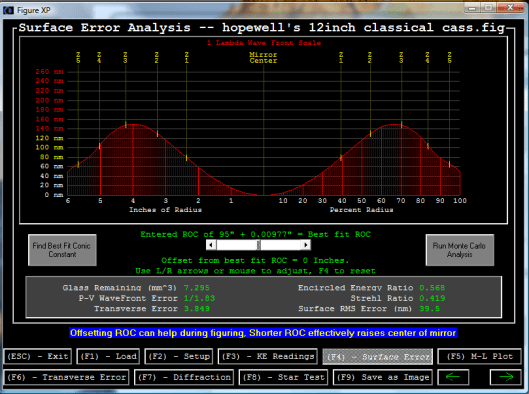
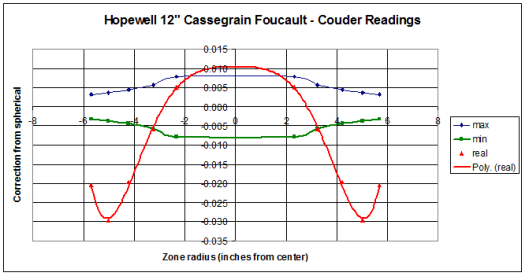
Recently, I was asked to check out the optics on this original classical Cassegrain telescope, which is supposed to have a parabolic primary and a hyperbolic secondary. I did Ronchi testing, Couder-Foucault zonal testing, and double-pass autocollimation testing, and I found that the primary is way over-corrected, veering into hyperbolic territory. In fact, Figure XP claims that the conic section of best fit has a Schwartzschild constant of about -1.1, but if it is supposed to be parabolic, then it has a wavefront error of about 5/9, which is not good at all.

Here are the results of the testing, if you care to look. The first graph was produced by a program called FigureXP from my six sets of readings:

figure xp on the 12 inch cass

my graph of 12 inch cass readings

I have not yet tested the secondary or been successful at running a test of the whole telescope with an artificial star. For the indoor star test, it appears that it only comes to a focus maybe a meter or two behind the primary! Unfortunately, the Chevy Chase Community Center where we have our workshop closes up tight by 10 pm on weekdays and the staff starts reminding us of that at about 9:15 pm. Setting up the entire indoor star-testing rig, which involves both red and green lasers bouncing off known optical flat mirrors seven times across a 60-foot-long room in order to get sufficient separation for a valid star test, and moving two very heavy tables into said room, and then putting it all away when we are done, because all sorts of other activities take place in that room. So we ran out of time on Tuesday the 5th.

A couple of people (including Michael Chesnes and Dave Groski) have suggested that this might not be a ‘classical Cassegrain’ – which is a telescope that has a concave, parabolic primary mirror and a convex, hyperbolic secondary. Instead, it might be intended to be a Ritchey-Chretien, which has both mirrors hyperbolic. We have not tried removing the secondary yet, and testing it involves finding a known spherical mirror and cutting a hole in its center, and aligning both mirrors so that the hyperboloid and the sphere have the exact same center. (You may recall that hyperboloids have two focal points, much like ellipses do.)

Here is a diagram and explanation of that test, by Vladimir Sacek at http://www.telescope-optics.net/hindle_sphere_test.htm

hindle sphere test

FIGURE 56: The Hindle sphere test setup: light source is at the far focus (FF) of the convex surface of the radius of curvature RC and eccentricity ε, and Hindle sphere center of curvature coincides with its near focus (NF). Far focus is at a distance A=RC/(1-ε) from convex surface, and the radius of curvature (RS) of the Hindle sphere is a sum of the mirror separation and near focus (NF) distance (absolute values), with the latter given by B=RC/(1+ε). Thus, the mirrorseparation equals RS-B. The only requirement for the sphere radius of curvature RS is to be sufficiently smaller than the sum of near and far focus distance to make the final focus accessible. Needed minimum sphere diameter is larger than the effective test surface diameter by a factor of RS/B. Clearly, Hindle test is limited to surfaces with usable far focus, which eliminates sphere (ε=0, near and far focus coinciding), prolate ellipsoids (1>ε>0, near and far foci on the same, concave side of the surface), paraboloid (ε=1, far focus at infinity) and hyperboloids close enough to a paraboloid to result in an impractically distant far focus.

We discovered that the telescope had a very interesting DC motor – cum – potentiometer assembly to help in moving the secondary mirror in and out, for focusing and such. We know that it’s a 12-volt DC motor, but have not yet had luck tracking down any specifications on that motor from the company that is the legatee of the original manufacturer.

Here are some images of that part:

IMG_8207
IMG_8210
IMG_8224

An Eclipse Seen in Wyoming

27 Sunday Aug 2017

Posted by gfbrandenburg in astronomy, astrophysics, Math, nature, Telescope Making

≈ Leave a comment

Tags

eclipse, Lander, luggage, Math, solar, sunspots, totality, travel, Wind River Indian Reservation, Wyoming

I was fortunate enough to have the time and cash to go to Wyoming for the August 21 eclipse. It was truly wonderful,. in large part due to the fact that I had made a 6″ diameter, f/8 Dob-Newt travel telescope that could play three roles: as an unfiltered projection scope onto a manila folder before and after totality; with a stopped-down Baader solar filter during and after totality; and with no filter at all during the two minutes or so of totality.

No photographic image that I have so far seen comes anywhere near the incredible details that I was able to see during those short two minutes.

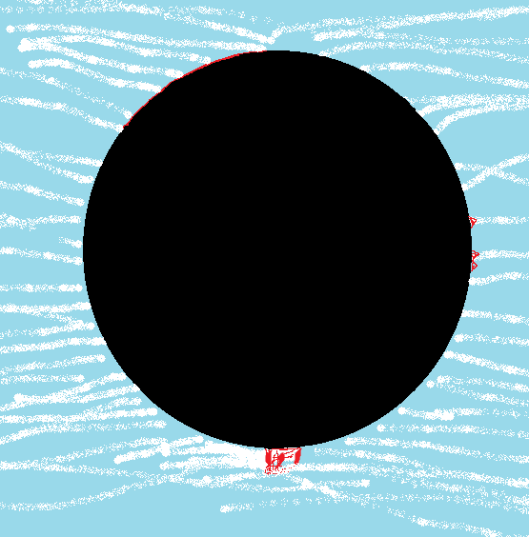
Here is my not-very-expert drawing of what I recall seeing:

solar eclipse

The red rim on the upper left is the ‘flash spectrum’, or chromosphere. It was only visible for a few seconds at the very beginning of the eclipse. The corona is the white fuzzy lines, but my drawing doesn’t do them justice. On the bottom, and on the right, are some amazing solar prominences — something that I don’t recall having seen in 1994, my first successful solar eclipse. The bottom one might not have been quite that large, but it really got my attention.

Here are a few photos I took before and after totality:

IMG_8070
IMG_8082
IMG_8091
IMG_8099
IMG_8105
IMG_8108
IMG_8114
IMG_8118
IMG_8120
IMG_8130
IMG_8138
IMG_8140
IMG_8141

I started planning this expedition over a year ago, and hoped to attend the Astronomical League meeting in Casper, WY. I quickly found that there were absolutely no rooms to be had there, even a year in advance.

Wyoming has fewer people than my home town (Washington DC), and not many populated places in the path of totality. However, I did find a motel in tiny Lander, Wyoming, very close to the southern edge — a location that I had previously found to be very good for viewing eclipses. One of the fellows in our telescope-making workshop, Oscar O (an actual PhD solar astrophysicist) decided he would bring some family and friends along and camp there to view it with me. So he did (see the group photo).

The night before, we went to a site near Fossil Hill, WY to look at stars. The Milky Way was amazing, stretching from northern to southern horizon, and the sky was very, very dark. We met a baking-soda miner (actually, a trona miner) and his 10-year-old daughter; she had a great time aiming my telescope, via Telrad, at interesting formations in the Milky Way. My friends from DC whipped up an amazing dinner on their tiny camp stove. There were LOTS of people camping in the back country there; I bet most of them were there to view the eclipse!

On the eve and morning of the eclipse, after consulting various weather ‘products’, we decided that the predicted clouds in Lander itself would be a problem. (I had been clouded out before, with my wife and children, back in 1991, in Mexico! It really spoils the experience, I assure you!)

So we drove north and west, through the Wind River Indian Reservation, and picked a spot just east of the tiny town of Dubois at a pulloff for a local fish hatchery. Along the drive to that location, we saw lots of folks had set up camp for the event at various pulloffs and driveways to nowhere. (If you didn’t know, Wyoming is mostly devoid of people, but has lots of fields and barbed wire fence. Many of those fields have driveways leading to some sort of gate, most of which are probably used at least three times every decade, if you get my drift….)

Not only is Wyoming largely empty (of people), but the path of totality in the United States was so long that I estimated that if the ENTIRE population of the USA were to decide to go view the eclipse, and somehow could magically spread themselves out evenly over the 70-mile-wide, and 3000-mile-long, path on dry land, that there would only be about 3 people per acre!

Here’s the math: 70 miles times 3000 miles is 210,000 square miles. The population of the USA is about 330,000,000. Divide the population by the area, and you get about 1600 people per square mile. But there are 640 acres in a square mile, so if you divide 1600 by 640, you get less than 3 people per acre, or 3 people on a football field (either NFL or FIFA; it doesn’t matter which).

(…looking to the future, the next decent eclipse doesn’t seem to occur anywhere in this hemisphere until 2024, when it will cross from Texas to Maine…)

As you can see from my photos, the little travel scope I made, called Guy’s Penny Tube-O III, performed very well. Before and after totality, we used it both for solar projection onto a manila folder, through the eyepiece. I also had fashioned a stopped-down solar filter with a different piece of cardboard and a small piece of Baader Solar Film. With both methods, we could clearly see a whole slew of sunspots, in great detail (umbra and penumbra) as well as the moon slowly slipping across the disk of the sun. Having the sunspots as ‘landmarks’ helped us to watch the progress!

Then, during totality, after the end of Baily’s Beads and the Diamond Ring, I took off the filter and re-adjusted the focus slightly, and was treated to the most amazing sight – a total eclipse, with coronal streamers to the left and right; the ‘flash spectrum’ appearing and winking out on the upper left-hand quadrant (iirc); and numerous solar flares/prominences.

I got generous and allowed a few other people to look, but only for a few seconds each! Time was precious, and I had spent so much work (and airfare) building, and re-building, and transporting that telescope there!

Planets? I didn’t see any, but others did. Apparently Regulus was right next to the Sun, but I wasn’t paying attention.

The corona and solar flares were much, much more pronounced than I recall from 1994.

That afternoon, the town of Lander had the largest traffic jam they had ever had, according to locals I talked to. Driving out of there on that afternoon was apparently kind of a nightmare: the state had received a million or so visitors, roughly double its normal population, and there just aren’t that many roads. I chose to spend the night in Lander and visited from friends I had gotten to know, who are now living in Boulder, on the night after that. Unfortunately, on that next day, I got a speeding ticket and a citation for reckless driving (I was guilty as hell!) for being too risky and going too fast on route 287, trying to pass a bunch of cars that I thought were going too slow…

When I did fly out from Denver, on Wednesday, all the various inspections of my very-suspicious-looking and very-heavy luggage caused me to miss my flight, so I went on standby. It wasn’t too bad, and I was only a few hours later than I had originally planned. And my lost suitcase was delivered to my door the next day, so that was good.

I am now in the process of making this travel scope lighter. I have removed the roller-skate wheels and replaced them with small posts, saving several pounds. I have begun using a mill to remove a lot of the metal from the struts. And I will also fabricate some sacks that I can fill with local rocks, instead of using the heavy and carefully machined counterweights! (Rocks are free, gut going over 50 pounds in your luggage can be VERY expensive!)


By the way: unless you like to travel with no luggage at all, NEVER use Spirit Airlines! They may be a few dollars cheaper, but they will even charge you for a carry-on bag! What’s next? Charging you for oxygen?


Actual images of various rovers on Mars — as well as aftermaths of unfortunate crashes

23 Friday Jun 2017

Posted by gfbrandenburg in astronomy, astrophysics, History, monochromatic, science

≈ Leave a comment

Tags

Mars, Moon, rovers

Proof once again that yes, NASA and the ESA and the Russians have indeed sent rovers and spacecraft to Mars (as well as to the Moon) – photos taken by various orbiting satellites.

Open House at the Hopewell Observatory: Saturday, October 15, 2022

09 Friday Jun 2017

Posted by gfbrandenburg in astronomy, Hopewell Observatorry, science, Telescope Making

≈ 1 Comment

Tags

Haymarket, Hopewell Observatory, invitation, open house, VA

You are all invited, and it’s free. The directions and many other details can be found at a previous post on this blog. 

(Just ignore the date, because it’s no longer 2016! The directions are long, and I didn’t feel like copying and pasting them here.)

Caveat: we do not have running water, so no modern lavatory. We do have bottled water, an outhouse, electricity, and hand sanitizer. This place is really in the middle of the woods, which is where lots of insects and other arthropods live, so keep that in mind. We do have some bug juice you can use, but keep any spray far away from the telescopes!

If you have a telescope of your own, or binoculars, feel free to bring them. A flashlght or headlamp will be useful. We prefer red light at night, since white light makes you night-blind for about 10-20 minutes. If your flashlight(s) put(s) out white light, we have red plastic, tape, scissors, and rubber bands that you can use to shield your light.

Two Simultaneous ‘First Lights’ at the NCA-CCCC Telescope Making Workshop

29 Saturday Apr 2017

Posted by gfbrandenburg in astronomy, monochromatic, optical flat, Telescope Making

≈ 1 Comment

Tags

First Light

Oscar Olmedo and Jeff Dunn both took the opportunity of a clear night last night to achieve first light with the telescopes that they have been working so hard on. The target was Jupiter. The location is right outside the Chevy Chase Community Center, and time was just about 10:00 pm. The fact that you can see so much in this iphone image shows that light pollution is a real problem there.

IMG_7246

We also managed to do a star test using an artificial star on Oscar’s 6″ f/3. I made the testing rig with considerable help from Alan Tarica and Bill Rohrer. We reflected the light off of a known optical flat so as to double the testing distance. We had everybody in attendance at the telescope=making workshop examine the inside- and outside-of-focus images, and we all agreed that using the images in Richard Suiter’s book, it’s a bit overcorrected, probably somewhere near 1/4 wave of green light, which was what we were using — a green laser pointer attenuated and stopped down to about 100 micron hole. But good enough.

Next step for Oscar is to aluminize his mirror in our vacuum chamber.

Congratulations to both gentlemen!

← Older posts
Newer posts →

Subscribe

  • Entries (RSS)
  • Comments (RSS)

Archives

  • February 2026
  • December 2025
  • November 2025
  • October 2025
  • September 2025
  • July 2025
  • January 2025
  • November 2024
  • October 2024
  • August 2024
  • July 2024
  • May 2024
  • April 2024
  • January 2024
  • December 2023
  • October 2023
  • August 2023
  • June 2023
  • May 2023
  • April 2023
  • November 2022
  • October 2022
  • August 2022
  • July 2022
  • June 2022
  • May 2022
  • April 2022
  • February 2022
  • January 2022
  • December 2021
  • October 2021
  • September 2021
  • August 2021
  • July 2021
  • June 2021
  • May 2021
  • March 2021
  • December 2020
  • October 2020
  • September 2020
  • August 2020
  • March 2020
  • February 2020
  • January 2020
  • December 2019
  • November 2019
  • September 2019
  • August 2019
  • June 2019
  • May 2019
  • January 2019
  • November 2018
  • October 2018
  • September 2018
  • August 2018
  • May 2018
  • March 2018
  • January 2018
  • November 2017
  • October 2017
  • September 2017
  • August 2017
  • July 2017
  • June 2017
  • May 2017
  • April 2017
  • February 2017
  • December 2016
  • September 2016
  • June 2016
  • May 2016
  • April 2016
  • March 2016
  • February 2016
  • January 2016
  • December 2015
  • November 2015
  • August 2015
  • July 2015
  • April 2015
  • March 2015
  • February 2015
  • January 2015
  • December 2014

Categories

  • astronomy
  • astrophysics
  • education
  • flat
  • History
  • Hopewell Observatorry
  • Math
  • monochromatic
  • nature
  • optical flat
  • Optics
  • Safety
  • science
  • teaching
  • Telescope Making
  • Uncategorized

Meta

  • Create account
  • Log in

Blog at WordPress.com.

  • Subscribe Subscribed
    • Guy's Math & Astro Blog
    • Join 54 other subscribers
    • Already have a WordPress.com account? Log in now.
    • Guy's Math & Astro Blog
    • Subscribe Subscribed
    • Sign up
    • Log in
    • Report this content
    • View site in Reader
    • Manage subscriptions
    • Collapse this bar
 

Loading Comments...