• My series on making a Newtonian telescope
  • How Leon Foucault Made Telescopes

Guy's Math & Astro Blog

Guy's Math & Astro Blog

Category Archives: science

Disturbing Racist Clauses Found in Early NCA Constitutions & Bylaws

29 Wednesday Sep 2021

Posted by gfbrandenburg in astronomy, History, science, Telescope Making

≈ Leave a comment

Tags

Albert Einstein, amateur, astronomy, Black people, by-laws, Carnegie Institution of Washington, Caucasian, CIW, constitution, DC, ERO, Eugenics, Eugenics Records Office, Fairfax, George Carruthers, High Schools, History, Hitler, Montgomery County, National Capital Astronomer, Nazis, NCA, Prince George's County, Racism, science, Segregation, Star Dust, Washington

By Guy Brandenburg

Recently, while preparing to give a talk at this year’s Stellafane telescope-makers’ convention, I was disappointed to discover that the National Capital Astronomers (NCA), which I’ve belonged to for about 30 years, specifically excluded Black members for nearly 3 decades: from about 1940 all the way up to1969.

But NCA didn’t start out being overtly racist. Our original 1937 founding document has no such language. It reads, in part,

“The particular business and objects of [the NCA] shall be the education and mutual improvement of its members in the science of Astronomy and the encouragement of an interest in this science among others. (…) The activities of this Association are designed for the enjoyment and cultural profit of all interested in astronomy, whether the member be a beginner, an advanced student, or one whose pursuit of the science is necessarily desultory.”

And today’s NCA home page reads, “All are welcome to join. Everyone who looks up to the sky with wonder is an astronomer and welcomed by NCA. You do not have to own a telescope, but if you do own one that is fine, too. You do not have to be deeply knowledgeable in astronomy, but if you are knowledgeable in astronomy that is fine, too. You do not have to have a degree, but if you do that is fine, too. WE ARE THE MOST DIVERSE local ASTRONOMY CLUB anywhere. Come to our meetings and you will find this out. WE REALLY MEAN THIS!”

But in the 1940’s, the original open-minded and scientific NCA membership policy changed. The January 1946 Star Dust listed a number of changes to be voted on by the membership in the club’s founding documents. (See https://capitalastronomers.org/SD_year/1946/StarDust_1946_01.pdf ) The organization voted to change article III of its constitution as follows:

From:

“only Caucasians over 16 years old are eligible for membership.”

To this:

“to include all ages (see by-laws), exclude only the Black race.”

While it may be shocking that a scientific organization like NCA had such a policy, people often forget how racist a nation the USA used to be, and for how long. If you look up actual pages of DC area newspapers from the 1950s, you will note that the classified advertisements were largely segregated both by race and by gender – want ads would very often specify male or female, single or married, White-only or Colored-only jobs, apartments, and so on.

Schools in DC, MD, and Virginia were mostly segregated, either by law or in practice, up until the late 1960s or early 1970s. The 1954 Brown v Board decision had very little real impact in most areas until much, much later. Queens (NYC), PG County (MD) and Boston (MA) had violent movements against integrating schools in the 1970s. I know because I attended demonstrations against those racists and have some scars to prove it.

While the Federal and DC governments offices were integrated immediately after the Civil War, that changed for the worse when Woodrow Wilson was elected President in 1912.

Many scientists in the USA and in Europe believed the pseudo-scientific ideas of racial superiority and eugenics that arose around 1900 and were still widespread 50 years ago – and even today, as recent events have sadly shown.

In The War Against the Weak: Eugenics and America’s Campaign to Create a Master Race, Edwin Black explains how august scientific institutions like the Carnegie Institution of Washington (CIW), the American Natural History Museum in New York, and a number of eminent statisticians and biologists for many decades supported the Eugenics Records Office (ERO) at Cold Spring Harbor. So did the fabulously wealthy Rockefeller and Harriman Foundations.

The ERO pushed the concept of the genetic superiority of the ‘Nordic’ race and helped to pass State laws sterilizing the ‘weak’ and forbidding interracial marriage. They were also successful in passing the 1924 Federal immigration law that severely cut back immigration from parts of the world where supposedly ‘inferior’ people lived – e.g. Eastern and Southern Europe. As a result, many Jews who would have loved to escape Hitler’s ovens by crossing the Atlantic never made it.  

Hitler and his acolytes always acknowledged their ideological and procedural debt to American eugenical laws, literature, and propaganda. As we all know, Germany’s Nazis put those ideas to work murdering millions of Jews, Gypsies, Slavs and others.

It took more than three decades for the CIW to withdraw their support of the ERO. A CIW committee concluded in 1935 “that the Eugenics Record Office was a worthless endeavor from top to bottom, yielding no real data, and that eugenics itself was not a science but rather a social propaganda campaign with no discernable value to the science of either genetics or human heredity.” (Black, p. 390) The members pointedly compared the work of the ERO to the excesses of Nazi Germany. However, it took four more years for CIW to cut all their ties – shortly after Hitler invaded Poland in 1939, starting World War Two.

I don’t know exactly when the ‘Caucasian’-only policy became part of the NCA rules, but it seems to have been between the club founding in 1937, and October 1943 when volume 1, number 1 of Star Dust was printed. At one point, perhaps around 1940, NCA decided that only ‘Caucasians’ over 16 could join. But as indicated above, in 1946, the racial exclusion policy was narrowed to only exclude Black people. Apparently Jews, Italians, young people, Latin Americans, and Asians were eligible to join NCA from 1946 to 1969. But not African-Americans.

While researching my talk, I found that the NCA held amateur telescope-making classes at a number of all-white DC, MD, and VA high schools, from the 1940s through about 1970, both during the days of de jure segregation and the merely de-facto type: McKinley, Roosevelt, Central, Bladensburg, Falls Church, and McLean high schools are listed. While Star Dust mentions a telescope-making course at (the largely-Black) Howard University in 1946, there is no mention of any assistance for that course from NCA.

I also found no evidence in any issue of Star Dust from that era that anybody at the time raised any vocal objections to racial exclusion. Not in 1946, nor 23 years later when the rule prohibiting Black members was quietly dropped (in 1969) when a new constitution was adopted.

A few current or past NCA members confirmed to me that at some point, they noticed that racist language and privately wondered about it. One person told me that they definitely recalled some now-deceased NCA members who were openly racist and not shy about expressing those views. Others told me that they had never heard any discussion of the subject at all.

 (As one who grew up in DC and Montgomery County, and attended essentially-segregated public schools there, I am sorry that neither I nor my family actively spoke up at the time, even though a farm adjacent to ours in Clarksburg was owned by a Black family [with no school-age children at the time]. Amazing how blind one can be! The racists of those days were not shy about committing violence to achieve their ends. Fear might be one reason for silence.)

One possibility is that some of the early NCA meetings might have been held at private residences; perhaps some of the racist members insisted in preventing non-‘Caucasian’ or ‘Black’ people from attending. It is too bad the other NCA members didn’t take the other route and stay true to the original ideas of the club, and tell the racist members to get lost.

Very ironic: the late George Carruthers, a celebrated Naval Research Labs and NASA scientist, and an instrument-maker for numerous astronomical probes and satellites, gave a talk to the NCA in September of 1970 – not too long after the NCA apparently dropped its racist membership rules (April, 1969). So, a mere year and a half before he gave his talk, he could not have legally joined the organization. Nor could he have done so when he was making his own telescopes from scratch as a teenager in the 1940s. See https://en.wikipedia.org/wiki/George_Robert_Carruthers on the life and work of this great African-American scientist and inventor.

To NCA’s credit, we have done better in the past few decades at encouraging participation in telescope viewing parties, telescope making, and lectures by members of all races and ethnic groups. However, I often find that not very many NCA members bring telescopes to viewing events, or show up to judge science fairs, in mostly-minority neighborhoods. Often, it’s just me. That needs to change. We need to encourage an interest in science, astronomy, and the universe in children and the public no matter their skin color or national origin, and we need to combat the racist twaddle that passes for eugenics.

I anticipate that NCA will have a formal vote repudiating the club’s former unscientific and racist policies and behavior. I hope we will redouble our efforts to promote the study of astronomy to members of all ethnic groups, especially those historically under-represented in science.

We could do well to note the words that Albert Einstein wrote in 1946, after he had been living in the US for a decade, and the same year that NCA confirmed that Black people could not join:

“a somber point in the social outlook of Americans. Their sense of equality and human dignity is mainly limited to men of white skins. Even among these there are prejudices of which I as a Jew am clearly conscious; but they are unimportant in comparison with the attitude of the “Whites” toward their fellow-citizens of darker complexion, particularly toward Negroes.

The more I feel an American, the more this situation pains me. I can escape the feeling of complicity in it only by speaking out.

Many a sincere person will answer: “Our attitude towards Negroes is the result of unfavorable experiences which we have had by living side by side with Negroes in this country. They are not our equals in intelligence, sense of responsibility, reliability.”

I am firmly convinced that whoever believes this suffers from a fatal misconception. Your ancestors dragged these black people from their homes by force; and in the white man’s quest for wealth and an easy life they have been ruthlessly suppressed and exploited, degraded into slavery. The modern prejudice against Negroes is the result of the desire to maintain this unworthy condition.

The ancient Greeks also had slaves. They were not Negroes but white men who had been taken captive in war. There could be no talk of racial differences. And yet Aristotle, one of the great Greek philosophers, declared slaves inferior beings who were justly subdued and deprived of their liberty. It is clear that he was enmeshed in a traditional prejudice from which, despite his extraordinary intellect, he could not free himself.

What, however, can the man of good will do to combat this deeply rooted prejudice? He must have the courage to set an example by word and deed, and must watch lest his children become influenced by this racial bias.

I do not believe there is a way in which this deeply entrenched evil can be quickly healed. But until this goal is reached there is no greater satisfaction for a just and well-meaning person than the knowledge that he has devoted his best energies to the service of the good cause.”

Source: http://www.kganu.net/sitebuildercontent/sitebuilderfiles/alberteinsteinonthenegroquestion-1946.pdf

I am indebted to Morgan Aronson, Nancy Byrd, Richard Byrd, Geoff Chester, Jeff Guerber, Jay Miller, Jeffrey Norman, Rachel Poe, Todd Supple, Wayne Warren, Elizabeth Warner, and Harold Williams for documents, memories, and/or technical support.

Some WW2 or Cold-War-Era Aerial Surveillance Cameras

02 Wednesday Sep 2020

Posted by gfbrandenburg in astronomy, History, Hopewell Observatorry, Optics, science, Telescope Making, Uncategorized

≈ 4 Comments

Tags

Aerial reconnaissance camera assemblies

(Think U2 spyplanes.. )

Hopewell Observatory has three WW2 or Cold-War aerial spy camera optical tube assemblies, including a relatively famous Fairchild K-38. No film holders, though. And no spy planes. The lenses are in good condition, and the shutters seem to work fine.

We would like to give them away to someone who wants and appreciates them, and can put them to good use. Does anybody know someone who would be interested?

They’ve been sitting unused in our clubhouse for over 20 years. Take one, take two, take all of them, we want them gone.

We are located in the DC / Northern Virginia area. Nearby pickup is best. Anybody who wants them shipped elsewhere would obviously need to pay for packaging and shipping.

Here are some photos.

This one is labeled K-38, has a special, delicate, fluorite lens in front, and is stamped with the label 10-10-57 – perhaps a date. The shoe is for scale.

IMG_2009
IMG_2010
IMG_2012
IMG_2014
IMG_2017
IMG_2018
IMG_2020
IMG_2022
IMG_2024


The next two have tape measures and shoes for scale.

hopewell jan 2013 023
hopewell jan 2013 024
hopewell jan 2013 025
hopewell jan 2013 026
hopewell jan 2013 027
hopewell jan 2013 028
hopewell jan 2013 029
hopewell jan 2013 030
hopewell jan 2013 031
hopewell jan 2013 032
hopewell jan 2013 033
hopewell jan 2013 034
hopewell jan 2013 035
hopewell jan 2013 036


Let me know (a comment will work) if you are interested.

More about spray-coating astronomical mirrors with silver!

30 Monday Dec 2019

Posted by gfbrandenburg in astronomy, Optics, Safety, science, Telescope Making, Uncategorized

≈ Leave a comment

Here is a batch of articles and links concerning the spray-on process for making astronomical mirrors reflective using protected silver solutions.

Long ago, I translated Foucault’s monograph on making paraboloidal, silvered astronomical mirrors. Part of his article described the process that he and Steinheil developed for silvering, which involved using silver nitrate solutions and various other reagents. It looked quite tricky, and also required further polishing! Plus, our telescope making workshop here in Washington DC had a Navy surplus vacuum chamber that was (and still is) quite effective at putting on good-quality, inexpensive aluminum coatings for any mirror up to 12.5″ diameter.

However, I and a couple of other ATMers (Bill R and Oscar O) are working on mirrors in the 16 to 18 inch range, and they simply won’t fit. So I was quite intrigued to watch how Peter Pekurar and some other folks coated a couple of rather large mirrors right in front of a small crowd of onlookers in a tent at this summer’s Stellafane.

I have a few videos on my webpage (here).

There is also an article on the process in the January 2020 Sky and Telescope, and a webpage (here) on the topic run by Pekurar and Howard Banich and others.

Not to mention a bunch of posts on Cloudy Nights (here) and a nice PDF explaining it all, (here).

What is really, really amazing is that the webpage by Pekurar and Banich also has interferograms showing that the overcoating has absolutely no effect on the sub-microscopic, geometrical figure of the mirror! Unfortunately, it’s only effective against chemical attack, not against dirty fingers or scratches. They also did some careful experiments on reflectivity at various wavelengths with various treatments of the surface.

A couple of local ATMers and at least one professional at Goddard Space Flight Center have told me about their experiments with the process; they found that it is easy to mess up if you aren’t stringently clean and also easy to waste materials.

Problems Solved with the Old 6″ Refractor?

23 Monday Sep 2019

Posted by gfbrandenburg in astronomy, Hopewell Observatorry, Optics, science, Telescope Making

≈ 3 Comments

Tags

crown, figuring, flint, Kiess, lens cell, lenses, refractor, symmetry, testing

I found a few things that may have been causing problems:

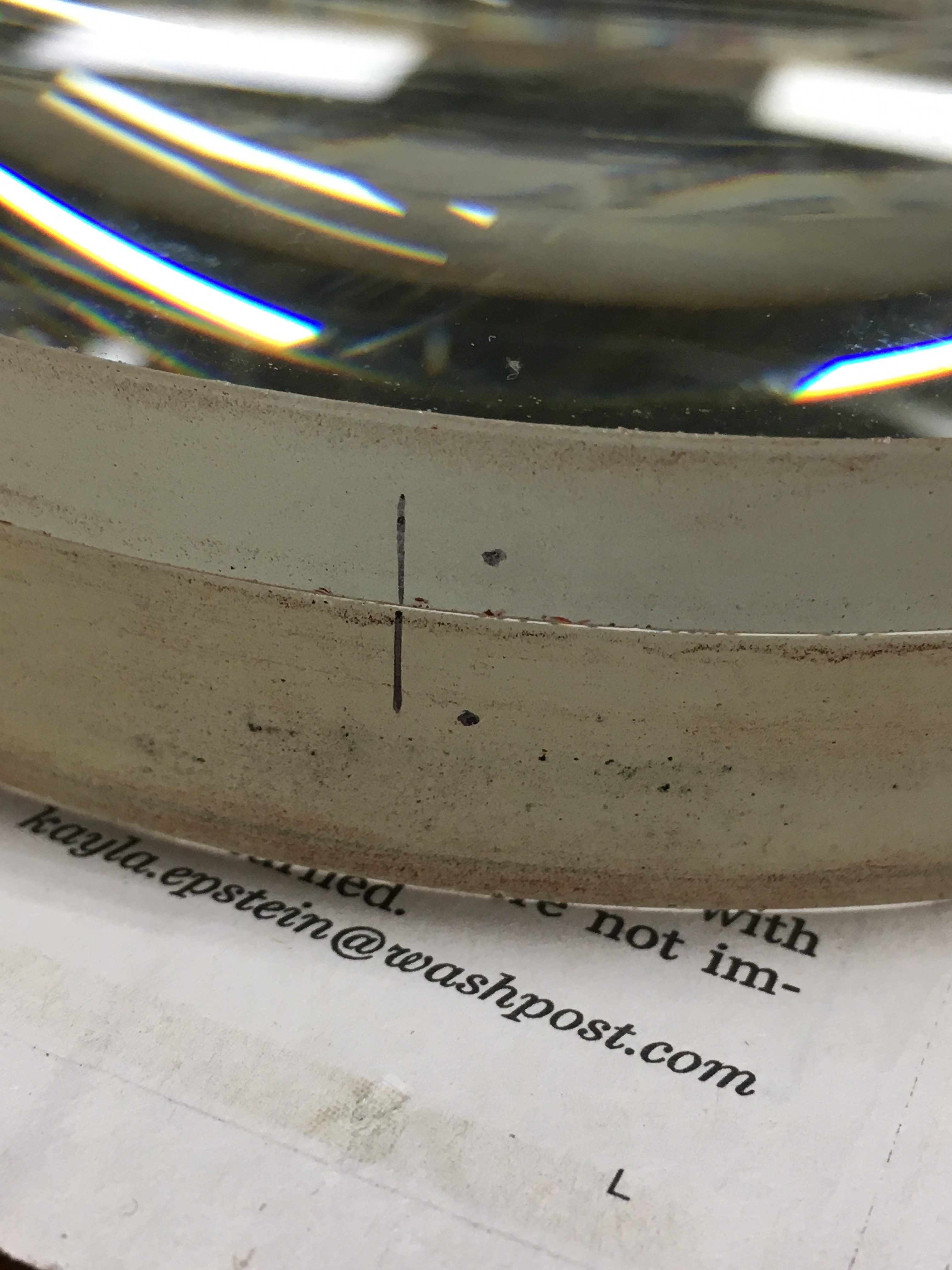
(1) Whoever put the lens cell together last didn’t pay any attention at all to the little registration marks that the maker had carefully placed on the edges of the lenses, to show how they were supposed to be aligned with each other. I fixed that, as you see in the photo below. The reason this is probably important is that the lenses are probably not completely symmetrical around their central axes, and the maker ‘figured’ (polished away small amounts of glass) them so that if you lined them up the way he planned it, the images would be good; otherwise, they would probably not work well at all and could very well be causing the poor star test images we saw.

IMG_5310

2. The previous assembler also put eleven little tape spacers around the edges, between the two pieces of glass. More is apparently not better; experts say you should have three spacers, each 120 degrees apart from the other two. Done.

3. The bottom (or ‘flint’) element is slightly smaller than the other one (the ‘crown’), so it probably shifted sideways. That alone would be enough to mess up the star tests in the way that we saw. So I wrapped two thicknesses of blue painter’s tape around the outside of the flint, and put some three cardboard shims between the edges of the ‘crown’ and the aluminum cell.

4. There were no shims at all between the flint and the aluminum ring that holds it in place underneath. This caused some small scratches on the glass, and might have been warping the glass. I put in three small shims of the same type of blue painter’s tape, lined up with the other spacers.

We will see if these improvements help. I really don’t want to haul this all the way out to Hopewell Observatory and struggle with putting it back on the mount for a star test. That was just way too much work, much more than I expected! The next test will be with an optical flat placed in front of the lenses, and a Ronchi grating.

I would like to thank Bart Fried, Dave Groski, and several other people on the Antique Telescope Society website for their advice.

————————————-

By the way, these photos show how we held the refractor on the mounting plate for the Ealing mount at Hopewell Observatory.

IMG_5197
IMG_5200
IMG_5233
IMG_5239
IMG_5241

A Weekend at Almost Heaven

06 Friday Sep 2019

Posted by gfbrandenburg in astronomy, Optics, science, Telescope Making, Uncategorized

≈ Leave a comment

Tags

Almost Heaven Star Party, binocular mount, dobsonian, NOVAC, Spruce Knob, star party

I spent Labor Day weekend at the Almost Heaven Star Party very close to Spruce Knob, the highest ridge in West Virginia. When the skies cleared at night, the stars and Milky Way were magnificent, but that only happened about 1 night out of three. My 12.5″ home-made Dobsonian telescope performed very well; in fact, because its primary and secondary mirror are almost fully enclosed by the light shrouds and upper cage, I was able to keep observing long after all the other refractors and Schmidt-Cassegrains were closed down by the heavy dew. (To keep the dew off of my finder scope and Telrad, I used large rubber bands to wrap chemical hand warmer packs around them, and that crude and cheap arrangement worked very well!)

Here are three photos taken by me:

Exploring the geology of Spruce Knob Mountain Center: Lyle Mars in blue shirt and white hat is in front of the entrance to a cave carved in limestone
Selfie with me in front of three others on the geology hike
This lovely sunset did not portend clear skies

All but the photo with the sextant were taken by Oscar.

Alan Goldberg teaching someone how to use a sextant
Me studying my charts, in front of parallelogram binocular mount
Oscar Olmedo and me at our campsite
Mike Laugherty and me
Me fiddling with my 12.5" home-made dob in the daytime
Me fiddling with my 12.5″ home-made dob in the daytime
Me fiddling with the parallelogram binocular mount in the daytime
Mike Laugherty and me fiddling with binocular mount
Left to right: Mike Laugherty, Oscar Olmedo, me
The lottery drawing for a whole bunch of neat prizes. None of us 3 won anything.

Silvering Mirrors, and More, at Stellafane

05 Monday Aug 2019

Posted by gfbrandenburg in astronomy, flat, History, Math, monochromatic, optical flat, Optics, science, teaching, Telescope Making, Uncategorized

≈ 3 Comments

For me, these were the two most significant demos at the 2019 Stellafane Convention in Springfield, Vermont:

(1) Silvering large mirrors, no vacuum needed

We had a demonstration by Peter Pekurar on how to apply a layer of Silver (metallic Ag, not aluminum) onto a telescope mirror, accurately, with a protective, non-tarnishing overcoat, that works well. I looked through such a scope; the view was quite good, and I was told that interferograms are great also.

What’s more, the process involves overcoating a mirror with spray bottles of the reagents, without any vacuum apparatus needed at all. Note: Silver coated, not aluminum coated. This is big for me because the upper limit at our club’s aluminizer is 12.5″, but some of us are working on larger mirrors than that; commercial coaters currently charge many hundreds of dollars to coat them.

You can find information on some of these materials at Angel Gilding. Peter P said he will have an article out in not too long. Here are a few photos and videos of the process:

IMG_4972

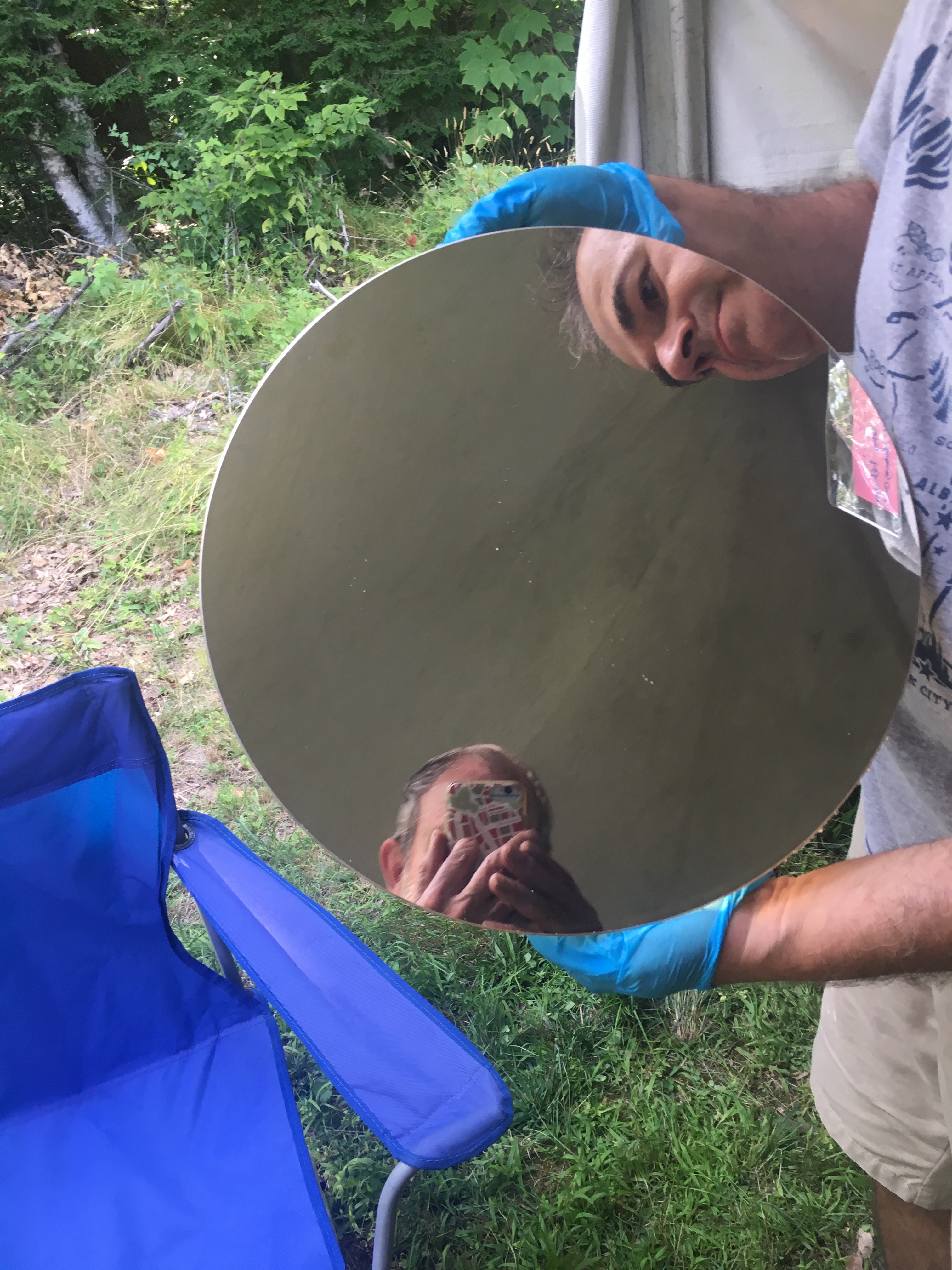
Finished mirror; notice it’s a little blotchy


IMG_4978

IMG_4978


IMG_4981

IMG_4981

IMG_4985IMG_4987

(2) Demo and links for Bath Interferometer (see http://gr5.org/bath )

How to set up and use a Bath interferometer to produce highly accurate interferograms of any mirror for many orders of magnitude less cash than a Zygo interferometer. As I wrote earlier, Alan Tarica had taken the lead on fabricating one at the CCCC – NCA ATM workshop, and we eventually got it to work, but found it rather frustrating and fiddly to use.

The presenter is a HS teacher, and it shows: he explains things very clearly! On his website ( http://gr5.org/bath ) you can get plans for 3-D printing the parts for the Bath device, if you have any access to a 3-D printer, so you can print the parts out for yourself. He also has links to vendors that are selling parts for it, such as certain small lenses, mirrors and beam splitters. He shows you where you can get them for very little money from Surplus Shed and such places. Or you can purchase his really inexpensive kits that he’s already 3-D printed for you. Plus parts for an XYZ stage, which you will need for fine focus. The whole setup (not counting mirror stand and two tripods, which he assumes you have access to already) is under $130.

I will need to look carefully at our setup as built almost completely by Alan, and see how it differs and what we would need to do to make it better. The problem is that there are lots of little, tiny parts, and many of them need to be adjustable. We saw him doing LOTS of little adjustments!

Before his talk, I had absolutely no idea how this (or similar interformeters) really worked. Now I understand: the interference fringes that we see are really contour lines – like we see on on a USGS topo map, only with the mirror tilted in one direction or the other. A big difference with the USGS topo map is that there, the contour lines (isohypses – a new word for me today) are often 10 feet to 100 meters apart. In interferometry, the contour intervals are either one or one-half lambda (wavelength of light) apart – a really tiny amount! We need that level of accuracy because the surface we are studying is sooooooo flat that no other measuring system can work. His explanation of this whole thing now makes perfect sense to me. And the purpose of the software (free!) is to un-slant the mirror and re-draw it using the countour-line information.

Beautifully clear explanation!

Caution: a friend who works professionally in optics told me his team had made three Bath interferometers, using cheap but good quality ebay xyz stages, and found that they were just too much trouble; so they borrowed a very expensive commercial interferometer (costing many tens of kilobucks) from another department and are using that instead. I’m not selling my house to get a Zygo interferometer!!! But I will try the Bath interferometer instead.


Latest Ronchi or Knife-Edge Tester for Mirrors and Other Optics Using a WebCam

07 Friday Sep 2018

Posted by gfbrandenburg in astronomy, Optics, science, Telescope Making

≈ 1 Comment

Tags

brightness, color balance, exposure, focus, foucault, gain, knife edge, Ronchi, testing, webcam

Here is the latest incarnation of my webcam Ronchi and knife edge (or Foucault) tester. It’s taken quite a few iterations to get here, including removing all the unnecessary parts of the webcam. I attach a still photo and a short video. The setup does quite a nice job of allowing everybody to see what is happening. The only problem is setting the gain, focus, exposure, brightness, color balance, contrast, and so on in such a way that what you see on the screen resembles in any way what your eye can see quite easily.

IMG_1335

IMG_1336

IMG_1336

Math – How Come We Forget So Much of What We Learned in School?

27 Monday Aug 2018

Posted by gfbrandenburg in astrophysics, education, History, Math, science, teaching, Telescope Making, Uncategorized

≈ Leave a comment

Tags

education, engineering, forgetting, France, mathematics, scientists, USA

This was a question on  Quora. Here is an answer I wrote:

In the US, judging strictly on what I’ve seen from my time in the classroom as both a student, a teacher, and a visiting mentor of other math teachers, I find that math and science was very often taught as sort of cookbook recipes without any real depth of understanding. The recent National Council of Teachers of Mathematics prescriptions have attempted to correct that, but results have been mixed, and the Common Core has ironically fostered a weird mix of conceptual math marred by teachers being *OBLIGATED* to follow a script, word-for-word, if they want to remain employed. Obviously, if students are really trying to understand WHY a certain mathematical or scientific thing/fact/theorem/theory/law is true, they are going to have questions, and it’s obviously the teacher’s job to figure out how best to answer said questions — which are not likely to have pre-formulated scripts to follow in case they come up — and which are going to take time.

Another thing that is true is that not everything in mathematics has real-world applications in every single person’s life. I taught a good bit of computer programming (aka ‘coding’ today), geometry, arithmetic, probability, algebra, statistics, and conic sections, and in fact I use a LOT of that every week fabricating telescope mirrors to amazing levels of precision, by hand, not for a living, but because I find telescope-making to be a lot of fun and good mental, aesthetic, manual, and physical exercise. But I’m a pretty rare exception!

Most people obviously don’t dabble in math and physics and optics like I do, nor should they!

In fact, I have made it a point to ask professional scientists and engineers that I meet if they actually use, on their jobs, all the calculus that they learned back in HS and college. So far, I think my count is several dozen “Noes” and only one definite “Yes” – and the latter was an actual rocket scientist / engineer and MIT grad and pro-am astronomer (and wonderful, funny, smart person) who deals/dealt with orbital rocket trajectories. (IIRC).

In France, when I went to school there 50 years ago and in my experience tutoring some kids at the fully-French Lycee Rochambeau near Washington, DC, is that they go very deeply into various topics in math, and the sequence of topics is very carefully thought out for each year for each kid in the entire nation (with varying levels of depth depending on what sort of track that the students elected to go into (say, languages/literature, pure math, or applied sciences, etc), but the kids were essentially obligated to accept certain ideas as factual givens and then work out more and more difficult problems that dealt with those particular givens. No questions allowed on where the givens came from, except to note the name of the long-dead classical Greek, French, Italian or German savant whose name is associated with it.

As an American kid who was mostly taught in American schools, but who also took 2 full years of the French system (half a year each of neuvieme, septieme, premiere, terminale, and then passed the baccalaureat in what they called at the time mathematiques elementaires, I found the choice of topics [eg ‘casting out nines’ and barycenters and non-orthogonal coordinate systems] in France rather strange. Interesting topics perhaps, but strange. And not necessarily any more related to the real world than what we teach here in the US.

Over in France, however, intellectuals are (mostly) respected, even revered, and of all the various academic strands, pure math has the highest level of respect. So people over there tend to be proud of however far they got in mathematics, and what they remember. Discourse in French tends to be extremely logical and clear in a way that I cannot imagine happening here in the public sphere.

So to sum up:

(a) most people never learned all that much math better than what was required to pass the test;

(b) only a very few geeky students like myself were motivated to ask ‘why’;

(c) most people don’t use all that much math in their real lives in the first place.


What a Great Night!

05 Monday Mar 2018

Posted by gfbrandenburg in astronomy, astrophysics, Hopewell Observatorry, monochromatic, Optics, Safety, science, Telescope Making, Uncategorized

≈ Leave a comment

Just got back from an exciting astro expedition to Hopewell Observatory with one of the other members. Great fun!

Anybody living on the East Coast in March 2018 has just lived through a very strong, multi-day gale. The same weather system brought snow and flooding to the northeast, and here in the DC-Mar-Va area, it was cut off power to many (including my mother-in law) and caused almost all local school districts to close — even the Federal Government! Two of my immediate neighbors in DC had serious roof damage.

Today, Sunday, Paul M and I decided the wind had calmed enough, and the sky was clear enough, for an expedition to go up and observe. We both figured there was a good chance the road up to the observatory would be blocked by trees, and it turns out that we were right. My chainsaw was getting repaired – long story, something I couldn’t fix on my own – so I brought along work gloves, a nice sharp axe, loppers, and a 3-foot bowsaw. We used all of them. There were two fairly large dead trees that had fallen across the road, and we were able to cut them up and push them out of the way.

IMG_9761
IMG_9762

However, there was a large and very dangerous ‘widow-maker’ tree (two images above) that had fallen across the road, but it was NOT on the ground. Instead, was solidly hung up on the thick telecommunications line at about a thirty-degree angle to the ground. The power lines above it didn’t seem to be touched. You could easily walk under the trunk, if you dared (and we did), and you probably could drive under it, but of course the motion of the car just might be enough to make it crack in half and crush some unlucky car and its driver. Or maybe it might make the phone line shake a bit …

No thanks.

So, we didn’t drive under.

I called the emergency phone for the cell phone tower (whose access road we share) to alert them that the road was blocked and could only be cleared by a professional. I also attempted to call a phone company via 611, without much success — after a long wait, the person at the other end eventually asked me for the code to my account before they would forward me to somebody who could take care of it. Very weird and confusing. What account? What code? My bank account? No way. We will both call tomorrow. Paul says he knows some lawyers at Verizon, whose line he thinks it is.

But then: how were we going to turn the cars around? It’s a very narrow road, with rocks and trees on one side. The other side has sort of a ravine and yet more trees. Paul realized before I did that we had to help each other and give directions in the darkness to the other person, or else we would have to back up all the way to the gate! Turning around took about four maneuvers, per car, in the dark, with the other person (armed with astronomer’s headlamp, of course) yelling directions on when to turn, how much to go forward, when to stop backing up, and so on. Success – no injuries! We both got our cars turned around, closed them up, got our cutting tools, gloves and hats, and then hiked the rest of the way up, south and along the ridge and past the big cell phone tower, to the Observatory buildings themselves, moving and cutting trees as we went.

As we were clearing the roadway and walking up the ridge, we peered to the west to try to find Venus and Mercury, which had heard were now evening planets again. It wasn’t easy, because we were looking through LOTS of trees, in the direction of a beautiful multi-color, clear-sky sunset featuring a bright orange line above the ridge to our west. Winter trees might not have any leaves, but they still make the search for sunset planets rather tough. Even if you hold perfectly still, one instant you see a flash that’s maybe a planet, or maybe an airplane, and then the branches (which are moving in the breeze, naturally) hide it again. So what was it? Paul’s planetarium smartphone app confirmed he saw Venus. If the trees weren’t there, I think we also would have seen Mercury, judging by Geoff Chester’s photo put out on the NOVAC email list. I think I saw one planet.

In any case, everything at the observatory was just fine – no tree damage on anything, thanks to our prior pruning efforts. The Ealing mount and its three main telescopes all worked well, and the sky and stars were gorgeous both to the naked eye and through the scopes. Orion the Hunter, along with the Big Dog and the Rabbit were right in front of us (to the south) and Auriga the Charioteer was right above us. Pleiades (or the Subaru) was off high in the west. Definitely the clearest night I’ve had since my visit to Wyoming for the solar eclipse last August, or to Spruce Knob WV for the Almost Heaven Star Party the month after that.

Paul said that he and his daughter had been learning the proper names of all the stars in the constellation Orion, such as Mintaka, Alnilam, and Alnitak. As with many other star names, all those names are Arabic, a language that I’ve been studying for a while now [but am not good at. So complicated!] Mintaka and Alnitak are essentially the same Arabic word.

After we got the scopes working, Paul suggested checking out Rigel, the bright ‘leg’ of Orion, because it supposedly had a companion star. {Rajul means “leg”} We looked, and after changing the various eyepieces and magnifications, we both agreed that Rigel definitely does have a little buddy.

I had just read in Sky & Telescope that Aristotle (from ancient Greece) may have given the first written account of what we now call an “open cluster” in the constellation Canis Major (Big Dog – that’s Latin, which I studied in grades 7 – 12) called Messier-41, only a couple of degrees south of Sirius, the brightest star in the sky. A passage in a book allegedly written by Aristotle (roughly 230 BC) seems to indicate that he could see this object with averted vision. (He was trying to establish that it was a fuzzy patch in the sky that was most definitely NOT a comet, just like Charles Messier was doing almost exactly two thousand years later!)

M41 was quite attractive. But no, we didn’t then look at M42. Been there, done that many times before. And no, what you see with a telescope does not have all those pretty colors that you see in a photograph.

Instead, we looked on a multi-sheet star atlas (that stays in the observatory) near M41 and found three other open clusters, all really beautiful. We first found M38 and thought that in the C-14 and 6″ Jaegers, it looked very anthropoid or like an angry insect, if you allowed your mind to connect the beautiful dots of light on the black background. In the shorter 5″ refractor made by Jerry Short, it looked like a sprinkling of diamond dust. This cluster must have been formed rather recently. We then found M36, which was much less rich, but still quite pretty. Lastly, we found M37, another open cluster, which has a very bright yellow star near the center, against background of much fainter stars. It seemed to me that those other stars might be partly obscured by a large and somewhat translucent cloud of dust. We saw a web of very opaque dust lanes, which we confirmed by readings on the Web. Really, really beautiful. But I’m glad we don’t live there: too dangerous. Some of the stars are in fact red giants, we read.

Then we looked straight overhead, in the constellation Auriga. We decided to bypass the electronics and have Paul aim the telescope, using the Telrad 1-power finderscope, at one of the fuzzy patches that he saw there. He did, and my notes indicate that we eventually figured out that he found Messier-46 (yet another open cluster) with his naked eye! Very rich cluster, I think, and we even found the fan-shaped planetary nebula inside!

At this point we were getting seriously cold so we moved over just a little, using the instruments, to find M47, again, a very pretty open cluster.

Realizing that the cold and fatigue makes you do really stupid things, and that we were out in the woods with no way to drive up here in case of a problem, we were very careful about making sure we were doing the closing up procedures properly and read the checklist at the door to each other, to make sure we didn’t forget anything.

On the walk back, we saw the Moon coming up all yellowish-orange, with the top of its ‘head’ seemingly cut off. When it got a bit higher, it became more silver-colored and less distorted, but still beautiful.

I really thought all of those open clusters were gorgeous in their own right, and I think it would be an excellent idea to make photographs of them, but perhaps black dots on white paper, and give them to young folks, and ask them to connect the dots, in whatever way they feel like doing. What sorts of interesting drawings would twenty-five students come up with?

I am not sure which of our various telescopes would do the best job at making astro images. I have a CCD camera (SBIG ST-2000XM), with a filter wheel. What about just making it a one-shot monochromatic black and white image? I also have a Canon EOS Revel XSI (aka 450D, I think). Compare and contrast… The CCD is really heavy, the Canon quite light. I also have a telephoto lens for the Canon, which means that I have essentially four telescopes to choose from (but not a big budget!). One problem with the C-14 and my cameras is that the field of view is tiny: you can only take images of very small bits of what you can see in the eyepiece with your naked eye. This means you would need to make a mosaic of numerous pictures.

In any case, no imaging last night! Not only did I not feel like hauling all that equipment for a quarter of a mile, after all that chopping, sawing, and shoving trees, it turns out I had left my laptop home in the first place. D’oh!

I had previously found every single one of these open clusters when I made my way through the entire Messier list of over 100 objects, with my various home-made telescopes, which had apertures up to 12.5 inches. However, I don’t think I had ever seen them look so beautiful before! Was it the amazing clarity of the night, or the adventure, or the company? I don’t know!

But this was a very fun adventure, and this photography project – attempting to make decent images of these six open clusters – promises to be quite interesting!


Australian TV Bit on Me and the DC ATM Workshop

27 Monday Nov 2017

Posted by gfbrandenburg in astronomy, astrophysics, nature, Safety, science, Telescope Making

≈ Leave a comment

Tags

2017, ATM, Australia, eclipse, Stephanie March, Telescope

Some very nice folks from the Australian Broadcasting Corporation came and interviewed me on film for a bit on folks who make their own telescopes to see the great August 2017 eclipse. Here is the link:

( https://www.facebook.com/abcnews.au/videos/10157157152414988/ )

← Older posts
Newer posts →

Subscribe

  • Entries (RSS)
  • Comments (RSS)

Archives

  • February 2026
  • December 2025
  • November 2025
  • October 2025
  • September 2025
  • July 2025
  • January 2025
  • November 2024
  • October 2024
  • August 2024
  • July 2024
  • May 2024
  • April 2024
  • January 2024
  • December 2023
  • October 2023
  • August 2023
  • June 2023
  • May 2023
  • April 2023
  • November 2022
  • October 2022
  • August 2022
  • July 2022
  • June 2022
  • May 2022
  • April 2022
  • February 2022
  • January 2022
  • December 2021
  • October 2021
  • September 2021
  • August 2021
  • July 2021
  • June 2021
  • May 2021
  • March 2021
  • December 2020
  • October 2020
  • September 2020
  • August 2020
  • March 2020
  • February 2020
  • January 2020
  • December 2019
  • November 2019
  • September 2019
  • August 2019
  • June 2019
  • May 2019
  • January 2019
  • November 2018
  • October 2018
  • September 2018
  • August 2018
  • May 2018
  • March 2018
  • January 2018
  • November 2017
  • October 2017
  • September 2017
  • August 2017
  • July 2017
  • June 2017
  • May 2017
  • April 2017
  • February 2017
  • December 2016
  • September 2016
  • June 2016
  • May 2016
  • April 2016
  • March 2016
  • February 2016
  • January 2016
  • December 2015
  • November 2015
  • August 2015
  • July 2015
  • April 2015
  • March 2015
  • February 2015
  • January 2015
  • December 2014

Categories

  • astronomy
  • astrophysics
  • education
  • flat
  • History
  • Hopewell Observatorry
  • Math
  • monochromatic
  • nature
  • optical flat
  • Optics
  • Safety
  • science
  • teaching
  • Telescope Making
  • Uncategorized

Meta

  • Create account
  • Log in

Blog at WordPress.com.

  • Subscribe Subscribed
    • Guy's Math & Astro Blog
    • Join 54 other subscribers
    • Already have a WordPress.com account? Log in now.
    • Guy's Math & Astro Blog
    • Subscribe Subscribed
    • Sign up
    • Log in
    • Report this content
    • View site in Reader
    • Manage subscriptions
    • Collapse this bar
 

Loading Comments...