Charon (NOT Pluto) with a huge crater that may have bashed it out of round

Tags

, , , , , , , ,

Here’s a very recent (7-12-2015) picture of Pluto Charon that shows a bright circular feature near 1 o’clock with a long white streak heading down and to the right for a very long way – possibly even as much as half the diameter of the entire planet. If you look near the top of the image, you can see that it’s partly in shadow, and the low angle of the light from the Sun exaggerates vertical elevation changes much as they do here on earth just after dawn and before sunset. So we can see that the upper portion of the surface of Charon Pluto appears to be very irregular and not precisely spherical.

pluto w large crater

Which should be no huge surprise, given how small Charon Pluto really is (only 1200 2300 km across, or about 750 1400 miles, which is much smaller than our own Moon (Luna or Selene), in fact less than the distance from my town (Washington DC) to Miami. In this image the ‘top’ of the planet looks almost like a somewhat-rounded 7-sided heptagon rather than a sphere.

It appears to me that the object (asteroid or comet or whatever) which smacked Charon Pluto and formed that large crater came not along a radius, but at some other angle — I’d have to do some experiments to see whether the object came, so to speak, from somewhere off to our right and from our back as we view the image, or from the exact opposite direction, from above and in front of us, perhaps a bit to our left. I just don’t know if the debris from such an impact would fly back in the direction from which the impactor came, or whether it would continue going forward in the direction of the impactor. It’s fun to do experiments with sandboxes and lofting various projectiles, but you never know how well your set up will match reality. Sand and water at room temperature probably don’t act the same way as the surface of Pluto (various types of frozen ices, at its insanely cold temperatures), being hit by something that vaporizes and melts solid rocks by the tremendous force of impact!

I got the image from here. And thought this was a picture of Pluto. But it’s not.

Felling Some Trees at Hopewell Observatory So We Can View Polaris Again

Yesterday, we felled a large red oak tree that was blocking our view of Polaris from the outside pier. (If you can’t see the North Star then it becomes very, very difficult to align your telescope for imaging.) Since the observatory was built in the 1970s and 1980s a lot of trees have grown a lot taller, and we’ve had to cut or trim several of them. This one apparently sprouted in 1940, by my count. Fortunately, one of our members heats his house with wood, and burned about 7 cords last winter. This tree is not even one cord.

The very first picture was taken just as the tree began toppling. I have a video of the tree falling and crashing, but WordPress doesn’t allow movies.

003

Timber!!!

008 007 006 005

Where I disagree with Francis S Collins

Collins is a scientific big shot (head of the Human Genome Project) and is famous for also being very religious.

I’m not. I am in awe of the incredible wonders of this planet, not to mention the wonders of the universe. I am awed even watching my 20-month-old granddaughter learn new skills and new words, but I have no idea what CAUSED all those wonders to come into being.

In the copy of Mationsl Geographic that I just opened, Collins is quoted thusly:

“At the most fundament level, it’s a miracle that there’s a universe at all.”

I agree! 

He continues:

“It’s a miracle that it [the universe] has order, fine-tuning that allows the possibility of complexity, and laws that follow precise mathematical formulas.”

Perhaps miracle isn’t the word I would use, but it is indeed amazing that the universe has those properties. Why is it that neutrons and electrons have the properties that the do, and hydrogen and oxygen and all the rest behave the way they do? I have no idea. Physicists and chemists and biologists can describe those properties, and explain why more complex phenomena occur as a result of the fundamental properties, but we have no frigging idea what caused the Big Bang or why atoms and subatomic particles behave the way they do. Its a mystery that I think we will never discover. But Collins continues:

“Contemplating this, an open-minded observer is almost forced to conclude that there must be a ‘mind’ behind all this.”

Here I disagree. I haveno idea what caused the universe to occur starting 14.7 billion years ago, but for a “mind” of some sort to be In charge of setting the values of all those physical constants raises even more questions. And provides even fewer explanations. For example, one might ask: ok, where did this “mind” come from? Why did it set the mass of a neutrino at such and such? Can this “mind” change its mind if it gets bored? If yes, what happens? If not, why not?

He concludes that “to me that qualifies as amiracle, a profound truth that lies outside of scientific explanation.”

Here I might agree. I doubt we will ever discover a cause for the Big Bang or why the various physical properties of the universe are what they are and are uniform in all places and for all time. (Or why dark energy may be an exception)

It does not force me to conclude there is a “mind@ controlling all that. No particular evidence would leave me to conclude that the human sky deities and inventions called Zeus, Legba, Thor, Cronis, Allah, Atman, or YHVH are responsible for any of those mysteries.

A good night at the DC NCA CCCC telescope-making workshop

Two major accomplishments tonight:

1. David C finally Aluminized his mirror in our vacuum chamber. Long story with mishaps that included pyrolized Sharpie marks on a previous quick and dirty aluminizationsfor attempt, and a Varian high-vacuum gauge that got stuck for a while. But he was persistent and diligent and forgiving as well.

2. Rich K appears to have finished parabolizing his 10″ f/7 mirror, which he had started about 20 years ago under the guidance of my predecessor, Jerry Schnall. If my Foucault knife-edge measurements are correct then it’s 1/15 lambda which is great.

Adventures in Making a Glass Surface Optically Flat

Tags

, , , , , ,

I’ve been trying to make an optical flat for some time now. It’s not easy, even if you are starting with a piece of ‘float’ glass – modern 3/4″ thick window sheet glass that is manufactured by floating a layer of molten glass on a bath of molten tin.

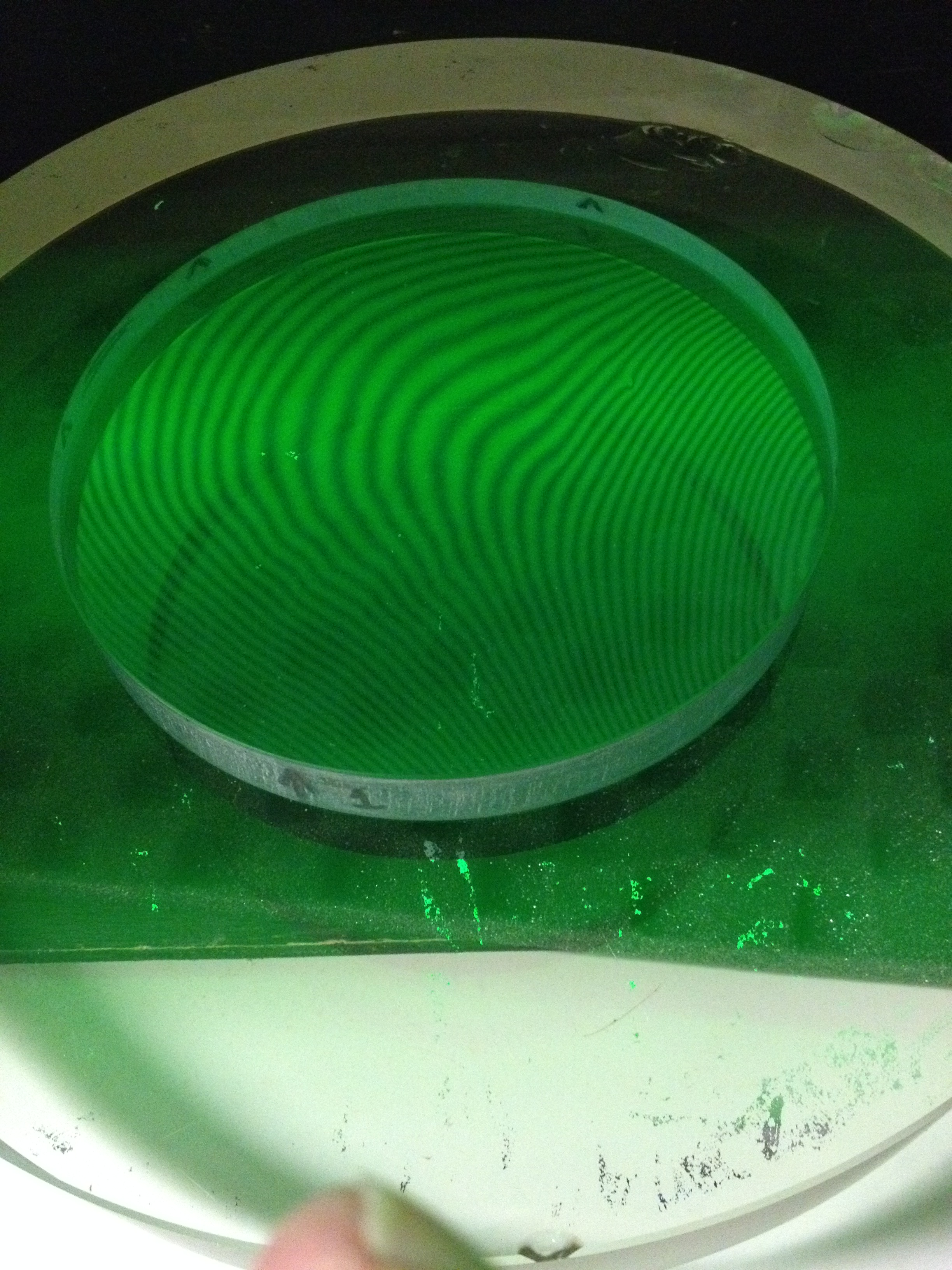
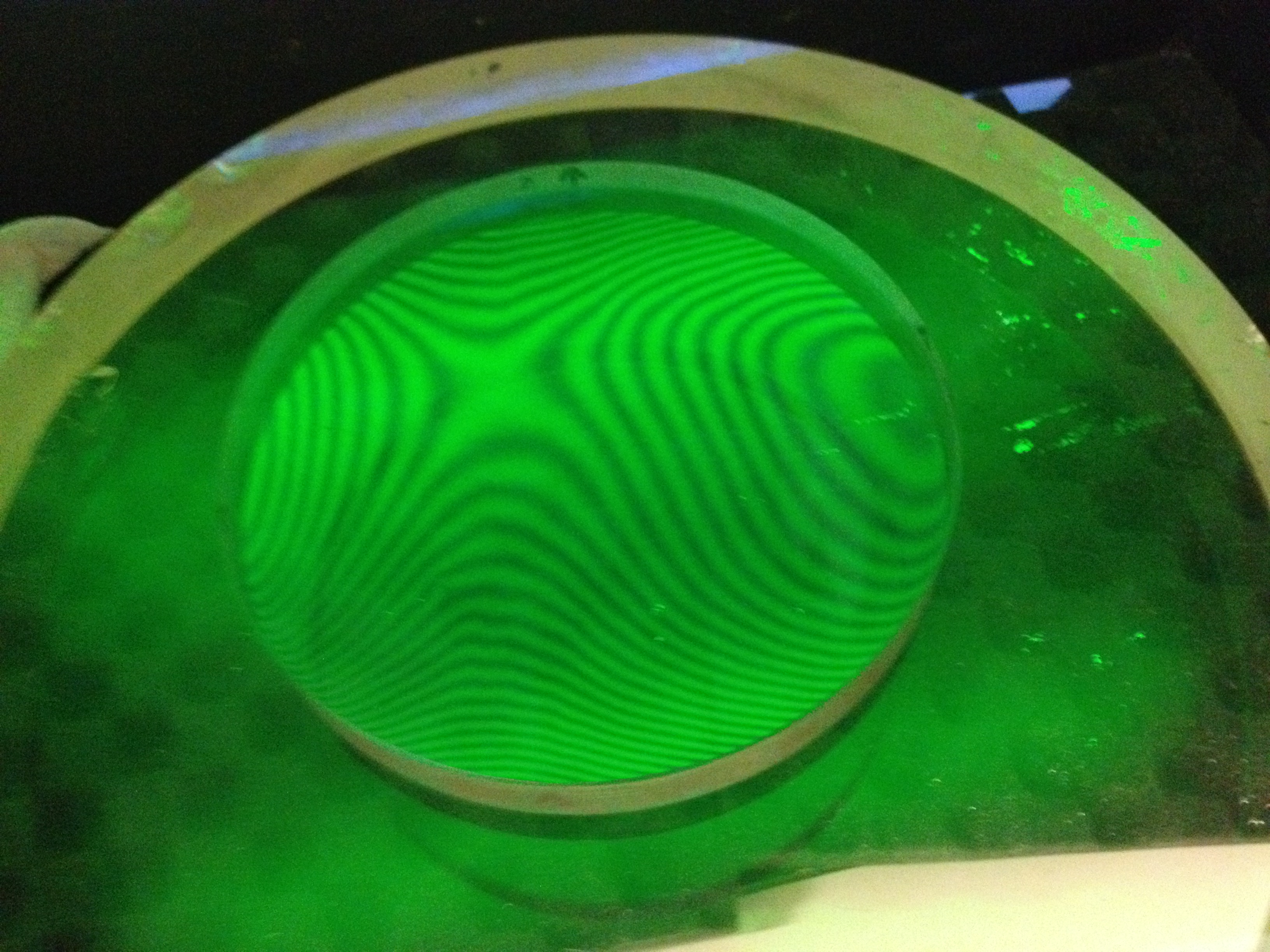
The test apparatus consists of a supposedly-flat 12-inch diameter and a monochromatic light box, and my own gradually-increasing understanding of what the interference lines actually mean. Essentially, they are like contour lines on a topographic map, but the trick is to figure out which sections represent valleys and which ones represent hills. It’s taken help from other amateur telescope makers (particularly Philip P) and sections of Malacara’s book on Optical Testing and http://www.lapping.com .

It’s pretty amazing how we can measure stuff that is soooooo small!

Here are some photos in chronological order of my working on them. I would paste some videos but WordPress won’t allow them and I don’t feel like uploading them to YouTube. BTW: I am not done!!!

022

006

008

009

That’s me looking skeptically at my cell phone, pretending to look skeptically at the glass.010

001

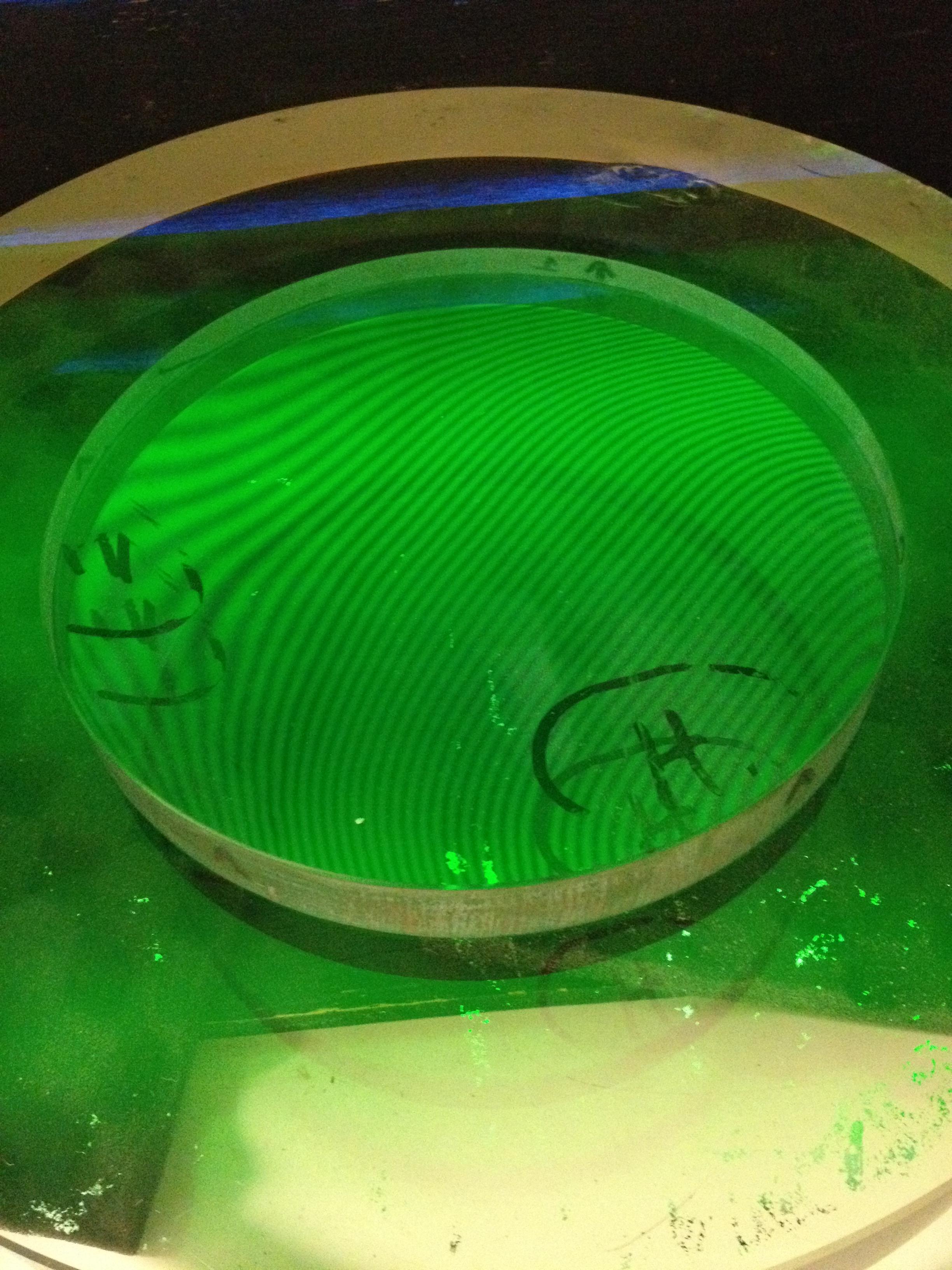
Up until this point I was trying to make the flat more perfect by using a hard Gugolz lap of full size (6 inches in diameter), much as we do with parabolizing concave mirrors. I don’t think I made a whole lot of progress. Then I read some of the papers that Philip P sent me, and re-read the Malacara, and decided to think of the contour lines in terms of measures of height, and decided to use a two-inch-diameter lap only on the parts that appeared to be “high”. I marked the back of those regions with a Sharpie permanent marker (which comes off easily with isopropyl alcohol when needed) so I could see where to work and could see if what I did made any difference.flats i guess 001The places that I marked with the letter H were High spots, kind of like you see on a weather map that is plotting isobars (lines connecting places with the same barometric pressure). The lower right-hand corner was one of those places, as was the smudged region at about 9 o’clock.

BTW I got the green color by using ordinary fluorescent lamps and two carefully-selected theatrical lighting gels to filter out all the light with wavelengths either longer than or shorter than the green Mercury vapor line of 5461 Angstroms.

By the way: I’ve discovered that the 12-inch-diameter optical flat that is underneath my 6 inch test flat isn’t as flat as I thought. Boo.

Will work on this some more this afternoon.

D’oh and Duh! 12 Inches in a Foot! My previous tables were all wrong!

Oh, jeez, what an idiot I am. I overlooked the amazingly obvious fact that the focal lengths in my table were in INCHES. I somehow thought they were in FEET, but they weren’t.

As they say about scientific investigation in general, the easiest person to fool is yourself. I see that I did a pretty good job of doing just that. Thanks to those who pointed out my error, for example Mel Bartels. I guess that’s the great thing about these interwefts: you can get immediate feedback and have other, wiser souls point out your stupid mistakes in a matter of hours or minutes.

Here’s how the table should go:

corrected min distances for star testAs you can see, the distances are still pretty long,  but not nearly as long as I claimed. For our fairly-standard 8-inch (20-cm) f/5 mirrors, the distance we would need for a good star test would be 73 feet (22 meters). We still can’t fit that inside the CCCC building in one straight line. However, I guess that if we get some good first-surface flat mirrors, we could arrange for 73 feet/22 meters if we reflect the pinhole light a few times. I also bet we won’t need that lens to reduce the size of the pinhole, which you can see here.

A 12.5″ f/6 mirror will need 119 feet, or about 3 times the width of the CCCC game room. My 16″ f/5 will need a distance of 287 feet or 87 meters. That’s a long way; 7 times the distance across our largest room! I guess we’ll need a bunch of decent small flats from Surplus Shed, as well as precision tip-tilt devices to line all those mirrors up properly.

Introducing another telescope making blog

David Collins has a nice blog where he’s been documenting his telescope making projects. His first scope, a 6″, is named the Riccioli, and his second, a 12″, is named the Schall von Bell. Beautiful workmanship and good optical practices as well. If you are interested in finding out why they have those names, you will need to read his blog.

The link for his blog is here.

Bad News on Star Testing

OOPS. These were all in INCHES, not FEET!

D’oh!! and Duh!

every single number in that table was supposed to be divided by 12 because there are, duh, 12 inches in a foot.

I have some bad news for myself and friends on the star-testing front. It turns out that even though it’s quite conceivable to make a source of light appear as a point for all practical purposes, and not too far from the telescope, I was forgetting all about spherical aberration.

The problem is that we don’t design and fabricate our telescopes so that they can look at birds or neighbors or even distant trees. Instead, our goal is to focus on sources that are INFINITELY far away – hundreds of thousands of miles or kilometers away at the very closest (i.e., the Moon and some comets). Our mirrors are designed to be paraboloids, which reflect light perfectly and to a point IF and ONLY IF the rays of light that hit the mirror are perfectly parallel to each other and to the axis of the mirror. But if the object being viewed is closer, you get a distortion that is known as Spherical Aberration. If you have objects that are, say, 8 feet away, the surface you want is a sphere with a radius of 8 feet, NOT a paraboloid. If you test a mirror at distance of merely, say, 40 feet, like I was planning to do, then your results will be all bogus: if the telescope passes the star test at that distance, then it definitely will NOT work on the stars.

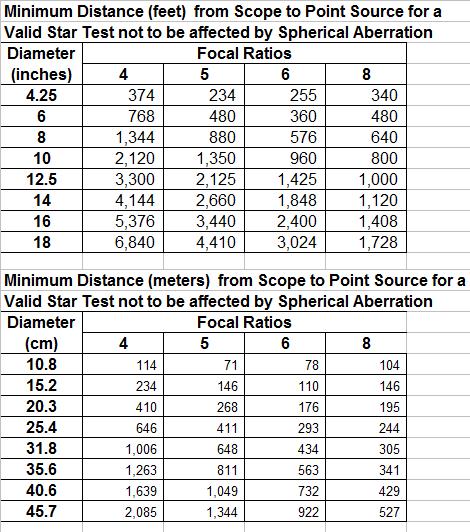
Which means that all of my rejoicing over having been able to make small holes is pretty much worthless. The source has to be much, much farther away than I thought. How do I know? I finally got a chance to re-read a section of Harold Suiter’s famous book Star Testing Astronomical Telescopes (2nd edition) and on page 2 he has a table that shows how much you have to multiply the focal length of the telescope to avoid spherical aberration.

He does not give these distances in actual feet or meters, so I thought I would calculate those distancers. It’s not pretty.

min distances for star test

So, for example, if you have an 8 – inch diameter telescope mirror, which you made to be f/5 (ie with a focal length of 40 inches, pretty typical with us), then you need for your point source to be 880 feet away from your scope,. In metric units, that would be a 20 cm diameter and a distance of 268 meters.

I do not have any idea how we are going to be able to arrange to hang a light source of any type at these distances. Notice that an 18 inch, f/5 telescope (46 cm) needs to have its point source be over 4400 feet away (1344 meters)!!!!

Thereare a couple of somewhat-distant radio towers visible from the parking lot of the Chevy Chase Community Center, but how on earth would we ever get permission to hang a tiny christmas tree ornament on one of them?

There is

The original Mémoire by Foucault, in French, which I apparently was the first to translate into English

I was given the original Memoire to translate by a now-deceased amateur astronomer (whose name escapes me). When he passed away, I figured I might as well publish it on my old blog.
Here is the link to Leon Foucault’s original article on making parabolic, silvered telescope mirrors from about 1859:

http://books.google.com/books?id=m6Y3AQAAIAAJ&pg=PA197#v=onepage&q&f=false