Most (but not all) of the variable stars I tried over the past month or so were simply too bright for this sensor. The target stars were saturated (ie some of the pixels’ electron wells simply overflowed) despite using the shortest available exposure, adding the light pollution filter and refocusing. Seestar won’t let your change the ISO nor open the shutter for less than 10 seconds.
I did get some believable light curves on BE Lyncis (aka HD67390)and U Cephii (aka HD 5679). I attack some graphs I made.
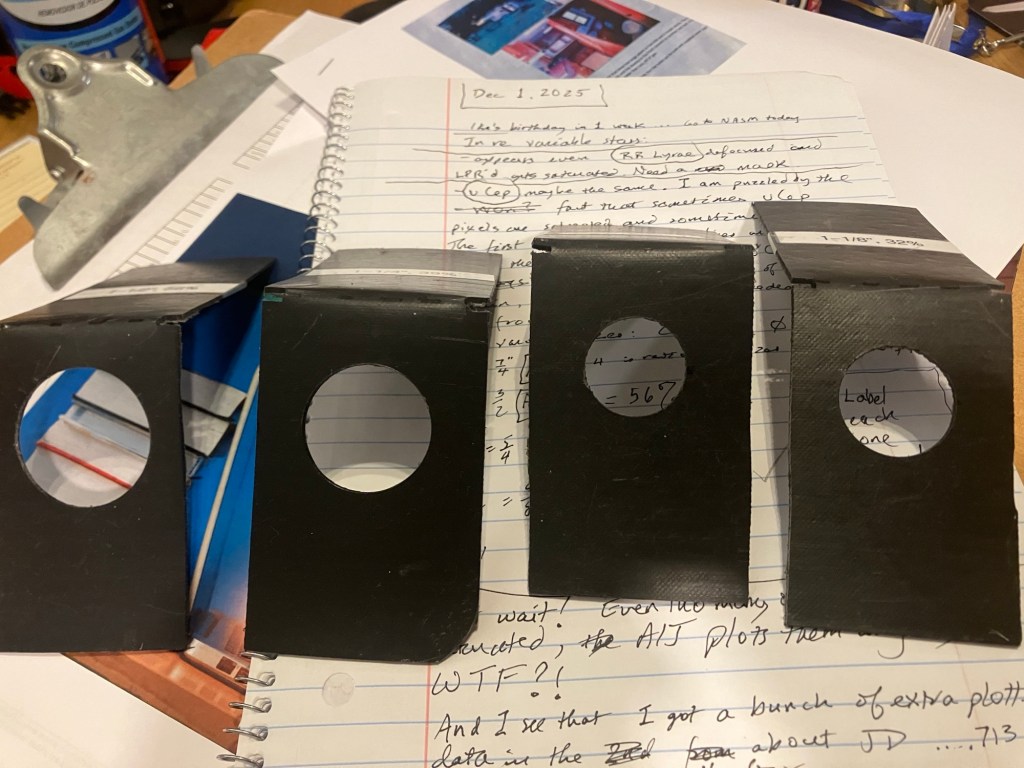
I used some black plastic I had,and my set of Forster bits, to make holes of sizes 1”, 1-1/8”, 1-1/4”, and 1-1/2”, in case I want to try brighter variable stars again like RR Lyrae.
I very impressed that Seestar absolutely nails the locations of every single one of these targets! I’m also pleased that AstroImageJ allows quick and easy plate-solving!
Dr Rob Zellem posed this question last night (9-13-2025) to NCA members and visitors at their monthly meeting at the University of Maryland Observatory.
Are we alone in the universe, or are there exoplanets with life of some sort, and even some advanced civilizations out there?
Dr Zellem said the correct answer right now is, maybe. We just don’t have enough data to tell.
He reminded us that Giordano Bruno and Isaac Newton both correctly predicted that other stars would have planets around them. We now know that just about every single star is born with a retinue of planets, asteroids, dust, and comets, so there are at least as many planets as there are stars in our galaxy and all the others as well. Previous speakers to NCA have noted that many of these objects end up getting flung out into the vast frozen emptiness of interstellar space in a giant random game of ‘crack the whip’. No life can exist out there.
My calculations here: It is estimated that there are literally trillions (10^12) of galaxies, each with millions (10^6) or billions (10^9) of stars. Let’s start with our own galaxy, the Milky Way, with maybe 200 billion stars (maybe more). I will assume that life needs a nice, calm, long-lived G class yellow star, which only make up 7.6% of all stars. Roughly 50% to 70% of those stars are in binary systems, which I fear will reduce the chances of having a planet survive in the Goldilocks zone. Perhaps one-third to two-thirds of those G stars have a planet in their habitable zone. We have no idea how likely life is to get started, but after reading Nick Lane’s The Vital Question it sounds pretty complicated to me, so I’ll use a range of estimates: somewhere between 10% and 80% of them develop some form of life. We know that on Earth, the only form of life that existed during the vast majority of the existence of the Earth was unicellular microbes. Four-footed tetrapods like ourselves have only occupied about 1% of the life of our planet, and we humans have only had the telescope for just over 400 years, out of the 400,000,000 years since four-footed animals evolved, which is one in a million. Low estimate:
If my low-end estimates are correct, then there are about five or so exo-planets somewhere in our galaxy with a civilization formed by some sort of animal that can look out into outer space. High estimate:
In that case, there are well over a hundred civilizations in our galaxy — but the Milky Way is huge, hundreds of thousands of light-years across! Most of our exoplanet detections have been within the nearest 100 light years, and we have no way of detecting most exoplanets at all because the planes of their orbits point the wrong way.
NOTE: Jim Kaiser pointed out that I made a dumb mistake: a hundred billion is ten to the 11th power, not ten to the 14th power. Fixed now.
Even so, Zellem pointed out that thanks to incredible advances in sensitivity of telescopes and cameras, we are now closer than ever to being able to answer the title question: Are We Alone.
Plus, any amateur astronomer can take useful measurements of exoplanet transits with any telescope, and any digital camera. Following the directions on NASA’s Planet Watch webpage, you can take your data, in your back yard or from a remote observatory, process it the best you can, send it in, and be credited as a co-author on any papers that are published about that particular exoplanet. Then, later, a massive space telescope can be aimed at the most promising exoplanets during their transits. Astronomers can use their extremely sensitive spectroscopes to detect the atmospheres of those bodies and look for signs of life. They do not want to waste extremely valuable telescope time waiting for a transit that doesn’t recur!
Some day we will be in a situation where scientists will be able to say that based on their measurements, the signal indicates a very good chance of life at least a bit like ours, with similar chemistry on some planet. They will also state what the chances are that they are wrong, and indicate what further steps could be made to disprove or confirm their claim.
Zellem noted that both the Doppler-shift method and the transit methods are quite biased in favor of large exoplanets that are close to their suns.
I asked the speaker how likely it would be for observers from some exoplanet to detect the planet Mercury, but couldn’t do the math in my head and didn’t have paper and pencil to write anything down at the time. But now I do.
The closer Mercury is to the Sun, the larger the possible viewing angle.
Using a calculator to find the arc-tangent of that ratio (865,000 miles solar diameter, divided by the smallest and also by the largest distances between them, namely 28,500,000 and 43,500,000 miles) gave me an angle between 2 and 3 degrees, depending. So there is a circular wedge of our galaxy where observers on some other planet might view a transit of our innermost planet. Where is that wedge in our galaxy?
The following sky diagram has the Ecliptic in pink. Only observers within a degree or so of that curvy line could detect that Sol has planets.
So what fraction of the sky can ever hope to catch a transit of Mercury? Only about 1% or 2% of the sky — not much.
Turning things around, this means that we can ourselves only detect, via transits, a very small portion of all extra-solar planetary systems – those whose planes are pointing almost directly at us, and those with large planets that are very close to their stars. (Any planet so close to a star is not a very good candidate for life, in my opinion.)
The biggest obstacle is the sheer distances between stars. At the speed of our very fastest space craft (the Parker Solar Probe), which only goes 0.064% of the speed of light, it would take about 6250 years to reach our closest stellar neighbors near Proxima Centauri. One way. Which probably explains why, if all these other civilizations do exist, we do not appear so far to have been visited by any other extraterrestrial civilization.
At the meeting, someone in the audience was pretty sure that yes, we have already been visited by aliens. I talked with him outside after the meeting. His main evidence was a 2020 New York Times article concerning the upcoming release of classified data about mysterious flying objects (now called UAPs rather than UFOs). In the article, one Eric Davis claimed (without producing any evidence) that some items have been retrieved from various places by the US military that couldn’t be made here on earth. That is of course true of every single asteroid or meteorite ever discovered, since we can’t reproduce the conditions in which they were formed, so his claim is not very helpful. No technological devices clearly of alien manufacture have ever been publicly produced by him or anybody else for testing.
(It’s pretty obvious that American and other military forces spend a lot of money producing objects that go very fast and are highly maneuverable — and which they want to keep secret.)
There are in fact many, many unsolved mysteries in science (eg, the nature of dark matter and dark energy, and exactly how the nucleus arose in eukaryotes). Many of the unidentified sky or water phenomena that have been witnessed do not have clear explanations so far, but the simplest explanation is usually the correct one. Reputable scientists require a lot more than hearsay evidence before they make bold claims.
We only truly discovered the nature of galaxies, of nuclear fusion, and of the scale of the universe a mere century ago.
Dark matter was discovered by Vera Rubin just over 40 years ago and dark energy a few years later, just before the time that both professional and amateur astronomers began switching over to CCD and later CMOS sensors instead of film
The first exoplanet was discovered only 30 years ago, and the count is now up to almost six thousand of them (as of 1/21/2024).
While multi-billion dollar space telescopes and giant observatories at places like Mauna Kea and the Atacama produce the big discoveries, amateur astronomers with a not-outrageous budget can now afford to purchase relatively small rigs armed with excellent optics and complete computer control, and lots of patience and hard work, can and so produce amazing images like the ones here https://www.novac.com/wp/observing/member-images/ or this one https://www.instagram.com/gaelsastroportrait?igsh=cjMzYWlqYjNzaDlw, by one of the interns on this project. Gael’s patience, cleverness, dedication and follow-through are all praiseworthy.
However, it is getting harder and harder every year for people to see anything other than the brightest planets, because of ever-increasing light pollution; the vast majority of the people in any of the major population centers on any continent have no hope of seeing the Milky Way from their homes unless there is a wide-spread power outage. Here in the US, such power outages are rare, which means that if you want to go out and find a Messier object, you pretty much cannot star-hop, because you can only see four to ten stars in the entire sky!
One choice is to buy a completely computer-controlled SCT like the ones sold by Celestron. They aren’t cheap, but they will find objects for you.
But what if you don’t want another telescope, but instead want to give nice big Dobsonian telescope the ability to find things easily, using the capabilities inside one’s cell phone?
Some very smart folks have been working on this, and have come up with some interesting solutions. When they work, they are wonderful, but they sometimes fail for reasons not fully understood. I guess it has something to do with the settings in the cell phone being used.
The rest of this will be on one such solution, a commercial one called StarSense from Celestron that holds your phone in a fixed position above a little mirror, and you aim the telescope and your cell phone’s camera at something like the top of a tower far away. Then it uses both the interior sensors on your cell phone and images of the sky to figure out where in the sky your scope is pointing, and tells you which way to push it to get to your desired target.
When it works, it’s great. But it sometimes fails.
You have to buy an entire set from Celestron – one of their telescopes (which has the gizmo built in) along with the license code to unlock the software.
You supply the cell phone.
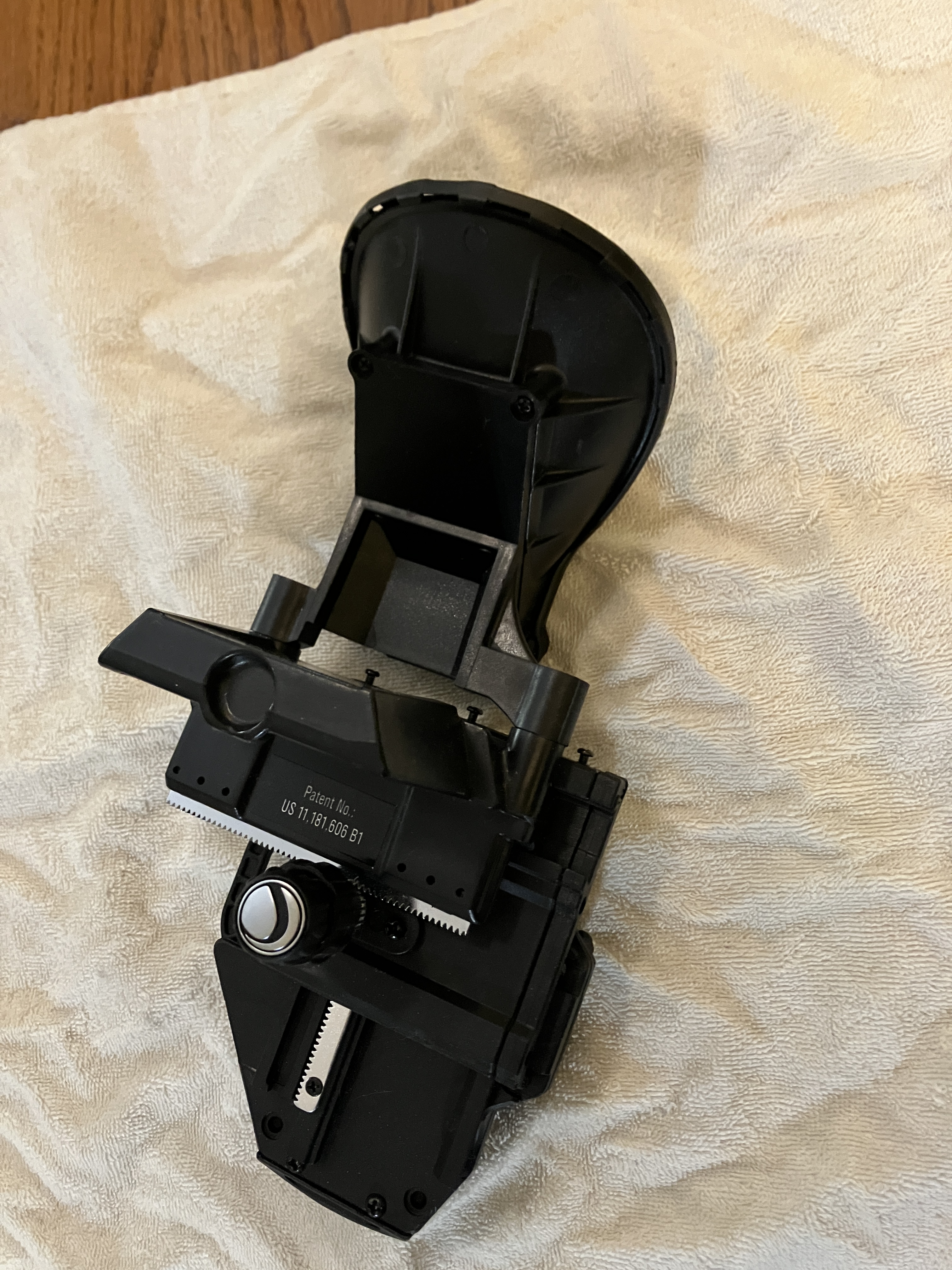
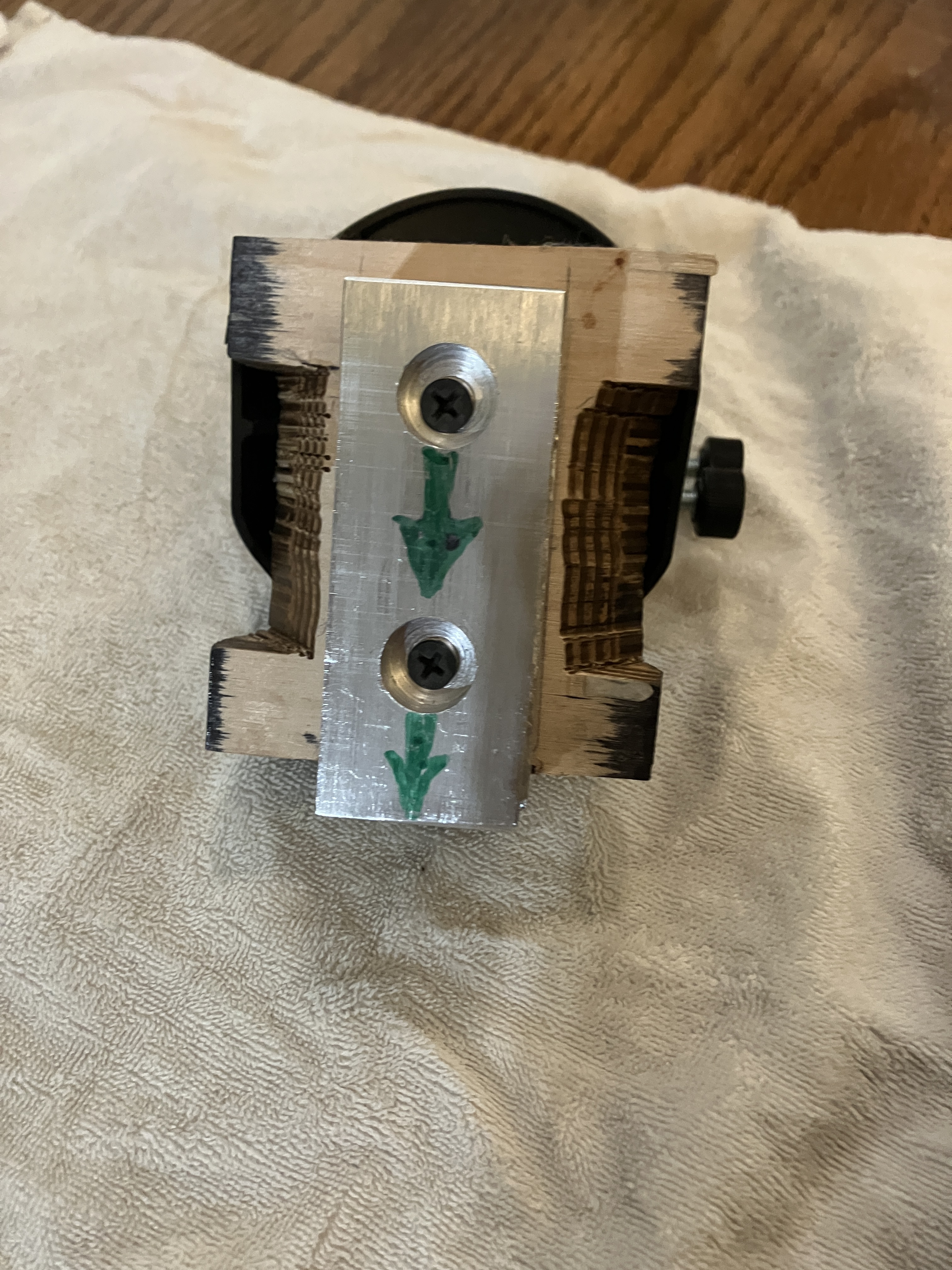
The entire setup ranges in price from about $200 to about $2,000. You cannot just buy the holder and the code from them; you must buy a telescope too. I already had decent telescopes, which I had made, so I bought the lowest-priced one. I then unscrewed the plastic gizmo, and carved and machined connection to a male dovetail slide for it. I also fastened a corresponding female dovetail to each of my scopes. The idea was to then slip this device off or onto whichever one of my telescopes is going to get used that night, as long as I that has a vixen dovetail saddle, and put inexpensive saddles on several scopes I have access to.
Here are some photos of the gizmo:
NCA’s current interns (Nabek Ababiya and Gael Gomez) and I were wondering about the geometry of the angles at which StarSense would aim at the sky in front of the scope. My guess had been that Celestron’s engineers would make the angles of their device so that the center of the optical pencil hitting the lens dead-on at 90 degrees, and hence coning to a focus at the central pixel of the CMOS sensor, would be parallel to the axis of the telescope tube.
We didn’t want to touch the mirror, because it’s quite delicate. But as a former geometry teacher, I couldn’t leave this one alone, so along with Gael and Nabek I made some diagrams and figured out what the angles had to be if the axis of the StarSense app’s image were designed to be precisely parallel to the axis of the telescope.
In my diagram below, L is the location of the Lens, and IJCK is the cell phone lying snug in its holder. The user can slide the cell phone left and right along that line JD as we see it here, or into out of the plane of the page, but it is not possible to change angle D aka <CDE – it’s fixed by the factory molds to be some fixed angle that we measured with various devices to be 19.0 degrees.
Here is a version of the diagrams we made that showed what we predicted all the angles would be so that optical axis OH will be parallel to the tube axis EBD, and that lens angle ILH is a right angle. We predicted that the mirror’s axis would need to be tilted upwards by an angle of 35.5 degrees (anle HBD).
To our surprise, our guesses and calculations were all wrong!
After careful measurements we found that Celestron’s engineers apparently decided that the optical axis of the SS gizmo should instead aim the cell phone’s camera up by 15.0 degrees (angle BGH below). The only parallel lines are the sides of the telescope tube!
We used a variety of devices to measure angle FBD and MNC to an accuracy of about half a degree; all angles turned out to be whole numbers.
Be that as it may, sometimes it works well and sometimes it does not.
Zach Gleiberman and I tested it on an open field in Rock Creek Park here in DC back in the fall of 2024, using the Hechinger-blue 8 inch dob I made 30 years ago and still use. We found that SS worked quite well, pointing us quite accurately to all sorts of targets using my iPhone SE. The sky was about as good as it gets inside the Beltway, and the device worked flawlessly.
Not too long afterwards, I decided to try out an Android-style phone (a REVVL 6 Pro) so that I wouldn’t have to give up my cell phone for the entire evening at Hopewell Observatory. I was unpleasantly surprised to find that it didn’t work well at all: the directions were very far off. I thought it might be because the scope in question had a rather wide plywood ring around the front of its very long tube, and that perhaps too much of the field of view was being cut off?
Why it fails was not originally clear. I thought nearly every modern phone would work, since for Androids, it just needs to be later than 2016 and have a camera, an accelerometer, and gyros, which is a pretty low bar these days. However, my REVVL 6 Pro from T-Mobile is not on the list of phones that have been tested to work!
Part of my assumption that the axis of the SS gizmo would be parallel to the axis of the scope was an explanation that StarSense on had such a large obstruction in front of the SS holder, in the form of a wide wooden disk reinforcing the front of a 10″ f/9 Newtonian, that the SS was missing part of the sky. We now know that’s not correct. It’s an interface problem (ie software) problem.
Come to Bull Run Mountain for a free night under the stars looking at a variety of targets using the telescopes at the Hopewell Observatory on Saturday, October 26, 2024. If it’s cloudy, we will try again on the next evening, Sunday the 27th.
You are invited, but will need to RSVP and, in this litigious age, must agree to a waiver of liability for anything that might happen up there, like tripping over rocks and trees. The waiver also includes detailed driving directions.
But if you take the risk you can view, for free, Venus, Saturn and its rings, Jupiter and its moons, Uranus, Neptune, the current comet Atlas, the Milky Way, and a whole bunch of nebulae, galaxies, Messier objects, and beautiful double stars.
We suggest arriving near sundown, which will happen near 6:15 PM. It will get truly dark about an hour later. You can stay until midnight, if you like.
There are no street lights near our observatory, other than some dimly illuminated temporary signs we put along the path, so you will probably want to bring a flashlight of some sort. In the operations cabin we have a supply of red translucent plastic film and tape and rubber bands so that you can filter out everything but red wavelengths on your flashlight. This will help preserve everybody’s night vision.
Hopewell is located on the first ridge of the Appalachian mountain chain that you see as you drive west from the DC beltway, near Haymarket. Our elevation is about 1100 feet, and we have much less of a problem with dew than other observing spots in northern Virginia. The last two miles of road are dirt and gravel, and you will need to walk about 200 meters/yards from where you park. Some parts of the road are pretty rough, so don’t drive anything with low clearance underneath. Our parking spaces are pretty limited, so consider car-pooling if possible. Handicapped persons or telescopes can be dropped off at the observatory.
We do have electricity, and a heated cabin, but since we have no running water, we use bottled water, hand sanitizer, and a pretty nice outhouse. We will have the makings for tea, coffee, and hot cocoa in that cabin.
If you like, you can bring a picnic dinner and a blanket or folding chairs, and/or your own telescope or binoculars, if you own one and feel like bringing them. We have outside 120VAC power, if you need it for your telescope drive.
At this time of year, the bothersome insects have mostly gone dormant, but feel free to use your favorite bug repellent, (we have some). Remember to check yourself for ticks after you get home.
We have a variety of permanently-mounted and portable telescopes of different designs, some commercial and some made by us. Two of our telescope mounts are permanently installed in the observatory under a roll-off roof. One of the mounts is a high-end Astro-Physics mount with a 14” Schmidt-Cassegrain and a 5” triplet refractor. The other mount was manufactured about 50 years ago by a firm called Ealing, but the motors and guidance system were recently completely re-done by us with modern electronics using a system called OnStep. We didn’t spend much cash on it, but it took us almost a year to solve a bunch of mysteries of involving integrated circuits, soldering, torque, gearing, currents, voltages, resistors, transistors, stepper drivers, and much else. We could not have completed this build without a lot of help from Arlen Raasch, Prasad Agrahar, Ken Hunter, and the online “OnStep” community.
We also have two home-made Dobsonian telescopes (10″ and 14″ apertures) that we roll out onto our lawn, and have been lent a pair of big binoculars on a parallelogram mount.
The location of the observatory is approximately latitude 38°52’12″N, longitude 77°41’54″W.
Click here for the RSVP form to get detailed directions. You must sign the waiver to visit. If we cancel on Saturday the 26th because of bad weather, we will notify you by email and will try again on Sunday the 27th.
When I show people things in the sky with a telescope, I want to help them to realize how lucky we are to live on a nice, warm, wet little planet in a relatively safe part of a medium-large galaxy.
I also want them to realize that if we aren’t careful, we could turn this planet into one of those many varieties of deadly hell that they are viewing in the eyepiece.
We should be very thankful that this planet got formed in a solar system that had sufficient oxygen, silicon, iron, nitrogen, and carbon for life as we know it. We are fortunate that all of those ‘metals’ I just listed (as astronomers call them) got cooked up in cycle after cycle of stars that went boom or whooshed their outer layers into the Milky Way. We are lucky to be alive at the far multicellular side of the timeline of life on Earth*, and that no star has gone supernova in our neighborhood recently or aimed a gamma-ray burst directly at us.
We are exceedingly lucky that a meteorite wiped out the dinosaurs 65 million years and allowed our ancestors, the mammals, to take over. We can rejoice that most of us in the USA can have our physical needs (food, shelter, clean water, clean air, and communication) taken care of by just turning a knob or a key, or pushing a button, instead of hauling the water or firewood on our backs. (There are, obviously, many folks here and abroad who live in tents and who have essentially none of those nice things. We could do something about that, as a society, if we really wanted to.)
I am often asked whether there is life elsewhere. My answer is that I am almost positive that there are lots of planets with some form of life in every single galaxy visible in an amateur telescope. But there is no possible way for us humans to ever visit such a planet. Nor can aliens from any exoplanet ever visit us, whether they be single-celled organisms or something you would see in a Sci-Fi movie.
Yes, it is possible to send a handful of people to Mars, if we are willing to spend enormous sums of money doing so, and if the voyagers are willing to face loss of bone and muscle mass, and the dangers of lethal radiation, meteorites, accidental explosions, and freezing to death. If they do survive the voyage, then by all means, let them pick up some rocks and bring them back for analysis before they die.
But wait: we already have robots that can do that! Plus, robots won’t leave nearly as many germs behind as would a group of human beings. And we already know a lot about how Mars looks, because of all the great photos sent back by ESA, JAXA, NASA and others for some decades now. You can see photos taken by NASA at JMARS, which I highly recommend. (https://jmars.asu.edu/ )
While one can justify sending a few brave folks to Mars for a little while, it is completely insane to think that we can avoid our terrestrial problems by sending large populations there. Mars is often colder than Antarctica, is close to waterless, has poisonous perchlorates in its soil, no vegetation whatsoever, and no atmosphere to speak of. How would millions or billions of exiles from Earth possibly live there? Do you seriously think they can gather enough solar energy to find and melt sufficient water to drink and cook and bathe and grow plants and livestock in the huge, pressurized, aluminum cans they would need to live in? No way.
I wish there was some way to get around the laws of physics, and that we could actually visit other exoplanets. But there isn’t, and we can’t. I’ve seen estimates that accelerating a medium-sized spaceship to a mere 1% of the speed of light would require the entire energy budget of the entire human population of the planet for quite some time. (For example, see https://physics.stackexchange.com/questions/447246/energy-requirements-for-relativistic-acceleration )
Let us assume, for the sake of argument, that you could actually generate enough energy to accelerate that spaceship with nuclear fusion or something else that doesn’t violate the laws of physics as far as we know.
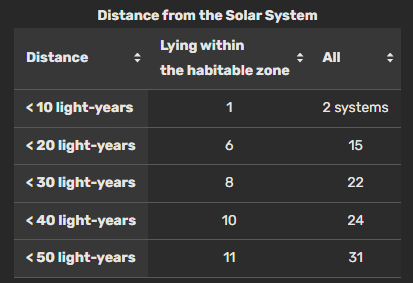
The next problem is the distance. It’s a bit over 4 light years to the nearest known exoplanet in a straight line, (compared with under 2 light-seconds for the Moon or about 35 light minutes for Jupiter). The table below gives the number of planets lying each extra solar system that are thought to be terrestrial (as opposed to gas giants) and to be within their stars’ habitable zones. Nobody knows if there is any life on any of those planets right not, but it is possible that astronomers may one day figure out a very effective way to test for extra-solar life. Let us suppose that a few of the ones in this list do have breathable atmospheres and are neither too cold nor too hot, have a fair amount of liquid water, and are protected from nasty radiation by magnetic fields and belts.
Unfortunately, a one-way trip to Proxima or Alpha Centauri for any possible spaceship, at one percent of the speed of light, (3,000 km per second), in a straight line, and pretending that you don’t need years and years to both accelerate and decelerate, would take over four centuries. And that’s for the very closest one! All the other planetary systems are many multiples of that distance! See this or this table:
Our fastest spacecraft so far, the Parker Solar Probe, reaches the insanely fast speed of 190 km/sec, but that’s still fifteen times slower than my hypothetical 1% of c. At the speed of Parker, it would take around six thousand years to reach the Proxima Cen planetary system! If all goes well!
Do you seriously think that a score or so generations of humans would all agree, century after century, that they, and their descendants — born and raised in a big metal box rushing through space — for the entire 400 years, would consent to live in a large metal box with no gravity to speak of, subject to who knows how many blasts of gamma rays, x-rays, and super-high-energy cosmic particles? What are the chances that each single generation would agree to stay the course and that not a single meteorite going the other direction, over a course of four centuries, would happen to smash into the space ship and instantly disable all the life support systems and kill all the passengers, quickly or slowly?
And how do you keep alive all the animals we would need to feed us upon arrival? I guess you compost all the poop from all the cattle, chickens, and so on. But do you also bring zillions of insects and tons of plant seeds as well, knowing full well that if you do so, then you lose the vast majority of the information you could have learned about an actual, functioning, extra-solar ecosystem like nothing we can possibly imagine.
The argument is made that perhaps the travelers would be put into suspended life. If that were possible, and nothing went wrong, upon arrival, they could take a triumphant group selfie and put it into a radio message back to Earth saying, “Hi, we made it, wish you were here…” That reply will of course take four years to reach Earth. Would people back on Earth still remember the handful of people who began the trip out, made over four centuries earlier? What will the humans back on earth remember about the absolutely prodigious effort expense that their ancestors had made to build and power that rocket, 20 generations or so earlier?
Let us suppose they have the tremendous luck to find, after 4 to 10 centuries of travel, a nice warm exoplanet with water, oxygen-producing life, and air that we can breathe.
Unfortunately, there is an overwhelming chance that there would be no humanoids or any other Sci-Fi characters. The chances are that creatures that look like insects, crustaceans, fish and salamanders are the most highly-organized life forms – at best; after all, for most of the existence of life on earth, it was single-celled organisms! Our travelers would have to have to build an entire urban and agricultural infrastructure *from scratch*, with no help. They could only do that if the plants and animals they brought from Earth are able to flourish.
The return trip, if desired, would of course take another four or more centuries, if the handful of travelers can find a proper power source and if they can figure out how to create, completely from scratch, an entire agricultural and industrial instructure. They would have to figure out where the natural resources of that planet (wood? minerals? energy sources?) are located, and how they can make use of them, to build something like the incredibly precise absolutely enormous rocket-building industries we have here, on a hypothetical planet that has never even had any mammals living on it.
If these voyagers should run into any technical problem while doing trying to build a modern civilization from nothing, fat chance of getting a prompt reply from Earth, since the question would take years to reach its home base back here!
Yes, the very closest exoplanets are a mere 4 LY away, but the others are all much, much farther away, so one-way trips for ones within 10 parsecs, i.e., in our tiny corner of our galaxy, at one percent of the speed of light, would require a thousand to three thousand years to reach. Each way.
Forget it. Just send a radio message, and see if we get a reply. Oh, wait – we’ve been doing that for several decades so far. No reply so far.
Speaking of radio – it’s only 120 years since Marconi first sent a very crude radio message from a ship to a station on land, and now we routinely use enormous parts of the entire electromagnetic spectrum for all sorts of private and public purposes, including sending messages like this one. Astronomers are able to gather amazing amounts of information via the longest radio waves to the very shortest gamma rays and make all sorts of inferences about worlds we have never seen at optical wavelengths. In addition, we have begun detecting gravity waves from extremely distant and powerful events with devices whose accuracy is quite literally unbelievable.
There is no planet B. We must, absolutely must, take care of this one, lest we turn into one of those freezing or burning variations of hell that we see through our eyepieces. Think I’m being alarmist? We now know this nice little planet Earth is more fragile than we once believed. It has been discovered that life was almost completely wiped out on this planet several times. The Chixculub impact I mentioned earlier, the Permian extinction and Snowball Earth are just three such events.
More recently, folks thought it was impossible for people to cause the extinction or near-extinction of the unbelievably huge flocks and herds and schools that once roamed the earth: passenger pigeons, buffaloes, cod, salmon, redwoods, elms, chestnuts, elephants, rhinos, tropical birds, rainforests, and so on, but we did, and continue to do so. The quantities of insects measured at site after site around the world have plummeted by 30 to 70% and more, over just a few decades, and so have the numbers of migratory birds observed on radar feeds. Light pollution, the bane of us amateur and professional astronomers, seems to be partly responsible for both the insect and bird population declines. The rise in the levels of atmospheric carbon dioxide and global temperatures are very scary.
In addition, we are dumping incredible amounts of plastic into the oceans, and rising water temperatures are causing coral reefs around the world to bleach themselves and die, while melting glaciers are causing average sea levels rise and threaten more and more low-lying cities.
What’s more, only a very tiny fraction of our planet’s mass is even habitable by humans: the deepest mine only goes down a few miles, and people die of altitude sickness when they climb just a few miles above sea level. Most of the planet is covered by ocean, deserts, and ice cap. By volume, the livable part of this planet is infinitesimal, and the temperatures on it are rising at an alarming rate.
Will we be able to curb the burning and leaking of fossil fuels sufficiently so as to turn around the parts of global warming caused by increases in carbon dioxide and methane? I am not optimistic, given that the main emitters have kept essentially none of the promises that they have been making to those various international gatherings on climate, and graphs like this one, taken from: https://ourworldindata.org/fossil-fuels
I have been wondering whether we may need to reduce temperatures more directly, by putting enough sulfur compounds into the stratosphere. We have excellent evidence that very violent volcanic eruptions have the power to lower global temperatures with the sulfates they put into the stratosphere. It would not be great for ground-based astronomy if such compounds were artificially lofted high into the atmosphere to lower global temperatures, and we won’t know for sure exactly which areas of the planet would benefit and which would be harmed, but at least it’s an experiment that can be stopped pretty easily, since the high-altitude sulfates would dissipate in a few years. High-altitude sulfur compounds do not seem to cause the obvious harm that SO2 does at the typical altitude of a terrestrial coal-burning power plant.
Adding iron to the oceans to increase the growth of phytoplankton, which then consumes CO2, dies, and settles to the bottom of the ocean, has been tried a number of times, but doesn’t seem to have a very large effect.
I agree that large-scale injection of sulfates into the stratosphere is scary. I also agree that there is a whole lot of unknown unknowns out there and inside of us, and we are being very short-sighted, as usual.
We have mapped the far side of the moon better than we have mapped the floors of Earth’s oceans – yet permits are being filed right now to begin deep-ocean dredging for manganese nodules, which will enrich some folks greatly. Unfortunately, that dredging is bound to utterly destroy those slow-growing ecosystems, before we even know what’s down there in the first place!
We continue to dump unbelievable amounts of plain old trash, fish nets, fishing lines, live ammunition, modern warships and hazardous chemicals into the oceans.
While the waters and atmosphere of the USA are much, much cleaner now than they were when I was a kid in the 50s and 60s, places like Delhi or Beijing are so polluted that folks can barely see the sun on a clear day.
If dark matter and dark energy really do exist, that means that scientists have absolutely no idea what 96% of the universe is made of!
If dark matter and dark energy don’t exist, then that means that astrophysicists don’t understand long-distance gravity and physics nearly as well as they thought. The late Vera Rubin (a past NCA member who should have won a Nobel for her careful measurements of the rotational measurements of galaxies that led to the Dark Matter hypothesis) once told me when we were co-chaperoning a field trip to the Smithsonian for the Carnegie Institution for Science’s Saturday program for middle-schoolers, that she thought that the entire question is perfectly open. I think she’s still correct.
If the Big Bang is real, then how come the Webb is seeing fully-formed galaxies as far back in time as it can see?
Do the alternative theories to the Big Bang (eg, Burbridge’s hypothesis that matter is being created in the centers of active galactic nuclei) make any sense?
But — does anybody have better solutions?
Can we engineer our way out of the mess we are making on this planet – the only home that humans will ever have?
There is cause for optimism:
Our NCA speaker this month, Deborah Shapley, will tell how, almost exactly a century ago, astronomers finally figured out that the Milky Way was just one of many billions of other galaxies. Since that time, the amount of astronomical information gathered has been staggering, as has the efficacy of the instruments!
After scientists figured out what was causing the ozone hole, every single agency and government in the entire world passed and enforced regulations that banned those chlorofluorocarbons that were used in almost everything from air conditioners to hair spray. Since that time, there has been almost complete compliance and agreement, and the ozone hole continues to shrink, as you can see here.
I have vivid memories about how smoggy and stinky the air used to be on a typical summer day in almost any American city of my youth. A fat-rendering plant right here in Georgetown (DC) stank worse than a hundred skunks, and is now gone. I know a paper mill in West Virginia whose fumes had long killed almost all the vegetation downwind of the factory. Nearby, acid drainage from an abandoned coal mine turned a stream so acidic that the rocks (and water) were amazing shades of orange, reds, and yellow. The rivers of this national often flowed with raw sewage, trash, and mine waste. Some, like the Cuyahoga, even caught fire, repeatedly (see https://www.smithsonianmag.com/history/cuyahoga-river-caught-fire-least-dozen-times-no-one-cared-until-1969-180972444/ ). The passage and actual enforcement of the Clean Air and the Clean Water Acts have cleaned up the air and water in this country to an amazing degree in my lifetime (I’m over 70). The cleanup of the Potomac and Anacostia Rivers in that period has also been tremendous. However, my friends who grew up in India and China tell me that the air and water pollution over there is worse than I can possibly imagine and is not improving at all.
When I was young, it appeared that nearly every adult I knew chain-smoked cigarettes and drank a lot of alcohol, and the bars, restaurants, dormitories, private houses, classrooms, buses and airplanes everywhere were filled with tobacco smoke. Despite the lies and obfuscation of the tobacco industry, not only legislation but also public opinion is such that today, I seldom encounter the nasty smell of tobacco smoke anywhere, even on people’s clothing on the bus or subway, and the number of drunk-driving fatalities is way down as well.
During my youth, the various nuclear powers exploded literally hundreds of nuclear weapons in the open air and underwater, spewing Strontium-90 and other radionucleides into things like cow or human milk, and doing untold destruction to the oceans nearby. While the number of world-wide nuclear explosions per year has dropped tremendously since then, they still continue, and may start up again on a larger scale.
Some noteworthy experiments re stopping global warming are listed in this month’s National Geographic. One of them, which has promise but also obvious drawbacks, involves dumping large quantities of finely ground-up alkaline rocks and minerals like olivine counteract the increasing acidification of the seas being caused by the absorption of so much carbon dioxide. Will these experiments work? I don’t know.
But let us not turn this planet – the only home we will ever know – into one of the barren, freezing or boiling versions of hell we see in the eyepieces of a telescope.
I have raised pigs, and I noticed that they never foul their own beds, if they are given any room to move around. Let’s be better than pigs and stop trying to extract riches in the short run while destroying the lovely planet we all love in the long run!
Heaven is not somewhere else.
It’s right here, if we can keep it that way and fix the damage we have done.
* For five-sixths of the roughly 3.7-billion-year time line of life on earth, all living things were single-celled microbes (or microbes living together in colonies). We mammals have only been important for the last 1.7% of that time, (ie since the dinosaurs died out 66 million years ago), the first known writing system was invented a few millennia ago, and Marconi only sent the first ship-to-shore radio message 130 years ago, which is an infinitesimally small fraction of 3.7 billion. Home radios only became popular 100 years ago.
Assuming that planets and stars are created at random times in the history of the universe, and assuming that a certain amount of enrichment of the interstellar medium by many generations of dead stars is necessary before life can begin at all, then it looks to me like the odds are not at all good for intelligent life of any sort to exist right now on any random planet we may study. And, unfortunately, if they do exist, we will never meet them. If there is an incredibly advanced civilization somewhere within 100 light years that can actually detect those first radio signals, then they just received our first messages. If they do respond, we won’t get the answer for another century or two!
For example, take a look at this time line of life on earth at a linear scale. If a hypothetical space traveler should somehow arrive on the 3rd rock from our Sun at a random moment in time over the past 4.5 billion years, then that’s like tossing a dart at this graph while blindfolded, and seeing where it lands. Notice the kind of organisms dominating during most of the past 4 billion years! The chances that they would happen to arrive here in the past few centuries or so, when we humans began to really understand science, are vanishingly small!
My original title began with “Space Travel is Impossible” — which is obviously false, because it is an incontrovertible fact of history that a handful of American astronauts, at enormous expense, did in fact land on the Moon and return. I remember the event well; I was working in a factory in Waltham, Mass that summer as part of the SDS Summer Work-In.
I should have written, “Space Travel to Exoplanets Is Impossible”.
But you could make the case that traveling to the Moon is barely even space travel! The distance to the moon is less than the total mileage on my last two automobiles (a Subaru Forester and a Toyota Prius) added together. Or, at the speed of light, the Moon is about 1.5 light-seconds away, the Sun about 8 light-minutes, Jupiter 34 light-minutes, and Saturn is about 85 light minutes this month. But the very nearest star-planet system to us is over four YEARS away, and the distances to the vast majority of exoplanets are measured in light-decades, light-centuries, or light-millennia.
I remember the Space Race! Both the USA and the Soviets poured incredible sums of cash, labor, raw materials, and brain power into that race, while, frankly, millions of people around the world starved or were killed in proxy wars between those two powers, representing two ideological and political opposing blocks. The incredibly expensive and dangerous race to win global prestige by being the first power bloc to reach the various goals has, so far, at its apogee, carted a handful of men to the near side of our Moon, less than two light-seconds away! And some people think we can easily travel to exoplanets that are light-decades or light-centuries away!












 Guy's Math & Astro Blog