
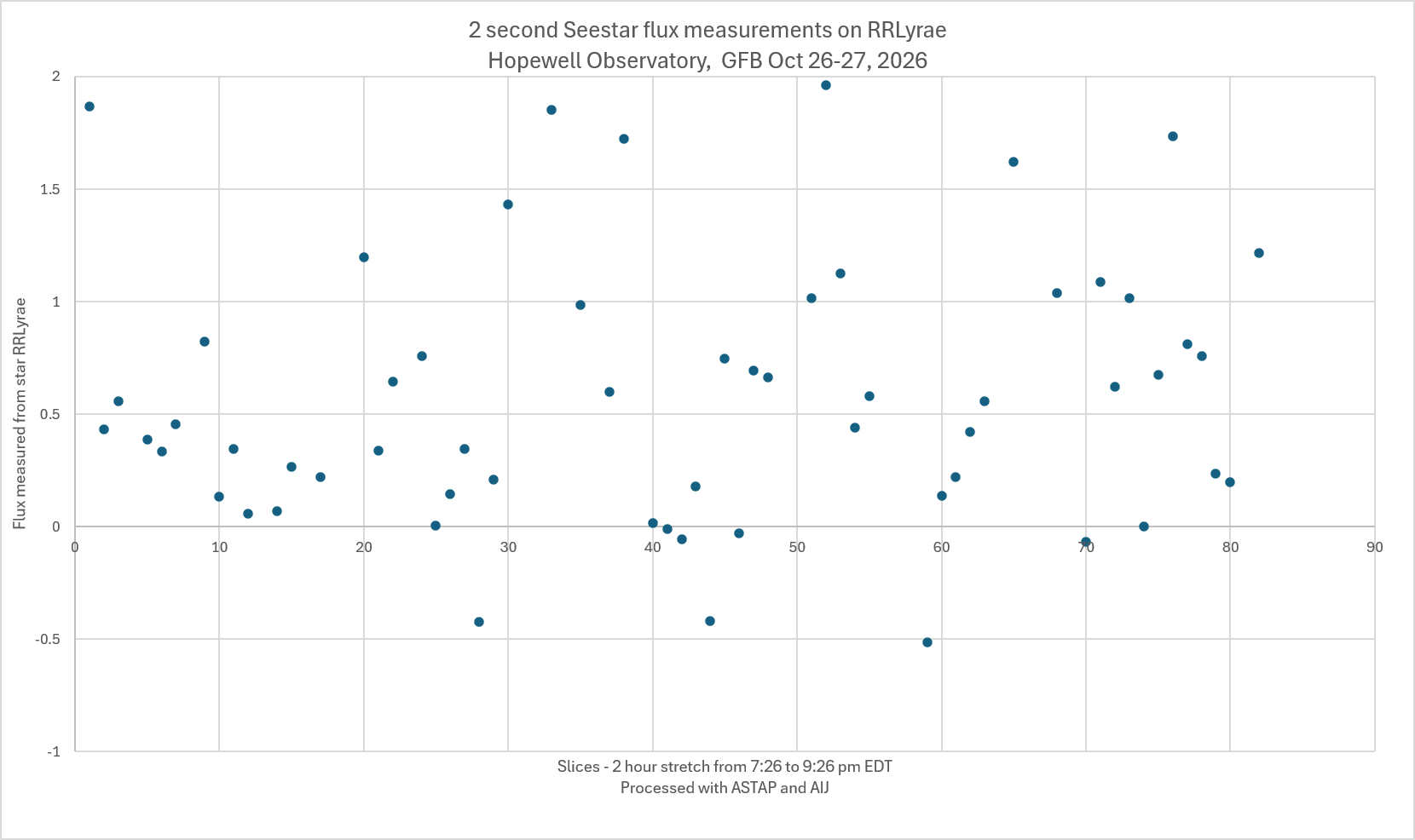
This last experiment doesn’t look very promising. This a classic graph of random noise.
Unfortunately, it’s what I got during two hours of two-second exposures of known variable star RR Lyrae, two nights ago. These were the shortest times ever available for the ordinary user; the engineers at ZWO apparently listened to complaints that 10 seconds was the very shortest exposure time available
I had previously found that even at 10 seconds, and de-focusing, and applying the light pollution filter, the pixels capturing light from RRLyrae and many other well-known variable stars were generally over-filled (saturated), which meant that I couldn’t do any useful measurements. I had remembered to bring
However, after asking ASTAP and AIJ to process a sample of 859 short exposures, it looks to me that, unfortunately, the Seestar chip is just too noisy to be very useful at all for photometry.
Phooey.

