• My series on making a Newtonian telescope
  • How Leon Foucault Made Telescopes

Guy's Math & Astro Blog

Guy's Math & Astro Blog

Category Archives: astronomy

Disturbing Racist Clauses Found in Early NCA Constitutions & Bylaws

29 Wednesday Sep 2021

Posted by gfbrandenburg in astronomy, History, science, Telescope Making

≈ Leave a comment

Tags

Albert Einstein, amateur, astronomy, Black people, by-laws, Carnegie Institution of Washington, Caucasian, CIW, constitution, DC, ERO, Eugenics, Eugenics Records Office, Fairfax, George Carruthers, High Schools, History, Hitler, Montgomery County, National Capital Astronomer, Nazis, NCA, Prince George's County, Racism, science, Segregation, Star Dust, Washington

By Guy Brandenburg

Recently, while preparing to give a talk at this year’s Stellafane telescope-makers’ convention, I was disappointed to discover that the National Capital Astronomers (NCA), which I’ve belonged to for about 30 years, specifically excluded Black members for nearly 3 decades: from about 1940 all the way up to1969.

But NCA didn’t start out being overtly racist. Our original 1937 founding document has no such language. It reads, in part,

“The particular business and objects of [the NCA] shall be the education and mutual improvement of its members in the science of Astronomy and the encouragement of an interest in this science among others. (…) The activities of this Association are designed for the enjoyment and cultural profit of all interested in astronomy, whether the member be a beginner, an advanced student, or one whose pursuit of the science is necessarily desultory.”

And today’s NCA home page reads, “All are welcome to join. Everyone who looks up to the sky with wonder is an astronomer and welcomed by NCA. You do not have to own a telescope, but if you do own one that is fine, too. You do not have to be deeply knowledgeable in astronomy, but if you are knowledgeable in astronomy that is fine, too. You do not have to have a degree, but if you do that is fine, too. WE ARE THE MOST DIVERSE local ASTRONOMY CLUB anywhere. Come to our meetings and you will find this out. WE REALLY MEAN THIS!”

But in the 1940’s, the original open-minded and scientific NCA membership policy changed. The January 1946 Star Dust listed a number of changes to be voted on by the membership in the club’s founding documents. (See https://capitalastronomers.org/SD_year/1946/StarDust_1946_01.pdf ) The organization voted to change article III of its constitution as follows:

From:

“only Caucasians over 16 years old are eligible for membership.”

To this:

“to include all ages (see by-laws), exclude only the Black race.”

While it may be shocking that a scientific organization like NCA had such a policy, people often forget how racist a nation the USA used to be, and for how long. If you look up actual pages of DC area newspapers from the 1950s, you will note that the classified advertisements were largely segregated both by race and by gender – want ads would very often specify male or female, single or married, White-only or Colored-only jobs, apartments, and so on.

Schools in DC, MD, and Virginia were mostly segregated, either by law or in practice, up until the late 1960s or early 1970s. The 1954 Brown v Board decision had very little real impact in most areas until much, much later. Queens (NYC), PG County (MD) and Boston (MA) had violent movements against integrating schools in the 1970s. I know because I attended demonstrations against those racists and have some scars to prove it.

While the Federal and DC governments offices were integrated immediately after the Civil War, that changed for the worse when Woodrow Wilson was elected President in 1912.

Many scientists in the USA and in Europe believed the pseudo-scientific ideas of racial superiority and eugenics that arose around 1900 and were still widespread 50 years ago – and even today, as recent events have sadly shown.

In The War Against the Weak: Eugenics and America’s Campaign to Create a Master Race, Edwin Black explains how august scientific institutions like the Carnegie Institution of Washington (CIW), the American Natural History Museum in New York, and a number of eminent statisticians and biologists for many decades supported the Eugenics Records Office (ERO) at Cold Spring Harbor. So did the fabulously wealthy Rockefeller and Harriman Foundations.

The ERO pushed the concept of the genetic superiority of the ‘Nordic’ race and helped to pass State laws sterilizing the ‘weak’ and forbidding interracial marriage. They were also successful in passing the 1924 Federal immigration law that severely cut back immigration from parts of the world where supposedly ‘inferior’ people lived – e.g. Eastern and Southern Europe. As a result, many Jews who would have loved to escape Hitler’s ovens by crossing the Atlantic never made it.  

Hitler and his acolytes always acknowledged their ideological and procedural debt to American eugenical laws, literature, and propaganda. As we all know, Germany’s Nazis put those ideas to work murdering millions of Jews, Gypsies, Slavs and others.

It took more than three decades for the CIW to withdraw their support of the ERO. A CIW committee concluded in 1935 “that the Eugenics Record Office was a worthless endeavor from top to bottom, yielding no real data, and that eugenics itself was not a science but rather a social propaganda campaign with no discernable value to the science of either genetics or human heredity.” (Black, p. 390) The members pointedly compared the work of the ERO to the excesses of Nazi Germany. However, it took four more years for CIW to cut all their ties – shortly after Hitler invaded Poland in 1939, starting World War Two.

I don’t know exactly when the ‘Caucasian’-only policy became part of the NCA rules, but it seems to have been between the club founding in 1937, and October 1943 when volume 1, number 1 of Star Dust was printed. At one point, perhaps around 1940, NCA decided that only ‘Caucasians’ over 16 could join. But as indicated above, in 1946, the racial exclusion policy was narrowed to only exclude Black people. Apparently Jews, Italians, young people, Latin Americans, and Asians were eligible to join NCA from 1946 to 1969. But not African-Americans.

While researching my talk, I found that the NCA held amateur telescope-making classes at a number of all-white DC, MD, and VA high schools, from the 1940s through about 1970, both during the days of de jure segregation and the merely de-facto type: McKinley, Roosevelt, Central, Bladensburg, Falls Church, and McLean high schools are listed. While Star Dust mentions a telescope-making course at (the largely-Black) Howard University in 1946, there is no mention of any assistance for that course from NCA.

I also found no evidence in any issue of Star Dust from that era that anybody at the time raised any vocal objections to racial exclusion. Not in 1946, nor 23 years later when the rule prohibiting Black members was quietly dropped (in 1969) when a new constitution was adopted.

A few current or past NCA members confirmed to me that at some point, they noticed that racist language and privately wondered about it. One person told me that they definitely recalled some now-deceased NCA members who were openly racist and not shy about expressing those views. Others told me that they had never heard any discussion of the subject at all.

 (As one who grew up in DC and Montgomery County, and attended essentially-segregated public schools there, I am sorry that neither I nor my family actively spoke up at the time, even though a farm adjacent to ours in Clarksburg was owned by a Black family [with no school-age children at the time]. Amazing how blind one can be! The racists of those days were not shy about committing violence to achieve their ends. Fear might be one reason for silence.)

One possibility is that some of the early NCA meetings might have been held at private residences; perhaps some of the racist members insisted in preventing non-‘Caucasian’ or ‘Black’ people from attending. It is too bad the other NCA members didn’t take the other route and stay true to the original ideas of the club, and tell the racist members to get lost.

Very ironic: the late George Carruthers, a celebrated Naval Research Labs and NASA scientist, and an instrument-maker for numerous astronomical probes and satellites, gave a talk to the NCA in September of 1970 – not too long after the NCA apparently dropped its racist membership rules (April, 1969). So, a mere year and a half before he gave his talk, he could not have legally joined the organization. Nor could he have done so when he was making his own telescopes from scratch as a teenager in the 1940s. See https://en.wikipedia.org/wiki/George_Robert_Carruthers on the life and work of this great African-American scientist and inventor.

To NCA’s credit, we have done better in the past few decades at encouraging participation in telescope viewing parties, telescope making, and lectures by members of all races and ethnic groups. However, I often find that not very many NCA members bring telescopes to viewing events, or show up to judge science fairs, in mostly-minority neighborhoods. Often, it’s just me. That needs to change. We need to encourage an interest in science, astronomy, and the universe in children and the public no matter their skin color or national origin, and we need to combat the racist twaddle that passes for eugenics.

I anticipate that NCA will have a formal vote repudiating the club’s former unscientific and racist policies and behavior. I hope we will redouble our efforts to promote the study of astronomy to members of all ethnic groups, especially those historically under-represented in science.

We could do well to note the words that Albert Einstein wrote in 1946, after he had been living in the US for a decade, and the same year that NCA confirmed that Black people could not join:

“a somber point in the social outlook of Americans. Their sense of equality and human dignity is mainly limited to men of white skins. Even among these there are prejudices of which I as a Jew am clearly conscious; but they are unimportant in comparison with the attitude of the “Whites” toward their fellow-citizens of darker complexion, particularly toward Negroes.

The more I feel an American, the more this situation pains me. I can escape the feeling of complicity in it only by speaking out.

Many a sincere person will answer: “Our attitude towards Negroes is the result of unfavorable experiences which we have had by living side by side with Negroes in this country. They are not our equals in intelligence, sense of responsibility, reliability.”

I am firmly convinced that whoever believes this suffers from a fatal misconception. Your ancestors dragged these black people from their homes by force; and in the white man’s quest for wealth and an easy life they have been ruthlessly suppressed and exploited, degraded into slavery. The modern prejudice against Negroes is the result of the desire to maintain this unworthy condition.

The ancient Greeks also had slaves. They were not Negroes but white men who had been taken captive in war. There could be no talk of racial differences. And yet Aristotle, one of the great Greek philosophers, declared slaves inferior beings who were justly subdued and deprived of their liberty. It is clear that he was enmeshed in a traditional prejudice from which, despite his extraordinary intellect, he could not free himself.

What, however, can the man of good will do to combat this deeply rooted prejudice? He must have the courage to set an example by word and deed, and must watch lest his children become influenced by this racial bias.

I do not believe there is a way in which this deeply entrenched evil can be quickly healed. But until this goal is reached there is no greater satisfaction for a just and well-meaning person than the knowledge that he has devoted his best energies to the service of the good cause.”

Source: http://www.kganu.net/sitebuildercontent/sitebuilderfiles/alberteinsteinonthenegroquestion-1946.pdf

I am indebted to Morgan Aronson, Nancy Byrd, Richard Byrd, Geoff Chester, Jeff Guerber, Jay Miller, Jeffrey Norman, Rachel Poe, Todd Supple, Wayne Warren, Elizabeth Warner, and Harold Williams for documents, memories, and/or technical support.

First Telescope Making Class Since March of 2020!

15 Wednesday Sep 2021

Posted by gfbrandenburg in astronomy, Optics, Telescope Making

≈ Leave a comment

Tags

aluminizing, Coulter, Mirror, parabolization, Silvering, spherical, Telescope

Tonight we were finally able to hold a telescope making workshop again, for the first time since March 13, 2020, according to our log-in sheet.

We had five people, and we looked at several mirrors.

The first one was a plate glass, 10″, f/5.5 Coulter mirror that Kevin Hartnett had obtained and wanted me to strip the old aluminum coating from and then silver it and overcoat it. I thought the coating looked rather good, especially given its age, and wanted to put it on the testing stand to see how the figure looked. All of us thought the geometric figure of the mirror looked pretty good, and the ronchi lines looked nice and smooth. Alin Tolea said he saw a narrow turned down edge region perhaps 1/4″. Kevin thought it performed well, and I can see why.

I hope my silvering job turns out at least as good as its current aluminization.

Here are a few frames from my video of the Ronchi images (100 lines per inch):

The second one was a 17.5″ f/4.5 pyrex mirror, also originally made by Coulter and then refigured by somebody called Optical Western Labs (?) in California. The owner, We did not like this mirror at all. We thought the Ronchi lines were not smooth; there is a raised area in the center; and it even shows some signs of astigmatism. Here are a couple of frames the video I took of its Ronchi measurements:

The third mirror was an 8″, under-f/4 plate glass mirror that the owner reported performed very poorly. Once we put it on the stand, we saw why: it had never been parabolized! The Ronchi lines were almost perfectly straight! You only want straight Ronchi lines if your goal is to have a spherical (as opposed to parabolic, ellipsoidal, or hyperbolic) mirror. That’s why all its images were blurry. Nagesh Kanvindeh immediately decided to start trying to parabolize it, and we happened to have a synthetic pitch lap of 8″ diameter that had been last used to finish an f/4 mirror, so he got started right away.

By the way, our new hours are 5:00 pm to 8:30 pm, Tuesdays and Fridays.

A piece of mystery glass

29 Sunday Aug 2021

Posted by gfbrandenburg in astronomy, Hopewell Observatorry, Math, Optics, Telescope Making

≈ 3 Comments

Tags

ATM, barium, Bausch & Lomb, Bureau of Standards, flint, glass, Hopewell Observatory, Math, mystery glass, Optics, Schott, Snell's Law, Telescope

Many years ago, the late Bob Bolster, a founding member of Hopewell Observatory and an amazing amateur telescope maker, got hold of a large piece of glass, perhaps World War Two military surplus left over from the old Bureau of Standards.

I have no idea what it is made out of. If Bob had any clue about its composition, he didn’t tell anyone.

Its diameter is 22 inches, and its thickness is about 3.25″. It has a yellowish tint, and it is very, very heavy.

If you didn’t know, telescope lenses (just like binocular or camera lenses) are made from a wide variety of ingredients, carefully selected to refract the various colors of light just so. Almost all glass contains quartz (SiO2), but they can also contain limestone (CaCO3), Boric oxide (B2O3), phosphates, fluorides, lead oxide, and even rare earth elements like lanthanum or thorium. This link will tell you more than you need to know.

If you are making lenses for a large refracting telescope, you need to have two very different types of glass, and you need to know their indices of refraction very precisely, so that you can calculate the the exact curvatures needed so that the color distortions produced by one lens will be mostly canceled out by the other piece(s) of glass. This is not simple! The largest working refractor today is the Yerkes, with a diameter of 40 inches (~1 meter). By comparison, the largest reflecting telescope made with a single piece of glass today is the Subaru on Mauna Kea, with a diameter of 8.2 meters (323 inches).

For a reflecting telescope, one generally doesn’t care very much what the exact composition of the glass might be, as long as it doesn’t expand and contract too much when the temperature rises or falls.

We weren’t quite sure what to do with this heavy disk, but we figured that before either grinding it into a mirror or selling it, we should try to figure out what type of glass it might be.

Several companies that produce optical glass publish catalogs that list all sorts of data, including density and indices of refraction and dispersion.

Some of us Hopewell members used a bathroom scale and tape measures to measure the density. We found that it weighed about 130 pounds. The diameter is 22 inches (55.9 cm) and the thickness is 3 and a quarter inches (8.26 cm). Using the formula for a cylinder, namely V = pi*r2*h, the volume is about 1235 cubic inches or 20,722 cubic centimeters. Using a bathroom scale, we got its weight to be about 130 lbs, or 59 kg (both +/- 1 or 2). It is possible that the scale got confused, since it expects two feet to be placed on it, rather than one large disk of glass.

However, if our measurements are correct, its density is about 2.91 grams per cc, or 1.68 ounces per cubic inches. (We figured that the density might be as low as 2.80 or as high as 3.00 if the scale was a bit off.)

It turns out that there are lots of different types of glass in that range.

Looking through the Schott catalog I saw the following types of glass with densities in that range, but I may have missed a few.

2.86  N-SF5

2.86 M-BAK2

2.89 N-BAF4

2.90 N-SF8

2.90 P-SF8

2.91 N-PSK3

2.92 N-SF15

2.93 P-SF69

2.94 LLF1

2.97 P-SK58A

3.00 N-KZFS5

3.01 P-SK57Q1

By comparison, some of the commonest and cheapest optical glasses are BAK-4 with density 3.05 and BK-7 with density 2.5.

Someone suggested that the glass might contain radioactive thorium. I don’t have a working Geiger counter, but used an iPhone app called GammaPix and it reported no gamma-ray radioactivity at all, and I also found that none of the glasses listed above (as manufactured today by Schott) contain any Uranium, Thorium or Lanthanum (which is used to replace thorium).

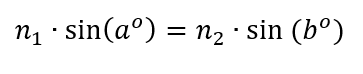
So I then rigged up a fixed laser pointer to measure its index of refraction using Snell’s Law, which says

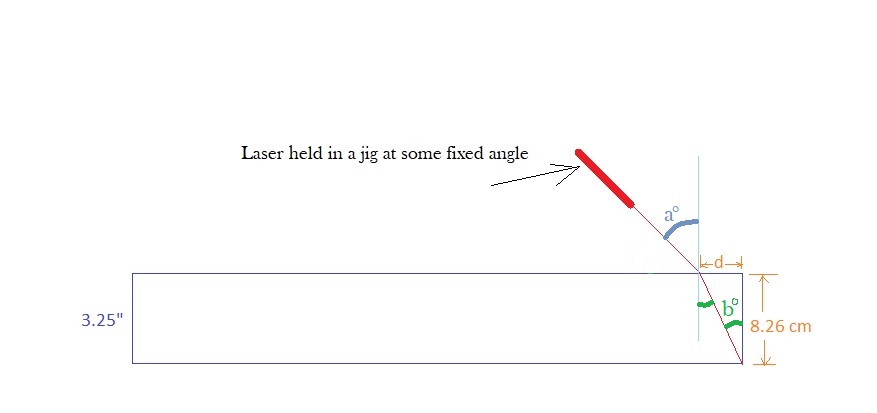
Here is a schematic of my setup:


The fixed angle a I found to be between 50 and 51 degrees by putting my rig on a large mirror and measuring the angle of reflection with a carpentry tool.

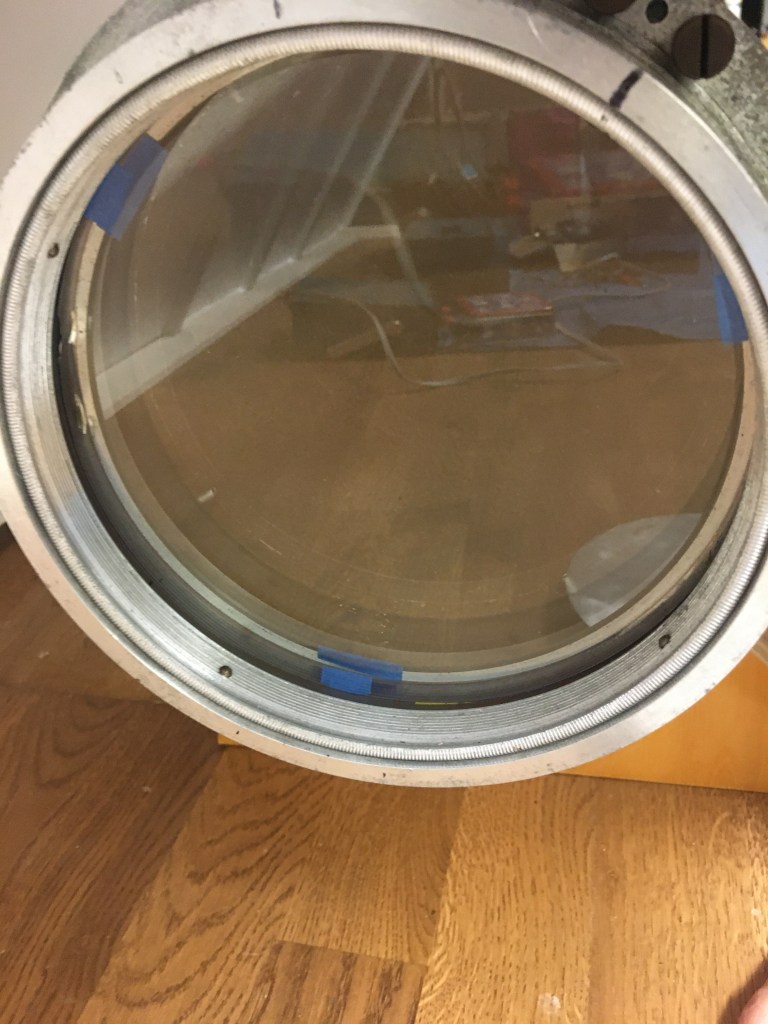
And here is what it looked like in practice:

I slid the jig back and forth until I could make it so that the refracted laser beam just barely hit the bottom edge of the glass blank.

I marked where the laser is impinging upon the glass, and I measured the distance d from that spot to the top edge of the glass.

I divided d by the thickness of the glass, in the same units, and found the arc-tangent of that ratio; that is the measure, b, of the angle of refraction.

One generally uses 1.00 for the index of refraction of air (n1). I am calling n2 the index of refraction of the glass. I had never actually done this experiment before; I had only read about doing it.

As you might expect, with such a crude setup, I got a range of answers for the thickness of the glass, and for the distance d. Even angle a was uncertain: somewhere around 49 or 50 degrees. For the angle of refraction, I got answers somewhere between 25.7 and 26.5 degrees.

All of this gave me an index of refraction for this class as being between 1.723 and 1.760.

This gave me a list of quite a few different glasses in several catalogs (two from Schott and one from Bausch & Lomb).

Unfortunately, there is no glass with a density between 2.80 and 3.00 g/cc that has an index of refraction in that range.

None.

So, either we have a disk of unobtanium, or else we did some measurements incorrectly.

I’m guessing it’s not unobtanium.

I’m also guessing the error is probably in our weighing procedure. The bathroom scale we used is not very accurate and probably got confused because the glass doesn’t have two feet.

A suggestion was made that this might be what Bausch and Lomb called Barium Flint, but that has an index of refraction that’s too low, only 1.605.

Mystery is still unsolved.

Clay Davies’ Links for Telescope Makers

24 Thursday Dec 2020

Posted by gfbrandenburg in astronomy, flat, optical flat, Telescope Making

≈ Leave a comment

Tags

albert highe, CLay Davies, Commercial, dobsonian, explore scientific, Jean Texereau, Mel Bartels, newtonian, R. F. Royce, Reiner Vogel, Royal Astronomical Society of Canada, stargazer steve, stellafane, Telescope Making, trigonometry

I am copying and pasting Clay Davies’ recent article published on a Facebook page for amateur telescope makers, where he gives links to extremely useful sources as well as commentary. I think he did a great job, and want to make this available to more people.

================================= here goes! ================================================

Amateur Telescope Making Resources & Fast Commercial Newtonian Telescopes

  • Observer’s Handbook, Royal Astronomical Society of Canada. Every amateur astronomer should have at least one copy of this book. Every “newby” should read it cover to cover. Old hands should keep it as a reference. Avid astronomers get it every year, because it’s updated annually.
  • How to Make a Telescope, Jean Texereau. A classic book by a superb optician. The author taught many people how to make their own telescopes, including grinding, polishing and figuring their own mirrors. This book offers unique and practical telescope and mount designs I have never seen anywhere else.
  • The Dobsonian Telescope, David Kriege & Richard Berry. Want to knock off an Obsession telescope? Here is your bible, written by the creators of Obsession Telescopes. Here you will find well thought out and time proven designs for truss Dobsonian telescopes from 12.5” to 25” and more. If you are handy, if you use one of these designs and follow step-by-step instructions, you can build a fine truss dobsonian. But use free PLOP software (below) to design your mirror cell.
  • PLOP Automated Mirror Cell Optimization. This free windows software can help you design a “perfect” mirror cell. Just plug in the numbers, and in seconds, you have a mirror cell design. https://www.davidlewistoronto.com/plop/
  • Engineering, Design and Construction of Portable Newtonian Telescopes, Albert Highe. Do you want your next telescope to truly satisfy you? This book dedicates an entire chapter that asks you questions that help you design and build (or buy!) a telescope that will do just that. And it has beautifully engineered contemporary designs for large truss telescopes.
  • Engineering, Design and Construction of String Telescopes, Albert Highe. Beautifully engineered, yet challenging, ultra-light, air transportable newtonian telescope designs.
  • Newt for the Web (Stellafane). This is a simple, yet effective tool for newtonian telescope design. You can design an excellent telescope with just this free tool, plus old school drafting tools like ruler, protractor, pencil and compass. https://stellafane.org/tm/newt-web/newt-web.html
  • Reflecting Telescope Optimizer Suite. Mel Bartels created this wonderful free online newtonian telescope design tool: https://www.bbastrodesigns.com/telescopeCriteriaCalc.html If you explore Mel’s website you will find innovative, ultra-fast dobsonian telescopes, beautiful deep sky sketches, and mind expanding ideas that will probably make you a better observer. https://www.bbastrodesigns.com/The%20New%20Sub-F3%20Richest%20Field%20Telescopes.html
  • Right Angled Triangles Calculator, Cleve Books. Are you building a truss telescope but can’t remember trigonometry? This site makes it easy: http://www.cleavebooks.co.uk/scol/calrtri.htm
  • Stargazer Steve 6” Truss Telescope. A very portable, ultra-light commercial truss telescope. Moderately priced, too! http://stargazer.isys.ca/6inch.html
  • Explore Scientific 8”f3.9 Want a fast scope but don’t want to build it? This fast astrograph optical tube assembly has a carbon fibre tube and weighs 18.3 pounds / 8.3kg. It’s remarkably affordable, too! https://explorescientificusa.com/products/208mm-newtonian-f-3-9-with-carbon-fiber-tube
  • Orion 8” f/3.9 You can save a lot of work by buying a telescope off the shelf, like this one. Similar to the Explore Scientific, but with a steel tube at an irresistable price. And this OTA is under 18 pounds / 8kg! https://www.telescope.com/Orion-8-f39-Newtonian-Astrograph-Reflector-Telescope/p/101450.uts
  • R. F. Royce Telescope Building Projects. Simple newtonian telescope designs by one of the finest opticians on planet Earth. The first telescope I built, a 10”f6, and the second telescope I built, a 6”f8, were both based on Royce’s designs. Both performed far beyond my expectations. In fact, the surrier-trusses for my 8”f4 design were based on the Royce design. http://www.rfroyce.com/Telescope%20Bulding%20Projects.htm Want to build your ultimate lunar and planetary telescope? Click the third link. And… considering how much you can learn from one of the world’s greatest opticians, shouldn’t you click every link? http://www.rfroyce.com/thoughts.htm
  • Reiner Vogel Travel Dobs. If you are interested in designing and building your own telescope, have a look at this website. You will find easy and effective construction techniques and ultralight, ultra-portable telescopes here. And big ones. You’ll find equatorial mounts and observing notes, too! http://www.reinervogel.net/index_e.html?/links_e.html
  • Here is my talk at the RASC, Toronto, (Royal Astronomical Society of Canada) entitled, “Designing and Building a Newtonian Telescope for Wide Field Visual and Air Travel”. You can scroll the video to 38:20 if you want to go directly to my presentation. https://www.youtube.com/watch?v=Gz7TVQkTGCM

SOLD: Antique 6″ f/14 Refractor With Good Optics Available No Longer

05 Monday Oct 2020

Posted by gfbrandenburg in astronomy, astrophysics, History, Hopewell Observatorry, Optics, Telescope Making

≈ 1 Comment

Tags

achromat, brass, Carl Kiess, doublet, John Brashear, optical tube assembly, refractor, Telescope

The Hopewell Observatory had available a finely-machined antique, brass-tube 6″ f./14 achromatic refractor.

The mount and drive were apparently made by John Brashear, but we don’t know for sure who made the tube, lens, focuser or optics.

We removed a lot of accumulated green or black grunge on the outside of the tube, but found no identifying markings of any sort anywhere, except for the degrees and such on the setting circles and some very subtle marks on the sides of the lens elements indicating the proper alignment.

The son of the original owner told me that the scope and mount were built a bit over a century ago for the American professional astronomer Carl Kiess. The latter worked mostly on stellar and solar spectra for the National Bureau of Standards, was for many years on the faculty of Georgetown University, and passed away in 1967. A few decades later, his son later donated this scope and mount to National Capital Astronomers (of DC), who were unable to use it. NCA then later sold it to us (Hopewell Observatory), who cleaned and tested it.

The attribution of the mount to Brashear was by Bart Fried of the Antique Telescope Society, who said that quite often Brashear didn’t initial or stamp his products. Looking at known examples of Brashear’s mounts, I think Fried is probably correct. Kiess’s son said he thought that the optics were made by an optician in California, but he didn’t remember any other details. His father got his PhD at UC Berkeley in 1913, and later worked at the Lick Observatory before settling in the DC area. The company that Brashear became doesn’t have any records going back that far.


When we first looked through the scope, we thought the views were terrible, which surprised us. However, as we were cleaning the lens cell, someone noticed subtle pencil marks on the edges of the two lens elements, indicating how they were supposed to be aligned with each other. Once we fixed that, and replaced the 8 or so paper tabs with three blue tape tabs, we found it produced very nice views indeed!

The focuser accepts standard 1.25″ eyepieces, and the focuser slides very smoothly (once we got the nasty, flaky corrosion off as delicately as possible and sprayed the metal with several coats of clear polyurethane). The workmanship is beautiful!

Top: tiller for hand control of right ascension. Middle: counterweight bar (machined by me to screw into the mount) with clamps to hold weights in place. Bottom: detail of 1.25″ rack-and-pinion focuser.

We have not cleaned the mechanical mount, or tried it out, but it does appear to operate: the user turns a miniature boat tiller at the end of a long lever to keep up with the motions of the stars.

The mount and cradle (with size 12 feet for scale)

The counterweight rod was missing, so I machined a replacement, which has weight holder clamps like you see in gymnasiums. Normal Barbell-type weights with 1 inch holes fit well and can be adjusted with the clamps.

Unfortunately, the whole device is rather heavy, and we already own a nice 6″ f/15 refractor made by Jaegers, as well as some Schmidt-Cassegrain telescopes that also have long focal lengths. Putting this scope on its own pedestal, outside our roll-off roof, with adequate protection from both the elements and from vandals, or figuring out a way to mount it and remove it when needed, are efforts that we don’t see as being wise for us.

Did I mention that it’s heavy? The OTA and the mount together weigh roughly 100 pounds.

However, it’s really a beautiful, historic piece with great optics. Perhaps a collector might be interested in putting this in a dome atop their home or in their office? Or perhaps someone might be interested in trading this towards a nice Ritchey Chretien or Corrected Dal-Kirkham telescope of moderate aperture?

Anybody know what might be a fair price for this?

Guy Brandenburg

President

The Hopewell Observatory

Some more photos of the process and to three previous posts on this telescope.

Partway through cleaning the greenish, peeling, grimy layer and old duct tape residue with a fine wire brush at low speed to reveal the beautiful brass OTA.
This shows the universal joint that attaches to the ’tiller’ and drives the RA axis
Do you see the secret mark, not aligned with anything?
Aluminum lens cover and cell before cleaning
Lens cell and cover, with adjustment screws highlighted, after cleaning
It works!

Some WW2 or Cold-War-Era Aerial Surveillance Cameras

02 Wednesday Sep 2020

Posted by gfbrandenburg in astronomy, History, Hopewell Observatorry, Optics, science, Telescope Making, Uncategorized

≈ 4 Comments

Tags

Aerial reconnaissance camera assemblies

(Think U2 spyplanes.. )

Hopewell Observatory has three WW2 or Cold-War aerial spy camera optical tube assemblies, including a relatively famous Fairchild K-38. No film holders, though. And no spy planes. The lenses are in good condition, and the shutters seem to work fine.

We would like to give them away to someone who wants and appreciates them, and can put them to good use. Does anybody know someone who would be interested?

They’ve been sitting unused in our clubhouse for over 20 years. Take one, take two, take all of them, we want them gone.

We are located in the DC / Northern Virginia area. Nearby pickup is best. Anybody who wants them shipped elsewhere would obviously need to pay for packaging and shipping.

Here are some photos.

This one is labeled K-38, has a special, delicate, fluorite lens in front, and is stamped with the label 10-10-57 – perhaps a date. The shoe is for scale.

IMG_2009
IMG_2010
IMG_2012
IMG_2014
IMG_2017
IMG_2018
IMG_2020
IMG_2022
IMG_2024


The next two have tape measures and shoes for scale.

hopewell jan 2013 023
hopewell jan 2013 024
hopewell jan 2013 025
hopewell jan 2013 026
hopewell jan 2013 027
hopewell jan 2013 028
hopewell jan 2013 029
hopewell jan 2013 030
hopewell jan 2013 031
hopewell jan 2013 032
hopewell jan 2013 033
hopewell jan 2013 034
hopewell jan 2013 035
hopewell jan 2013 036


Let me know (a comment will work) if you are interested.

More about spray-coating astronomical mirrors with silver!

30 Monday Dec 2019

Posted by gfbrandenburg in astronomy, Optics, Safety, science, Telescope Making, Uncategorized

≈ Leave a comment

Here is a batch of articles and links concerning the spray-on process for making astronomical mirrors reflective using protected silver solutions.

Long ago, I translated Foucault’s monograph on making paraboloidal, silvered astronomical mirrors. Part of his article described the process that he and Steinheil developed for silvering, which involved using silver nitrate solutions and various other reagents. It looked quite tricky, and also required further polishing! Plus, our telescope making workshop here in Washington DC had a Navy surplus vacuum chamber that was (and still is) quite effective at putting on good-quality, inexpensive aluminum coatings for any mirror up to 12.5″ diameter.

However, I and a couple of other ATMers (Bill R and Oscar O) are working on mirrors in the 16 to 18 inch range, and they simply won’t fit. So I was quite intrigued to watch how Peter Pekurar and some other folks coated a couple of rather large mirrors right in front of a small crowd of onlookers in a tent at this summer’s Stellafane.

I have a few videos on my webpage (here).

There is also an article on the process in the January 2020 Sky and Telescope, and a webpage (here) on the topic run by Pekurar and Howard Banich and others.

Not to mention a bunch of posts on Cloudy Nights (here) and a nice PDF explaining it all, (here).

What is really, really amazing is that the webpage by Pekurar and Banich also has interferograms showing that the overcoating has absolutely no effect on the sub-microscopic, geometrical figure of the mirror! Unfortunately, it’s only effective against chemical attack, not against dirty fingers or scratches. They also did some careful experiments on reflectivity at various wavelengths with various treatments of the surface.

A couple of local ATMers and at least one professional at Goddard Space Flight Center have told me about their experiments with the process; they found that it is easy to mess up if you aren’t stringently clean and also easy to waste materials.

Problems Solved with the Old 6″ Refractor?

23 Monday Sep 2019

Posted by gfbrandenburg in astronomy, Hopewell Observatorry, Optics, science, Telescope Making

≈ 3 Comments

Tags

crown, figuring, flint, Kiess, lens cell, lenses, refractor, symmetry, testing

I found a few things that may have been causing problems:

(1) Whoever put the lens cell together last didn’t pay any attention at all to the little registration marks that the maker had carefully placed on the edges of the lenses, to show how they were supposed to be aligned with each other. I fixed that, as you see in the photo below. The reason this is probably important is that the lenses are probably not completely symmetrical around their central axes, and the maker ‘figured’ (polished away small amounts of glass) them so that if you lined them up the way he planned it, the images would be good; otherwise, they would probably not work well at all and could very well be causing the poor star test images we saw.

IMG_5310

2. The previous assembler also put eleven little tape spacers around the edges, between the two pieces of glass. More is apparently not better; experts say you should have three spacers, each 120 degrees apart from the other two. Done.

3. The bottom (or ‘flint’) element is slightly smaller than the other one (the ‘crown’), so it probably shifted sideways. That alone would be enough to mess up the star tests in the way that we saw. So I wrapped two thicknesses of blue painter’s tape around the outside of the flint, and put some three cardboard shims between the edges of the ‘crown’ and the aluminum cell.

4. There were no shims at all between the flint and the aluminum ring that holds it in place underneath. This caused some small scratches on the glass, and might have been warping the glass. I put in three small shims of the same type of blue painter’s tape, lined up with the other spacers.

We will see if these improvements help. I really don’t want to haul this all the way out to Hopewell Observatory and struggle with putting it back on the mount for a star test. That was just way too much work, much more than I expected! The next test will be with an optical flat placed in front of the lenses, and a Ronchi grating.

I would like to thank Bart Fried, Dave Groski, and several other people on the Antique Telescope Society website for their advice.

————————————-

By the way, these photos show how we held the refractor on the mounting plate for the Ealing mount at Hopewell Observatory.

IMG_5197
IMG_5200
IMG_5233
IMG_5239
IMG_5241

Trying to Figure Out Problems With a Century-Old Refractor

22 Sunday Sep 2019

Posted by gfbrandenburg in astronomy, History, Optics, Telescope Making, Uncategorized

≈ Leave a comment

Tags

antique, crown, flint, glass, Kiess, refractor, Telescope, testing

I am disassembling the lens cell of the >100 year old 6” f/14 Kiess refractor that produces horrible results on star tests.

There is absolutely no information inscribed anywhere inside the cell, inside the tube or outside it, nor on the edges of the lens elements. I can only guess as to what type of glass they used, and figuring it out won’t be easy. The least destructive method I can think of beginning to do this is by weighing them and calculating out their precise volumes, and from that calculating their densities. A graduate gemologist could probably calculate their indices of refraction, but not me.

Tomorrow I plan to measure the curvatures of the lens elements; perhaps someone familiar with old telescopes will then have clues as to who might have made this particular type of optical prescription.

The shims seem to me to be intact, so I think I can rule out astigmatism from lens elements put in crooked. [OTOH, someone on the Antique Telescopes Facebook group says that the large number of small black spacers in between the lenses may itself be causing the massive astigmatism problem that we found in the star test. I don’t have enough experience to be able to tell whether that’s correct or not.]

The small chips on the edge of the second (meniscus? Flint?) lens element were already there when I got it. I was also surprised to find that the first (biconvex, crown?) lens element has a small bubble very close to the center. It’s probably not significant, but I will check for strain as well.


Gently tapping off the lens cell from the tube
Note that the retaining ring holding the front of the first lens merely slides into the cell; it’s held in place by four screws. The threading is on the inside of the ring, and the outside is smooth
You can see the black tape and tan cardboard spacers
Me looking puzzled
Me looking puzzled
The cardboard spacers around the edges
The two lenses together; note the multiple, small black tape spacers between the pieces of glass
The original chips on the second lens element
The empty lens cell. Note that they didn't make it black
The empty lens cell. Note that they didn’t make it black

A Weekend at Almost Heaven

06 Friday Sep 2019

Posted by gfbrandenburg in astronomy, Optics, science, Telescope Making, Uncategorized

≈ Leave a comment

Tags

Almost Heaven Star Party, binocular mount, dobsonian, NOVAC, Spruce Knob, star party

I spent Labor Day weekend at the Almost Heaven Star Party very close to Spruce Knob, the highest ridge in West Virginia. When the skies cleared at night, the stars and Milky Way were magnificent, but that only happened about 1 night out of three. My 12.5″ home-made Dobsonian telescope performed very well; in fact, because its primary and secondary mirror are almost fully enclosed by the light shrouds and upper cage, I was able to keep observing long after all the other refractors and Schmidt-Cassegrains were closed down by the heavy dew. (To keep the dew off of my finder scope and Telrad, I used large rubber bands to wrap chemical hand warmer packs around them, and that crude and cheap arrangement worked very well!)

Here are three photos taken by me:

Exploring the geology of Spruce Knob Mountain Center: Lyle Mars in blue shirt and white hat is in front of the entrance to a cave carved in limestone
Selfie with me in front of three others on the geology hike
This lovely sunset did not portend clear skies

All but the photo with the sextant were taken by Oscar.

Alan Goldberg teaching someone how to use a sextant
Me studying my charts, in front of parallelogram binocular mount
Oscar Olmedo and me at our campsite
Mike Laugherty and me
Me fiddling with my 12.5" home-made dob in the daytime
Me fiddling with my 12.5″ home-made dob in the daytime
Me fiddling with the parallelogram binocular mount in the daytime
Mike Laugherty and me fiddling with binocular mount
Left to right: Mike Laugherty, Oscar Olmedo, me
The lottery drawing for a whole bunch of neat prizes. None of us 3 won anything.

← Older posts
Newer posts →

Subscribe

  • Entries (RSS)
  • Comments (RSS)

Archives

  • February 2026
  • December 2025
  • November 2025
  • October 2025
  • September 2025
  • July 2025
  • January 2025
  • November 2024
  • October 2024
  • August 2024
  • July 2024
  • May 2024
  • April 2024
  • January 2024
  • December 2023
  • October 2023
  • August 2023
  • June 2023
  • May 2023
  • April 2023
  • November 2022
  • October 2022
  • August 2022
  • July 2022
  • June 2022
  • May 2022
  • April 2022
  • February 2022
  • January 2022
  • December 2021
  • October 2021
  • September 2021
  • August 2021
  • July 2021
  • June 2021
  • May 2021
  • March 2021
  • December 2020
  • October 2020
  • September 2020
  • August 2020
  • March 2020
  • February 2020
  • January 2020
  • December 2019
  • November 2019
  • September 2019
  • August 2019
  • June 2019
  • May 2019
  • January 2019
  • November 2018
  • October 2018
  • September 2018
  • August 2018
  • May 2018
  • March 2018
  • January 2018
  • November 2017
  • October 2017
  • September 2017
  • August 2017
  • July 2017
  • June 2017
  • May 2017
  • April 2017
  • February 2017
  • December 2016
  • September 2016
  • June 2016
  • May 2016
  • April 2016
  • March 2016
  • February 2016
  • January 2016
  • December 2015
  • November 2015
  • August 2015
  • July 2015
  • April 2015
  • March 2015
  • February 2015
  • January 2015
  • December 2014

Categories

  • astronomy
  • astrophysics
  • education
  • flat
  • History
  • Hopewell Observatorry
  • Math
  • monochromatic
  • nature
  • optical flat
  • Optics
  • Safety
  • science
  • teaching
  • Telescope Making
  • Uncategorized

Meta

  • Create account
  • Log in

Blog at WordPress.com.

  • Subscribe Subscribed
    • Guy's Math & Astro Blog
    • Join 54 other subscribers
    • Already have a WordPress.com account? Log in now.
    • Guy's Math & Astro Blog
    • Subscribe Subscribed
    • Sign up
    • Log in
    • Report this content
    • View site in Reader
    • Manage subscriptions
    • Collapse this bar
 

Loading Comments...