• My series on making a Newtonian telescope
  • How Leon Foucault Made Telescopes

Guy's Math & Astro Blog

Guy's Math & Astro Blog

Category Archives: Telescope Making

Australian TV Bit on Me and the DC ATM Workshop

27 Monday Nov 2017

Posted by gfbrandenburg in astronomy, astrophysics, nature, Safety, science, Telescope Making

≈ Leave a comment

Tags

2017, ATM, Australia, eclipse, Stephanie March, Telescope

Some very nice folks from the Australian Broadcasting Corporation came and interviewed me on film for a bit on folks who make their own telescopes to see the great August 2017 eclipse. Here is the link:

( https://www.facebook.com/abcnews.au/videos/10157157152414988/ )

Calculations with a Curious Cassegrain

08 Sunday Oct 2017

Posted by gfbrandenburg in astronomy, flat, Hopewell Observatorry, optical flat, Optics, Telescope Making

≈ Leave a comment

Tags

cassegrain, completing the square, ellipsoid, hyperbola, hyperboloids, Optics, parabola, sphere, testing

I continue to try to determine the foci of the apparent hyperbolic primary on the Hopewell Ealing 12inch cassegrain, which has serious optical problems.

My two given pieces of information are that the mirror has a radius of curvature (R) of 95 inches by my direct measurement, and its Schwarzschild constant of best fit,(generally indicated by the letter K)  according to FigureXP using my six sets of Couder-mask Foucault readings, is -1.112.

I prefer to use the letter p, which equals K + 1. Thus, p = -0.112. I decided R should be negative, that is, off to the left (I think), though I get the same results, essentially, if R is positive, just flipped left-and-right.

One can obtain the equation of any conic by using the formula

Y^2 – 2Rx + px^2 = 0.

When I plug in my values, I get

Y^2 + 190x -0.112x^2 = 0.

I then used ordinary completing-the-square techniques to find the values of a, b, and c when putting this equation in standard form, that is something like y^2/a^2 – x^2/b^2 = 1

Omitting some of the steps because they are a pain to type, and rounding large values on this paper to the nearest integer (but not in my calculator), I get

I got

y^2 – 0.112(x – 848)^2 = – 80540

and eventually

(x – 848)^2 / 848^2 – y^2 / 248^2 = 1

Which means that a is 848 inches, which is over 70 feet, and b is 284 inches, or almost 24 feet. Since a^2 + b^2 = c^2, then c is about 894. And the focal points are 894 inches from the center of the double-knapped hyperboloid, which is located at (848, 0), so it looks a lot like this:

cass equations

Which of the two naps of this conic section is the location of the actual mirror? I suppose it doesn’t make a big difference.

Making that assumption that means that the foci of this hyperbolic mirror are about 894 – 848 = 46 inches from the center of the primary mirror. I don’t have the exact measurement from the center of the primary to the center of the secondary, but this at least gives me a start. That measurement will need to be made very, very carefully and the location of the secondary checked in three dimensions so that the ronchi lines are as straight as possible.

It certainly does not look like the common focal point for the primary and secondary will be very far behind the front of the secondary!

Bob Bolster gave me an EXTREMELY fast spherical mirror that is about f/0.9 and has diameter 6 inches. I didn’t think at first that would be useful for doing a Hindle sphere test, since I thought that the focal point in back of the secondary would be farther away. But now I think it will probably work after all. (Excellent job as usual, Bob!) (I think)


Trying to Test a 50-year-old Cassegran Telescope

07 Thursday Sep 2017

Posted by gfbrandenburg in astronomy, flat, Hopewell Observatorry, Math, science, Telescope Making

≈ Leave a comment

Tags

artificial star, celestron, classical cassegrain, couder, double pass autocollimation test, ealing, FigureXP, focus, foucault, hyperbolic, optical tube assembly, parabolic, primary, refurbishing, ritchey-chretien, Ronchi, schmidt-cassegrain, secondary, spherical, Telescope

We at the Hopewell Observatory have had a classical 12″ Cassegrain optical tube and optics that were manufactured about 50 years ago.; They were originally mounted on an Ealing mount for the University of Maryland, but UMd at some point discarded it, and the whole setup eventually made its way to us (long before my time with the observatory).


The optics were seen by my predecessors as being very disappointing. At one point, a cardboard mask was made to reduce the optics to about a 10″ diameter, but that apparently didn’t help much. The OTA was replaced with an orange-tube Celestron 14″ Schmidt-Cassegrain telescope on the same extremely-beefy Ealing mount, and it all works reasonably well.


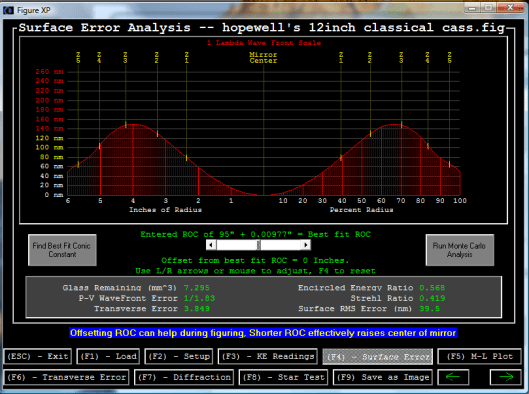
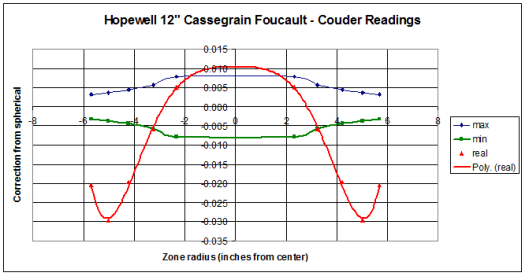
Recently, I was asked to check out the optics on this original classical Cassegrain telescope, which is supposed to have a parabolic primary and a hyperbolic secondary. I did Ronchi testing, Couder-Foucault zonal testing, and double-pass autocollimation testing, and I found that the primary is way over-corrected, veering into hyperbolic territory. In fact, Figure XP claims that the conic section of best fit has a Schwartzschild constant of about -1.1, but if it is supposed to be parabolic, then it has a wavefront error of about 5/9, which is not good at all.

Here are the results of the testing, if you care to look. The first graph was produced by a program called FigureXP from my six sets of readings:

figure xp on the 12 inch cass

my graph of 12 inch cass readings

I have not yet tested the secondary or been successful at running a test of the whole telescope with an artificial star. For the indoor star test, it appears that it only comes to a focus maybe a meter or two behind the primary! Unfortunately, the Chevy Chase Community Center where we have our workshop closes up tight by 10 pm on weekdays and the staff starts reminding us of that at about 9:15 pm. Setting up the entire indoor star-testing rig, which involves both red and green lasers bouncing off known optical flat mirrors seven times across a 60-foot-long room in order to get sufficient separation for a valid star test, and moving two very heavy tables into said room, and then putting it all away when we are done, because all sorts of other activities take place in that room. So we ran out of time on Tuesday the 5th.

A couple of people (including Michael Chesnes and Dave Groski) have suggested that this might not be a ‘classical Cassegrain’ – which is a telescope that has a concave, parabolic primary mirror and a convex, hyperbolic secondary. Instead, it might be intended to be a Ritchey-Chretien, which has both mirrors hyperbolic. We have not tried removing the secondary yet, and testing it involves finding a known spherical mirror and cutting a hole in its center, and aligning both mirrors so that the hyperboloid and the sphere have the exact same center. (You may recall that hyperboloids have two focal points, much like ellipses do.)

Here is a diagram and explanation of that test, by Vladimir Sacek at http://www.telescope-optics.net/hindle_sphere_test.htm

hindle sphere test

FIGURE 56: The Hindle sphere test setup: light source is at the far focus (FF) of the convex surface of the radius of curvature RC and eccentricity ε, and Hindle sphere center of curvature coincides with its near focus (NF). Far focus is at a distance A=RC/(1-ε) from convex surface, and the radius of curvature (RS) of the Hindle sphere is a sum of the mirror separation and near focus (NF) distance (absolute values), with the latter given by B=RC/(1+ε). Thus, the mirrorseparation equals RS-B. The only requirement for the sphere radius of curvature RS is to be sufficiently smaller than the sum of near and far focus distance to make the final focus accessible. Needed minimum sphere diameter is larger than the effective test surface diameter by a factor of RS/B. Clearly, Hindle test is limited to surfaces with usable far focus, which eliminates sphere (ε=0, near and far focus coinciding), prolate ellipsoids (1>ε>0, near and far foci on the same, concave side of the surface), paraboloid (ε=1, far focus at infinity) and hyperboloids close enough to a paraboloid to result in an impractically distant far focus.

We discovered that the telescope had a very interesting DC motor – cum – potentiometer assembly to help in moving the secondary mirror in and out, for focusing and such. We know that it’s a 12-volt DC motor, but have not yet had luck tracking down any specifications on that motor from the company that is the legatee of the original manufacturer.

Here are some images of that part:

IMG_8207
IMG_8210
IMG_8224

An Eclipse Seen in Wyoming

27 Sunday Aug 2017

Posted by gfbrandenburg in astronomy, astrophysics, Math, nature, Telescope Making

≈ Leave a comment

Tags

eclipse, Lander, luggage, Math, solar, sunspots, totality, travel, Wind River Indian Reservation, Wyoming

I was fortunate enough to have the time and cash to go to Wyoming for the August 21 eclipse. It was truly wonderful,. in large part due to the fact that I had made a 6″ diameter, f/8 Dob-Newt travel telescope that could play three roles: as an unfiltered projection scope onto a manila folder before and after totality; with a stopped-down Baader solar filter during and after totality; and with no filter at all during the two minutes or so of totality.

No photographic image that I have so far seen comes anywhere near the incredible details that I was able to see during those short two minutes.

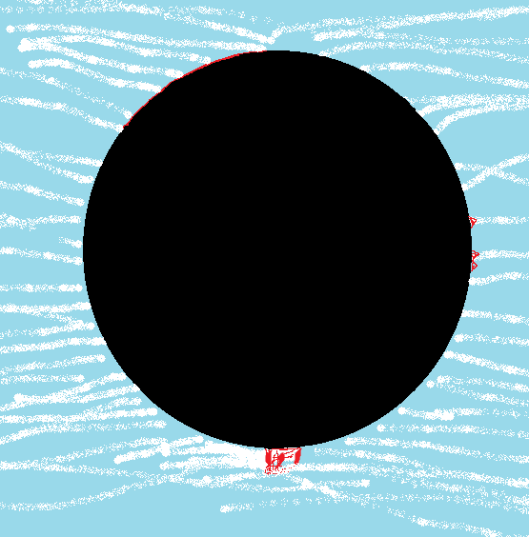
Here is my not-very-expert drawing of what I recall seeing:

solar eclipse

The red rim on the upper left is the ‘flash spectrum’, or chromosphere. It was only visible for a few seconds at the very beginning of the eclipse. The corona is the white fuzzy lines, but my drawing doesn’t do them justice. On the bottom, and on the right, are some amazing solar prominences — something that I don’t recall having seen in 1994, my first successful solar eclipse. The bottom one might not have been quite that large, but it really got my attention.

Here are a few photos I took before and after totality:

IMG_8070
IMG_8082
IMG_8091
IMG_8099
IMG_8105
IMG_8108
IMG_8114
IMG_8118
IMG_8120
IMG_8130
IMG_8138
IMG_8140
IMG_8141

I started planning this expedition over a year ago, and hoped to attend the Astronomical League meeting in Casper, WY. I quickly found that there were absolutely no rooms to be had there, even a year in advance.

Wyoming has fewer people than my home town (Washington DC), and not many populated places in the path of totality. However, I did find a motel in tiny Lander, Wyoming, very close to the southern edge — a location that I had previously found to be very good for viewing eclipses. One of the fellows in our telescope-making workshop, Oscar O (an actual PhD solar astrophysicist) decided he would bring some family and friends along and camp there to view it with me. So he did (see the group photo).

The night before, we went to a site near Fossil Hill, WY to look at stars. The Milky Way was amazing, stretching from northern to southern horizon, and the sky was very, very dark. We met a baking-soda miner (actually, a trona miner) and his 10-year-old daughter; she had a great time aiming my telescope, via Telrad, at interesting formations in the Milky Way. My friends from DC whipped up an amazing dinner on their tiny camp stove. There were LOTS of people camping in the back country there; I bet most of them were there to view the eclipse!

On the eve and morning of the eclipse, after consulting various weather ‘products’, we decided that the predicted clouds in Lander itself would be a problem. (I had been clouded out before, with my wife and children, back in 1991, in Mexico! It really spoils the experience, I assure you!)

So we drove north and west, through the Wind River Indian Reservation, and picked a spot just east of the tiny town of Dubois at a pulloff for a local fish hatchery. Along the drive to that location, we saw lots of folks had set up camp for the event at various pulloffs and driveways to nowhere. (If you didn’t know, Wyoming is mostly devoid of people, but has lots of fields and barbed wire fence. Many of those fields have driveways leading to some sort of gate, most of which are probably used at least three times every decade, if you get my drift….)

Not only is Wyoming largely empty (of people), but the path of totality in the United States was so long that I estimated that if the ENTIRE population of the USA were to decide to go view the eclipse, and somehow could magically spread themselves out evenly over the 70-mile-wide, and 3000-mile-long, path on dry land, that there would only be about 3 people per acre!

Here’s the math: 70 miles times 3000 miles is 210,000 square miles. The population of the USA is about 330,000,000. Divide the population by the area, and you get about 1600 people per square mile. But there are 640 acres in a square mile, so if you divide 1600 by 640, you get less than 3 people per acre, or 3 people on a football field (either NFL or FIFA; it doesn’t matter which).

(…looking to the future, the next decent eclipse doesn’t seem to occur anywhere in this hemisphere until 2024, when it will cross from Texas to Maine…)

As you can see from my photos, the little travel scope I made, called Guy’s Penny Tube-O III, performed very well. Before and after totality, we used it both for solar projection onto a manila folder, through the eyepiece. I also had fashioned a stopped-down solar filter with a different piece of cardboard and a small piece of Baader Solar Film. With both methods, we could clearly see a whole slew of sunspots, in great detail (umbra and penumbra) as well as the moon slowly slipping across the disk of the sun. Having the sunspots as ‘landmarks’ helped us to watch the progress!

Then, during totality, after the end of Baily’s Beads and the Diamond Ring, I took off the filter and re-adjusted the focus slightly, and was treated to the most amazing sight – a total eclipse, with coronal streamers to the left and right; the ‘flash spectrum’ appearing and winking out on the upper left-hand quadrant (iirc); and numerous solar flares/prominences.

I got generous and allowed a few other people to look, but only for a few seconds each! Time was precious, and I had spent so much work (and airfare) building, and re-building, and transporting that telescope there!

Planets? I didn’t see any, but others did. Apparently Regulus was right next to the Sun, but I wasn’t paying attention.

The corona and solar flares were much, much more pronounced than I recall from 1994.

That afternoon, the town of Lander had the largest traffic jam they had ever had, according to locals I talked to. Driving out of there on that afternoon was apparently kind of a nightmare: the state had received a million or so visitors, roughly double its normal population, and there just aren’t that many roads. I chose to spend the night in Lander and visited from friends I had gotten to know, who are now living in Boulder, on the night after that. Unfortunately, on that next day, I got a speeding ticket and a citation for reckless driving (I was guilty as hell!) for being too risky and going too fast on route 287, trying to pass a bunch of cars that I thought were going too slow…

When I did fly out from Denver, on Wednesday, all the various inspections of my very-suspicious-looking and very-heavy luggage caused me to miss my flight, so I went on standby. It wasn’t too bad, and I was only a few hours later than I had originally planned. And my lost suitcase was delivered to my door the next day, so that was good.

I am now in the process of making this travel scope lighter. I have removed the roller-skate wheels and replaced them with small posts, saving several pounds. I have begun using a mill to remove a lot of the metal from the struts. And I will also fabricate some sacks that I can fill with local rocks, instead of using the heavy and carefully machined counterweights! (Rocks are free, gut going over 50 pounds in your luggage can be VERY expensive!)


By the way: unless you like to travel with no luggage at all, NEVER use Spirit Airlines! They may be a few dollars cheaper, but they will even charge you for a carry-on bag! What’s next? Charging you for oxygen?


Safer Table Saws Should Be Mandatory

14 Monday Aug 2017

Posted by gfbrandenburg in History, Safety, science, Telescope Making

≈ 5 Comments

Tags

finger, Safety, SawStop, table saw

Three parts to this little essay:

  • What happened to me about a month into my retirement, with an old, nearly-free table saw that lacked SawStop safety features (and which I was using totally improperly, because I didn’t know better)
  • Table saws are one of the most commonly-used power tools both commercially and at home, and are responsible for an AMAZING number of injuries and amputations every DAY.
  • A fix for this exists — the technology included in every single SawStop table saw. The inventor tried, but failed to convince table saw manufacturers to incorporate this essential, and not-terribly-expensive feature, and they ALL turned it down, essentially saying that ‘safety doesn’t sell’. Congress has the power to make this feature mandatory and to save many a hand, finger, or eye.
IMG_6365
IMG_6366

Part One

These are not trick shots. It’s just my left hand, imaged poorly just now with my smart phone. I was really ashamed, embarrassed, and sad when this injury occurred, roughly a month after I retired from teaching, for several reasons:

(1) It turned out that I was using the table saw totally improperly, holding a very small piece of wood as I fed it into the blade

(2) I literally did not know that was an improper way of feeding wood into a table saw; I was treating it like a band saw

(3) I should have read up on safety rules for table saws, even though I had used them without incident quite a few times earlier, and thought that I was safe enough (and I wasn’t)

(4) While I am right-handed, losing part of one’s left-hand index finger and having the adjacent finger be mauled so that it lacks feeling on one side, and doesn’t bend properly, and is crooked, means that there are many things one can never do again – for example typing quickly and efficiently. The letters e, r, t, d, f, g, c, v, and b (look at your keyboard and if you ever learned touch typing, you’ll see why) are all now much harder for me to type. And unfortunately for me, E and T are the two most common letters in the alphabet. (I’m not asking for sympathy! Just don’t do this to yourself!! Wear safety equipment and read the fri&&14& manuals!)


On the good side, I am extremely grateful and amazed at the skill of Dr. Reisin, my hand surgeon. Without any warning that I could see, my hand got dragged into the blade by the tiny piece of wood. My two fingers looked like very fresh hamburger, and I thought I had lost them down to stumps. I was amazed that when I got my first view of the damage, I still had most of them! Yay Dr. Reisin! Really, amazing job!

In addition, we have Kaiser Permanente family high option insurance. It’s not cheap, something like $400 a month that I pay, plus I have a wonderful subsidy from the DC government, which pays something like $1000 a month. All of that adds up to just about 1/3 of my gross retirement pay, but at least I was never asked to liquidate my retirement savings or sell our house to pay for the astronomically huge bills for all of the doctors’ fees (think anaesthesiologist, primary care physician, ER physicians, surgeon, just to name a few) and the hospital stay and the several months of careful and skillful rehabilitation. It was tens of thousands of dollars, though I certainly don’t know the exact total. If we did not have medical insurance, it would have been very, very tough, but we had minimal co-pays for each visit and for the various antibiotics and painkillers. EVERYBODY SHOULD HAVE THAT!

Again, I was really embarrassed at my own stupidity. For the first few months, I labored under the misapprehension that the wood had been thrown INTO my hand by kickback. But a more knowledgeable friend (WHR) convinced me otherwise; plus I looked at the sawblade scars on the underside of the other pieces that I had fed through – in each case, the saw had started grabbing the wood and had left its marks on the pieces of plywood — and I was too stupid and ignorant to notice. This video shows how dangerous table saws can be – it’s pretty similar to what happened to me: the blade catches the wood, AND the author’s pushing block, AND just barely misses taking off his finger(s).

SECOND PART:

It took me a while to realize that I was far from the only person who had suffered this sort of injury. I was quite aware that the workers at my college (Dartmouth) were almost ALL missing a finger or two or five – but that was from industrial accidents in the textile mills that used to exist all over New England, but had moved on to other places, probably because the owners could get labor for even less and spend even less on safety than before… I wish now I had asked them more about those injuries… But I’m pretty sure that they were not operating table saws.

I did not know that anywhere from SCORES to HUNDREDS of Americans have some sort of an injury with a table saw not per year, not per month, not per week, but EVERY SINGLE DAY.

Let that sink in. Somewhere between 40 and 400 people in the USA have an accident with a table saw, EVERY SINGLE DAY. Some of these accidents were worse than mine, some were less so (two sources on numbers: here,  here and here, each with links pointing elsewhere. It seems to me reprehensible that Robert Lang, the author of the Popular Woodworking magazine (the second link), belittles the number of injuries, comparing them to the number of kids who are hurt by doors everyday.

‘Back in January 2005, the Consumer Product Safety Commission (CPSC) required that new tablesaw models include a riving knife and modular guard to prevent these injuries. Since that time injury rates have remained virtually unchanged, which begs the question: “Why are so many people hurt while using tablesaws, despite improvements in guards and splitters?”’ (source)

As soon as I could use my arm again, I supervised getting rid of that old table saw. I think we sold it for scrap iron. (It had been sold to us for a pittance by a friend — who passed away from a heart attack at a very early age, as it happened. I never had the chance to mention to him what happened to me.)

Fortunately, after this event, the same friend (WHB) got wind of someone who wanted to donate funds so that we at the NCA Amateur Telescope Making workshop could actually get a decent, SAFE table saw. We also used the monies to purchase a very nice H-Alpha solar telescope for the astronomy club under whose auspices we operate, as well as a nearly-unused Grizzly milling machine… And while it doesn’t have lots of fancy features, that SawStop table saw will immediately (in 0.003 seconds) if it senses anything like your finger touching the blade while in operation; if it does, it slams the blade down into an aluminum chunk and stops it immediately and OUT OF THE WAY. (Have you seen any of those hot-dog table-saw videos? or ) Sure, it kills the blade and the chunk of aluminum (roughly $60)  but that’s way better than cutting off your finger!

In fact, the inventor agrees to put HIS OWN finger into a SawStop table saw, under a high-speed camera and very bright lighting, here. He does so, and the sawblade stops instantly, you can see that no damage to his finger at all: no blood, no bruising, no nothing. The inventor says it felt a little like a buzzing insect or a tickle. Absolutely amazing!

Plus, the saws are really, really well made and easy to put together, and have a very good manual that comes with a spiral-bound notebook with laminated pages and very clear instuctions in English, that you can lay flat at any page you want.  In other words, not the incomprehensible hieroglyphics, printed on flimsy paper, that is so common with manuals today. (Think IKEA…) And the prices are well within range of the prices of other table saws with comparable features.

The original inventor has recently testified at the Consumer Product Safety Commission, and was interviewed by NPR. He could not get manufacturers to agree to put his device (or one just like it) into their saws, EVEN AS AN OPTION. So he set up his own company to make them.

It’s also reprehensible that something like the Power Tool Institute wants to prevent the government from making this electronic safety feature mandatory, as you can see here. 

It’s the usual crapload of hysterical propaganda: higher unemployment, making companies go bankrupt — the same lies that the Big Three carmakers said when they resisted putting in seat belts, antilock brakes, turn signals, doors that have hinges at the front and not the back, unleaded gas, airbags, and so on. But those inventions (and others) have saved untold millions of lives, despite the resistance of the rich and powerful. It’s disgraceful.

Yes, we ordinary humans do make mistakes, each and every single day. People are going to lose focus, or get distracted, or make stupid errors of judgement, like me. It doesn’t matter if you drive (or use a table saw) correctly 99.9% of the time: that still leaves that one time in a thousand where you don’t, AND IT CAN KILL YOU OR MAIM YOU FOR LIFE.

If the fix for that is simple — and even if it costs something — it should be done.

We are only human.
Open House at the Hopewell Observatory: Saturday, October 15, 2022

09 Friday Jun 2017

Posted by gfbrandenburg in astronomy, Hopewell Observatorry, science, Telescope Making

≈ 1 Comment

Tags

Haymarket, Hopewell Observatory, invitation, open house, VA

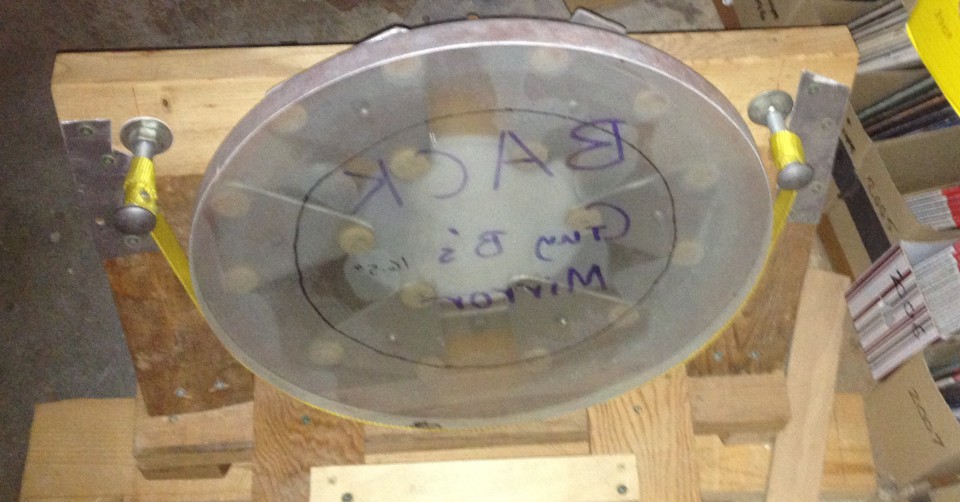
You are all invited, and it’s free. The directions and many other details can be found at a previous post on this blog. 

(Just ignore the date, because it’s no longer 2016! The directions are long, and I didn’t feel like copying and pasting them here.)

Caveat: we do not have running water, so no modern lavatory. We do have bottled water, an outhouse, electricity, and hand sanitizer. This place is really in the middle of the woods, which is where lots of insects and other arthropods live, so keep that in mind. We do have some bug juice you can use, but keep any spray far away from the telescopes!

If you have a telescope of your own, or binoculars, feel free to bring them. A flashlght or headlamp will be useful. We prefer red light at night, since white light makes you night-blind for about 10-20 minutes. If your flashlight(s) put(s) out white light, we have red plastic, tape, scissors, and rubber bands that you can use to shield your light.

Two Simultaneous ‘First Lights’ at the NCA-CCCC Telescope Making Workshop

29 Saturday Apr 2017

Posted by gfbrandenburg in astronomy, monochromatic, optical flat, Telescope Making

≈ 1 Comment

Tags

First Light

Oscar Olmedo and Jeff Dunn both took the opportunity of a clear night last night to achieve first light with the telescopes that they have been working so hard on. The target was Jupiter. The location is right outside the Chevy Chase Community Center, and time was just about 10:00 pm. The fact that you can see so much in this iphone image shows that light pollution is a real problem there.

IMG_7246

We also managed to do a star test using an artificial star on Oscar’s 6″ f/3. I made the testing rig with considerable help from Alan Tarica and Bill Rohrer. We reflected the light off of a known optical flat so as to double the testing distance. We had everybody in attendance at the telescope=making workshop examine the inside- and outside-of-focus images, and we all agreed that using the images in Richard Suiter’s book, it’s a bit overcorrected, probably somewhere near 1/4 wave of green light, which was what we were using — a green laser pointer attenuated and stopped down to about 100 micron hole. But good enough.

Next step for Oscar is to aluminize his mirror in our vacuum chamber.

Congratulations to both gentlemen!

Telescope Fix, Scudding Clouds Over Moon, Tom Turkeys Hiding, and Successful Cloud Chamber!

12 Monday Dec 2016

Posted by gfbrandenburg in astronomy, astrophysics, science, Telescope Making, Uncategorized

≈ Leave a comment

Tags

cloud chamber, Digital Setting Circles, dry ice, Isopropanol, Moon, Sky Wizard, Turkeys

I had a productive 24 hours!

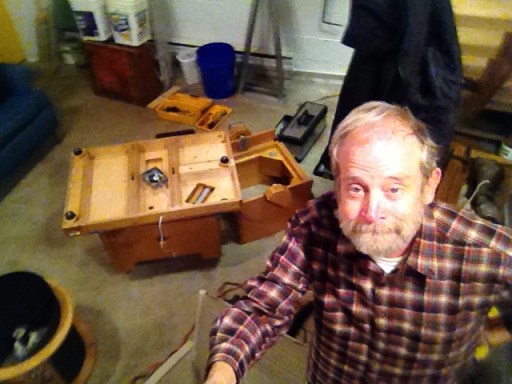
  • Night before last, I think I finally got Sky Wizard Digital Setting Circles installed on the 14″ alt-az telescope we were most generously donated by Alan Bromborsky. (That’s me, in the operations cabin  at Hopewell Observatory, taking a break and a picture, long before completion.)img_6169
  • So I went out to look at the sky at 1 AM. I saw no stars, but the 80% gibbous moon appeared to race dramatically through the clouds
  •  That afternoon, as I was driving out, I saw 5, maybe 6 tom turkeys playing hide-and-seek with me behind the trees. Believe me, they are REALLY GOOD at hiding behind little saplings, logs, and rocks! Or if you don’t believe me, ask anyone who’s tried to hunt them.
  •  Late that evening, I got a dry-ice-and-isopropanol particle detector working for the first time. (I had tried and failed, when I was a teenager, some 50 years ago, and failed several other times since then as well.) If you look at my little video, you can see the particles more easily than I could with your naked eye as I was filming it. Don’t ask me yet which ones are muons, which are alpha particles, and which are beta particles, because I don’t know yet. But you could look it up!

Productive 24 hours!

A Talk at AHSP on Telescope Making

16 Friday Sep 2016

Posted by gfbrandenburg in astronomy, History, Telescope Making

≈ Leave a comment

Tags

AHSP, Almost Heaven Star Party, Charles Messier, Messier Objects, NOVAC, Spruce Knob, West Virginia

Two weeks ago was the Almost Heaven Star Party on the slopes of Spruce Knob, West Virginia, sponsored and organized by the Northern Virginia Astronomy Club (NOVAC). The weather was wonderful, and we could see the Milky Way and lots of Messier objects with our naked eyes, every single night for four nights. This is by far the longest stretch of good weather I’ve ever experienced up there at The Mountain Institute.

(Friday and Saturday, it was only clear for a few hours, but Sunday and Monday nights were clear all night, AND there was NO DEW to speak of!! Wow!!)

During the daytime, there were lots of talks and also activities and expeditions such as hiking, spelunking, visiting the National Radio Astronomy Observatory at Green Bank, canoeing, and Phun With Physics and arts & crafts for kids. I particularly enjoyed the talks on Russell Porter (the founder of amateur telescope making in the US and one of the major designers of the 200-inch telescope at Palomar), LIGO (detection of gravity waves), and Rod Molisse’s talk on 50 years of mostly-commercial telescopes as seen in the pages of various astronomy regime.

I was one of the speakers and gave a little talk on telescope-making. If you care to sit through it, you can find it along with all of the other talks (many of which I missed for various reasons) at this web-page.

I brought my home-made 12.5″ Dob-Newt [shown to the left in the picture below] and added about a dozen items to my formal list of Messier objects. (I had already seen all 100+ objects, but hadn’t recorded enough details on them to be able to earn one of the ‘merit badge’ pins from the Astronomical League, so I’m going through the list again

.img_0198

(If you didn’t know: Charles Messier loved hunting comets about 220 years ago, with what we would consider today to be a fairly small (4″ diameter) refractor that he used from downtown Paris, not far from where I lived back in 1959. Comets look like fuzzy patches in the sky, and so do galaxies, star clusters, and illuminated clouds of gas, all of which are MUCH farther away and MUCH larger. Comets are part of our own solar system, and move noticeably from one night to the next against the apparently fixed background of stars. Messier is credited with discovering 13 comets. But when he discovered a fuzzy item in the sky that did NOT move, he would record its location and its appearance, so as to avoid looking at it again. He published and updated this list a few times before he died, 199 years ago. Nowadays, his list of things-to-be-avoided are some of the most amazing and beautiful things you can see in the night sky. I’ve tried imaging a few of them, but am very, very far from being proficient at it. I attach my best one so far, of something called the Dumbbell Nebula. No, it’s not named after me. And thanks to Mike Laugherty for helping with the color balance!)

dumbbell-processed-november-1-2015

When was the last time you spent a night under the stars?

29 Wednesday Jun 2016

Posted by gfbrandenburg in astronomy, astrophysics, Hopewell Observatorry, Telescope Making

≈ Leave a comment

Tags

astronomy, Hopewell Observatory, open house, Telescope

If it’s been a while since you spent time looking up at the heavens with your naked eyes, binoculars and telescopes, looking at planets, stars and galaxies, then this Saturday might be your night.

The Hopewell Observatory is having an open house on Saturday, July 2, 2016, and we have a variety of scopes to look through. Some of the scopes will be under our roll-off roof and some will be rolled out onto the small lawn outside the observatory itself.

Mars, Jupiter and Saturn will be very conveniently placed for viewing right at sundown, and if it’s dry and clear enough, we should be able to see the Milky Way. Many nebulae, open and globular clusters, galaxies, and double or triple stars will be visible as well.

You are invited!  And it’s free!

The location is about an hour due west of Washington DC by way of I-66, near the town of Haymarket, VA. For detailed directions, follow this link, which I posted for one of the dates which got canceled because of bad weather. Ignore the date, but do pay attention to the fact that we have no running water! We have bottled water and a composting toilet and hand sanitizer. Plus makings for coffee, tea, and hot chocolate – all gratis.

picture of hopewell

The picture above is of one of our telescope mounts, which carries several telescopes and was set up to take astrophotographs at the time. Below is a picture of the outside of the observatory shortly after a snowstorm.. Notice that there is no dome – instead, the galvanized steel roof rolls back on the rails and columns to the right of the picture when the scopes are in use.

showA13

If you have your own telescope, feel free to bring it. If it needs electricity, we have an outdoor 120VAC outlet, but you should bring your own extension cord and plug strip.  If you want to stay all night, that will be fine, too! If you feel like bringing a cot or a tarpaulin and a sleeping bag, that’s equally OK by us! Show up at or near sunset, and stay until the sun comes up, if you like!

Warning: the area definitely has insects, such as ticks and chiggers, which appear to avoid everybody else and to do their best to attack me. I strongly recommend long pants, shoes/boots, and socks that you can tuck the pants into. Tuck your shirt into your pants as well, and use bug spray, too. I have personally seen plenty of deer, cicadas, moths, wild turkeys, squirrels, and birds, and I have heard from a neighbor that a bear tried to eat his chickens, but other than the insect pests, the wildlife stays out of your way.

Again – for detailed directions, look at this link.

← Older posts
Newer posts →

Subscribe

  • Entries (RSS)
  • Comments (RSS)

Archives

  • February 2026
  • December 2025
  • November 2025
  • October 2025
  • September 2025
  • July 2025
  • January 2025
  • November 2024
  • October 2024
  • August 2024
  • July 2024
  • May 2024
  • April 2024
  • January 2024
  • December 2023
  • October 2023
  • August 2023
  • June 2023
  • May 2023
  • April 2023
  • November 2022
  • October 2022
  • August 2022
  • July 2022
  • June 2022
  • May 2022
  • April 2022
  • February 2022
  • January 2022
  • December 2021
  • October 2021
  • September 2021
  • August 2021
  • July 2021
  • June 2021
  • May 2021
  • March 2021
  • December 2020
  • October 2020
  • September 2020
  • August 2020
  • March 2020
  • February 2020
  • January 2020
  • December 2019
  • November 2019
  • September 2019
  • August 2019
  • June 2019
  • May 2019
  • January 2019
  • November 2018
  • October 2018
  • September 2018
  • August 2018
  • May 2018
  • March 2018
  • January 2018
  • November 2017
  • October 2017
  • September 2017
  • August 2017
  • July 2017
  • June 2017
  • May 2017
  • April 2017
  • February 2017
  • December 2016
  • September 2016
  • June 2016
  • May 2016
  • April 2016
  • March 2016
  • February 2016
  • January 2016
  • December 2015
  • November 2015
  • August 2015
  • July 2015
  • April 2015
  • March 2015
  • February 2015
  • January 2015
  • December 2014

Categories

  • astronomy
  • astrophysics
  • education
  • flat
  • History
  • Hopewell Observatorry
  • Math
  • monochromatic
  • nature
  • optical flat
  • Optics
  • Safety
  • science
  • teaching
  • Telescope Making
  • Uncategorized

Meta

  • Create account
  • Log in

Blog at WordPress.com.

  • Subscribe Subscribed
    • Guy's Math & Astro Blog
    • Join 54 other subscribers
    • Already have a WordPress.com account? Log in now.
    • Guy's Math & Astro Blog
    • Subscribe Subscribed
    • Sign up
    • Log in
    • Report this content
    • View site in Reader
    • Manage subscriptions
    • Collapse this bar
 

Loading Comments...