I think I have figured out what was going wrong with our OnStep build:
Our unmodified Arduino-based, green, MaxESP3.03 OnStep micro-controller unit board had two major errors: it didn’t put out any signal at all in the Enable channel in either Right Ascension or in Declination, and in Declination, the Step channel didn’t work either. (I can only guess what caused this, or when it happened, but these errors explain why we couldn’t get this particular board to work any more.)
We had the connecting wires between the two blue, modified boards of the same type and the external TB6600 stepper drivers in the wrong arrangement. We stumbled upon a better arrangement that Bob Benward had suggested, and indeed it worked!
I never would have figured this out without the nice hand-held digital oscilloscope belonging to Alan Tarica; his help and comittment to this project; advice from Ken Hunter that it was a bad idea to have the boards and stepper drivers connected, because the impedance of the motors makes the signal from the board too complicated, and also the signals to the motors themselves are extremely complex! Let me also thank Bob Benward for making beautiful and elegant schematics from the drawings I’m making with pencil and eraser on a couple of 11″x17″ sheets of stiff art paper and pointing out the anomalies between our (Ken’s? I thought I was faithfully copying his arrangements….) original wiring connections and what the manual recommends.
I’m puzzled that our earlier arrangement worked at all. Given that this oscilloscope sees extremely complex, though faint, voltage curves from my own body (anywhere!), I am guessing that electrical interference fooled the drivers into sending the correct commands to the stepper motors even though the STEP and the DIRECTION wires were crossed.
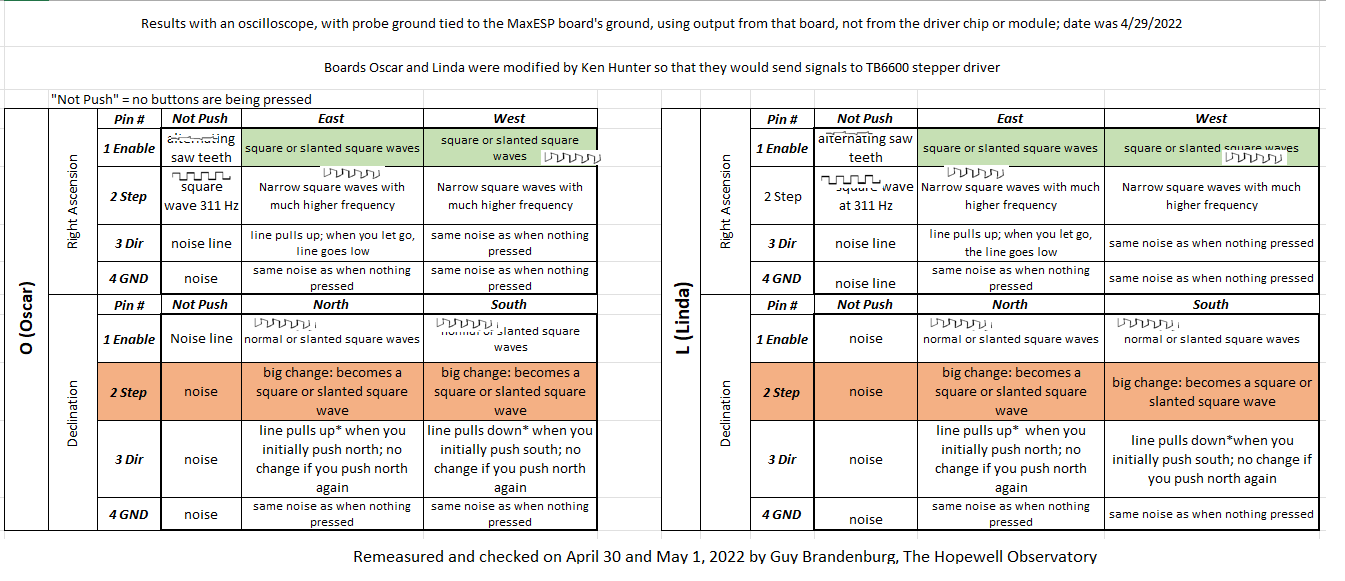
In any case, I attach tables summarizing what I found with the same oscilloscope I had in the previous post. I have highlighted parts that differ between the three boards. Boards “Oscar” and “Linda” are basically identical ones, both of them modified to bypass the location where small, internal stepper motor drivers (about the size of the last joint on your pinky finger) are normally held. Instead, these two boards, both blue in color, connect to two external black-and-green stepper drivers about the size of your hand.
Board “Nancy” differs from the other two in a number of ways: it’s green, which is not important for its function but makes it easier to distinguish. It is also an unmodified one, and it carries TMC5160 stepper driver chips pushed into two rails.
I used orange and green to highlight the differences in output.
With electronics: when it works, it’s amazing, but it is very, very fragile.
==========================
Edit: It all works just fine on my desk. I hope it will also work once we put it into the telescope’s cavities and wire everything up!
We are still at work trying to debug our OnStep re-build of the venerable Ealing telescope drive system at Hopewell Observatory.
Without having a whole lot of experience with oscilloscopes, we used a brand-new OWON 200-series hand-held unit to measure the output of our various MaxESP3.03 boards towards the stepper motors. We don’t really understand what these waveforms actually mean, and a brief search of the OnStep wiki page does not immediately point me to screenshots of what the signals should look like under various conditions.
In any case, some of the waveforms we see look like simple square wave signals. Some look like weird semi-random combinations of square waves, and some look like just plain noise.
In this first video, we have an unmodified MaxESP3.03 board with TMC5160 drivers, not connected to any stepper motors. I attached the ground pin of the probe to one of the grounding grommets at a corner of the MaxESP board, and systematically probed the pins that come out towards the various windings on the stepper motor. We also pressed N, S, E, and W buttons to see what happened. Here goes:
Those of you who are experts on this: do these waveforms appear to be OK to you in this situation?
This next setup is different. It’s a MaxESP3.03 board that Ken Hunter has modified by adding or moving about ten jumpers on the underside of the board; it has no slip-stick drivers for RA or DEC mounted on the MaxESP board itself. Instead, each axis has three (not four) wires coming out of the same place that four wires generally come out to connect to your stepper motor; these three wires connect to four of the inputs on an external, and separately-powered TB6600 stepper driver, which then feeds four wires to the two coils on the stepper.
The arrangement we have now does seem to work, at least on our workbench at the ATM workshop in Chevy Chase Community Center in NW DC, as you can see and hear in this video, but, once again, neither Alan nor I have any idea if the waveforms are correct. Here is the video:
Again: experts — do you think those waveforms are correct?
We were surprised at how complex, and apparently noisy, are the signals on the Step and Dir lines from this modified MaxESP board to the green-and-black external TB6600 drivers. They don’t show up at all in these two previous videos, but they will show up in the next one, which I’m having a bit of trouble uploading at the moment.
In that video, I test both RA and DEC output.
In RA, pin #1 is Enable and is apparently not connected to anything. It produces a wave that looks like a crosscut saw seen from above that has teeth very widely spaced apart. That ENA signal doesn’t change no matter what buttons we push; we think the graph is merely showing interference from something or other.
Still in RA, pin #2 is the STEP pin, and it produces a nice square wave that changes dramatically in frequency when you press the E or W buttons on the SHC. We don’t really see the difference between the E or W graphs.
Still in RA, and in contrast, the graphs for both the Dir and GND pins seem to just look like noise. When one presses ‘E’ the noise graph from the Dir pin definitely changes voltage (it drops off the screen), but not when we press ‘W’. Nothing happens to the noise graph on the fourth pin (GND), no matter what we do.
On the DEC side, all pins seem to put out flat but noisy signals. The noise signal on Pin 2 (Step) moves dramatically but identically lower when you press either the North or South button on the SHC. The noise signal on Pin 3 (Dir) does not change when you press buttons, and neither does the noise signal on pin 4 (GND).
An alarming article about studies of bird deaths due to bright city lighting. A couple of quotes:
Every 11 September at dusk, in memory of the 2001 attacks, New York City mounts the Tribute in Light, an art installation in lower Manhattan. And every year, as twin towers of light bloom skyward, they attract thousands of migrating birds, sucking in warblers, seabirds, and thrushes—along with predators such as peregrine falcons eager to take advantage of the confusion. On each anniversary, bird conservationists wait below, counting and listening to disoriented chirps. If the observers report too many birds circling aimlessly in the beams, organizers flip off the lights.
In recent years, on-site observers have also used a complementary tool to quantify the orbiting birds: weather radar, which bounces off birds as well as raindrops. In 2017, a group led by Cornell University ornithologist Andrew Farnsworth found that during seven previous anniversaries, the once-a-year installation had attracted a total of about 1.1 million birds. Within 20 minutes of lighting up, up to 16,000 birds crammed themselves into a half-kilometer radius. But when the lights flicked off, the dense clouds of birds on the radar screen dissipated just as fast, a finding later confirmed by on-site thermal cameras.’
Later, discussing a single building, the author found that a
‘key factor was how many of the convention center’s windows had been illuminated. Each individual bright window left more dead birds for volunteers to find the next day. The correlation suggests halving the number of lit window bays would halve the number of bird strikes, the team estimated, saving thousands of birds at this one three-story building. “It really does seem that each window makes a difference,” van Doren says.’
I have made a lot of progress over this winter break in converting the 50-year-old Ealing telescope mount at the Hopewell Observatory, as you can see in this video.
We are swapping out an electro-mechanical “dumb” drive that failed, in favor of a modern, solid-state one built in the Arduino environment. If it all works out as planned, this mount will be able to slew to any target and keep the target steady enough for astrophotograpy. I hope.
With a project like this, with delicate electronics that can easily get fried, I believe that having spare parts on hand is a good idea. The main board is pretty cheap: under $100, completely assembled, and the motors were about $30 each. We have spare stepper motors, spare stepper drivers, and a total of three main MaxESP OnStep boards.
Except that two of them (the ones we purchased from George C) don’t work at all, and I don’t know why. The one that Ken Hunter built and **donated** to us works just fine, after I did the required tweaking of various settings inside the Smart Hand Controller or SHC and inside a CONFIG.H file in the Arduino programming environment. And added the gears and belt.
I see almost no serious differences between George’s boards and Ken’s board. I am confident the problem is not my wiring or soldering, and it’s not the fact that George’s boards have RJ45 jacks, but what it is, I have no idea.
This is my second build of the connections between the stepper motor and the worm gear.
Without the help of Ken H, Howard Dutton, another Ken, Alan Tarica, Prasad Agrahar, and Khaled Bahayeldin, I never would have gotten this far. I am very appreciative of the amount of work that went into programming all of the many parts of the OnStep project as a whole. However, I found the OnStep Wiki rather confusing for beginners, and I hope to help them make it clearer in the future.
You can probably see that there is a good bit of wobble in the gears that involve the belts. That is probably because I failed to get the gears perfectly flush against the lathe chuck when I was enlarging their central holes from 5 mm to 1/4 inch despite using a dial indicator with a magnetic base to center it. I think I will need to order a new set of gears that have a 1/4″ axle hole already made at the factory. I don’t think I can do any better than I did, and that wasn’t good enough.
The reason for having the gears and belts is something to do with microstepping on the stepper motors that I really don’t understand. OnStep experts told me that the OnStep board, drivers, and steppers simply cannot handle gears that are 1 : 20 : 359. So we added a 3:1 toothed-gear-and-belt system so that the ratios are now 3 : 1 : 20 : 359. That set of ratios seems to make the steppers happy. (These motors have 200 steps per rotation, and are being currently driven at a rate of 1/16 of a step.) They don’t scream and stall any more, but the wobbly gears will probably translate into periodic error that one can see in the eyepiece or on long exposures with some kind of camera.
My next step is to take this entire apparatus up to the Hopewell Observatory itself and see what happens when I install them in the Right Ascension and Declination drives.
Then, we need to repair the electrical supply for the roll-off roof.
Then we have to put the telescopes back onto the mount.
Then, and only then, can we try having a “First Light” with the new motor pushing a very nice Ed Byers drive in an big, old, and very well-built university-grade telescope mount.
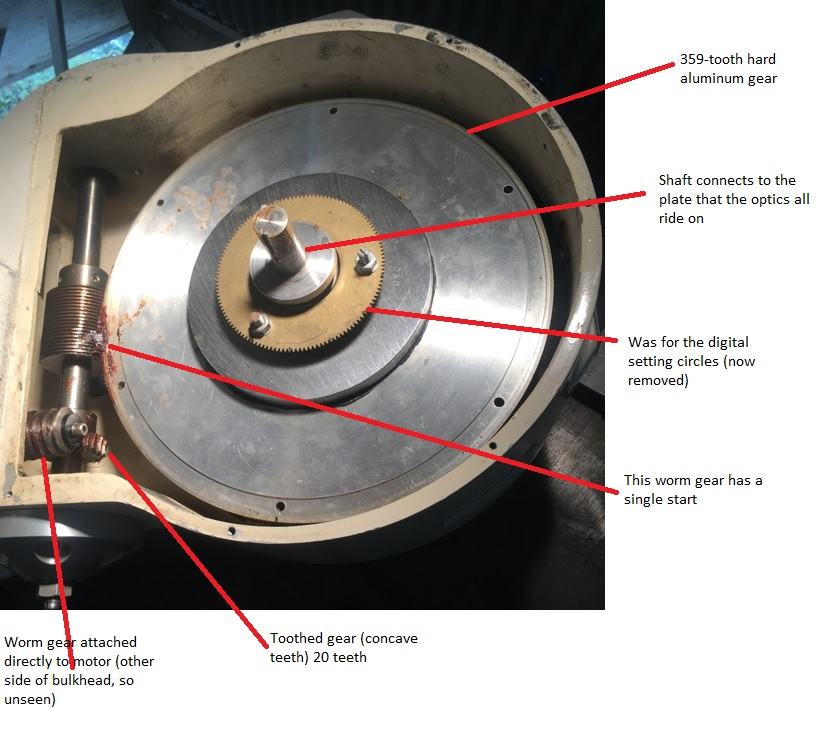
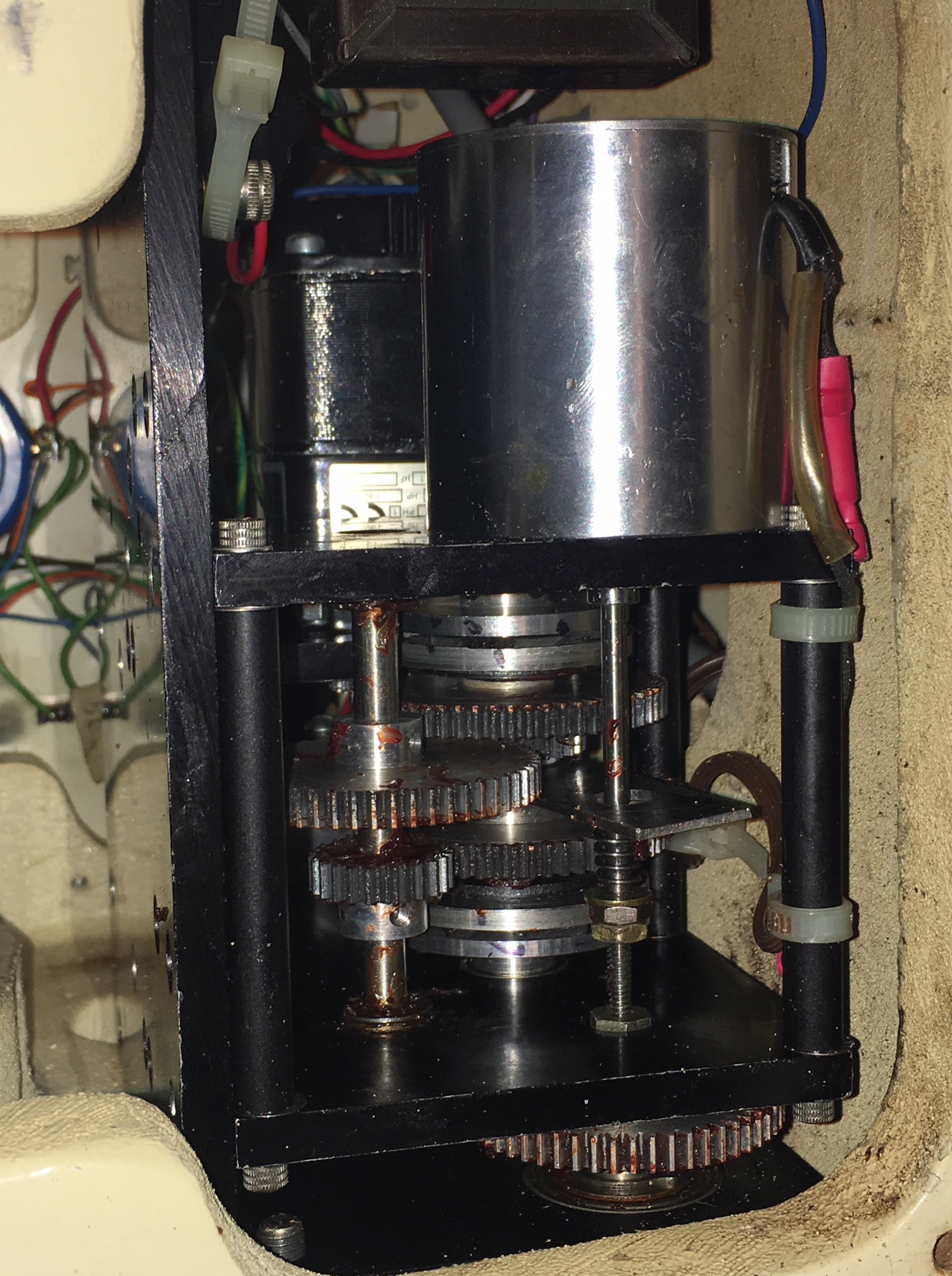
Here is a photo of the inside of the declination axis of the Ealing mount at Hopewell Observatory.
The gears you see were made about 50 years ago by the Ed Byers company, who continue to produce some of the finest gears anywhere. The periodic error on this mount is very, very low, which is a Good Thing, and why we want to keep it and just upgrade the old drive. As you can see in a previous post, the old system had a finicky clutch drive that had caused a lot of problems, but worked very well indeed when it worked properly.
I am working to replace it with a more modern, reliable and user-friendly, namely an OnStep ‘build’.
The friendly and helpful folks at the OnStep project were asking for a picture showing how the existing Byers drive was put together. I hope these four photos help.
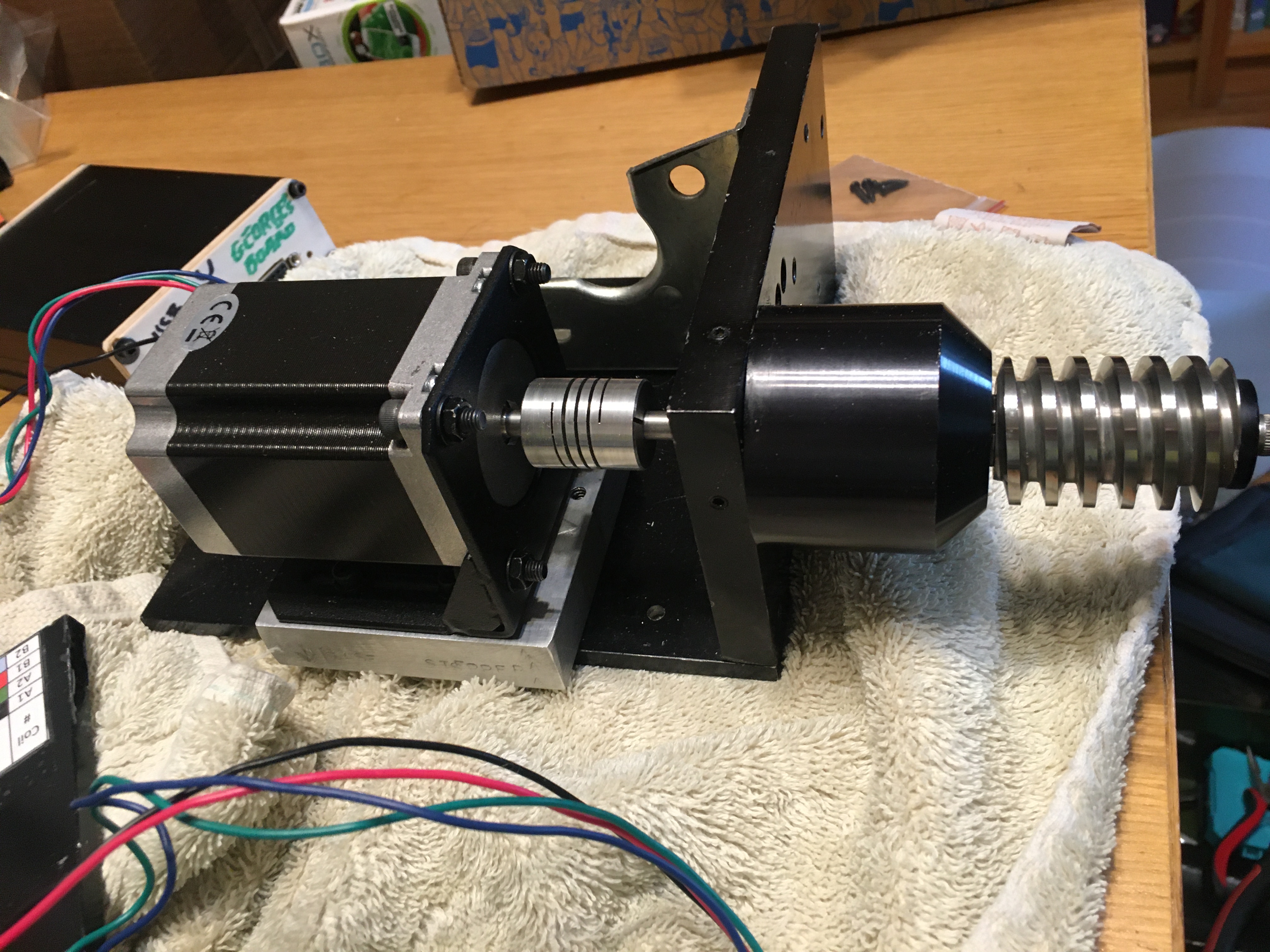
In the first photo, notice the greasy worm gear at the bottom left. It was removed from the mount, along with the old motors, and is sitting on my desk (with the old grease cleaned off), directly coupled to the stepper motor, which connects to one of the OnStep boards (in the wood-and-black aluminum box). In the second photo,
The black anodized bracket in the second photo holds the motor and the worm gear rigidly together. The bracket bolts into a place in the mount (not shown). It took a bit of work to get the stepper motor and the worm gear lined up within a couple of thousandths of an inch, but it’s done. Prasad turned me onto those cool little universal joints that permit one to connect items that don’t match perfectly.
20 turns of the worm gear, times 359 teeth on the big gear, means that it takes 7,180 turns of the stepper motor to make one full revolution of this declination axis or of the right ascension axis, which is identically mounted. (Not that you would want to go about spinning your telescope very far on either axis!)
So 19.97 turns of either motor make the scope travel 1 degree (7180 divided by 360).
And since our stepper motors make 200 steps in one revolution of the worm gear, it takes about 3994 motor steps to make the scope turn by that one degree (the last result, times 200).
Or if you are micro-stepping by, say, the rate of one sixteenth of a step, then by my calculations it will take 63,911 microsteps to turn by that degree (the last result, times 16). And that seems to be outside the range of permissible microsteps for these stepper motors, perhaps causing them to scream in protest. (I swear, that’s what it sounds like!)
From left to right: A spare OnStep board inside its wood-and-aluminum project box; the NEMA23 stepper motor on its bracket; a universal joint; a big bearing; the first worm gear (now cleaned off)
It appears that Khaled and Prasad might be correct: I might need to add a toothed gears and a belt to this arrangement to reduce that last number (63,911) by some factor. For very little money I just ordered a pair of such things, designed for 3-D printers and other computer-controlled machines. It will have 60 teeth on the motor and 20 teeth on the worm gear, and then the above would instead have only 21,304 microsteps to turn one degree. (No wonder they protest!) Once again I’ll have to disassemble the motor and drive bracket and do a bit of machining. A drill press and a punch will be fine.
The last two photos give some more detail on how the old drive system worked.
Close up of worm gear driving a toothed gear wheel that drives another worm gear that drives the right ascension axis
One of the original drive motor and clutch assemblies in place, inside the mount. All those gears have now been removed.
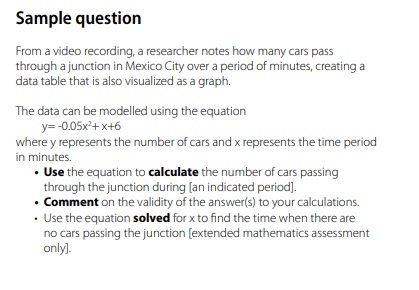
This is a sample question for middle school math, published by the International Baccalaureate (IB) program. I found it here.
Here is a graph I made of this equation, using Desmos:
Looking at this graph, you see that after about 10 minutes, there are 11 cars per minute going through the intersection – and that’s the most cars. After about 25 minutes, there are zero cars going through the intersection, and after that, there is a negative number of cars (!!!).
I don’t think this equation models anything having to do with any intersection I’ve ever visited. Instead, I think that any intersection controlled by a traffic light is going to be more periodic, that is to say, something like some mix of sine or cosine functions — obviously not middle school material.
Despite the populist hype of billionaire Sci-Fi fanboys and a perpetual stream of Hollywood entertainments to the contrary, humans will never explore the galaxy in person. In fact, we won’t even explore our own solar system up close and personal. This is not merely because robotic missions can do the job 1,000% better for 1/1000th the cost. It’s because of two fundamental biological reasons.
The first is gravity. Everything about our bodies is evolved to function under a gravitational acceleration at sea level of approximately 9.8 meters per second squared (9.8m²). Our hearts pump blood up to our heads, fighting gravity every centimeter of the way. Our muscles and bones are as strong as they are because every part of our bodies is fighting gravity every moment of our lives. Our sense of balance, which orients us spatially, depends on gravity being constant in one direction only: straight down.
Without gravity, very bad things happen: the heart pumps too much blood to the head and too little to the lower extremities, leading to ocular distortions, crushing headaches, and nausea as the inner ear loses all sense of up and down. Our bones and muscles atrophy dramatically, even when hours each day are dedicated to exercises specifically designed with the intention of slowing down this decay. Put simply, our bodies are incapable of handling microgravity and despite the pictures of smiling astronauts merrily enjoying microgravity on the ISS, the harsh reality is that every single one of those astronauts pays a price very few of us would wish to incur.
The Sci-Fi fanboy response to this fundamental problem is either (a) to ignore it entirely, as per Musk and Bezos, or (b) claim that artificial gravity is the answer.
As Musk and Bezos are ignoring the problem we can likewise ignore them. So what about artificial gravity?
There are only two ways to create artificial gravity. The first is called “constant-g” which means that we accelerate our hypothetical space ship at a constant 9.8m² for the first half of the trip and then flip it around and decelerate it at a constant 9.8m² for the second half of the trip. Einstein’s insight that over areas too small to experience tidal effects such acceleration would be indistinguishable from regular gravity means that in theory Earth-style gravity could be induced in such a manner. Better yet, because the acceleration is constant, relativistic speeds will eventually be attained. In just 12 years (in the reference frame of the spacecraft) we could travel across our Milky Way galaxy. In a single human lifetime (in the reference frame of the spacecraft), under constant acceleration, we could reach the edge of the universe that’s observable from Earth. An Earth upon which, in that frame of reference, billions of years would have passed.
So with constant acceleration we get a “twofer.” Earth-identical gravity and the ability to traverse vast distances within a human lifetime. Problem solved!
Except that there is no way, theoretical or otherwise, to achieve constant acceleration of this magnitude. No propulsion mechanism, theoretical or otherwise, can overcome the problem of mass. In order to power the continual acceleration, our imaginary space ship is constrained by Newton’s observation that any action in a vacuum requires an equal and opposite reaction. In other words, to accelerate a mass of X by some amount of velocity we will need to discharge an equivalent amount of energy in the opposite direction. And that energy can only come from fuel. Which adds to the mass of our space ship. So now we need to expend more energy, which means we need more fuel, which means we’re now carrying even more mass, which means we need to expend even more energy, which means…
In other words, even with some imaginary technology that could convert matter into energy with 100% efficiency, there’s simply no way to get to 9.8m² constant acceleration for any meaningful amount of time. Sure, we can talk about things like an Alcubierre drive but then we’re just as entitled to say that Hogwarts will invent the Spaciamus drive to solve our problem instead. In other words, running off to hide inside imaginary “solutions” is no solution at all.
If constant acceleration can’t provide artificial gravity, what about centrifugal force? We all remember the rotating space station in 2001 A Space Odyssey and everyone knows that this was the only Sci-Fi movie ever to have utilized a science-based series of technologies. Plus, it’s easy to find on the Internet lots of schemes to create artificial gravity in this way, from tethering ships together and spinning them around a central axis to building enormous hollow rotating cylinders on the inside of which humans will experience Earth-like gravity. So, problem solved!
Except the movies and the Sci-Fi books mislead us, as is the way of popular entertainments.
First, the good news: if a person stood perfectly still and did not move in any way whatsoever, then centrifugal force could seem to mimic Earth-style gravity. Unfortunately, here’s the bad news: if they made any movement whatsoever, they would instantly be overcome by nausea and be disoriented.
Why is this? Imagine throwing a ball up into the air here on Earth. If you throw it straight up, it will come straight down, pulled by gravity toward the center of the Earth we’re standing on. But under conditions of “gravity” induced by centrifugal force, a ball thrown straight up will arc and fall away from the person who threw it because unlike here on Earth there’s a second force acting on the ball: centripetal force. As our inner ear orients us by means of reference to the constant downward force of gravity, this means that any movement at all — even something as minor as turning one’s head — would result in signals from the inner ear (responding to the centripetal force) jarring dramatically with the signals from our eyes. At best this would lead to our hypothetical human vomiting in a majestic arc; at worst it could render them incapable of any controlled movement whatsoever.
The diagrams below show the difference between gravity (or constant acceleration at 9.8m²) and a rotating object. On Earth there’s only one force acting on us: gravity. On our imaginary rotating artificial gravity environment there are two forces: centrifugal, and centripetal. And that makes all the difference in the world.
Perhaps this is why Bezos prefers to ignore the problem; it can’t be solved just by throwing money at it. As for Musk, he makes people with ADHD look like paragons of sustained concentration so he probably doesn’t even know the problem exists. But even if you don’t know a brick wall exists, it still kills you if you slam into it at 1,000 kilometers per hour.
Gravity, therefore, is one reason why human beings will never be a space-faring species. It’s also the reason why it’s highly unlikely any other species capable of developing suitable technologies would ever become space-faring either. All organisms are highly adapted to the environments in which they evolve and it is extremely difficult to sustain organisms outside of their natural environments for any significant period of time. Add it the problems of solar radiation, the deleterious effects of microgravity, and everything else associated with space travel and it’s apparent that Sci-Fi fanboy dreams are a very poor guide to the future.
There is a second major reason why we humans will never be a space-faring species: psychology.
Our brains are as much the result of selection pressures as our bodies. Like our bodies, our brains are highly adapted to life on Earth. As a primate group species adapted to foraging, we’re not well-suited to being cooped up in tiny cages. We become obese and we develop all manner of mental problems. Without access to natural cues like water and grass and trees, we become stressed. When forced to interact with the same small group of people for years without respite, we become irrational and angry, or conversely withdrawn and depressed. Worse still, our emotional hardwiring makes us competitive even when cooperation is the optimal strategy, and our intellectual limitations lead us to acquiring and then strongly defending irrational and harmful beliefs.
Imagine, therefore, a space ship upon which 200 hapless humans attempt to exist for years or even decades. Instead of looking to Star Trek as our inspiration, a more probable vision is depicted in One Flew Over The Cuckoo’s Nest or perhaps the concluding episodes of some trash reality TV show.
It is difficult to imagine any species capable of making spacecraft not having equivalent psychological limitations, albeit likely somewhat different from those that control our own behaviors.
There are many other reasons why humans will never spread across the galaxy, but these two should suffice to prove the contention. This does not mean, however, that there won’t be money to be made in enabling space tourism. A few days in microgravity, ensconced in a modestly comfortable environment with a small number of others, could be a very congenial way for the wealthy to break up the monotony of holidaying in the Hamptons or on a private island in the Bahamas. Sheltered in low orbit by the Earth’s magnetic field, the dangers of solar radiation are reduced to a perfectly acceptable level and likely no worse than a dozen trips in a private jet. Microgravity sex will no doubt become this century’s equivalent of the Mile High Club that was so popular among the early jet-setters of the 1960s and 1970s.
But beyond a few amusing days spent orbiting the Earth while watching one’s champagne bubble around one’s head, and after the inevitable disaster of Mars Colony One, we will accept the fact that robotic missions are the real future. And then we will expand our knowledge of the universe exponentially instead of wasting hundreds of billions of dollars on futile dead-end fanboy dreams.
A few days ago, we silvered an 8” diameter 43” FL mirror that had previously been aluminized, and applied the Angel Guard coating.
We did a Ronchi test and some Foucault-Couder knife edge tests before stripping the aluminum and after the silver was applied.
To my amazement, we found that the mirror’s figure was about the same in both cases. How that works, especially how the Angel Guard coating is laid down so even and smooth over the entire mirror, is beyond me. But it DOES work.
This is a video of us washing off the Angel Guard coating.
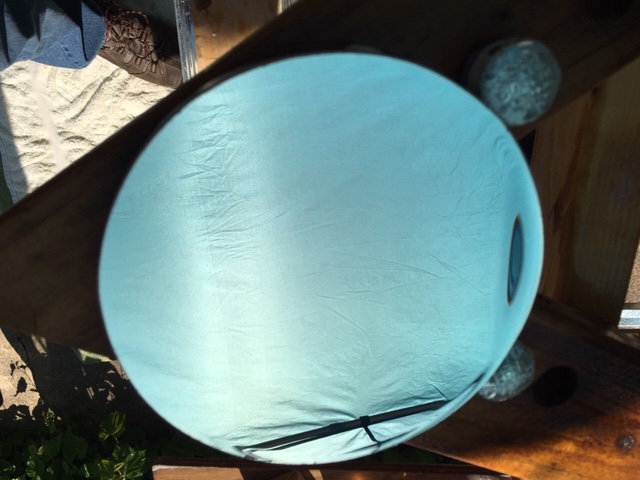
Here is a video of the finished mirror after drying. Notice that the very edge of this mirror did not take the silver coating, but the area uncoated is probably on the order of one or two percent of the total area.
Ive been doing the aluminization process for telescope mirrors at the NCA ATM workshop with a 55-year-old military surplus aluminizer at a DC rec center for about 20 years. (I’ve had a lot of help!!) This involves high vacuum, a noisy pump, voltage both very high and very low, and quite a lot of time.
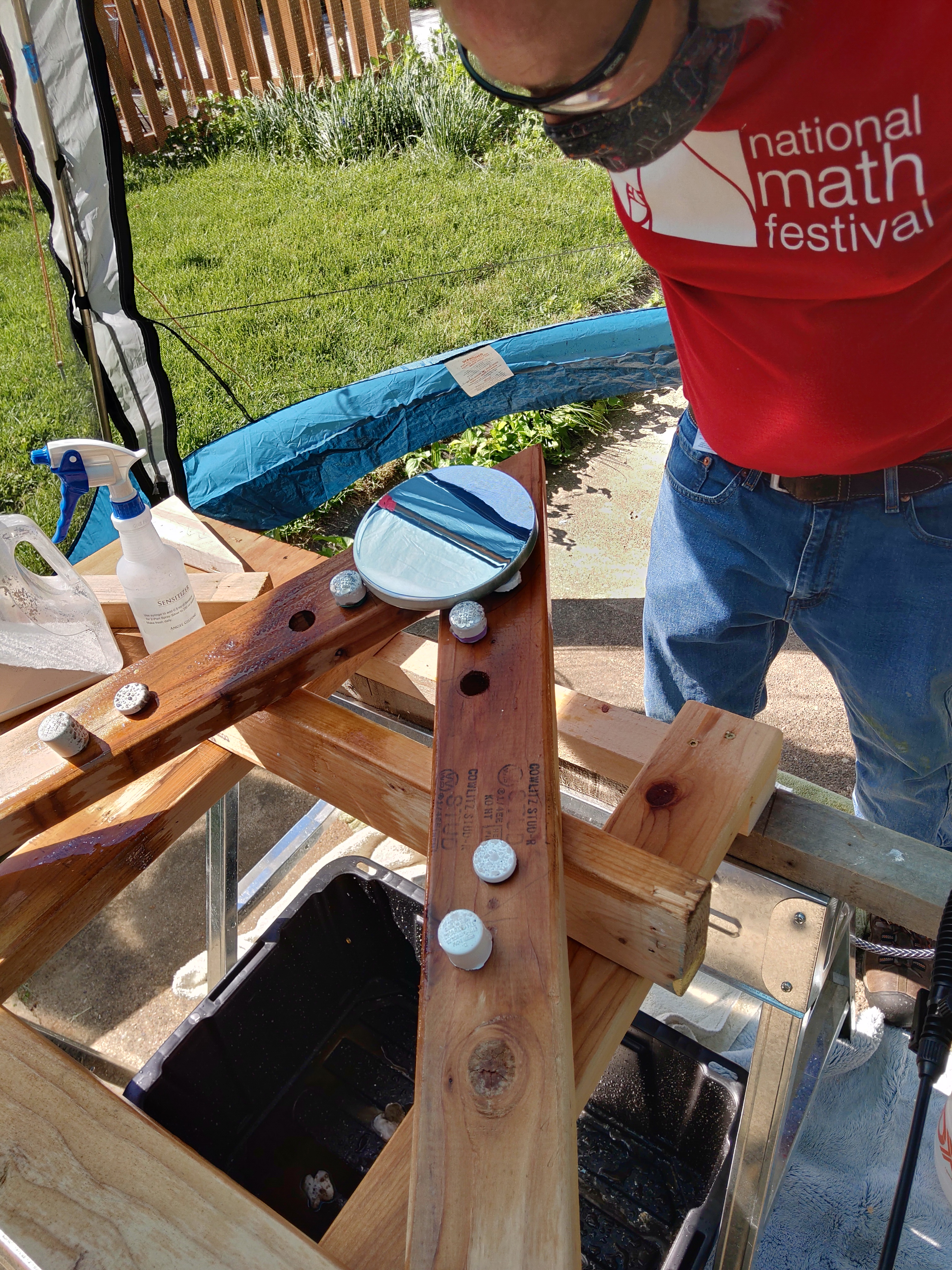
Today, I had the opportunity to silver a random piece of glass, in my driveway, with the aid of another longtime ATMer and some chemicals from Angel Gilding. I had seen this demonstrated at Stellafane by Howard Banich and Peter Pekurar in 2019.
Doing it myself was quite eye-opening.
Almost finished, except for the spray-on Angel-Guard, which we didn’t have
Here’s what I wrote on FB:
Success with our first attempt at silvering a piece of glass under a tent canopy, and then stripping off the silver quickly and easily with PCB etchant (FeCl?).
I’ve aluminized many mirrors with the NCA’s vacuum chamber, using a modified version of John Strong’s method from the 1930s.
I must admit that this method was faster, easier, quieter, and much more low-tech, compared to depositing aluminum. In the latter case, sometimes you have to wait an hour or more for the dual-stage vacuum chamber (the primary pump is VERY noisy!!) to finish all the preparatory steps and pump down low enough that a hot atom of gaseous aluminum can travel two or three feet before striking any other remaining air molecule! (That is one hell of a vacuum!)
With the silvering process, you can do any size mirror you can fit on your cleaning jig — and you can make it out of pieces of scrap wood, a few nylon chair legs, two old hinges, and some screws! !
With our NCA-ATM-CCCC aluminizer, we are limited to 12.5” max. I’m currently working on a 16.5” thin Pyrex mirror; the price I’m quoted for aluminizing it is about $600 at Majestic Coatings, which is about three times what I paid for the blank!! And that doesn’t even include shipping!
Today Alan T and I tested the silvering process in my driveway using the screen tent canopy that we use at the ATM workshop to stop dust particles from landing on mirrors that are being polished. (After getting permission to go retrieve the canopy from the Covid-closed rec center, we immediately went into the parking lot to hose off a decade of dust!!)
We unfortunately do not have Angel-Guard overcoating on hand. It should arrive Wednesday. As most folks know, bare silver, unlike bare aluminum, tarnishes very quickly (in weeks or months) when exposed to ordinary air, whereas a I have seen many bare Aluminum layers last a decade. This overcoating is said to extend the life of the coating to about a year, but obviously conditions will vary.
We used a 6″ float glass mirror blank to try out the process today – not an actual, parabolized mirror.
How does it work?
This is basically a five step process:
1. Get prepared and mix the tinning solution afresh;
2. Clean off the mirror properly with precipitated CaCO3 and/or Alconox; rinse;
3. Sensitize the mirror with an invisible layer of tin (Sn); rinse;
4. Spray on the silver solution and its reducer at the exact same time with two separate brand-new one-pint hand squirt bottles, until fully silvered & shiny; rinse;
5. Spray on the Angel-Guard overcoat; rinse; dry.
The amount of chemicals used is minimal. The nastiest stuff was the reducer. I’m glad we did this outside.
Btw: a number of people have bench-tested mirrors before and after this process. Some report no change in figure; somebody I trust, who has a Zygo interferometer, says there is a little degradation, but not much: a mirror that was 1/10 lambda (excellent) might go to 1/4 lambda, which is certainly usable for a big Dob, iirc.
And it’s cheap! And fast! And easy! And quiet!
We were able to fully and completely strip the brand new silver off with the PCB etchant in under 3 minutes. Aluminum takes much longer.
One spray for the silver solution, one spray for its reducer (chemistry)
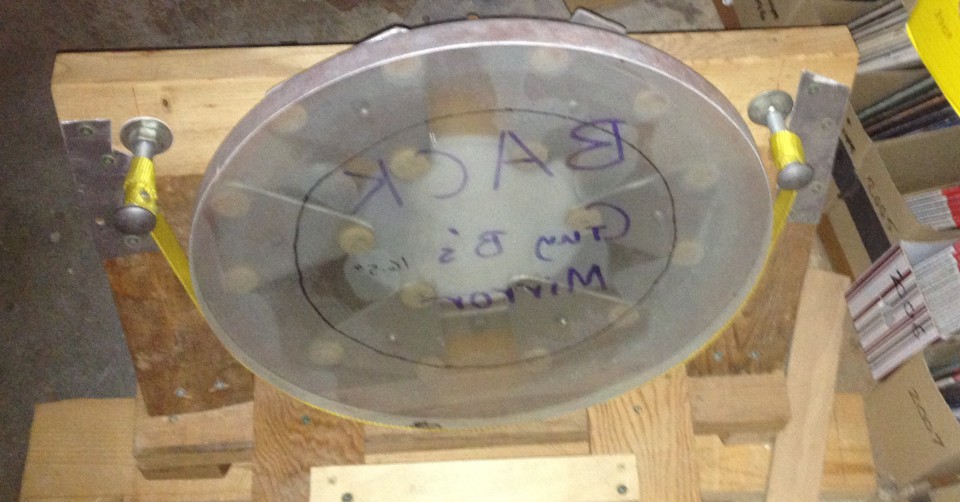
It’s the tent canopy that’s bent, I think. But this is not a telescope mirror; just a 6 inch disk of float glass.
That’s Alan
I made the jig to hold the mirrors out of some scrap two-by-fours, some screws and reinforcement plates; two old hinges; some nylon chair feet; some 1/2″ PVC pipe; and some 1/2″ PVC end caps.
The tent-screen canopy needed staking and tying down to prevent it flying off. Putting up the frame took three people (me, Alan, and my wife, Gail).
‘Shruti” will explain how to do it, but she doesn’t explain why it works:
Personally, I had never come across this one in my over 40 years of teaching math. She is correct, it does work, but WHY?
I’ll try to explain.
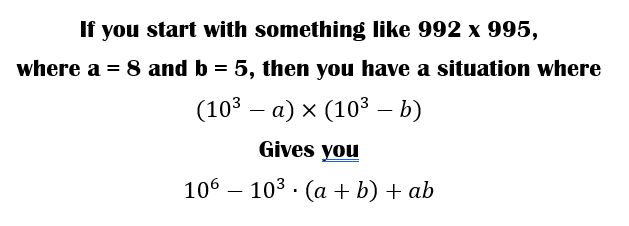
994 is 6 away from 1000, or 10^3 minus 6.
And 997 is 3 away from 1000, or 10^3 minus 3.
If we multiply (10^3 – 6) by (10^3 – 3), we get 10^6 – (6+3)*10^3 + 6*3
So as she explains, we count down from a million by nine thousand, and then we add on 18.
or, if we take away any small number from a thousand, say, a, and subtract any other small number b from a thousand, you have a situation like this if you use the area model for multiplication:







 Guy's Math & Astro Blog