Look what this little thing can do that I’ve always failed at myself, even with an entire observatory at my disposal: take decent astrophotos.
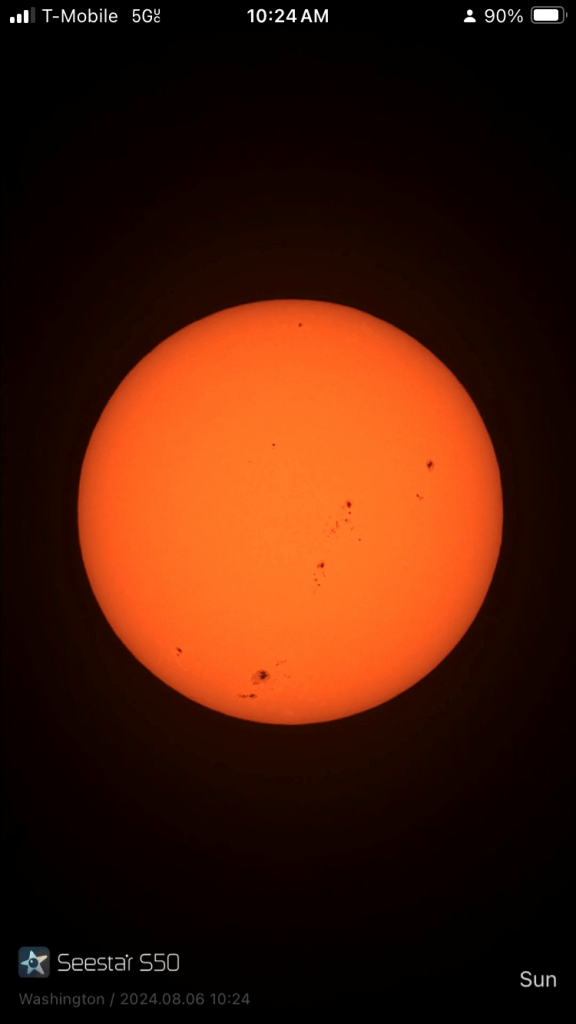
Here it is on a home made tripod, taking photos of the sun. Notice the reflective solar filter. Here are two images:
The device woke up, and after less than a minute of self’s-calibration, it pointed very accurately at the sun and focused itself perfectly. It produces a continuous feed; I even did 100 frames of a time-lapse. It’s all stored on my cell phone but I can share the photos or even live views with folks nearby.
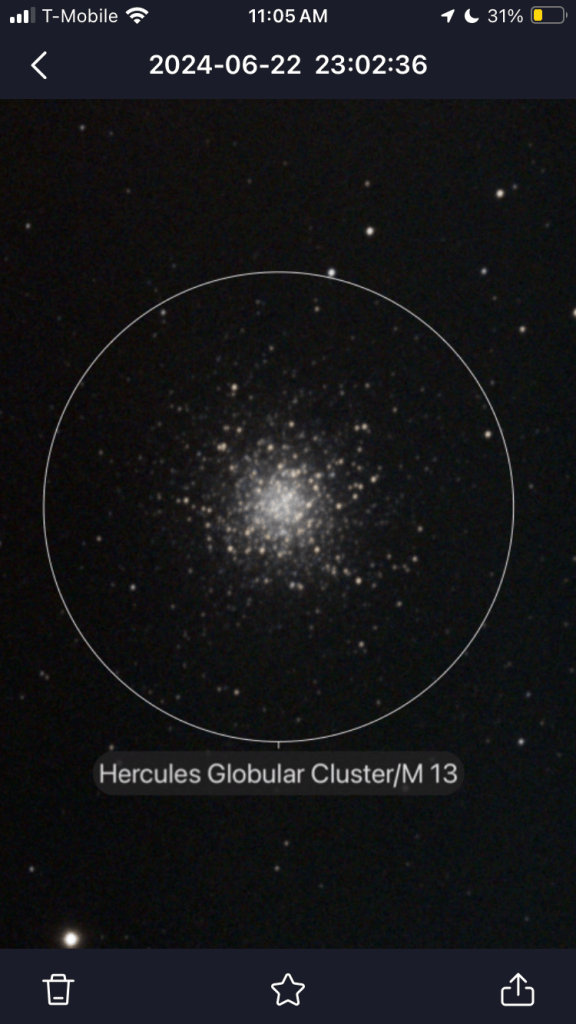
And from night time spots here in DC and NOVA:
This can take tolerable astrophotos even when surrounded by streetlights!
The Hopewell Observatory had available a finely-machined antique, brass-tube 6″ f./14 achromatic refractor.
The mount and drive were apparently made by John Brashear, but we don’t know for sure who made the tube, lens, focuser or optics.
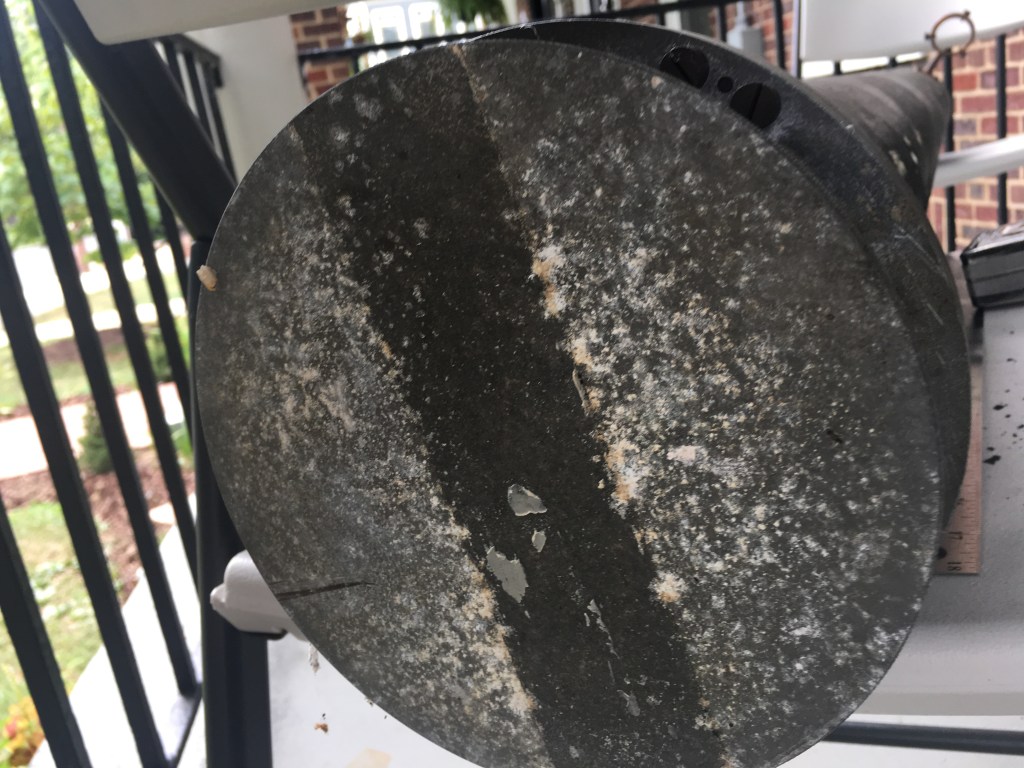
We removed a lot of accumulated green or black grunge on the outside of the tube, but found no identifying markings of any sort anywhere, except for the degrees and such on the setting circles and some very subtle marks on the sides of the lens elements indicating the proper alignment.
The son of the original owner told me that the scope and mount were built a bit over a century ago for the American professional astronomer Carl Kiess. The latter worked mostly on stellar and solar spectra for the National Bureau of Standards, was for many years on the faculty of Georgetown University, and passed away in 1967. A few decades later, his son later donated this scope and mount to National Capital Astronomers (of DC), who were unable to use it. NCA then later sold it to us (Hopewell Observatory), who cleaned and tested it.
The attribution of the mount to Brashear was by Bart Fried of the Antique Telescope Society, who said that quite often Brashear didn’t initial or stamp his products. Looking at known examples of Brashear’s mounts, I think Fried is probably correct. Kiess’s son said he thought that the optics were made by an optician in California, but he didn’t remember any other details. His father got his PhD at UC Berkeley in 1913, and later worked at the Lick Observatory before settling in the DC area. The company that Brashear became doesn’t have any records going back that far.
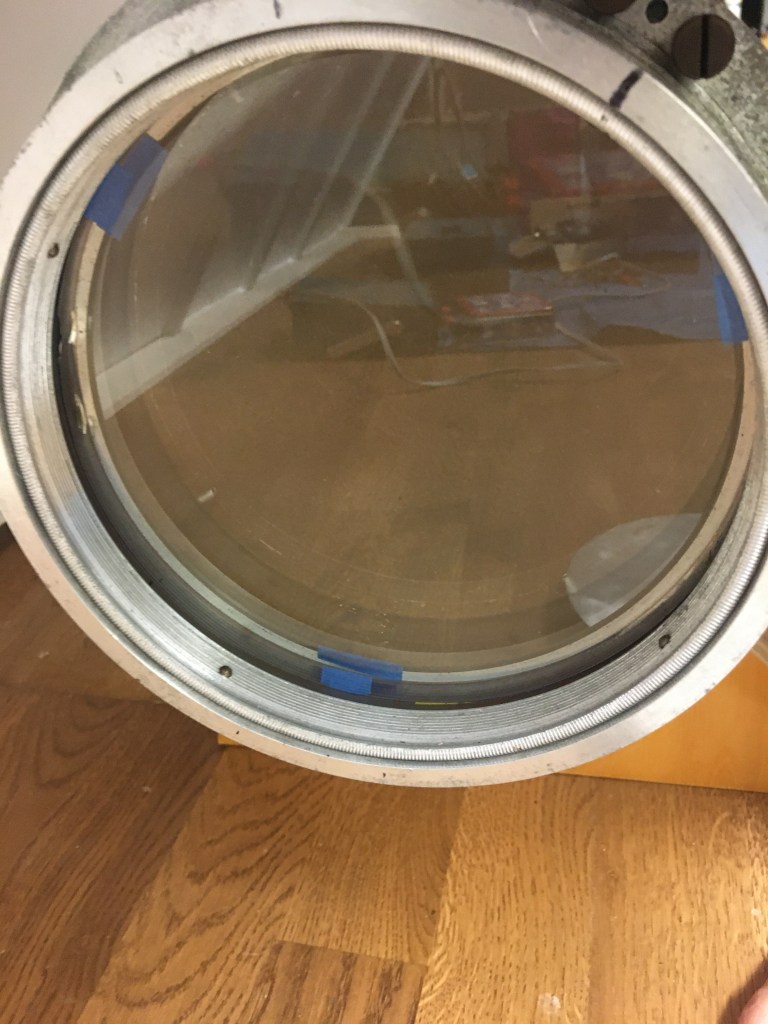
When we first looked through the scope, we thought the views were terrible, which surprised us. However, as we were cleaning the lens cell, someone noticed subtle pencil marks on the edges of the two lens elements, indicating how they were supposed to be aligned with each other. Once we fixed that, and replaced the 8 or so paper tabs with three blue tape tabs, we found it produced very nice views indeed!
The focuser accepts standard 1.25″ eyepieces, and the focuser slides very smoothly (once we got the nasty, flaky corrosion off as delicately as possible and sprayed the metal with several coats of clear polyurethane). The workmanship is beautiful!
Top: tiller for hand control of right ascension. Middle: counterweight bar (machined by me to screw into the mount) with clamps to hold weights in place. Bottom: detail of 1.25″ rack-and-pinion focuser.
We have not cleaned the mechanical mount, or tried it out, but it does appear to operate: the user turns a miniature boat tiller at the end of a long lever to keep up with the motions of the stars.
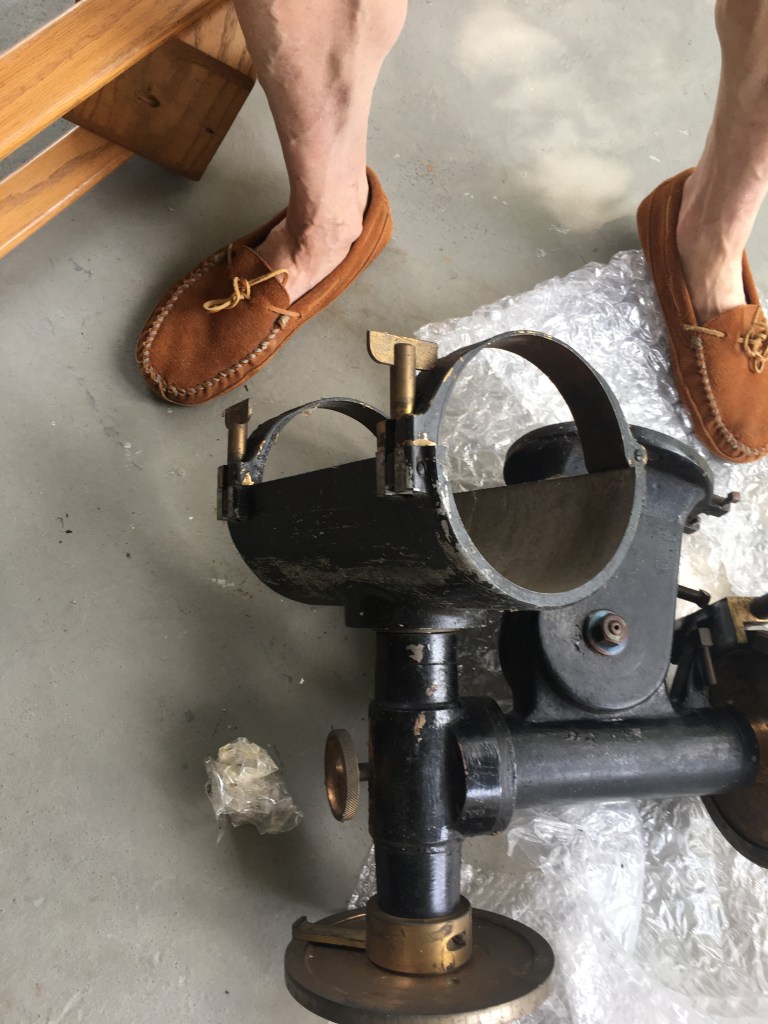
The mount and cradle (with size 12 feet for scale)
The counterweight rod was missing, so I machined a replacement, which has weight holder clamps like you see in gymnasiums. Normal Barbell-type weights with 1 inch holes fit well and can be adjusted with the clamps.
Unfortunately, the whole device is rather heavy, and we already own a nice 6″ f/15 refractor made by Jaegers, as well as some Schmidt-Cassegrain telescopes that also have long focal lengths. Putting this scope on its own pedestal, outside our roll-off roof, with adequate protection from both the elements and from vandals, or figuring out a way to mount it and remove it when needed, are efforts that we don’t see as being wise for us.
Did I mention that it’s heavy? The OTA and the mount together weigh roughly 100 pounds.
However, it’s really a beautiful, historic piece with great optics. Perhaps a collector might be interested in putting this in a dome atop their home or in their office? Or perhaps someone might be interested in trading this towards a nice Ritchey Chretien or Corrected Dal-Kirkham telescope of moderate aperture?
Anybody know what might be a fair price for this?
Guy Brandenburg
President
The Hopewell Observatory
Some more photos of the process and to three previous posts on this telescope.
Partway through cleaning the greenish, peeling, grimy layer and old duct tape residue with a fine wire brush at low speed to reveal the beautiful brass OTA.This shows the universal joint that attaches to the ’tiller’ and drives the RA axisDo you see the secret mark, not aligned with anything?Aluminum lens cover and cell before cleaningLens cell and cover, with adjustment screws highlighted, after cleaningIt works!
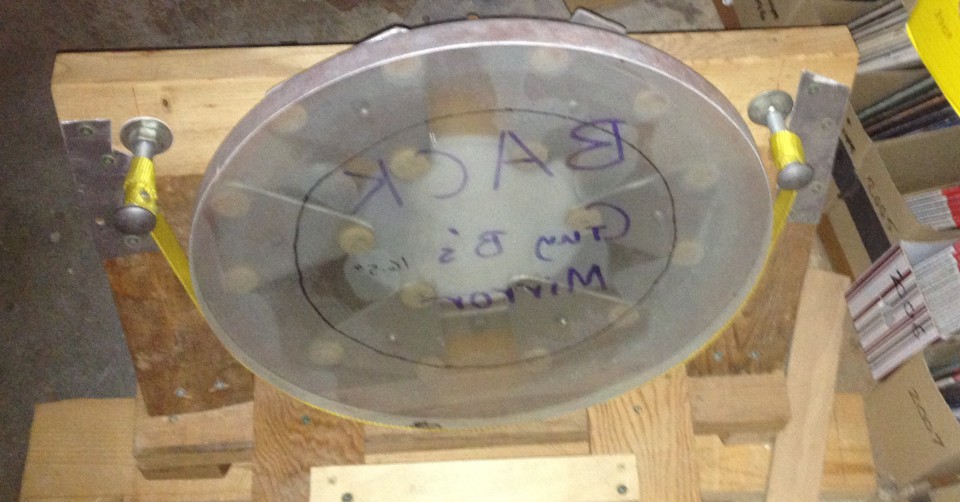
We at the Hopewell Observatory have had a classical 12″ Cassegrain optical tube and optics that were manufactured about 50 years ago.; They were originally mounted on an Ealing mount for the University of Maryland, but UMd at some point discarded it, and the whole setup eventually made its way to us (long before my time with the observatory).
The optics were seen by my predecessors as being very disappointing. At one point, a cardboard mask was made to reduce the optics to about a 10″ diameter, but that apparently didn’t help much. The OTA was replaced with an orange-tube Celestron 14″ Schmidt-Cassegrain telescope on the same extremely-beefy Ealing mount, and it all works reasonably well.
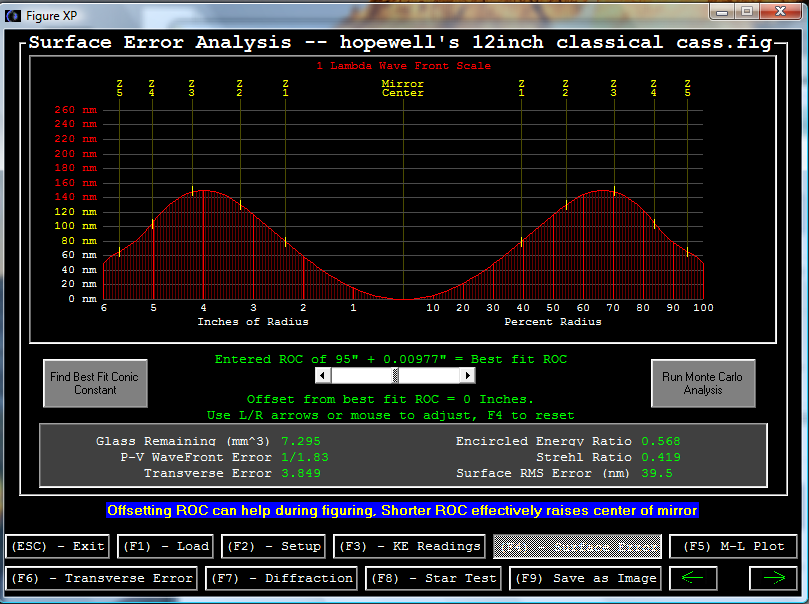
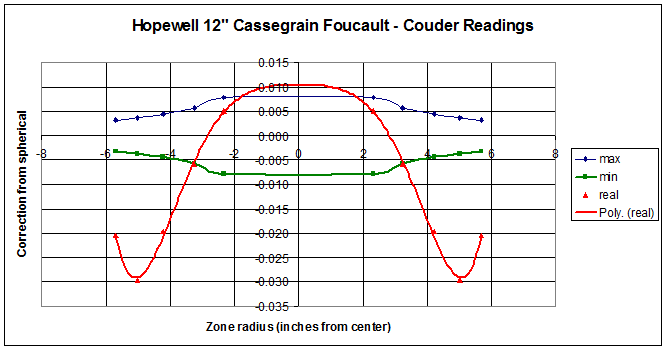
Recently, I was asked to check out the optics on this original classical Cassegrain telescope, which is supposed to have a parabolic primary and a hyperbolic secondary. I did Ronchi testing, Couder-Foucault zonal testing, and double-pass autocollimation testing, and I found that the primary is way over-corrected, veering into hyperbolic territory. In fact, Figure XP claims that the conic section of best fit has a Schwartzschild constant of about -1.1, but if it is supposed to be parabolic, then it has a wavefront error of about 5/9, which is not good at all.
Here are the results of the testing, if you care to look. The first graph was produced by a program called FigureXP from my six sets of readings:
I have not yet tested the secondary or been successful at running a test of the whole telescope with an artificial star. For the indoor star test, it appears that it only comes to a focus maybe a meter or two behind the primary! Unfortunately, the Chevy Chase Community Center where we have our workshop closes up tight by 10 pm on weekdays and the staff starts reminding us of that at about 9:15 pm. Setting up the entire indoor star-testing rig, which involves both red and green lasers bouncing off known optical flat mirrors seven times across a 60-foot-long room in order to get sufficient separation for a valid star test, and moving two very heavy tables into said room, and then putting it all away when we are done, because all sorts of other activities take place in that room. So we ran out of time on Tuesday the 5th.
A couple of people (including Michael Chesnes and Dave Groski) have suggested that this might not be a ‘classical Cassegrain’ – which is a telescope that has a concave, parabolic primary mirror and a convex, hyperbolic secondary. Instead, it might be intended to be a Ritchey-Chretien, which has both mirrors hyperbolic. We have not tried removing the secondary yet, and testing it involves finding a known spherical mirror and cutting a hole in its center, and aligning both mirrors so that the hyperboloid and the sphere have the exact same center. (You may recall that hyperboloids have two focal points, much like ellipses do.)
Here is a diagram and explanation of that test, by Vladimir Sacek at http://www.telescope-optics.net/hindle_sphere_test.htm
FIGURE 56: The Hindle sphere test setup: light source is at the far focus (FF) of the convex surface of the radius of curvature RC and eccentricityε, and Hindle sphere center of curvature coincides with its near focus (NF). Far focus is at a distance A=RC/(1-ε) from convex surface, and the radius of curvature (RS) of the Hindle sphere is a sum of the mirror separation and near focus (NF) distance (absolute values), with the latter given by B=RC/(1+ε). Thus, the mirrorseparation equals RS-B. The only requirement for the sphere radius of curvature RS is to be sufficiently smaller than the sum of near and far focus distance to make the final focus accessible. Needed minimum sphere diameter is larger than the effective test surface diameter by a factor of RS/B. Clearly, Hindle test is limited to surfaces with usable far focus, which eliminates sphere (ε=0, near and far focus coinciding), prolate ellipsoids (1>ε>0, near and far foci on the same, concave side of the surface), paraboloid (ε=1, far focus at infinity) and hyperboloids close enough to a paraboloid to result in an impractically distant far focus.
We discovered that the telescope had a very interesting DC motor – cum – potentiometer assembly to help in moving the secondary mirror in and out, for focusing and such. We know that it’s a 12-volt DC motor, but have not yet had luck tracking down any specifications on that motor from the company that is the legatee of the original manufacturer.










 Guy's Math & Astro Blog