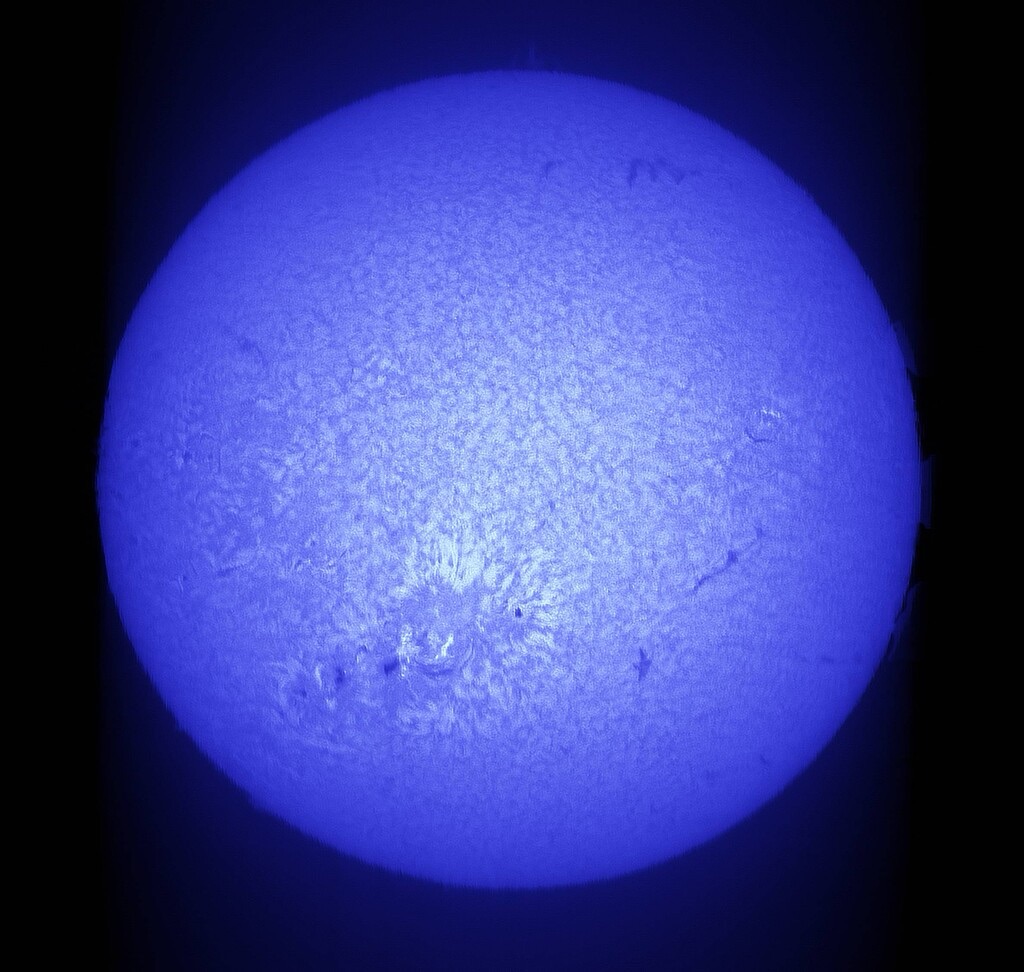
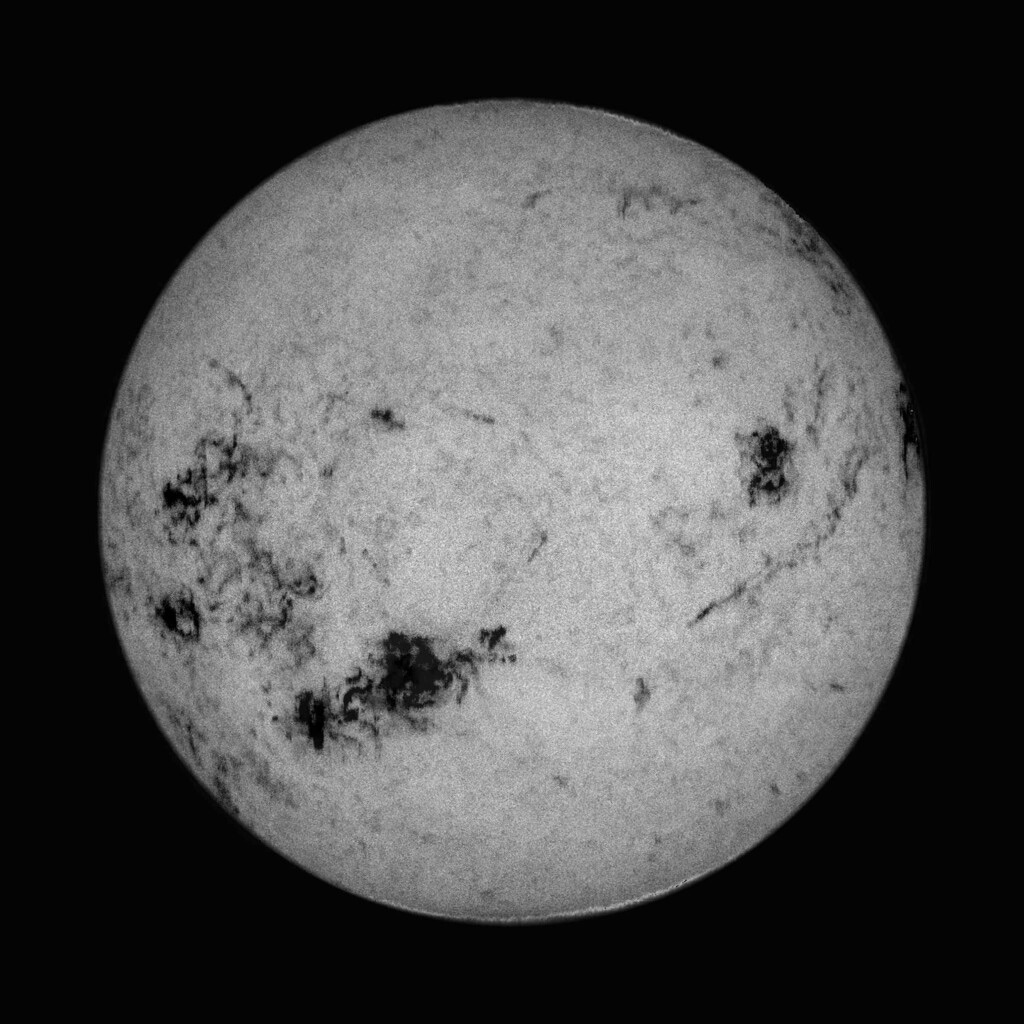
I’d like to share these spectacular images of our Sun, taken by Prasad Agrahar with his home-made spectroheliograph.
His first image is at H-alpha (656 nm), second is at H-beta (486 nm), and the third is at Helium D3 (585 nm).
With this device, IIUC, he can make an image at just about any wavelength that makes it through the front lens of the optics. He posted this to the NCA email list.
DIY!!
Guy Brandenburg
Prasad wrote:
Here are three images of our Sun, taken on Thursday morning with my DIY spectroheliograph. The weather was quite windy, and the seeing was poor.
The above is H-alpha with [sunspot groups] AR 4294 and 4296 dazzling.
This is H-beta
And finally,
The above image is (…) Helium-D3, the emission line at 5875A.
Most (but not all) of the variable stars I tried over the past month or so were simply too bright for this sensor. The target stars were saturated (ie some of the pixels’ electron wells simply overflowed) despite using the shortest available exposure, adding the light pollution filter and refocusing. Seestar won’t let your change the ISO nor open the shutter for less than 10 seconds.
I did get some believable light curves on BE Lyncis (aka HD67390)and U Cephii (aka HD 5679). I attack some graphs I made.
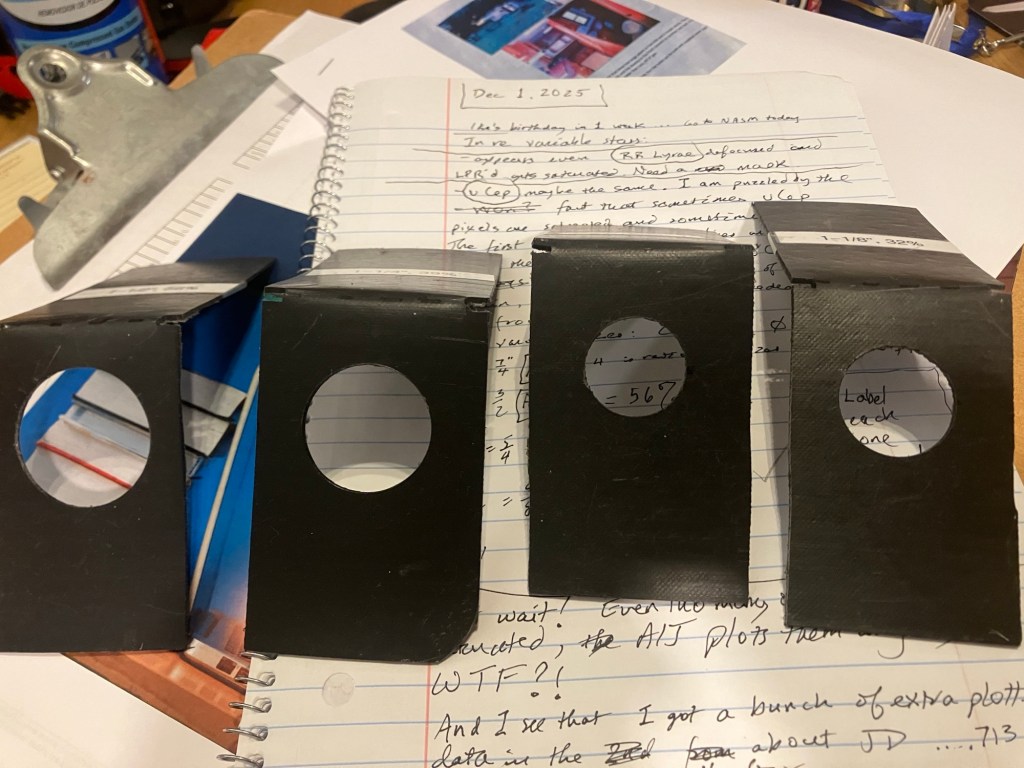
I used some black plastic I had,and my set of Forster bits, to make holes of sizes 1”, 1-1/8”, 1-1/4”, and 1-1/2”, in case I want to try brighter variable stars again like RR Lyrae.
I very impressed that Seestar absolutely nails the locations of every single one of these targets! I’m also pleased that AstroImageJ allows quick and easy plate-solving!
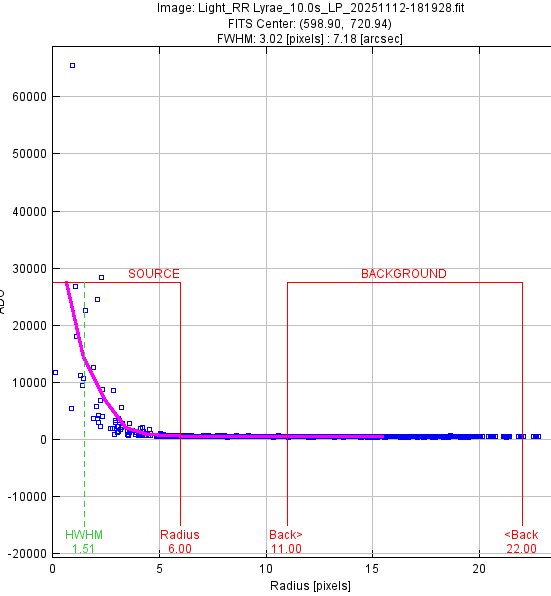
This graph gives me confidence that defocusing will solve my overflow problem. It’s a profile of the number of photons/electrons captured (vertical axis) versus the distance from what I thought was the exact center of the star RR Lyrae aka HD 182989.
(It is amazing how fast the computer works this out! I’m used to my middle school or high school students working things out like this by hand at first — it’s a very slow and tedious process! Let us give a tip of the hat to Williamina Fleming, who was the first person to notice and record that RR Lyrae was a variable star. She did so by examining glass plates on which were little dark spots made by stars’ light striking particles of suspended silver nitrate, without a blink comparator! Wow!)
Notice that there is one
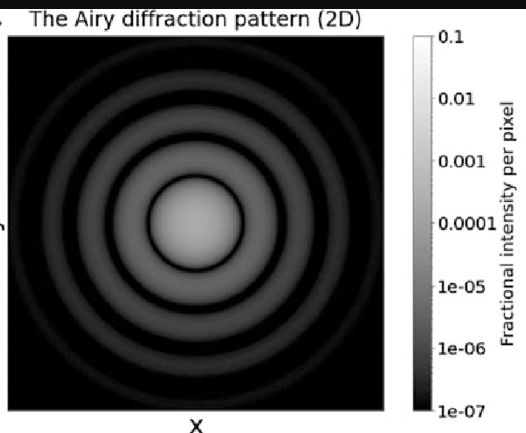
If I defocus the camera a bit, that saturated value would get spread out over an airy disk that might look like this:
I went up to Hopewell on Wednesday night, and practiced once again taking images of RRLyrae with my Seestar S50, but this time with the built-in light-pollution rejection filter in place. I figured that would reduce the number of photons by a lot, and maybe by enough to stop overwhelming the pixels.
Unfortunately, it was not sufficient, so, since I cannot reduce the number of seconds of exposure for each sub-image (or ‘slice’ as AstroImageJ calls them) below 10, and I cannot change the ISO or gain for the chip, the only choices left are, in order of ease of implementation:
De-focus the images to spread the photons into a wider range of pixels, hopefully not causing any of them to become saturated, but not so much as to confuse the plate-solving app;
Make a black, circular mask smaller than 50 mm in diameter and put it in front of the lens, reducing the total number of photons;
Persuade the engineers and programmers at ZWO to change the software to allow users to reduce the length of exposures, and to allow time lapse photography with what they call Star-Gazing but everybody else calls deep-space observing.
Number 1 I will do next time.
By the way, the exact mechanism by which this variable star dims and brightens is still not fully understood, though its timing cycle is extremely regular and quite well known.
No Auroras for me:
It was very cold and windy so I couldn’t stand being outside up on the Bull Run Mountain ridge for very long at a time. The sky was almost perfectly clear the entire night, and the beautiful winter constellations were extremely bright, and it was fun watching them make that apparent great pivot around us.
I saw no auroras; since I was was groggy (from forgetting my meds) and quite cold, so I spent most of the night inside napping and trying to get warm, but went out from time to time to look around and to check on the progress of my little Seestar. So when the peak happened I was probably dozing. Not too many other folks saw it, apparently, and the images I’ve seen were not nearly as impressive as for other aurorae on other dates. Oh, well.
As described in my last post, I got a light curve for a known variable star in my little Seestar S50 a few weeks ago that showed absolutely no variability whatsoever over a roughly 4 hour period. Since this star’s variation occurs extremely regularly, there is a known formula that will give you the precise location in its cycle if you feed in the Julian day (JD). I plugged the start and end times for my run, and got the following:
And was confused
So RRLyrae should have dropped from something near 7.3 magnitude to around 7.6 magnitude, which is a LOT for this sort of thing. But my graph of brightness of RRLyae, compared to a nearby star of roughly the same magnitude, looks like this:
Which is barely any change at all. The few pairs of dots below the blue blob line are glitchy data that should be ignored; notice that it happens for both stars. In fact, I see more variability in the pink comparison star’s brightness than I do with RRRLyrae.
Was the scope indeed pointed at the correct star? Well, I had plate solving on each and every frame, and they all agreed, so, yes.
I did notice a problem with saturation, but didn’t know exactly by how much. Nikolaos Bafitis suggested that I use my mouse to look more closely at the centers of the star images themselves in AstroImageJ. I did so, and at last noticed that one of the boxes held the number of pixel counts right under my mouse pointer. Duh! Sure enough, my target star, RR Lyrae, had a count of 65,533, which is 2^16, and (I looked it up) that is precisely the maximum for these pixels on these CMOS cameras. So that’s why RR Lyrae’s brightness was so steady: it was always OVERFLOWING.
So I have to figure out a way to gather fewer photons per pixel around the target and comparison stars. There are several possible ways of doing so without changing the electronics or trying to mess with the operating system or user interface.
Reduce the ISO setting from the current default value.
Shorten the exposure time.
Change the focal ratio by placing a circular mask over the lens aperture.
De-focus the images so that the light is spread out over a larger area.
Add some sort of filter.
Unfortunately right now, the Seestar doesn’t allow you to do either number 1 or number 2. It would be nice if ZWO engineers would add those capabilities in the ‘advanced’ menu,
Number 3 is quite doable. I happen to have on hand a large roll of black Kydex plastic and a set of Forstner bits to make nice holes with. But it this would require a fair amount of time and effort. It would also reduce the resolution of an already rather small 50mm lens.
Number 4 is more easily doable: turn off the autofocus feature and do some experimentation to find a good fixed de-focus point. However, if the stars are too fuzzy, then plate-solving becomes much harder and slower.
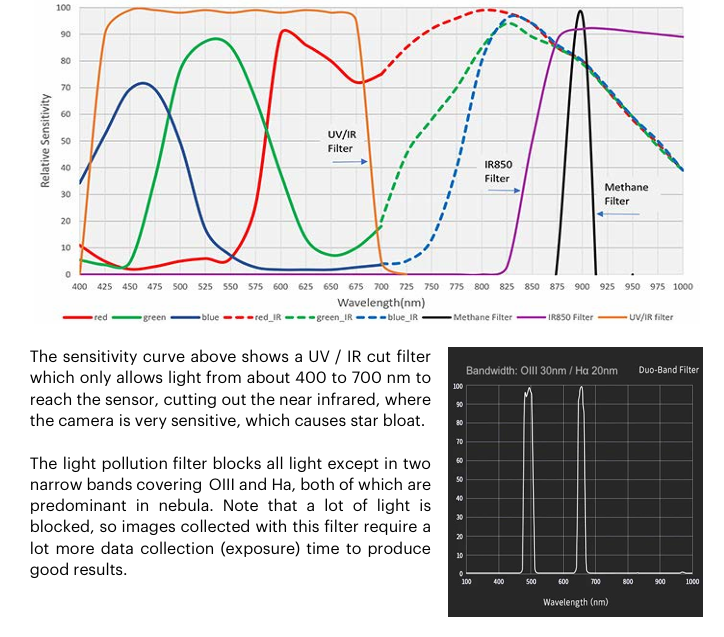
Number 5 can be done by using the built-in light pollution filter, whose transmission bandwidth is very small. It’s the bottom graphic below.
The graphics above come from an excellent Unofficial Seestar handbook written by Tom Harnish. He has a number of suggestions that I hope the engineers at ZWO pay attention to and follow.
The option that seems easiest is number 5, using the light pollution filter. If I couple that with the built-in time-lapse feature, I won’t fill the Seestar’s entire memory with a zillion FITS images.
I hope to try this tonight up at Hopewell Observatory, where I can set this up, have it run all night connected to mains power, and I can sleep in a nice warm cabin.
I’m still struggling to do simple astronometry even on a well-known variable star like RRLyrae. If you could measure its brightness for several nights without any breaks, you should in theory get a light curve like this:
I don’t. I’m still trying to figure out why my light curve for RRLyrae is so flat.
In 2004, during a two-week astronomy summer class at Mount Wilson, with a professional astronomer on hand guiding me at every step of the way over a couple of nights, I got light curves looking like pieces of the good example above. (Why only pieces? Because you can’t image a star in the daytime or when it’s cloudy or if the star is on the other side of our planet!)
A couple of weeks or so ago, inspired by an exoplanet light curve taken by a 9th grader with a Seestar, I had the opportunity to run my tiny automated Seestar S50 for 8 hours outside at Hopewell Observatory, which is a nice, safe location, connected to wall power. The weather was perfect for it. The scope is about the size of a large cookie tin on a tripod. It did nothing but take ten-second photos of a small region around RRLyrae from whenever stars came out until dawn.
Afterwards I then had to start analyzing those 972 images. My first step was to learn how to use YET ANOTHER astro-imaging package, called AstroImageJ. It’s quite impressive, but It pisses me off that every few years I have to learn an entirely new piece of software, and just throw out nearly everything I learned regarding anything software-related over the past 60 years!
I eventually figured out how to get AIJ to verify that the little scope was in fact looking at my chosen star — and it was.
I then asked AIJ to compare the brightness of RRLyrae to the brightness of five or six other stars of similar brightness that happened to be located in the same field of view, for each image. (Today’s computers quickly do all sorts of math on the values of certain pixels in certain rings around certain stars, at lightning speeds, but the human computer of 1899, Williamina Fleming, who discovered this star, had to do it completely manually by comparing the size of the spots on a glass photographic plate. My hat is off to you, Ms Fleming, and all the other unsung female computers!
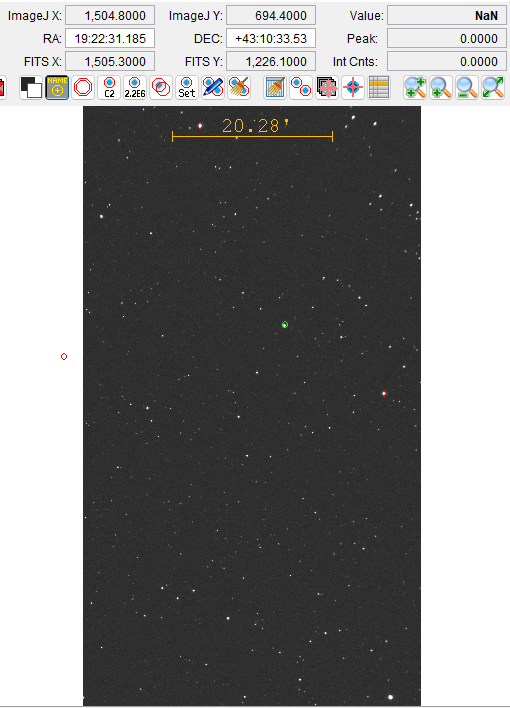
Here is a screenshot of the very last image in the series I took. The RA and Dec are the coordinates of RRLyrae, which AIJ has circled in green. The stars circled in red are comparison stars. That 20.28′ legend is in arc-minutes, 60 of which equal one degree. So the field of view is a bit over half a degree across and roughly a degree vertically.
To my surprise, my results were totally different from what I expected to find.
The blue dots are RRLyrae’s brightness on some scale that the computer cooked up, and the pink ones are from one of the known comparison stars. The x-axis goes from roughly 0.48 to 0.64, or 0.16, which is 1/6 of a day, or 4 hours.
The cases where both the blue and pink dots drop down below 1.0 are garbage caused by some glitch and should be ignored. But one thing is for sure: there is no sawtooth spike in my data for RRLyrae’s brightness during those 8 or 9 hours!
Four possible reasons are:
I’ve made a great scientific discovery! (probably not correct)
2. Wrong star? (I don’t think so. Checked and re-checked)
3. Perhaps those 8 hours happened to correspond to a flat place in the light curve (Possible — I just noticed that these images end before midnight, but I thought it kept working until dawn! Must re-check!)
4. The pixels all are too saturated, ie were exposed for too long,, which fills up the pixel with too many electrons. (This is possible, I guess, but each of these were merely 10 second-long exposures, which doesn’t sound very long to me, but maybe I’m missing something important).
Saturation is what the following graphic seems to indicate:
If it is indeed saturation that is making all the stars not change brightness, then what do I do?
I don’t think I can control the gain or ISO inside SeeStar, but I can ask for shorter time exposures, I think, by trying a time lapse and asking for shorter exposures, if possible. I just need to have time and a location to let it run all night without anybody disturbing it, making a time lapse of the sky.
We’ve all been brainwashed by years of Star Wars, Star Trek, Marvel Universe, Avatar, etc, to think that space should be teeming with intelligent civilizations, most of them vaguely like ourselves, working with and against each other to carve up the galaxy. As a result, it’s easy to overlook the huge assumptions embedded in your question.
Habitable worlds exist. Do they? It seems overwhelmingly likely, given that there are probably a trillion planets in the Milky Way alone, but for now we don’t know. Perhaps there are many near-miss planets like Venus and Mars, but extremely few true Earth analogs. For instance, life might require a particular rock/ice ratio, a large moon, and a specific style of plate tectonics. That level of specificity seems unlikely to me, but that’s just my random opinion. Until we find another planet with truly Earthlike conditions, we cannot say for sure that this is true.
Alien life exists. Does it? Honestly, we have no idea. There are many strong arguments suggesting that the fundamental biochemistry of self-replication is practically inevitable given the right conditions. But we don’t know how common those conditions are (see above), and even then we don’t know if there is some extremely low-probability gap that hinders the emergence of even simple microbial life.
Intelligent life exists. Does it? This one is a complete unknown. Keep in mind that there was no intelligent, self-aware life on Earth for 99.999% of its existence. Maybe the emergence of intelligence here was a rare fluke, unlikely to be reproduced anywhere else. Rat-level intelligence seems to have existed for at least 200 million years without any indication that higher level intelligence would confer a big evolutionary advantage. (There are all kinds of speculations about why intelligent life could not emerge until now on Earth, but these are just-so stories, trying to paint an explanation on top of a truth that we already know.)
Intelligent species want to “colonize” the galaxy. Do they? Life does have a tendency to explore every available ecological niche, and humans sure do like to spread out. From our example of one Earth, it seems likely that this is a general tendency of life everywhere, but we are doing an awful lot of extrapolating here. Maybe other types of intelligence have other motivations that have nothing to do with expansion.
Intelligent species become technological species. Do they? It’s certainly true for humans, but dolphins have a high level of intelligence and they are not trying to build spaceships. Crows, chimps, and bonobos are also capable of simple tool use, but they don’t appear to have experienced any evolutionary pressure to become true technological species.
Technological species can travel a significant fraction of the speed of light. (I assume you mean something like more than 1% of light speed.) Can they? Extrapolating from human technology, that seems extremely likely. Then again, the fastest spacecraft we have ever built would take about 300,000 years to reach the next star. Nobody is going to be colonizing the galaxy at that rate. You have to accept that speculative but unproven technologies are both feasible and practical for more advanced technological civilizations. Maybe intelligent life is out there, but in isolated pockets.
Intelligent, technological, space-faring species survive for a long time. Do they? Oh boy, we have no idea at all if this is true. Earth is 4.5 billion years old. Life has been around 4 billion years. Land species have been around 400 million years. Rat-level intelligence has maybe been around 200 million years. Our species has been around for about 100 thousand years. We have been capable of spaceflight for less than 100 years. It may seem inconceivable that humans could go extinct—but even if we last another 100,000 years, that may not be nearly enough time to spread across the galaxy, even if we develop the means to do it and maintain the will to do it. If intelligent species typically last less than 100,000 years, thousands of them could have come and gone in our galaxy without us ever knowing.
So there’s not one answer, but a whole set of overlapping possible answers why we don’t see evidence of any alien civilizations around us. And that doesn’t even consider more exotic possibilities, such as the idea that they might be here but just undetectable to us or deliberately hidden from our primitive eyes.
Dr Rob Zellem posed this question last night (9-13-2025) to NCA members and visitors at their monthly meeting at the University of Maryland Observatory.
Are we alone in the universe, or are there exoplanets with life of some sort, and even some advanced civilizations out there?
Dr Zellem said the correct answer right now is, maybe. We just don’t have enough data to tell.
He reminded us that Giordano Bruno and Isaac Newton both correctly predicted that other stars would have planets around them. We now know that just about every single star is born with a retinue of planets, asteroids, dust, and comets, so there are at least as many planets as there are stars in our galaxy and all the others as well. Previous speakers to NCA have noted that many of these objects end up getting flung out into the vast frozen emptiness of interstellar space in a giant random game of ‘crack the whip’. No life can exist out there.
My calculations here: It is estimated that there are literally trillions (10^12) of galaxies, each with millions (10^6) or billions (10^9) of stars. Let’s start with our own galaxy, the Milky Way, with maybe 200 billion stars (maybe more). I will assume that life needs a nice, calm, long-lived G class yellow star, which only make up 7.6% of all stars. Roughly 50% to 70% of those stars are in binary systems, which I fear will reduce the chances of having a planet survive in the Goldilocks zone. Perhaps one-third to two-thirds of those G stars have a planet in their habitable zone. We have no idea how likely life is to get started, but after reading Nick Lane’s The Vital Question it sounds pretty complicated to me, so I’ll use a range of estimates: somewhere between 10% and 80% of them develop some form of life. We know that on Earth, the only form of life that existed during the vast majority of the existence of the Earth was unicellular microbes. Four-footed tetrapods like ourselves have only occupied about 1% of the life of our planet, and we humans have only had the telescope for just over 400 years, out of the 400,000,000 years since four-footed animals evolved, which is one in a million. Low estimate:
If my low-end estimates are correct, then there are about five or so exo-planets somewhere in our galaxy with a civilization formed by some sort of animal that can look out into outer space. High estimate:
In that case, there are well over a hundred civilizations in our galaxy — but the Milky Way is huge, hundreds of thousands of light-years across! Most of our exoplanet detections have been within the nearest 100 light years, and we have no way of detecting most exoplanets at all because the planes of their orbits point the wrong way.
NOTE: Jim Kaiser pointed out that I made a dumb mistake: a hundred billion is ten to the 11th power, not ten to the 14th power. Fixed now.
Even so, Zellem pointed out that thanks to incredible advances in sensitivity of telescopes and cameras, we are now closer than ever to being able to answer the title question: Are We Alone.
Plus, any amateur astronomer can take useful measurements of exoplanet transits with any telescope, and any digital camera. Following the directions on NASA’s Planet Watch webpage, you can take your data, in your back yard or from a remote observatory, process it the best you can, send it in, and be credited as a co-author on any papers that are published about that particular exoplanet. Then, later, a massive space telescope can be aimed at the most promising exoplanets during their transits. Astronomers can use their extremely sensitive spectroscopes to detect the atmospheres of those bodies and look for signs of life. They do not want to waste extremely valuable telescope time waiting for a transit that doesn’t recur!
Some day we will be in a situation where scientists will be able to say that based on their measurements, the signal indicates a very good chance of life at least a bit like ours, with similar chemistry on some planet. They will also state what the chances are that they are wrong, and indicate what further steps could be made to disprove or confirm their claim.
Zellem noted that both the Doppler-shift method and the transit methods are quite biased in favor of large exoplanets that are close to their suns.
I asked the speaker how likely it would be for observers from some exoplanet to detect the planet Mercury, but couldn’t do the math in my head and didn’t have paper and pencil to write anything down at the time. But now I do.
The closer Mercury is to the Sun, the larger the possible viewing angle.
Using a calculator to find the arc-tangent of that ratio (865,000 miles solar diameter, divided by the smallest and also by the largest distances between them, namely 28,500,000 and 43,500,000 miles) gave me an angle between 2 and 3 degrees, depending. So there is a circular wedge of our galaxy where observers on some other planet might view a transit of our innermost planet. Where is that wedge in our galaxy?
The following sky diagram has the Ecliptic in pink. Only observers within a degree or so of that curvy line could detect that Sol has planets.
So what fraction of the sky can ever hope to catch a transit of Mercury? Only about 1% or 2% of the sky — not much.
Turning things around, this means that we can ourselves only detect, via transits, a very small portion of all extra-solar planetary systems – those whose planes are pointing almost directly at us, and those with large planets that are very close to their stars. (Any planet so close to a star is not a very good candidate for life, in my opinion.)
The biggest obstacle is the sheer distances between stars. At the speed of our very fastest space craft (the Parker Solar Probe), which only goes 0.064% of the speed of light, it would take about 6250 years to reach our closest stellar neighbors near Proxima Centauri. One way. Which probably explains why, if all these other civilizations do exist, we do not appear so far to have been visited by any other extraterrestrial civilization.
At the meeting, someone in the audience was pretty sure that yes, we have already been visited by aliens. I talked with him outside after the meeting. His main evidence was a 2020 New York Times article concerning the upcoming release of classified data about mysterious flying objects (now called UAPs rather than UFOs). In the article, one Eric Davis claimed (without producing any evidence) that some items have been retrieved from various places by the US military that couldn’t be made here on earth. That is of course true of every single asteroid or meteorite ever discovered, since we can’t reproduce the conditions in which they were formed, so his claim is not very helpful. No technological devices clearly of alien manufacture have ever been publicly produced by him or anybody else for testing.
(It’s pretty obvious that American and other military forces spend a lot of money producing objects that go very fast and are highly maneuverable — and which they want to keep secret.)
There are in fact many, many unsolved mysteries in science (eg, the nature of dark matter and dark energy, and exactly how the nucleus arose in eukaryotes). Many of the unidentified sky or water phenomena that have been witnessed do not have clear explanations so far, but the simplest explanation is usually the correct one. Reputable scientists require a lot more than hearsay evidence before they make bold claims.
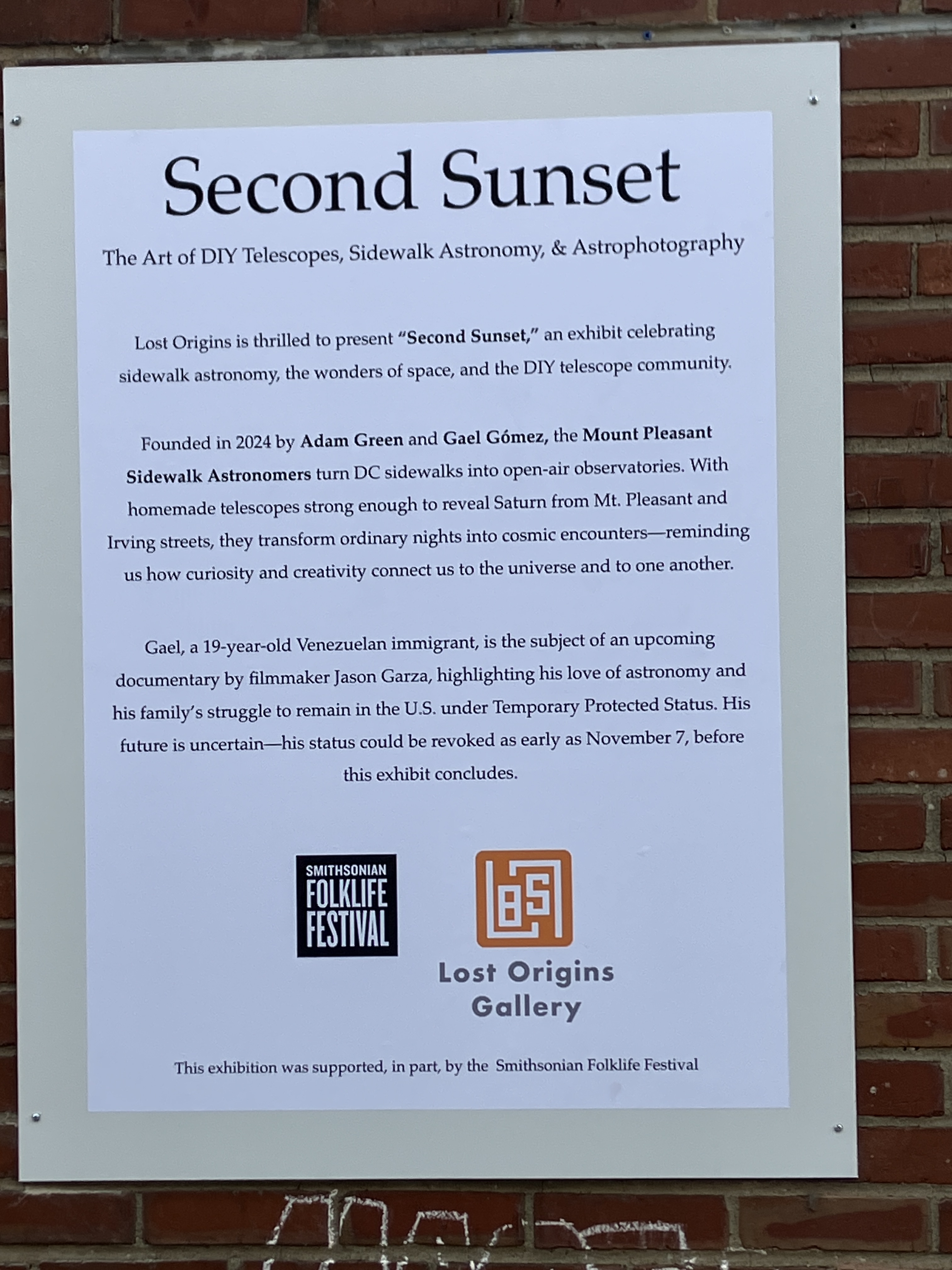
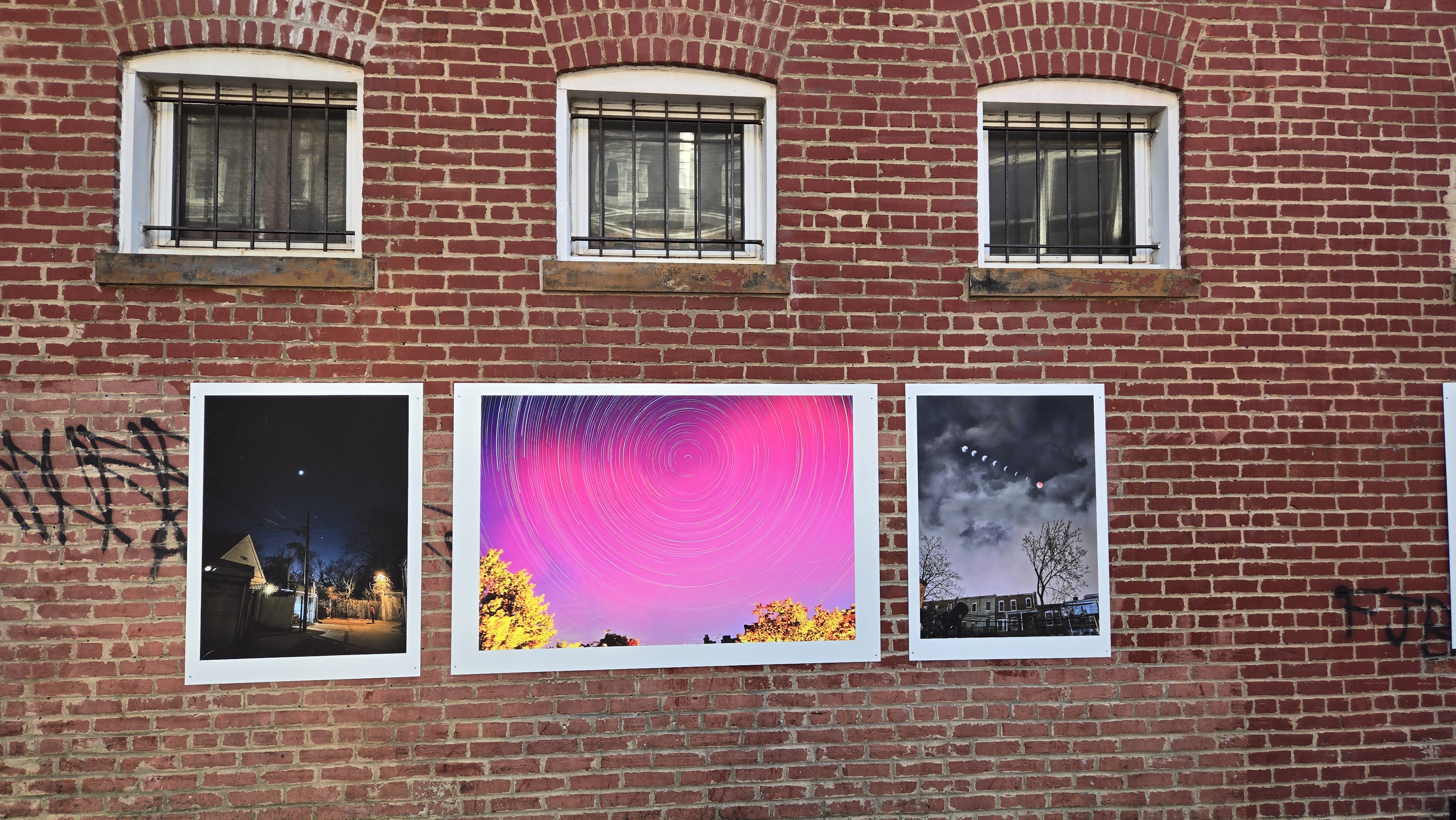
Last night was the opening of an exhibit called Second Sunset in an alley off Mt Pleasant Triangle in NW DC. Great astrophotos by 19-year old Gael Gomez, his neighbor Adam Green, and NCA VP Bryan Vandrovec! The images are huge – four to six feet across, and printed on durable sandwiches of aluminum and plastic, so they will survive outside for months. They were printed by Jason Hamacher of Lost Origins Gallery, located about a block away, aided in part by the Smithsonian’s Folk Life Festival.
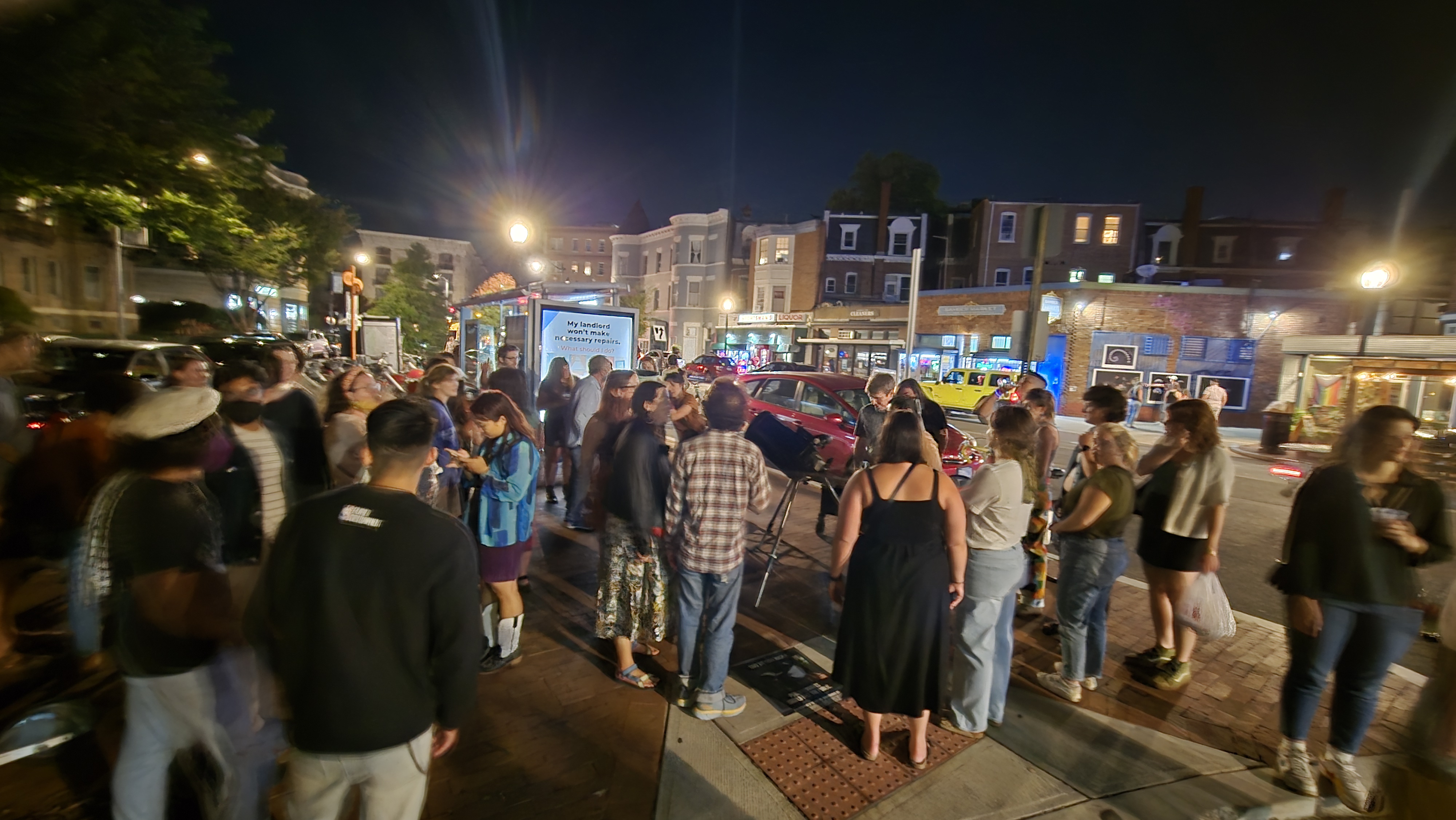
It coincided with the 3rd annual Art All Night – Mount Pleasant, so a LOT of people were out having a good time, listening to a live Colombian band and visiting dozens of vendors and exhibits under tent covers on the Triangle.
So when Gael and Guy Brandenburg (NCA president) brought out their telescopes on the other side of Mt Pleasant Street, once we could actually see a few stars, we had long lines of people waiting patiently to look at double stars, Saturn, the ISS, and the Moon, and then discussing what they had seen, right up until 11:30 PM. We all had a blast!
If you can’t read the text, it says, “The Art of DIY Telescopes, Sidewalk Astronomy, and Astrophotography: The Debut Exhibit of the Mt Pleasant Sidewalk Astronomers”. As well as “Lost Origins Outside” and “November 12 to November 9, 2025.”
Captions are coming for all of the photos, explaining how they were made and what they depict, as well as a sign explaining the National Capital Astronomers which has been running the DC DIY telescope workshop since World War 2, in which both Guy and Gael made their first telescopes.