• My series on making a Newtonian telescope
  • How Leon Foucault Made Telescopes

Guy's Math & Astro Blog

Guy's Math & Astro Blog

Author Archives: gfbrandenburg

A piece of mystery glass

29 Sunday Aug 2021

Posted by gfbrandenburg in astronomy, Hopewell Observatorry, Math, Optics, Telescope Making

≈ 3 Comments

Tags

ATM, barium, Bausch & Lomb, Bureau of Standards, flint, glass, Hopewell Observatory, Math, mystery glass, Optics, Schott, Snell's Law, Telescope

Many years ago, the late Bob Bolster, a founding member of Hopewell Observatory and an amazing amateur telescope maker, got hold of a large piece of glass, perhaps World War Two military surplus left over from the old Bureau of Standards.

I have no idea what it is made out of. If Bob had any clue about its composition, he didn’t tell anyone.

Its diameter is 22 inches, and its thickness is about 3.25″. It has a yellowish tint, and it is very, very heavy.

If you didn’t know, telescope lenses (just like binocular or camera lenses) are made from a wide variety of ingredients, carefully selected to refract the various colors of light just so. Almost all glass contains quartz (SiO2), but they can also contain limestone (CaCO3), Boric oxide (B2O3), phosphates, fluorides, lead oxide, and even rare earth elements like lanthanum or thorium. This link will tell you more than you need to know.

If you are making lenses for a large refracting telescope, you need to have two very different types of glass, and you need to know their indices of refraction very precisely, so that you can calculate the the exact curvatures needed so that the color distortions produced by one lens will be mostly canceled out by the other piece(s) of glass. This is not simple! The largest working refractor today is the Yerkes, with a diameter of 40 inches (~1 meter). By comparison, the largest reflecting telescope made with a single piece of glass today is the Subaru on Mauna Kea, with a diameter of 8.2 meters (323 inches).

For a reflecting telescope, one generally doesn’t care very much what the exact composition of the glass might be, as long as it doesn’t expand and contract too much when the temperature rises or falls.

We weren’t quite sure what to do with this heavy disk, but we figured that before either grinding it into a mirror or selling it, we should try to figure out what type of glass it might be.

Several companies that produce optical glass publish catalogs that list all sorts of data, including density and indices of refraction and dispersion.

Some of us Hopewell members used a bathroom scale and tape measures to measure the density. We found that it weighed about 130 pounds. The diameter is 22 inches (55.9 cm) and the thickness is 3 and a quarter inches (8.26 cm). Using the formula for a cylinder, namely V = pi*r2*h, the volume is about 1235 cubic inches or 20,722 cubic centimeters. Using a bathroom scale, we got its weight to be about 130 lbs, or 59 kg (both +/- 1 or 2). It is possible that the scale got confused, since it expects two feet to be placed on it, rather than one large disk of glass.

However, if our measurements are correct, its density is about 2.91 grams per cc, or 1.68 ounces per cubic inches. (We figured that the density might be as low as 2.80 or as high as 3.00 if the scale was a bit off.)

It turns out that there are lots of different types of glass in that range.

Looking through the Schott catalog I saw the following types of glass with densities in that range, but I may have missed a few.

2.86  N-SF5

2.86 M-BAK2

2.89 N-BAF4

2.90 N-SF8

2.90 P-SF8

2.91 N-PSK3

2.92 N-SF15

2.93 P-SF69

2.94 LLF1

2.97 P-SK58A

3.00 N-KZFS5

3.01 P-SK57Q1

By comparison, some of the commonest and cheapest optical glasses are BAK-4 with density 3.05 and BK-7 with density 2.5.

Someone suggested that the glass might contain radioactive thorium. I don’t have a working Geiger counter, but used an iPhone app called GammaPix and it reported no gamma-ray radioactivity at all, and I also found that none of the glasses listed above (as manufactured today by Schott) contain any Uranium, Thorium or Lanthanum (which is used to replace thorium).

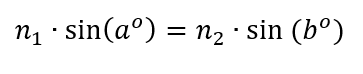
So I then rigged up a fixed laser pointer to measure its index of refraction using Snell’s Law, which says

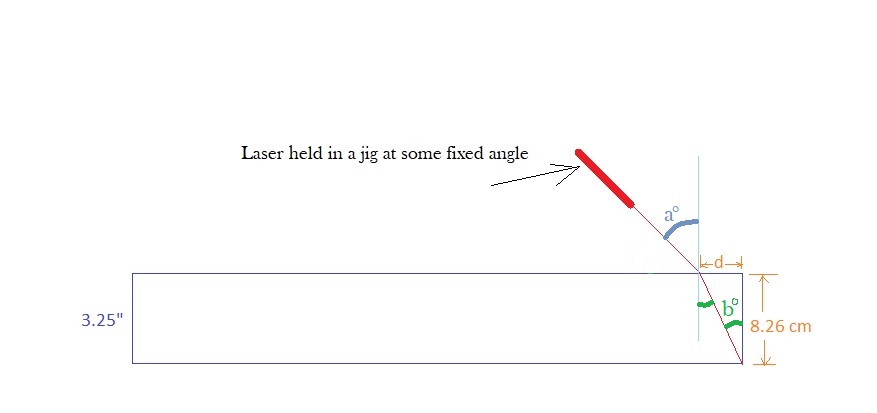
Here is a schematic of my setup:


The fixed angle a I found to be between 50 and 51 degrees by putting my rig on a large mirror and measuring the angle of reflection with a carpentry tool.

And here is what it looked like in practice:

I slid the jig back and forth until I could make it so that the refracted laser beam just barely hit the bottom edge of the glass blank.

I marked where the laser is impinging upon the glass, and I measured the distance d from that spot to the top edge of the glass.

I divided d by the thickness of the glass, in the same units, and found the arc-tangent of that ratio; that is the measure, b, of the angle of refraction.

One generally uses 1.00 for the index of refraction of air (n1). I am calling n2 the index of refraction of the glass. I had never actually done this experiment before; I had only read about doing it.

As you might expect, with such a crude setup, I got a range of answers for the thickness of the glass, and for the distance d. Even angle a was uncertain: somewhere around 49 or 50 degrees. For the angle of refraction, I got answers somewhere between 25.7 and 26.5 degrees.

All of this gave me an index of refraction for this class as being between 1.723 and 1.760.

This gave me a list of quite a few different glasses in several catalogs (two from Schott and one from Bausch & Lomb).

Unfortunately, there is no glass with a density between 2.80 and 3.00 g/cc that has an index of refraction in that range.

None.

So, either we have a disk of unobtanium, or else we did some measurements incorrectly.

I’m guessing it’s not unobtanium.

I’m also guessing the error is probably in our weighing procedure. The bathroom scale we used is not very accurate and probably got confused because the glass doesn’t have two feet.

A suggestion was made that this might be what Bausch and Lomb called Barium Flint, but that has an index of refraction that’s too low, only 1.605.

Mystery is still unsolved.

Is this question reasonable?

20 Tuesday Jul 2021

Posted by gfbrandenburg in Uncategorized

≈ 2 Comments

Tags

IB, International Baccalaureate, Math, middle school, quadratic, sample question, teaching

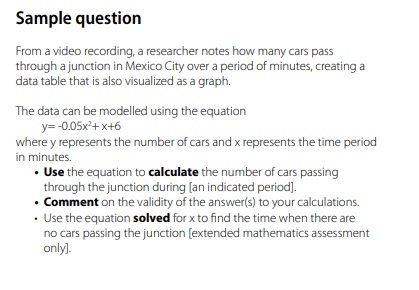
This is a sample question for middle school math, published by the International Baccalaureate (IB) program. I found it here.

Here is a graph I made of this equation, using Desmos:

Looking at this graph, you see that after about 10 minutes, there are 11 cars per minute going through the intersection – and that’s the most cars. After about 25 minutes, there are zero cars going through the intersection, and after that, there is a negative number of cars (!!!).

I don’t think this equation models anything having to do with any intersection I’ve ever visited. Instead, I think that any intersection controlled by a traffic light is going to be more periodic, that is to say, something like some mix of sine or cosine functions — obviously not middle school material.

Why there are no space-faring civilizations, and never will be

08 Tuesday Jun 2021

Posted by gfbrandenburg in Uncategorized

≈ 1 Comment

Very persuasive article explains why space travel is impossible. The main reason is gravity. Written by Allan Milne Lees; I found it on Medium.

Allan Milne Lees5 days ago·7 min read

===============================

Image credit: Air & Space Magazine

Despite the populist hype of billionaire Sci-Fi fanboys and a perpetual stream of Hollywood entertainments to the contrary, humans will never explore the galaxy in person. In fact, we won’t even explore our own solar system up close and personal. This is not merely because robotic missions can do the job 1,000% better for 1/1000th the cost. It’s because of two fundamental biological reasons.

The first is gravity. Everything about our bodies is evolved to function under a gravitational acceleration at sea level of approximately 9.8 meters per second squared (9.8m²). Our hearts pump blood up to our heads, fighting gravity every centimeter of the way. Our muscles and bones are as strong as they are because every part of our bodies is fighting gravity every moment of our lives. Our sense of balance, which orients us spatially, depends on gravity being constant in one direction only: straight down.

Without gravity, very bad things happen: the heart pumps too much blood to the head and too little to the lower extremities, leading to ocular distortions, crushing headaches, and nausea as the inner ear loses all sense of up and down. Our bones and muscles atrophy dramatically, even when hours each day are dedicated to exercises specifically designed with the intention of slowing down this decay. Put simply, our bodies are incapable of handling microgravity and despite the pictures of smiling astronauts merrily enjoying microgravity on the ISS, the harsh reality is that every single one of those astronauts pays a price very few of us would wish to incur.

The Sci-Fi fanboy response to this fundamental problem is either (a) to ignore it entirely, as per Musk and Bezos, or (b) claim that artificial gravity is the answer.

As Musk and Bezos are ignoring the problem we can likewise ignore them. So what about artificial gravity?

There are only two ways to create artificial gravity. The first is called “constant-g” which means that we accelerate our hypothetical space ship at a constant 9.8m² for the first half of the trip and then flip it around and decelerate it at a constant 9.8m² for the second half of the trip. Einstein’s insight that over areas too small to experience tidal effects such acceleration would be indistinguishable from regular gravity means that in theory Earth-style gravity could be induced in such a manner. Better yet, because the acceleration is constant, relativistic speeds will eventually be attained. In just 12 years (in the reference frame of the spacecraft) we could travel across our Milky Way galaxy. In a single human lifetime (in the reference frame of the spacecraft), under constant acceleration, we could reach the edge of the universe that’s observable from Earth. An Earth upon which, in that frame of reference, billions of years would have passed.

So with constant acceleration we get a “twofer.” Earth-identical gravity and the ability to traverse vast distances within a human lifetime. Problem solved!

Except that there is no way, theoretical or otherwise, to achieve constant acceleration of this magnitude. No propulsion mechanism, theoretical or otherwise, can overcome the problem of mass. In order to power the continual acceleration, our imaginary space ship is constrained by Newton’s observation that any action in a vacuum requires an equal and opposite reaction. In other words, to accelerate a mass of X by some amount of velocity we will need to discharge an equivalent amount of energy in the opposite direction. And that energy can only come from fuel. Which adds to the mass of our space ship. So now we need to expend more energy, which means we need more fuel, which means we’re now carrying even more mass, which means we need to expend even more energy, which means…

In other words, even with some imaginary technology that could convert matter into energy with 100% efficiency, there’s simply no way to get to 9.8m² constant acceleration for any meaningful amount of time. Sure, we can talk about things like an Alcubierre drive but then we’re just as entitled to say that Hogwarts will invent the Spaciamus drive to solve our problem instead. In other words, running off to hide inside imaginary “solutions” is no solution at all.

If constant acceleration can’t provide artificial gravity, what about centrifugal force? We all remember the rotating space station in 2001 A Space Odyssey and everyone knows that this was the only Sci-Fi movie ever to have utilized a science-based series of technologies. Plus, it’s easy to find on the Internet lots of schemes to create artificial gravity in this way, from tethering ships together and spinning them around a central axis to building enormous hollow rotating cylinders on the inside of which humans will experience Earth-like gravity. So, problem solved!

Except the movies and the Sci-Fi books mislead us, as is the way of popular entertainments.

First, the good news: if a person stood perfectly still and did not move in any way whatsoever, then centrifugal force could seem to mimic Earth-style gravity. Unfortunately, here’s the bad news: if they made any movement whatsoever, they would instantly be overcome by nausea and be disoriented.

Why is this? Imagine throwing a ball up into the air here on Earth. If you throw it straight up, it will come straight down, pulled by gravity toward the center of the Earth we’re standing on. But under conditions of “gravity” induced by centrifugal force, a ball thrown straight up will arc and fall away from the person who threw it because unlike here on Earth there’s a second force acting on the ball: centripetal force. As our inner ear orients us by means of reference to the constant downward force of gravity, this means that any movement at all — even something as minor as turning one’s head — would result in signals from the inner ear (responding to the centripetal force) jarring dramatically with the signals from our eyes. At best this would lead to our hypothetical human vomiting in a majestic arc; at worst it could render them incapable of any controlled movement whatsoever.

The diagrams below show the difference between gravity (or constant acceleration at 9.8m²) and a rotating object. On Earth there’s only one force acting on us: gravity. On our imaginary rotating artificial gravity environment there are two forces: centrifugal, and centripetal. And that makes all the difference in the world.

Perhaps this is why Bezos prefers to ignore the problem; it can’t be solved just by throwing money at it. As for Musk, he makes people with ADHD look like paragons of sustained concentration so he probably doesn’t even know the problem exists. But even if you don’t know a brick wall exists, it still kills you if you slam into it at 1,000 kilometers per hour.

Gravity, therefore, is one reason why human beings will never be a space-faring species. It’s also the reason why it’s highly unlikely any other species capable of developing suitable technologies would ever become space-faring either. All organisms are highly adapted to the environments in which they evolve and it is extremely difficult to sustain organisms outside of their natural environments for any significant period of time. Add it the problems of solar radiation, the deleterious effects of microgravity, and everything else associated with space travel and it’s apparent that Sci-Fi fanboy dreams are a very poor guide to the future.

There is a second major reason why we humans will never be a space-faring species: psychology.

Our brains are as much the result of selection pressures as our bodies. Like our bodies, our brains are highly adapted to life on Earth. As a primate group species adapted to foraging, we’re not well-suited to being cooped up in tiny cages. We become obese and we develop all manner of mental problems. Without access to natural cues like water and grass and trees, we become stressed. When forced to interact with the same small group of people for years without respite, we become irrational and angry, or conversely withdrawn and depressed. Worse still, our emotional hardwiring makes us competitive even when cooperation is the optimal strategy, and our intellectual limitations lead us to acquiring and then strongly defending irrational and harmful beliefs.

Imagine, therefore, a space ship upon which 200 hapless humans attempt to exist for years or even decades. Instead of looking to Star Trek as our inspiration, a more probable vision is depicted in One Flew Over The Cuckoo’s Nest or perhaps the concluding episodes of some trash reality TV show.

It is difficult to imagine any species capable of making spacecraft not having equivalent psychological limitations, albeit likely somewhat different from those that control our own behaviors.

There are many other reasons why humans will never spread across the galaxy, but these two should suffice to prove the contention. This does not mean, however, that there won’t be money to be made in enabling space tourism. A few days in microgravity, ensconced in a modestly comfortable environment with a small number of others, could be a very congenial way for the wealthy to break up the monotony of holidaying in the Hamptons or on a private island in the Bahamas. Sheltered in low orbit by the Earth’s magnetic field, the dangers of solar radiation are reduced to a perfectly acceptable level and likely no worse than a dozen trips in a private jet. Microgravity sex will no doubt become this century’s equivalent of the Mile High Club that was so popular among the early jet-setters of the 1960s and 1970s.

But beyond a few amusing days spent orbiting the Earth while watching one’s champagne bubble around one’s head, and after the inevitable disaster of Mars Colony One, we will accept the fact that robotic missions are the real future. And then we will expand our knowledge of the universe exponentially instead of wasting hundreds of billions of dollars on futile dead-end fanboy dreams.

Final Silvering Results, with Angel Guard

18 Tuesday May 2021

Posted by gfbrandenburg in Uncategorized

≈ 2 Comments

A few days ago, we silvered an 8” diameter 43” FL mirror that had previously been aluminized, and applied the Angel Guard coating.

We did a Ronchi test and some Foucault-Couder knife edge tests before stripping the aluminum and after the silver was applied.

To my amazement, we found that the mirror’s figure was about the same in both cases. How that works, especially how the Angel Guard coating is laid down so even and smooth over the entire mirror, is beyond me. But it DOES work.

Prior figure (aluminized mirror), seen with Ronchi grating of 100 lines per inch: https://share.icloud.com/photos/0LyqGC35cx0QfWKcd08aI0vzw…

Final figure (silvered mirror), with same Ronchi grating:

https://share.icloud.com/photos/03mdTeZD3dZ-bqGNoDZXSqpjw…

This is a video of us washing off the Angel Guard coating.

Here is a video of the finished mirror after drying. Notice that the very edge of this mirror did not take the silver coating, but the area uncoated is probably on the order of one or two percent of the total area.

Silvering a Mirror (vs Aluminizing)

11 Tuesday May 2021

Posted by gfbrandenburg in Uncategorized

≈ 3 Comments

Ive been doing the aluminization process for telescope mirrors at the NCA ATM workshop with a 55-year-old military surplus aluminizer at a DC rec center for about 20 years. (I’ve had a lot of help!!) This involves high vacuum, a noisy pump, voltage both very high and very low, and quite a lot of time.

Today, I had the opportunity to silver a random piece of glass, in my driveway, with the aid of another longtime ATMer and some chemicals from Angel Gilding. I had seen this demonstrated at Stellafane by Howard Banich and Peter Pekurar in 2019.

Doing it myself was quite eye-opening.

Almost finished, except for the spray-on Angel-Guard, which we didn’t have

Here’s what I wrote on FB:

Success with our first attempt at silvering a piece of glass under a tent canopy, and then stripping off the silver quickly and easily with PCB etchant (FeCl?).

I’ve aluminized many mirrors with the NCA’s vacuum chamber, using a modified version of John Strong’s method from the 1930s.

I must admit that this method was faster, easier, quieter, and much more low-tech, compared to depositing aluminum. In the latter case, sometimes you have to wait an hour or more for the dual-stage vacuum chamber (the primary pump is VERY noisy!!) to finish all the preparatory steps and pump down low enough that a hot atom of gaseous aluminum can travel two or three feet before striking any other remaining air molecule! (That is one hell of a vacuum!)

With the silvering process, you can do any size mirror you can fit on your cleaning jig — and you can make it out of pieces of scrap wood, a few nylon chair legs, two old hinges, and some screws! !

With our NCA-ATM-CCCC aluminizer, we are limited to 12.5” max. I’m currently working on a 16.5” thin Pyrex mirror; the price I’m quoted for aluminizing it is about $600 at Majestic Coatings, which is about three times what I paid for the blank!! And that doesn’t even include shipping!

Today Alan T and I tested the silvering process in my driveway using the screen tent canopy that we use at the ATM workshop to stop dust particles from landing on mirrors that are being polished. (After getting permission to go retrieve the canopy from the Covid-closed rec center, we immediately went into the parking lot to hose off a decade of dust!!)

We unfortunately do not have Angel-Guard overcoating on hand. It should arrive Wednesday. As most folks know, bare silver, unlike bare aluminum, tarnishes very quickly (in weeks or months) when exposed to ordinary air, whereas a I have seen many bare Aluminum layers last a decade. This overcoating is said to extend the life of the coating to about a year, but obviously conditions will vary.

We used a 6″ float glass mirror blank to try out the process today – not an actual, parabolized mirror.

How does it work?

This is basically a five step process:

1. Get prepared and mix the tinning solution afresh;

2. Clean off the mirror properly with precipitated CaCO3 and/or Alconox; rinse;

3. Sensitize the mirror with an invisible layer of tin (Sn); rinse;

4. Spray on the silver solution and its reducer at the exact same time with two separate brand-new one-pint hand squirt bottles, until fully silvered & shiny; rinse;

5. Spray on the Angel-Guard overcoat; rinse; dry.

The amount of chemicals used is minimal. The nastiest stuff was the reducer. I’m glad we did this outside.

Btw: a number of people have bench-tested mirrors before and after this process. Some report no change in figure; somebody I trust, who has a Zygo interferometer, says there is a little degradation, but not much: a mirror that was 1/10 lambda (excellent) might go to 1/4 lambda, which is certainly usable for a big Dob, iirc.

And it’s cheap! And fast! And easy! And quiet!

We were able to fully and completely strip the brand new silver off with the PCB etchant in under 3 minutes. Aluminum takes much longer.

Thanks to: Léon Foucault; Steinheil; Howard Banich; Peter Pekurar; Angel Gilding; Alan Tarica; and my wife, Gail.

One spray for the silver solution, one spray for its reducer (chemistry)
It’s the tent canopy that’s bent, I think. But this is not a telescope mirror; just a 6 inch disk of float glass.
That’s Alan
I made the jig to hold the mirrors out of some scrap two-by-fours, some screws and reinforcement plates; two old hinges; some nylon chair feet; some 1/2″ PVC pipe; and some 1/2″ PVC end caps.
The tent-screen canopy needed staking and tying down to prevent it flying off. Putting up the frame took three people (me, Alan, and my wife, Gail).

A mental math trick

02 Tuesday Mar 2021

Posted by gfbrandenburg in Uncategorized

≈ Leave a comment

Can you do 994 times 997 in your head?

‘Shruti” will explain how to do it, but she doesn’t explain why it works:

Personally, I had never come across this one in my over 40 years of teaching math. She is correct, it does work, but WHY?

I’ll try to explain.

994 is 6 away from 1000, or 10^3 minus 6.

And 997 is 3 away from 1000, or 10^3 minus 3.

If we multiply (10^3 – 6) by (10^3 – 3), we get 10^6 – (6+3)*10^3 + 6*3

So as she explains, we count down from a million by nine thousand, and then we add on 18.

or, if we take away any small number from a thousand, say, a, and subtract any other small number b from a thousand, you have a situation like this if you use the area model for multiplication:

Clay Davies’ Links for Telescope Makers

24 Thursday Dec 2020

Posted by gfbrandenburg in astronomy, flat, optical flat, Telescope Making

≈ Leave a comment

Tags

albert highe, CLay Davies, Commercial, dobsonian, explore scientific, Jean Texereau, Mel Bartels, newtonian, R. F. Royce, Reiner Vogel, Royal Astronomical Society of Canada, stargazer steve, stellafane, Telescope Making, trigonometry

I am copying and pasting Clay Davies’ recent article published on a Facebook page for amateur telescope makers, where he gives links to extremely useful sources as well as commentary. I think he did a great job, and want to make this available to more people.

================================= here goes! ================================================

Amateur Telescope Making Resources & Fast Commercial Newtonian Telescopes

  • Observer’s Handbook, Royal Astronomical Society of Canada. Every amateur astronomer should have at least one copy of this book. Every “newby” should read it cover to cover. Old hands should keep it as a reference. Avid astronomers get it every year, because it’s updated annually.
  • How to Make a Telescope, Jean Texereau. A classic book by a superb optician. The author taught many people how to make their own telescopes, including grinding, polishing and figuring their own mirrors. This book offers unique and practical telescope and mount designs I have never seen anywhere else.
  • The Dobsonian Telescope, David Kriege & Richard Berry. Want to knock off an Obsession telescope? Here is your bible, written by the creators of Obsession Telescopes. Here you will find well thought out and time proven designs for truss Dobsonian telescopes from 12.5” to 25” and more. If you are handy, if you use one of these designs and follow step-by-step instructions, you can build a fine truss dobsonian. But use free PLOP software (below) to design your mirror cell.
  • PLOP Automated Mirror Cell Optimization. This free windows software can help you design a “perfect” mirror cell. Just plug in the numbers, and in seconds, you have a mirror cell design. https://www.davidlewistoronto.com/plop/
  • Engineering, Design and Construction of Portable Newtonian Telescopes, Albert Highe. Do you want your next telescope to truly satisfy you? This book dedicates an entire chapter that asks you questions that help you design and build (or buy!) a telescope that will do just that. And it has beautifully engineered contemporary designs for large truss telescopes.
  • Engineering, Design and Construction of String Telescopes, Albert Highe. Beautifully engineered, yet challenging, ultra-light, air transportable newtonian telescope designs.
  • Newt for the Web (Stellafane). This is a simple, yet effective tool for newtonian telescope design. You can design an excellent telescope with just this free tool, plus old school drafting tools like ruler, protractor, pencil and compass. https://stellafane.org/tm/newt-web/newt-web.html
  • Reflecting Telescope Optimizer Suite. Mel Bartels created this wonderful free online newtonian telescope design tool: https://www.bbastrodesigns.com/telescopeCriteriaCalc.html If you explore Mel’s website you will find innovative, ultra-fast dobsonian telescopes, beautiful deep sky sketches, and mind expanding ideas that will probably make you a better observer. https://www.bbastrodesigns.com/The%20New%20Sub-F3%20Richest%20Field%20Telescopes.html
  • Right Angled Triangles Calculator, Cleve Books. Are you building a truss telescope but can’t remember trigonometry? This site makes it easy: http://www.cleavebooks.co.uk/scol/calrtri.htm
  • Stargazer Steve 6” Truss Telescope. A very portable, ultra-light commercial truss telescope. Moderately priced, too! http://stargazer.isys.ca/6inch.html
  • Explore Scientific 8”f3.9 Want a fast scope but don’t want to build it? This fast astrograph optical tube assembly has a carbon fibre tube and weighs 18.3 pounds / 8.3kg. It’s remarkably affordable, too! https://explorescientificusa.com/products/208mm-newtonian-f-3-9-with-carbon-fiber-tube
  • Orion 8” f/3.9 You can save a lot of work by buying a telescope off the shelf, like this one. Similar to the Explore Scientific, but with a steel tube at an irresistable price. And this OTA is under 18 pounds / 8kg! https://www.telescope.com/Orion-8-f39-Newtonian-Astrograph-Reflector-Telescope/p/101450.uts
  • R. F. Royce Telescope Building Projects. Simple newtonian telescope designs by one of the finest opticians on planet Earth. The first telescope I built, a 10”f6, and the second telescope I built, a 6”f8, were both based on Royce’s designs. Both performed far beyond my expectations. In fact, the surrier-trusses for my 8”f4 design were based on the Royce design. http://www.rfroyce.com/Telescope%20Bulding%20Projects.htm Want to build your ultimate lunar and planetary telescope? Click the third link. And… considering how much you can learn from one of the world’s greatest opticians, shouldn’t you click every link? http://www.rfroyce.com/thoughts.htm
  • Reiner Vogel Travel Dobs. If you are interested in designing and building your own telescope, have a look at this website. You will find easy and effective construction techniques and ultralight, ultra-portable telescopes here. And big ones. You’ll find equatorial mounts and observing notes, too! http://www.reinervogel.net/index_e.html?/links_e.html
  • Here is my talk at the RASC, Toronto, (Royal Astronomical Society of Canada) entitled, “Designing and Building a Newtonian Telescope for Wide Field Visual and Air Travel”. You can scroll the video to 38:20 if you want to go directly to my presentation. https://www.youtube.com/watch?v=Gz7TVQkTGCM

Easy ways to show the earth is not flat

18 Friday Dec 2020

Posted by gfbrandenburg in Uncategorized

≈ Leave a comment

Tags

astronomy, earth, flat, flat earth, foucault, Leon Foucault, mathematics, planet, solar system

Sharing Steve Ruis’ handy methods anybody can use to show that the earth is in fact round. Very clever!

An Open Letter to the Many Flat Earthers Now in Existence

by Steve Ruis

Dear Flat Earthers,
Many people have been derogatory of your belief that the Earth is flat. Please note that they are belittling your belief, not you per se. You, personally, are an idiot, but that is probably not your fault.

Here are any number of accessible approaches for discovering the shape of our beloved planet. Enjoy!

* * *

Use Your Phone!
On Christmas Day, here in Chicago, I expect there to be snow on the ground because, well, it is winter. On Christmas Day I can pick up my phone and dial up anyone in Australia and ask them “What season is it?” They will tell you that it is summer in Australia. You might want to ask your flat Earth mentors how it could be winter and summer simultaneously on a flat Earth.

Use Your Phone!
Go to a globe and pick a spot half way around the Earth (I know it is a false representation in your belief, but humor me.) In the middle of the day, phone somebody at or near that spot. Call a hotel, they are always open. Ask whoever responds “Is it light or dark outside?” They will tell you that it is dark where they are. You might want to ask your flat Earth mentors how it could be light and dark simultaneously on a flat Earth.

Look Up What Local Time Was
In the US there was this concept of “local time” which was that “noon” was when the sun was at its highest point in its arc. You could call up people on the telephone who were not that far away and ask them what time it was and they would tell you something different from what your clock was telling you. The farther away they were, the greater the difference would be. On a flat Earth the time would be the same everywhere.

Look Up What Time Zones Are
I am writing this in the central time zone in the U.S. These zones were created at the behest of the railroad industry whose dispatchers were going crazy making up schedules for trains when every place had their own times. By creating these “zones” everything would be exactly one hour off from those in neighboring zones, two hours off for the next over zones, and so on. If you don’t believe me . .  pick up your phone and dial up a friend who lives a considerable distance (east-west) away from you and ask them what time it is. The time they state will be a whole number of hours away from your time. Heck, even the NFL knows this. When I lived on the left coast, the games started at 10 AM and 1 PM. Now that I live in the central time zone, the games start at 12 Noon and 3 PM. Over New York way the games start at 1PM and 4 PM. Do you think those games are replayed in one hour increments? Nope, time zones!. You might want to ask your flat earth mentors how it could be that simultaneous games start at different times on a flat Earth.

Watch the Video
Astronauts in the International Space Station (ISS) have made continuous videos of an entire orbit of the Earth. It takes only about an hour and a half about the length of a typical Hollywood movie. During the whole movie the earth appears round, and yet it is clear that different continents are passing in our view.

Now you may argue that NASA made this movie as propaganda for the Round Earth Conspiracy. It is certainly within our CGI abilities at this point, but you may want to ask why NASA would want to do such a thing? Plus, many astronauts have taken their own cameras aboard and taken pictures for themselves and they show the same thing. How could the Round Earth Conspiracy have allowed that to happen? It must be incompetence! Conspiracies aren’t what they used to be!

Da Balloon, Boss, Da Balloon
Many amateurs, unaffiliated with the government, have launched rockets and balloons high up into the atmosphere to take pictures. Every damned one of those pictures shows that the Earth is round. How come all of those cameras ended up pointed at the curved edge of your round and flat disk Earth? Such a coincidence!

An Oldie But Goodie #1
Occasionally, during a lunar eclipse, you can see the shadow of the earth falling upon the Moon. The shadow is always circular. This would be true if the flat earth were always dead on to the Moon, but the Moon orbits the Earth and wouldn’t a flat Earth be edgewise, often as not, and wouldn’t that create a non-round shadow on the Moon? Inquiring minds want to know.

An Oldie But Goodie #2
It was claimed that one of the first demonstrations of the earth being round was the observation of ships sailing west from Europe/England could be observed for a while but the ship itself was lost to sight while the mast was still visible. This would not happen on a flat Earth. The whole ship would just get smaller and smaller as it sailed west.

For pity’s sake, I live 22 stories up and the shores of Lake Michigan and I cannot see anything directly opposite me in Michigan. All I can see is water, with any kind of magnification I can muster. And I am not looking across the widest part of this lake! If the earth were flat, the lake would be flat and I could see the Michigan shore.

And Finally . . .

All of the fricking satellites! Do the math. What kind of orbit is stable around a flat disk earth? Answer none! And there are hundreds of the danged things in orbit.

Also, just for giggles. Look up what a Foucault pendulum is, And explain its behavior based upon a flat Earth.

PS You may be getting good vibes in your special knowledge that you know something other people do not. However, would not that special feeling be more worthwhile were you to volunteer at a food bank or a day care center or senior center? Wouldn’t doing something worthwhile be more rewarding that making a statement about how those pointy-headed intellectuals aren’t so smart?

PPS I have seen the cute models with the Sun and Moon on sticks rotating around (see photo above). If that were the case, everyone could see the Sun and Moon all day, every day. (There is straight line access to both objects in that model from everywhere on the flat disk.) Do you see the Sun and Moon all day, every day? No? Maybe someone who had more creativity than knowledge came up with those models. They do sell well, I must admit, so maybe their interest is commercial.

PPPS Regarding the 200 foot wall of ice that supposedly exists at the “edge of the disk,” supposedly so all the water doesn’t flow off and be lost into space. By now don’t you think someone would have sailed next to that wall all of the way? That distance would be somewhere in the neighborhood of a 28,000 mile trip. Has anyone ever report such a thing? Hmm, I wonder why not

SOLD: Antique 6″ f/14 Refractor With Good Optics Available No Longer

05 Monday Oct 2020

Posted by gfbrandenburg in astronomy, astrophysics, History, Hopewell Observatorry, Optics, Telescope Making

≈ 1 Comment

Tags

achromat, brass, Carl Kiess, doublet, John Brashear, optical tube assembly, refractor, Telescope

The Hopewell Observatory had available a finely-machined antique, brass-tube 6″ f./14 achromatic refractor.

The mount and drive were apparently made by John Brashear, but we don’t know for sure who made the tube, lens, focuser or optics.

We removed a lot of accumulated green or black grunge on the outside of the tube, but found no identifying markings of any sort anywhere, except for the degrees and such on the setting circles and some very subtle marks on the sides of the lens elements indicating the proper alignment.

The son of the original owner told me that the scope and mount were built a bit over a century ago for the American professional astronomer Carl Kiess. The latter worked mostly on stellar and solar spectra for the National Bureau of Standards, was for many years on the faculty of Georgetown University, and passed away in 1967. A few decades later, his son later donated this scope and mount to National Capital Astronomers (of DC), who were unable to use it. NCA then later sold it to us (Hopewell Observatory), who cleaned and tested it.

The attribution of the mount to Brashear was by Bart Fried of the Antique Telescope Society, who said that quite often Brashear didn’t initial or stamp his products. Looking at known examples of Brashear’s mounts, I think Fried is probably correct. Kiess’s son said he thought that the optics were made by an optician in California, but he didn’t remember any other details. His father got his PhD at UC Berkeley in 1913, and later worked at the Lick Observatory before settling in the DC area. The company that Brashear became doesn’t have any records going back that far.


When we first looked through the scope, we thought the views were terrible, which surprised us. However, as we were cleaning the lens cell, someone noticed subtle pencil marks on the edges of the two lens elements, indicating how they were supposed to be aligned with each other. Once we fixed that, and replaced the 8 or so paper tabs with three blue tape tabs, we found it produced very nice views indeed!

The focuser accepts standard 1.25″ eyepieces, and the focuser slides very smoothly (once we got the nasty, flaky corrosion off as delicately as possible and sprayed the metal with several coats of clear polyurethane). The workmanship is beautiful!

Top: tiller for hand control of right ascension. Middle: counterweight bar (machined by me to screw into the mount) with clamps to hold weights in place. Bottom: detail of 1.25″ rack-and-pinion focuser.

We have not cleaned the mechanical mount, or tried it out, but it does appear to operate: the user turns a miniature boat tiller at the end of a long lever to keep up with the motions of the stars.

The mount and cradle (with size 12 feet for scale)

The counterweight rod was missing, so I machined a replacement, which has weight holder clamps like you see in gymnasiums. Normal Barbell-type weights with 1 inch holes fit well and can be adjusted with the clamps.

Unfortunately, the whole device is rather heavy, and we already own a nice 6″ f/15 refractor made by Jaegers, as well as some Schmidt-Cassegrain telescopes that also have long focal lengths. Putting this scope on its own pedestal, outside our roll-off roof, with adequate protection from both the elements and from vandals, or figuring out a way to mount it and remove it when needed, are efforts that we don’t see as being wise for us.

Did I mention that it’s heavy? The OTA and the mount together weigh roughly 100 pounds.

However, it’s really a beautiful, historic piece with great optics. Perhaps a collector might be interested in putting this in a dome atop their home or in their office? Or perhaps someone might be interested in trading this towards a nice Ritchey Chretien or Corrected Dal-Kirkham telescope of moderate aperture?

Anybody know what might be a fair price for this?

Guy Brandenburg

President

The Hopewell Observatory

Some more photos of the process and to three previous posts on this telescope.

Partway through cleaning the greenish, peeling, grimy layer and old duct tape residue with a fine wire brush at low speed to reveal the beautiful brass OTA.
This shows the universal joint that attaches to the ’tiller’ and drives the RA axis
Do you see the secret mark, not aligned with anything?
Aluminum lens cover and cell before cleaning
Lens cell and cover, with adjustment screws highlighted, after cleaning
It works!

Some WW2 or Cold-War-Era Aerial Surveillance Cameras

02 Wednesday Sep 2020

Posted by gfbrandenburg in astronomy, History, Hopewell Observatorry, Optics, science, Telescope Making, Uncategorized

≈ 4 Comments

Tags

Aerial reconnaissance camera assemblies

(Think U2 spyplanes.. )

Hopewell Observatory has three WW2 or Cold-War aerial spy camera optical tube assemblies, including a relatively famous Fairchild K-38. No film holders, though. And no spy planes. The lenses are in good condition, and the shutters seem to work fine.

We would like to give them away to someone who wants and appreciates them, and can put them to good use. Does anybody know someone who would be interested?

They’ve been sitting unused in our clubhouse for over 20 years. Take one, take two, take all of them, we want them gone.

We are located in the DC / Northern Virginia area. Nearby pickup is best. Anybody who wants them shipped elsewhere would obviously need to pay for packaging and shipping.

Here are some photos.

This one is labeled K-38, has a special, delicate, fluorite lens in front, and is stamped with the label 10-10-57 – perhaps a date. The shoe is for scale.

IMG_2009
IMG_2010
IMG_2012
IMG_2014
IMG_2017
IMG_2018
IMG_2020
IMG_2022
IMG_2024


The next two have tape measures and shoes for scale.

hopewell jan 2013 023
hopewell jan 2013 024
hopewell jan 2013 025
hopewell jan 2013 026
hopewell jan 2013 027
hopewell jan 2013 028
hopewell jan 2013 029
hopewell jan 2013 030
hopewell jan 2013 031
hopewell jan 2013 032
hopewell jan 2013 033
hopewell jan 2013 034
hopewell jan 2013 035
hopewell jan 2013 036


Let me know (a comment will work) if you are interested.

← Older posts
Newer posts →

Subscribe

  • Entries (RSS)
  • Comments (RSS)

Archives

  • April 2026
  • February 2026
  • December 2025
  • November 2025
  • October 2025
  • September 2025
  • July 2025
  • January 2025
  • November 2024
  • October 2024
  • August 2024
  • July 2024
  • May 2024
  • April 2024
  • January 2024
  • December 2023
  • October 2023
  • August 2023
  • June 2023
  • May 2023
  • April 2023
  • November 2022
  • October 2022
  • August 2022
  • July 2022
  • June 2022
  • May 2022
  • April 2022
  • February 2022
  • January 2022
  • December 2021
  • October 2021
  • September 2021
  • August 2021
  • July 2021
  • June 2021
  • May 2021
  • March 2021
  • December 2020
  • October 2020
  • September 2020
  • August 2020
  • March 2020
  • February 2020
  • January 2020
  • December 2019
  • November 2019
  • September 2019
  • August 2019
  • June 2019
  • May 2019
  • January 2019
  • November 2018
  • October 2018
  • September 2018
  • August 2018
  • May 2018
  • March 2018
  • January 2018
  • November 2017
  • October 2017
  • September 2017
  • August 2017
  • July 2017
  • June 2017
  • May 2017
  • April 2017
  • February 2017
  • December 2016
  • September 2016
  • June 2016
  • May 2016
  • April 2016
  • March 2016
  • February 2016
  • January 2016
  • December 2015
  • November 2015
  • August 2015
  • July 2015
  • April 2015
  • March 2015
  • February 2015
  • January 2015
  • December 2014

Categories

  • astronomy
  • astrophysics
  • education
  • flat
  • History
  • Hopewell Observatorry
  • Math
  • monochromatic
  • nature
  • optical flat
  • Optics
  • Safety
  • science
  • teaching
  • Telescope Making
  • Uncategorized

Meta

  • Create account
  • Log in

Blog at WordPress.com.

  • Subscribe Subscribed
    • Guy's Math & Astro Blog
    • Join 54 other subscribers
    • Already have a WordPress.com account? Log in now.
    • Guy's Math & Astro Blog
    • Subscribe Subscribed
    • Sign up
    • Log in
    • Report this content
    • View site in Reader
    • Manage subscriptions
    • Collapse this bar
 

Loading Comments...