Look what this little thing can do that I’ve always failed at myself, even with an entire observatory at my disposal: take decent astrophotos.
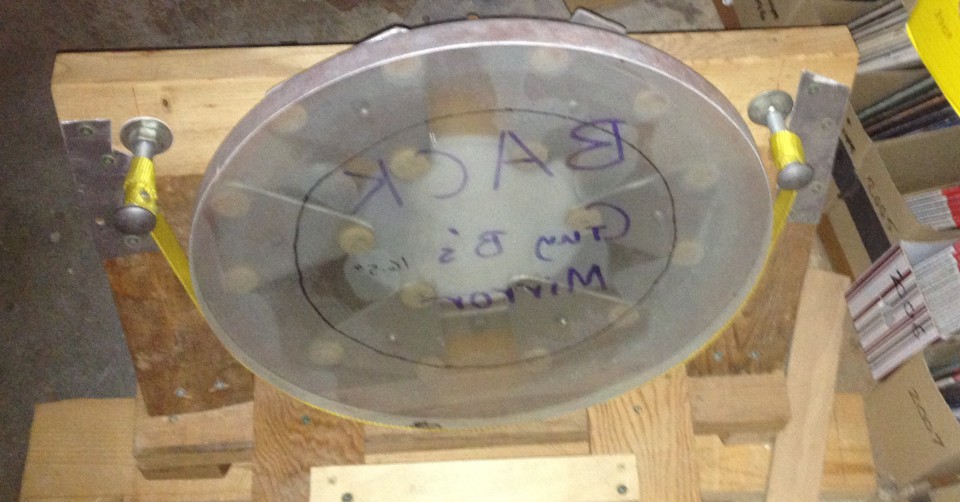
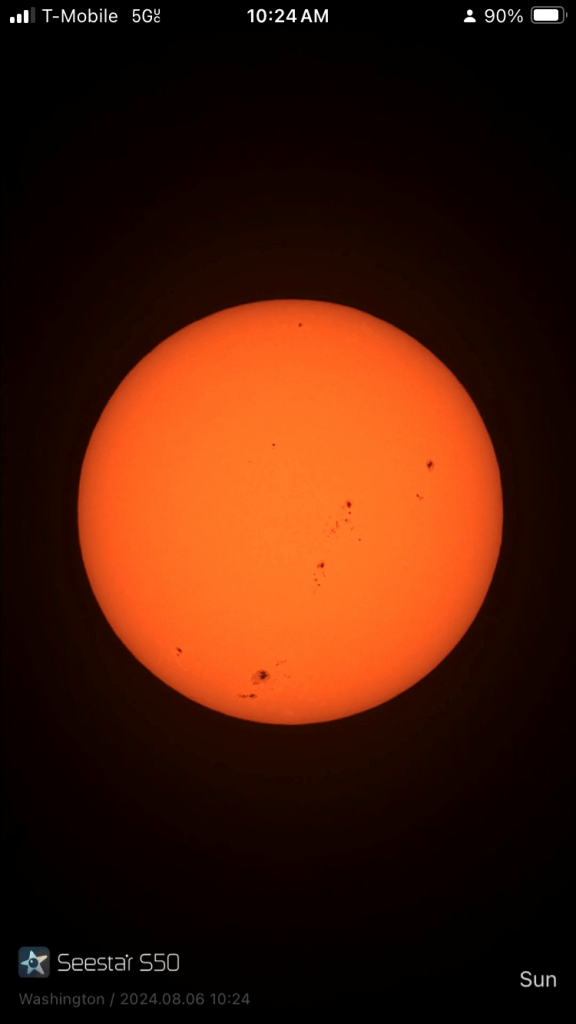
Here it is on a home made tripod, taking photos of the sun. Notice the reflective solar filter. Here are two images:
The device woke up, and after less than a minute of self’s-calibration, it pointed very accurately at the sun and focused itself perfectly. It produces a continuous feed; I even did 100 frames of a time-lapse. It’s all stored on my cell phone but I can share the photos or even live views with folks nearby.
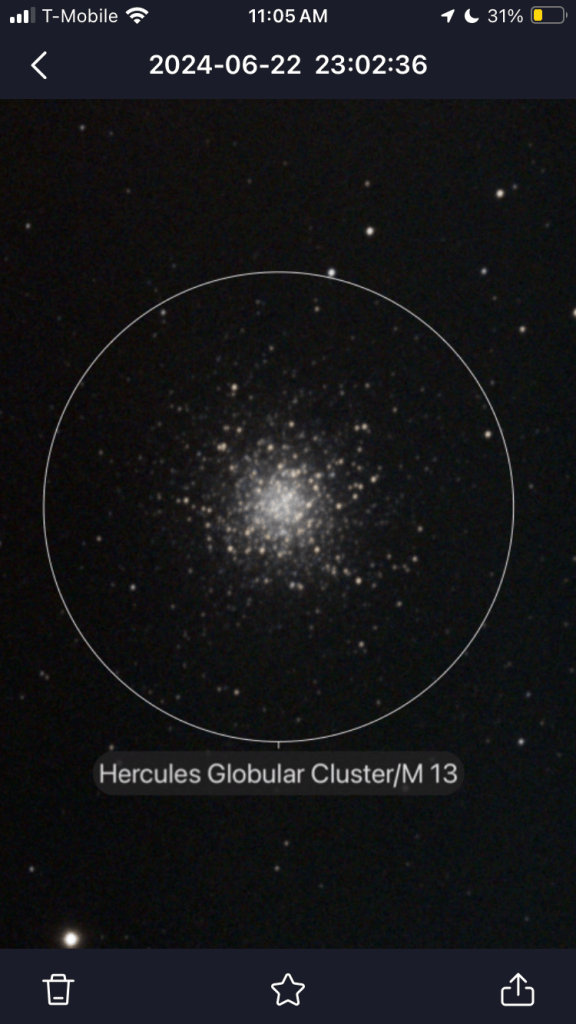
And from night time spots here in DC and NOVA:
This can take tolerable astrophotos even when surrounded by streetlights!
When I show people things in the sky with a telescope, I want to help them to realize how lucky we are to live on a nice, warm, wet little planet in a relatively safe part of a medium-large galaxy.
I also want them to realize that if we aren’t careful, we could turn this planet into one of those many varieties of deadly hell that they are viewing in the eyepiece.
We should be very thankful that this planet got formed in a solar system that had sufficient oxygen, silicon, iron, nitrogen, and carbon for life as we know it. We are fortunate that all of those ‘metals’ I just listed (as astronomers call them) got cooked up in cycle after cycle of stars that went boom or whooshed their outer layers into the Milky Way. We are lucky to be alive at the far multicellular side of the timeline of life on Earth*, and that no star has gone supernova in our neighborhood recently or aimed a gamma-ray burst directly at us.
We are exceedingly lucky that a meteorite wiped out the dinosaurs 65 million years and allowed our ancestors, the mammals, to take over. We can rejoice that most of us in the USA can have our physical needs (food, shelter, clean water, clean air, and communication) taken care of by just turning a knob or a key, or pushing a button, instead of hauling the water or firewood on our backs. (There are, obviously, many folks here and abroad who live in tents and who have essentially none of those nice things. We could do something about that, as a society, if we really wanted to.)
I am often asked whether there is life elsewhere. My answer is that I am almost positive that there are lots of planets with some form of life in every single galaxy visible in an amateur telescope. But there is no possible way for us humans to ever visit such a planet. Nor can aliens from any exoplanet ever visit us, whether they be single-celled organisms or something you would see in a Sci-Fi movie.
Yes, it is possible to send a handful of people to Mars, if we are willing to spend enormous sums of money doing so, and if the voyagers are willing to face loss of bone and muscle mass, and the dangers of lethal radiation, meteorites, accidental explosions, and freezing to death. If they do survive the voyage, then by all means, let them pick up some rocks and bring them back for analysis before they die.
But wait: we already have robots that can do that! Plus, robots won’t leave nearly as many germs behind as would a group of human beings. And we already know a lot about how Mars looks, because of all the great photos sent back by ESA, JAXA, NASA and others for some decades now. You can see photos taken by NASA at JMARS, which I highly recommend. (https://jmars.asu.edu/ )
While one can justify sending a few brave folks to Mars for a little while, it is completely insane to think that we can avoid our terrestrial problems by sending large populations there. Mars is often colder than Antarctica, is close to waterless, has poisonous perchlorates in its soil, no vegetation whatsoever, and no atmosphere to speak of. How would millions or billions of exiles from Earth possibly live there? Do you seriously think they can gather enough solar energy to find and melt sufficient water to drink and cook and bathe and grow plants and livestock in the huge, pressurized, aluminum cans they would need to live in? No way.
I wish there was some way to get around the laws of physics, and that we could actually visit other exoplanets. But there isn’t, and we can’t. I’ve seen estimates that accelerating a medium-sized spaceship to a mere 1% of the speed of light would require the entire energy budget of the entire human population of the planet for quite some time. (For example, see https://physics.stackexchange.com/questions/447246/energy-requirements-for-relativistic-acceleration )
Let us assume, for the sake of argument, that you could actually generate enough energy to accelerate that spaceship with nuclear fusion or something else that doesn’t violate the laws of physics as far as we know.
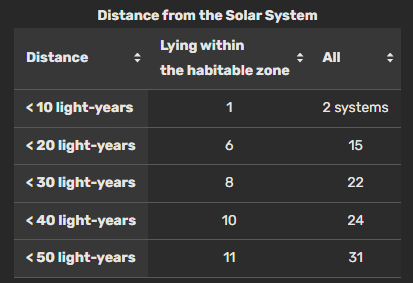
The next problem is the distance. It’s a bit over 4 light years to the nearest known exoplanet in a straight line, (compared with under 2 light-seconds for the Moon or about 35 light minutes for Jupiter). The table below gives the number of planets lying each extra solar system that are thought to be terrestrial (as opposed to gas giants) and to be within their stars’ habitable zones. Nobody knows if there is any life on any of those planets right not, but it is possible that astronomers may one day figure out a very effective way to test for extra-solar life. Let us suppose that a few of the ones in this list do have breathable atmospheres and are neither too cold nor too hot, have a fair amount of liquid water, and are protected from nasty radiation by magnetic fields and belts.
Unfortunately, a one-way trip to Proxima or Alpha Centauri for any possible spaceship, at one percent of the speed of light, (3,000 km per second), in a straight line, and pretending that you don’t need years and years to both accelerate and decelerate, would take over four centuries. And that’s for the very closest one! All the other planetary systems are many multiples of that distance! See this or this table:
Our fastest spacecraft so far, the Parker Solar Probe, reaches the insanely fast speed of 190 km/sec, but that’s still fifteen times slower than my hypothetical 1% of c. At the speed of Parker, it would take around six thousand years to reach the Proxima Cen planetary system! If all goes well!
Do you seriously think that a score or so generations of humans would all agree, century after century, that they, and their descendants — born and raised in a big metal box rushing through space — for the entire 400 years, would consent to live in a large metal box with no gravity to speak of, subject to who knows how many blasts of gamma rays, x-rays, and super-high-energy cosmic particles? What are the chances that each single generation would agree to stay the course and that not a single meteorite going the other direction, over a course of four centuries, would happen to smash into the space ship and instantly disable all the life support systems and kill all the passengers, quickly or slowly?
And how do you keep alive all the animals we would need to feed us upon arrival? I guess you compost all the poop from all the cattle, chickens, and so on. But do you also bring zillions of insects and tons of plant seeds as well, knowing full well that if you do so, then you lose the vast majority of the information you could have learned about an actual, functioning, extra-solar ecosystem like nothing we can possibly imagine.
The argument is made that perhaps the travelers would be put into suspended life. If that were possible, and nothing went wrong, upon arrival, they could take a triumphant group selfie and put it into a radio message back to Earth saying, “Hi, we made it, wish you were here…” That reply will of course take four years to reach Earth. Would people back on Earth still remember the handful of people who began the trip out, made over four centuries earlier? What will the humans back on earth remember about the absolutely prodigious effort expense that their ancestors had made to build and power that rocket, 20 generations or so earlier?
Let us suppose they have the tremendous luck to find, after 4 to 10 centuries of travel, a nice warm exoplanet with water, oxygen-producing life, and air that we can breathe.
Unfortunately, there is an overwhelming chance that there would be no humanoids or any other Sci-Fi characters. The chances are that creatures that look like insects, crustaceans, fish and salamanders are the most highly-organized life forms – at best; after all, for most of the existence of life on earth, it was single-celled organisms! Our travelers would have to have to build an entire urban and agricultural infrastructure *from scratch*, with no help. They could only do that if the plants and animals they brought from Earth are able to flourish.
The return trip, if desired, would of course take another four or more centuries, if the handful of travelers can find a proper power source and if they can figure out how to create, completely from scratch, an entire agricultural and industrial instructure. They would have to figure out where the natural resources of that planet (wood? minerals? energy sources?) are located, and how they can make use of them, to build something like the incredibly precise absolutely enormous rocket-building industries we have here, on a hypothetical planet that has never even had any mammals living on it.
If these voyagers should run into any technical problem while doing trying to build a modern civilization from nothing, fat chance of getting a prompt reply from Earth, since the question would take years to reach its home base back here!
Yes, the very closest exoplanets are a mere 4 LY away, but the others are all much, much farther away, so one-way trips for ones within 10 parsecs, i.e., in our tiny corner of our galaxy, at one percent of the speed of light, would require a thousand to three thousand years to reach. Each way.
Forget it. Just send a radio message, and see if we get a reply. Oh, wait – we’ve been doing that for several decades so far. No reply so far.
Speaking of radio – it’s only 120 years since Marconi first sent a very crude radio message from a ship to a station on land, and now we routinely use enormous parts of the entire electromagnetic spectrum for all sorts of private and public purposes, including sending messages like this one. Astronomers are able to gather amazing amounts of information via the longest radio waves to the very shortest gamma rays and make all sorts of inferences about worlds we have never seen at optical wavelengths. In addition, we have begun detecting gravity waves from extremely distant and powerful events with devices whose accuracy is quite literally unbelievable.
There is no planet B. We must, absolutely must, take care of this one, lest we turn into one of those freezing or burning variations of hell that we see through our eyepieces. Think I’m being alarmist? We now know this nice little planet Earth is more fragile than we once believed. It has been discovered that life was almost completely wiped out on this planet several times. The Chixculub impact I mentioned earlier, the Permian extinction and Snowball Earth are just three such events.
More recently, folks thought it was impossible for people to cause the extinction or near-extinction of the unbelievably huge flocks and herds and schools that once roamed the earth: passenger pigeons, buffaloes, cod, salmon, redwoods, elms, chestnuts, elephants, rhinos, tropical birds, rainforests, and so on, but we did, and continue to do so. The quantities of insects measured at site after site around the world have plummeted by 30 to 70% and more, over just a few decades, and so have the numbers of migratory birds observed on radar feeds. Light pollution, the bane of us amateur and professional astronomers, seems to be partly responsible for both the insect and bird population declines. The rise in the levels of atmospheric carbon dioxide and global temperatures are very scary.
In addition, we are dumping incredible amounts of plastic into the oceans, and rising water temperatures are causing coral reefs around the world to bleach themselves and die, while melting glaciers are causing average sea levels rise and threaten more and more low-lying cities.
What’s more, only a very tiny fraction of our planet’s mass is even habitable by humans: the deepest mine only goes down a few miles, and people die of altitude sickness when they climb just a few miles above sea level. Most of the planet is covered by ocean, deserts, and ice cap. By volume, the livable part of this planet is infinitesimal, and the temperatures on it are rising at an alarming rate.
Will we be able to curb the burning and leaking of fossil fuels sufficiently so as to turn around the parts of global warming caused by increases in carbon dioxide and methane? I am not optimistic, given that the main emitters have kept essentially none of the promises that they have been making to those various international gatherings on climate, and graphs like this one, taken from: https://ourworldindata.org/fossil-fuels
I have been wondering whether we may need to reduce temperatures more directly, by putting enough sulfur compounds into the stratosphere. We have excellent evidence that very violent volcanic eruptions have the power to lower global temperatures with the sulfates they put into the stratosphere. It would not be great for ground-based astronomy if such compounds were artificially lofted high into the atmosphere to lower global temperatures, and we won’t know for sure exactly which areas of the planet would benefit and which would be harmed, but at least it’s an experiment that can be stopped pretty easily, since the high-altitude sulfates would dissipate in a few years. High-altitude sulfur compounds do not seem to cause the obvious harm that SO2 does at the typical altitude of a terrestrial coal-burning power plant.
Adding iron to the oceans to increase the growth of phytoplankton, which then consumes CO2, dies, and settles to the bottom of the ocean, has been tried a number of times, but doesn’t seem to have a very large effect.
I agree that large-scale injection of sulfates into the stratosphere is scary. I also agree that there is a whole lot of unknown unknowns out there and inside of us, and we are being very short-sighted, as usual.
We have mapped the far side of the moon better than we have mapped the floors of Earth’s oceans – yet permits are being filed right now to begin deep-ocean dredging for manganese nodules, which will enrich some folks greatly. Unfortunately, that dredging is bound to utterly destroy those slow-growing ecosystems, before we even know what’s down there in the first place!
We continue to dump unbelievable amounts of plain old trash, fish nets, fishing lines, live ammunition, modern warships and hazardous chemicals into the oceans.
While the waters and atmosphere of the USA are much, much cleaner now than they were when I was a kid in the 50s and 60s, places like Delhi or Beijing are so polluted that folks can barely see the sun on a clear day.
If dark matter and dark energy really do exist, that means that scientists have absolutely no idea what 96% of the universe is made of!
If dark matter and dark energy don’t exist, then that means that astrophysicists don’t understand long-distance gravity and physics nearly as well as they thought. The late Vera Rubin (a past NCA member who should have won a Nobel for her careful measurements of the rotational measurements of galaxies that led to the Dark Matter hypothesis) once told me when we were co-chaperoning a field trip to the Smithsonian for the Carnegie Institution for Science’s Saturday program for middle-schoolers, that she thought that the entire question is perfectly open. I think she’s still correct.
If the Big Bang is real, then how come the Webb is seeing fully-formed galaxies as far back in time as it can see?
Do the alternative theories to the Big Bang (eg, Burbridge’s hypothesis that matter is being created in the centers of active galactic nuclei) make any sense?
But — does anybody have better solutions?
Can we engineer our way out of the mess we are making on this planet – the only home that humans will ever have?
There is cause for optimism:
Our NCA speaker this month, Deborah Shapley, will tell how, almost exactly a century ago, astronomers finally figured out that the Milky Way was just one of many billions of other galaxies. Since that time, the amount of astronomical information gathered has been staggering, as has the efficacy of the instruments!
After scientists figured out what was causing the ozone hole, every single agency and government in the entire world passed and enforced regulations that banned those chlorofluorocarbons that were used in almost everything from air conditioners to hair spray. Since that time, there has been almost complete compliance and agreement, and the ozone hole continues to shrink, as you can see here.
I have vivid memories about how smoggy and stinky the air used to be on a typical summer day in almost any American city of my youth. A fat-rendering plant right here in Georgetown (DC) stank worse than a hundred skunks, and is now gone. I know a paper mill in West Virginia whose fumes had long killed almost all the vegetation downwind of the factory. Nearby, acid drainage from an abandoned coal mine turned a stream so acidic that the rocks (and water) were amazing shades of orange, reds, and yellow. The rivers of this national often flowed with raw sewage, trash, and mine waste. Some, like the Cuyahoga, even caught fire, repeatedly (see https://www.smithsonianmag.com/history/cuyahoga-river-caught-fire-least-dozen-times-no-one-cared-until-1969-180972444/ ). The passage and actual enforcement of the Clean Air and the Clean Water Acts have cleaned up the air and water in this country to an amazing degree in my lifetime (I’m over 70). The cleanup of the Potomac and Anacostia Rivers in that period has also been tremendous. However, my friends who grew up in India and China tell me that the air and water pollution over there is worse than I can possibly imagine and is not improving at all.
When I was young, it appeared that nearly every adult I knew chain-smoked cigarettes and drank a lot of alcohol, and the bars, restaurants, dormitories, private houses, classrooms, buses and airplanes everywhere were filled with tobacco smoke. Despite the lies and obfuscation of the tobacco industry, not only legislation but also public opinion is such that today, I seldom encounter the nasty smell of tobacco smoke anywhere, even on people’s clothing on the bus or subway, and the number of drunk-driving fatalities is way down as well.
During my youth, the various nuclear powers exploded literally hundreds of nuclear weapons in the open air and underwater, spewing Strontium-90 and other radionucleides into things like cow or human milk, and doing untold destruction to the oceans nearby. While the number of world-wide nuclear explosions per year has dropped tremendously since then, they still continue, and may start up again on a larger scale.
Some noteworthy experiments re stopping global warming are listed in this month’s National Geographic. One of them, which has promise but also obvious drawbacks, involves dumping large quantities of finely ground-up alkaline rocks and minerals like olivine counteract the increasing acidification of the seas being caused by the absorption of so much carbon dioxide. Will these experiments work? I don’t know.
But let us not turn this planet – the only home we will ever know – into one of the barren, freezing or boiling versions of hell we see in the eyepieces of a telescope.
I have raised pigs, and I noticed that they never foul their own beds, if they are given any room to move around. Let’s be better than pigs and stop trying to extract riches in the short run while destroying the lovely planet we all love in the long run!
Heaven is not somewhere else.
It’s right here, if we can keep it that way and fix the damage we have done.
* For five-sixths of the roughly 3.7-billion-year time line of life on earth, all living things were single-celled microbes (or microbes living together in colonies). We mammals have only been important for the last 1.7% of that time, (ie since the dinosaurs died out 66 million years ago), the first known writing system was invented a few millennia ago, and Marconi only sent the first ship-to-shore radio message 130 years ago, which is an infinitesimally small fraction of 3.7 billion. Home radios only became popular 100 years ago.
Assuming that planets and stars are created at random times in the history of the universe, and assuming that a certain amount of enrichment of the interstellar medium by many generations of dead stars is necessary before life can begin at all, then it looks to me like the odds are not at all good for intelligent life of any sort to exist right now on any random planet we may study. And, unfortunately, if they do exist, we will never meet them. If there is an incredibly advanced civilization somewhere within 100 light years that can actually detect those first radio signals, then they just received our first messages. If they do respond, we won’t get the answer for another century or two!
For example, take a look at this time line of life on earth at a linear scale. If a hypothetical space traveler should somehow arrive on the 3rd rock from our Sun at a random moment in time over the past 4.5 billion years, then that’s like tossing a dart at this graph while blindfolded, and seeing where it lands. Notice the kind of organisms dominating during most of the past 4 billion years! The chances that they would happen to arrive here in the past few centuries or so, when we humans began to really understand science, are vanishingly small!
My original title began with “Space Travel is Impossible” — which is obviously false, because it is an incontrovertible fact of history that a handful of American astronauts, at enormous expense, did in fact land on the Moon and return. I remember the event well; I was working in a factory in Waltham, Mass that summer as part of the SDS Summer Work-In.
I should have written, “Space Travel to Exoplanets Is Impossible”.
But you could make the case that traveling to the Moon is barely even space travel! The distance to the moon is less than the total mileage on my last two automobiles (a Subaru Forester and a Toyota Prius) added together. Or, at the speed of light, the Moon is about 1.5 light-seconds away, the Sun about 8 light-minutes, Jupiter 34 light-minutes, and Saturn is about 85 light minutes this month. But the very nearest star-planet system to us is over four YEARS away, and the distances to the vast majority of exoplanets are measured in light-decades, light-centuries, or light-millennia.
I remember the Space Race! Both the USA and the Soviets poured incredible sums of cash, labor, raw materials, and brain power into that race, while, frankly, millions of people around the world starved or were killed in proxy wars between those two powers, representing two ideological and political opposing blocks. The incredibly expensive and dangerous race to win global prestige by being the first power bloc to reach the various goals has, so far, at its apogee, carted a handful of men to the near side of our Moon, less than two light-seconds away! And some people think we can easily travel to exoplanets that are light-decades or light-centuries away!
A decade or so ago, I bought a brand-new Personal Solar Telescope from Hands On Optics. It was great! Not only could you see sunspots safely, but you could also make out prominences around the circumference of the sun, and if sky conditions were OK, you could make out plages, striations, and all sorts of other features on the Sun’s surface. If you were patient, you could tune the filters so that with the Doppler effect and the fact that many of the filaments and prominences are moving very quickly, you could make them appear and disappear as you changed the H-alpha frequency ever so slightly to one end of the spectrum to the other.
However, as the years went on, the Sun’s image got harder and harder to see. Finally I couldn’t see anything at all. And the Sun got quiet, so my PST just sat in its case, unused, for over a year. I was hoping it wasn’t my eyes!
I later found some information at Starry Nights on fixing the problem: one of the several filters (a ‘blocking’ or ‘ITF’ filter) not far in front of the eyepiece tends to get oxidized, and hence, opaque. I ordered a replacement from Meier at about $80, but was frankly rather apprehensive about figuring out how to do the actual deed. (Unfortunately they are now out of stock: https://maierphotonics.com/656bandpassfilter-1.aspx )
I finally found some threads on Starry Nights that explained more clearly what one was supposed to do ( https://www.cloudynights.com/topic/530890-newbie-trouble-with-coronado-pst/page-4 ) and with a pair of taped-up channel lock pliers and an old 3/4″ chisel that I ground down so that it would turn the threads on the retaining ring, I was able to remove the old filter and put in the new one. Here is a photo of the old filter (to the right, yellowish – blue) and the new one, which is so reflective you can see my red-and-blue cell phone with a fuzzy shiny Apple logo in the middle.
This afternoon, since for a change it wasn’t raining, I got to take it out and use it.
At long last, we have finally got the venerable, massive Ealing telescope mount at Hopewell Observatory working again, after nearly 9 months, with a totally different, modern, electronic stepper motor drive based on Arduino.
My first post to the OnStep group ( https://onstep.groups.io/g/main/message/37699 ) was on October 21, 2021, over eight months ago. In it, I wrote that I had decided to give up trying to fix the electro-mechanical synchronous drive and clutches on our Ealing-Byers mount at Hopewell Observatory, and asked the folks on the OnStep message boards for help in choosing the best OnStep combination to drive such a mount.
Since then, it’s been a very long and steep learning curve. We only fried a couple of little slip-stick drivers and maybe one MaxESP board. We got LOTS of help from the OnStep list (not that the posters all agreed with each other on everything)! We ran into a lot of mysteries, especially when we found, repeatedly, that configurations that worked just fine on our workbench wouldn’t work at all when the components were put into the mount!
But now it works.
Let me thank again in particular:
* Prasad Agrahar for giving me the OnStep idea in the first place by showing me a conversion he had done;
* Alan Tarica, a fellow ATMer, for cheerfully partnering and persevering with me in working on this project for the past 8 months in many, many ways;
* Ken Hunter for providing tons of basic and advanced advice and a lot of hardware, all for free;
* Robert Benward for extremely helpful advice and drawings;
* George Cushing for providing some of the original boards we used;
* Khalid Bahayeldin for lots and lots of OnStep design features;
* Howard Dutton for designing, implementing, and supporting this whole project in the first place; and
* Arlen Raasch for bringing his wealth of trouble-shooting experience and a lot of nice equipment up to Hopewell, spending full days up there, and saving our asses in figuring out the final mysteries. Among other things, he kluged (by the way, “kluge” is German for “clever”, not clumsy) a level shifter to make it so that the 3.3 volt signals from our MaxESP3 board would actually and reliably communicate with the higher-voltage external DM542T stepper drivers that controlled the very-high-torque NEMA23 steppers, rewiring some of the jumpers on our already-modified MaxESP boards, and making the wiring look professional, and other stuff as well, thus essentially pushing us over the finish line.
* All of the Hopewell members for supporting this project
* Bill Rohrer and Michael Chesnes who physically helped out with soldering and wiring work at the observatory.
I plan to write up a coherent narrative with a list of lessons learned, and perhaps I can help make some of the step-by-step directions in the OnStep wiki a bit clearer to the uninitiated. Obviously I’ll need to write a user guide for this mount for the other Hopewell members.
If Alan and I had gone straight to our final configuration, this project would have been quite a bit cheaper. In addition to what’s inside the mount and control box at the observatory, we now have on hand something like this list of surplus items:
* four MaxESP boards in various stages of construction and functionality;
* a dozen or more different slip stick stepper drivers we aren’t using;
* four or more external stepper drivers, mostly TB6600;
* five or more stepper motors of different sizes;
* a hand-held digital oscilloscope;
* lots and lots of wires of many types;
* lots of metal and plastic project boxes of various sizes;
* lots of tiny motherboards; and
* lots and lots of sets of various mechanical electrical connectors (many were used, later cut off, and then ended up in the trash).
Yes, one does need spares, and yes, lots of this stuff has multiple uses, but this has not been a ‘green’ project. On the third hand, it has been extremely interesting and fun to learn all these new skills.
The final substantive changes that got the Ealing mount up and running were made during the Fourth of July fireworks down in the valleys on each side of the ridge that our observatory sits on. What were the changes? (1) switching the black and white leads from the mains power leads (they original, scavenged, cord had the white lead as Hot!) and (2) reversing the Declination motor direction. It also helped that I was not zoned-out and punchy from lack of sleep, as we had been when Arlen and I had last worked on it.
On July 4th, it at long last worked properly!
This Ealing mount’s original, labeled, built-in manual RA and DEC setting circles make it quite easy to put the scope into Home position before you turn on the power. One just loosens the clutches and moves the axes to 6:00 hours exactly in Right Ascension and 90 degrees exactly in Declination. From there, I found the OnStep system behaves very nicely. It accurately slewed to a number of bright, obvious targets of various sorts on both sides of the meridian. However, when I tried to get it to aim that night at M13, it refused, sending an error message that it was too close to the zenith for safety. And it was (altitude 87 degrees)! Very impressive – a safety feature I hadn’t even known about!
None of the objects that I slewed to was far from the center of the field of view, even when the scope slewed across the meridian. I was using an old, 2-inch diameter 50 mm Kellner eyepiece on an f/12 six-inch aperture D&G refractor.
I found that the Android app to be **much** better for initial setup than the SHC. Arlen, Alan and I all found that setting the correct latitude, longitude, UTC offset and so on from the SHC was a real brain-twister because of its unfortunately not-very-friendly user interface. Using the OnStep app on a cheap, old Android tablet made the whole initialization process very much easier and faster, especially after I let the tablet discover what time it really was from my iPhone’s wireless HotSpot.
However, I found that the hand paddle is much better for fine-tuning of pointing and so on, because the bright display on an Android, no matter how dim one makes it, will destroy one’s night vision, and one cannot reliably feel where the directional buttons are on a flat screen while staring through an eyepiece. Obviously, one can feel the buttons on the SHC quite well, maybe even with gloves. A joy stick would be even better…
Alan and I and the other Hopewell members still have many more OnStep features to learn.
However: if I had known this project would take over eight months of hard work, I think I might have tried fiddling with the original Ealing clutches some more.
Oh well, we have a mount that has much more capabilities than it ever had, and Alan and I have learned quite a bit of electronics! I’m proud of what we did!
The Hopewell Observatory had available a finely-machined antique, brass-tube 6″ f./14 achromatic refractor.
The mount and drive were apparently made by John Brashear, but we don’t know for sure who made the tube, lens, focuser or optics.
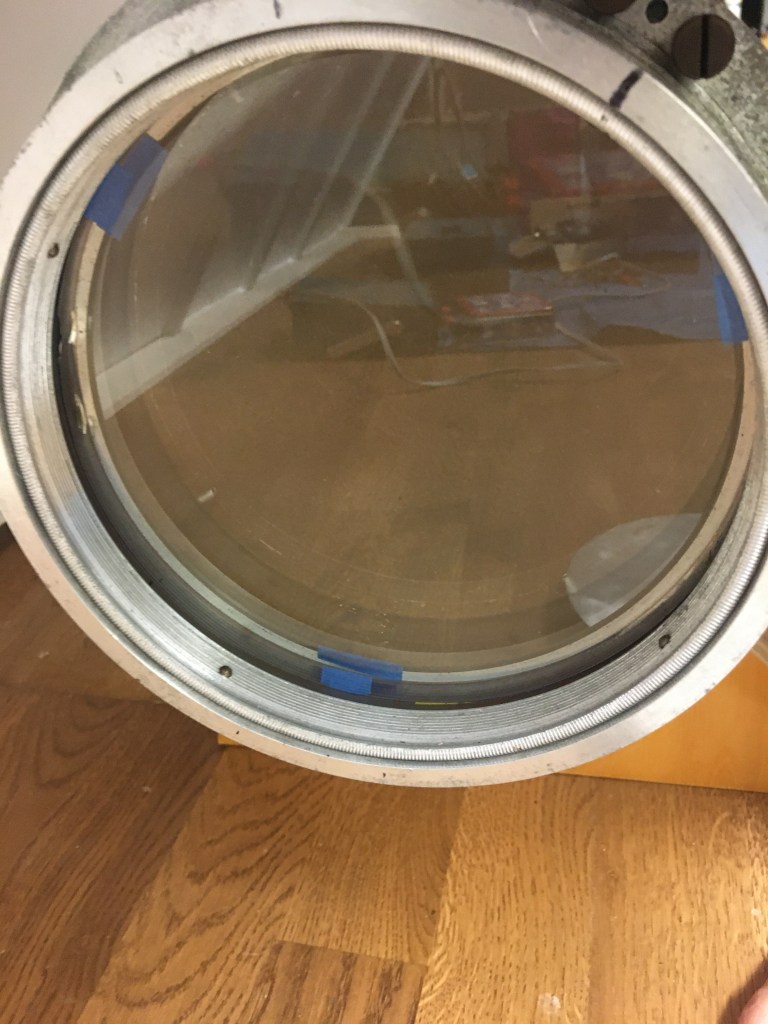
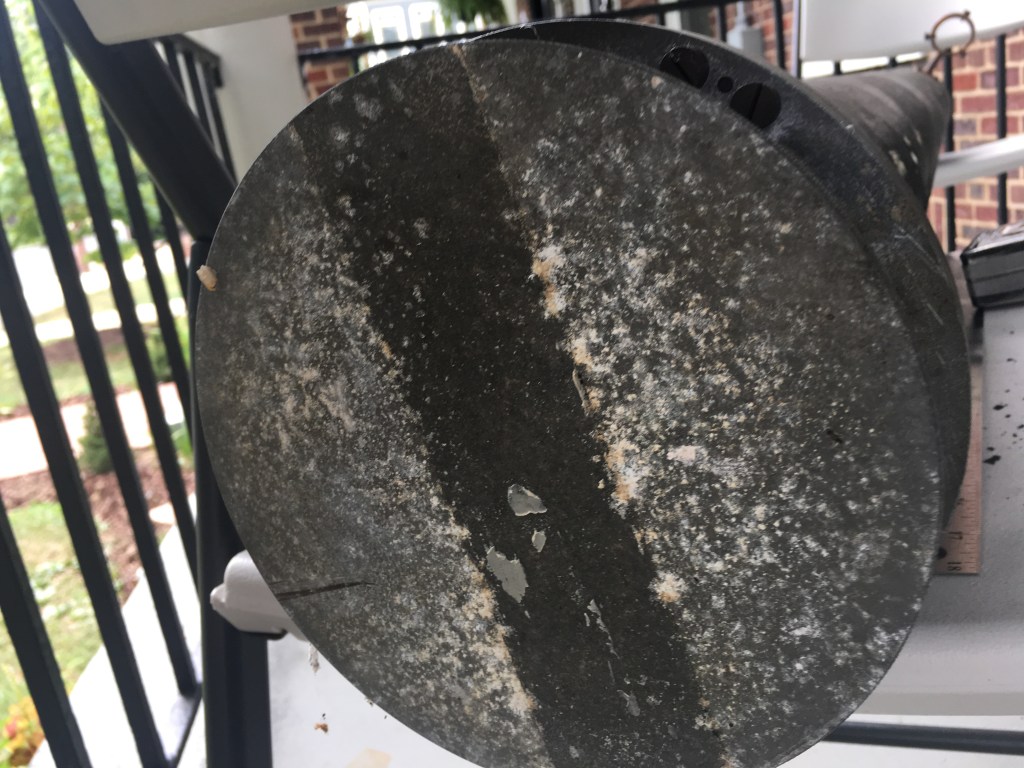
We removed a lot of accumulated green or black grunge on the outside of the tube, but found no identifying markings of any sort anywhere, except for the degrees and such on the setting circles and some very subtle marks on the sides of the lens elements indicating the proper alignment.
The son of the original owner told me that the scope and mount were built a bit over a century ago for the American professional astronomer Carl Kiess. The latter worked mostly on stellar and solar spectra for the National Bureau of Standards, was for many years on the faculty of Georgetown University, and passed away in 1967. A few decades later, his son later donated this scope and mount to National Capital Astronomers (of DC), who were unable to use it. NCA then later sold it to us (Hopewell Observatory), who cleaned and tested it.
The attribution of the mount to Brashear was by Bart Fried of the Antique Telescope Society, who said that quite often Brashear didn’t initial or stamp his products. Looking at known examples of Brashear’s mounts, I think Fried is probably correct. Kiess’s son said he thought that the optics were made by an optician in California, but he didn’t remember any other details. His father got his PhD at UC Berkeley in 1913, and later worked at the Lick Observatory before settling in the DC area. The company that Brashear became doesn’t have any records going back that far.
When we first looked through the scope, we thought the views were terrible, which surprised us. However, as we were cleaning the lens cell, someone noticed subtle pencil marks on the edges of the two lens elements, indicating how they were supposed to be aligned with each other. Once we fixed that, and replaced the 8 or so paper tabs with three blue tape tabs, we found it produced very nice views indeed!
The focuser accepts standard 1.25″ eyepieces, and the focuser slides very smoothly (once we got the nasty, flaky corrosion off as delicately as possible and sprayed the metal with several coats of clear polyurethane). The workmanship is beautiful!
Top: tiller for hand control of right ascension. Middle: counterweight bar (machined by me to screw into the mount) with clamps to hold weights in place. Bottom: detail of 1.25″ rack-and-pinion focuser.
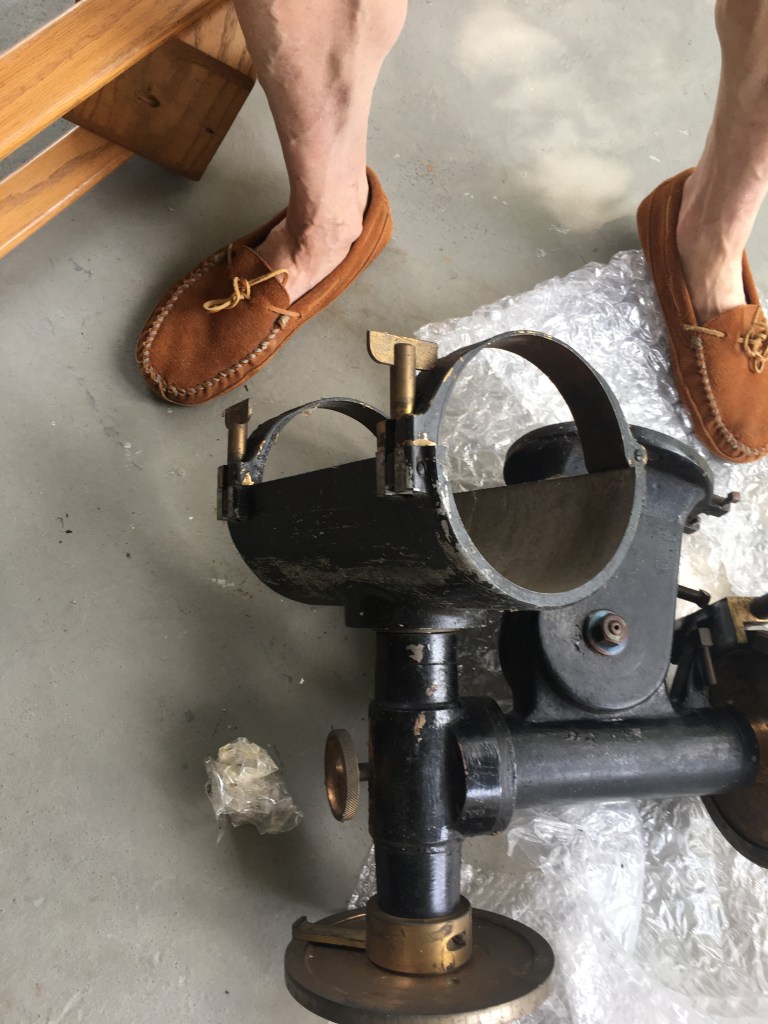
We have not cleaned the mechanical mount, or tried it out, but it does appear to operate: the user turns a miniature boat tiller at the end of a long lever to keep up with the motions of the stars.
The mount and cradle (with size 12 feet for scale)
The counterweight rod was missing, so I machined a replacement, which has weight holder clamps like you see in gymnasiums. Normal Barbell-type weights with 1 inch holes fit well and can be adjusted with the clamps.
Unfortunately, the whole device is rather heavy, and we already own a nice 6″ f/15 refractor made by Jaegers, as well as some Schmidt-Cassegrain telescopes that also have long focal lengths. Putting this scope on its own pedestal, outside our roll-off roof, with adequate protection from both the elements and from vandals, or figuring out a way to mount it and remove it when needed, are efforts that we don’t see as being wise for us.
Did I mention that it’s heavy? The OTA and the mount together weigh roughly 100 pounds.
However, it’s really a beautiful, historic piece with great optics. Perhaps a collector might be interested in putting this in a dome atop their home or in their office? Or perhaps someone might be interested in trading this towards a nice Ritchey Chretien or Corrected Dal-Kirkham telescope of moderate aperture?
Anybody know what might be a fair price for this?
Guy Brandenburg
President
The Hopewell Observatory
Some more photos of the process and to three previous posts on this telescope.
Partway through cleaning the greenish, peeling, grimy layer and old duct tape residue with a fine wire brush at low speed to reveal the beautiful brass OTA.This shows the universal joint that attaches to the ’tiller’ and drives the RA axisDo you see the secret mark, not aligned with anything?Aluminum lens cover and cell before cleaningLens cell and cover, with adjustment screws highlighted, after cleaningIt works!
Gordon Waite is a commercial telescope maker who has made a number of very useful YouTube videos on his grinding, polishing, parabolizing, and testing procedures. I thought some of my readers might be interested in viewing them. The link is here, or else you can copy and paste this:
This was a question on Quora. Here is an answer I wrote:
In the US, judging strictly on what I’ve seen from my time in the classroom as both a student, a teacher, and a visiting mentor of other math teachers, I find that math and science was very often taught as sort of cookbook recipes without any real depth of understanding. The recent National Council of Teachers of Mathematics prescriptions have attempted to correct that, but results have been mixed, and the Common Core has ironically fostered a weird mix of conceptual math marred by teachers being *OBLIGATED* to follow a script, word-for-word, if they want to remain employed. Obviously, if students are really trying to understand WHY a certain mathematical or scientific thing/fact/theorem/theory/law is true, they are going to have questions, and it’s obviously the teacher’s job to figure out how best to answer said questions — which are not likely to have pre-formulated scripts to follow in case they come up — and which are going to take time.
Another thing that is true is that not everything in mathematics has real-world applications in every single person’s life. I taught a good bit of computer programming (aka ‘coding’ today), geometry, arithmetic, probability, algebra, statistics, and conic sections, and in fact I use a LOT of that every week fabricating telescope mirrors to amazing levels of precision, by hand, not for a living, but because I find telescope-making to be a lot of fun and good mental, aesthetic, manual, and physical exercise. But I’m a pretty rare exception!
Most people obviously don’t dabble in math and physics and optics like I do, nor should they!
In fact, I have made it a point to ask professional scientists and engineers that I meet if they actually use, on their jobs, all the calculus that they learned back in HS and college. So far, I think my count is several dozen “Noes” and only one definite “Yes” – and the latter was an actual rocket scientist / engineer and MIT grad and pro-am astronomer (and wonderful, funny, smart person) who deals/dealt with orbital rocket trajectories. (IIRC).
In France, when I went to school there 50 years ago and in my experience tutoring some kids at the fully-French Lycee Rochambeau near Washington, DC, is that they go very deeply into various topics in math, and the sequence of topics is very carefully thought out for each year for each kid in the entire nation (with varying levels of depth depending on what sort of track that the students elected to go into (say, languages/literature, pure math, or applied sciences, etc), but the kids were essentially obligated to accept certain ideas as factual givens and then work out more and more difficult problems that dealt with those particular givens. No questions allowed on where the givens came from, except to note the name of the long-dead classical Greek, French, Italian or German savant whose name is associated with it.
As an American kid who was mostly taught in American schools, but who also took 2 full years of the French system (half a year each of neuvieme, septieme, premiere, terminale, and then passed the baccalaureat in what they called at the time mathematiques elementaires, I found the choice of topics [eg ‘casting out nines’ and barycenters and non-orthogonal coordinate systems] in France rather strange. Interesting topics perhaps, but strange. And not necessarily any more related to the real world than what we teach here in the US.
Over in France, however, intellectuals are (mostly) respected, even revered, and of all the various academic strands, pure math has the highest level of respect. So people over there tend to be proud of however far they got in mathematics, and what they remember. Discourse in French tends to be extremely logical and clear in a way that I cannot imagine happening here in the public sphere.
So to sum up:
(a) most people never learned all that much math better than what was required to pass the test;
(b) only a very few geeky students like myself were motivated to ask ‘why’;
(c) most people don’t use all that much math in their real lives in the first place.
Just got back from an exciting astro expedition to Hopewell Observatory with one of the other members. Great fun!
Anybody living on the East Coast in March 2018 has just lived through a very strong, multi-day gale. The same weather system brought snow and flooding to the northeast, and here in the DC-Mar-Va area, it was cut off power to many (including my mother-in law) and caused almost all local school districts to close — even the Federal Government! Two of my immediate neighbors in DC had serious roof damage.
Today, Sunday, Paul M and I decided the wind had calmed enough, and the sky was clear enough, for an expedition to go up and observe. We both figured there was a good chance the road up to the observatory would be blocked by trees, and it turns out that we were right. My chainsaw was getting repaired – long story, something I couldn’t fix on my own – so I brought along work gloves, a nice sharp axe, loppers, and a 3-foot bowsaw. We used all of them. There were two fairly large dead trees that had fallen across the road, and we were able to cut them up and push them out of the way.
However, there was a large and very dangerous ‘widow-maker’ tree (two images above) that had fallen across the road, but it was NOT on the ground. Instead, was solidly hung up on the thick telecommunications line at about a thirty-degree angle to the ground. The power lines above it didn’t seem to be touched. You could easily walk under the trunk, if you dared (and we did), and you probably could drive under it, but of course the motion of the car just might be enough to make it crack in half and crush some unlucky car and its driver. Or maybe it might make the phone line shake a bit …
No thanks.
So, we didn’t drive under.
I called the emergency phone for the cell phone tower (whose access road we share) to alert them that the road was blocked and could only be cleared by a professional. I also attempted to call a phone company via 611, without much success — after a long wait, the person at the other end eventually asked me for the code to my account before they would forward me to somebody who could take care of it. Very weird and confusing. What account? What code? My bank account? No way. We will both call tomorrow. Paul says he knows some lawyers at Verizon, whose line he thinks it is.
But then: how were we going to turn the cars around? It’s a very narrow road, with rocks and trees on one side. The other side has sort of a ravine and yet more trees. Paul realized before I did that we had to help each other and give directions in the darkness to the other person, or else we would have to back up all the way to the gate! Turning around took about four maneuvers, per car, in the dark, with the other person (armed with astronomer’s headlamp, of course) yelling directions on when to turn, how much to go forward, when to stop backing up, and so on. Success – no injuries! We both got our cars turned around, closed them up, got our cutting tools, gloves and hats, and then hiked the rest of the way up, south and along the ridge and past the big cell phone tower, to the Observatory buildings themselves, moving and cutting trees as we went.
As we were clearing the roadway and walking up the ridge, we peered to the west to try to find Venus and Mercury, which had heard were now evening planets again. It wasn’t easy, because we were looking through LOTS of trees, in the direction of a beautiful multi-color, clear-sky sunset featuring a bright orange line above the ridge to our west. Winter trees might not have any leaves, but they still make the search for sunset planets rather tough. Even if you hold perfectly still, one instant you see a flash that’s maybe a planet, or maybe an airplane, and then the branches (which are moving in the breeze, naturally) hide it again. So what was it? Paul’s planetarium smartphone app confirmed he saw Venus. If the trees weren’t there, I think we also would have seen Mercury, judging by Geoff Chester’s photo put out on the NOVAC email list. I think I saw one planet.
In any case, everything at the observatory was just fine – no tree damage on anything, thanks to our prior pruning efforts. The Ealing mount and its three main telescopes all worked well, and the sky and stars were gorgeous both to the naked eye and through the scopes. Orion the Hunter, along with the Big Dog and the Rabbit were right in front of us (to the south) and Auriga the Charioteer was right above us. Pleiades (or the Subaru) was off high in the west. Definitely the clearest night I’ve had since my visit to Wyoming for the solar eclipse last August, or to Spruce Knob WV for the Almost Heaven Star Party the month after that.
Paul said that he and his daughter had been learning the proper names of all the stars in the constellation Orion, such as Mintaka, Alnilam, and Alnitak. As with many other star names, all those names are Arabic, a language that I’ve been studying for a while now [but am not good at. So complicated!] Mintaka and Alnitak are essentially the same Arabic word.
After we got the scopes working, Paul suggested checking out Rigel, the bright ‘leg’ of Orion, because it supposedly had a companion star. {Rajul means “leg”} We looked, and after changing the various eyepieces and magnifications, we both agreed that Rigel definitely does have a little buddy.
I had just read in Sky & Telescope that Aristotle (from ancient Greece) may have given the first written account of what we now call an “open cluster” in the constellation Canis Major (Big Dog – that’s Latin, which I studied in grades 7 – 12) called Messier-41, only a couple of degrees south of Sirius, the brightest star in the sky. A passage in a book allegedly written by Aristotle (roughly 230 BC) seems to indicate that he could see this object with averted vision. (He was trying to establish that it was a fuzzy patch in the sky that was most definitely NOT a comet, just likeCharles Messier was doing almost exactly two thousand years later!)
M41 was quite attractive. But no, we didn’t then look at M42. Been there, done that many times before. And no, what you see with a telescope does not have all those pretty colors that you see in a photograph.
Instead, we looked on a multi-sheet star atlas (that stays in the observatory) near M41 and found three other open clusters, all really beautiful. We first found M38 and thought that in the C-14 and 6″ Jaegers, it looked very anthropoid or like an angry insect, if you allowed your mind to connect the beautiful dots of light on the black background. In the shorter 5″ refractor made by Jerry Short, it looked like a sprinkling of diamond dust. This cluster must have been formed rather recently. We then found M36, which was much less rich, but still quite pretty. Lastly, we found M37, another open cluster, which has a very bright yellow star near the center, against background of much fainter stars. It seemed to me that those other stars might be partly obscured by a large and somewhat translucent cloud of dust. We saw a web of very opaque dust lanes, which we confirmed by readings on the Web. Really, really beautiful. But I’m glad we don’t live there: too dangerous. Some of the stars are in fact red giants, we read.
Then we looked straight overhead, in the constellation Auriga. We decided to bypass the electronics and have Paul aim the telescope, using the Telrad 1-power finderscope, at one of the fuzzy patches that he saw there. He did, and my notes indicate that we eventually figured out that he found Messier-46 (yet another open cluster) with his naked eye! Very rich cluster, I think, and we even found the fan-shaped planetary nebula inside!
At this point we were getting seriously cold so we moved over just a little, using the instruments, to find M47, again, a very pretty open cluster.
Realizing that the cold and fatigue makes you do really stupid things, and that we were out in the woods with no way to drive up here in case of a problem, we were very careful about making sure we were doing the closing up procedures properly and read the checklist at the door to each other, to make sure we didn’t forget anything.
On the walk back, we saw the Moon coming up all yellowish-orange, with the top of its ‘head’ seemingly cut off. When it got a bit higher, it became more silver-colored and less distorted, but still beautiful.
I really thought all of those open clusters were gorgeous in their own right, and I think it would be an excellent idea to make photographs of them, but perhaps black dots on white paper, and give them to young folks, and ask them to connect the dots, in whatever way they feel like doing. What sorts of interesting drawings would twenty-five students come up with?
I am not sure which of our various telescopes would do the best job at making astro images. I have a CCD camera (SBIG ST-2000XM), with a filter wheel. What about just making it a one-shot monochromatic black and white image? I also have a Canon EOS Revel XSI (aka 450D, I think). Compare and contrast… The CCD is really heavy, the Canon quite light. I also have a telephoto lens for the Canon, which means that I have essentially four telescopes to choose from (but not a big budget!). One problem with the C-14 and my cameras is that the field of view is tiny: you can only take images of very small bits of what you can see in the eyepiece with your naked eye. This means you would need to make a mosaic of numerous pictures.
In any case, no imaging last night! Not only did I not feel like hauling all that equipment for a quarter of a mile, after all that chopping, sawing, and shoving trees, it turns out I had left my laptop home in the first place. D’oh!
I had previously found every single one of these open clusters when I made my way through the entire Messier list of over 100 objects, with my various home-made telescopes, which had apertures up to 12.5 inches. However, I don’t think I had ever seen them look so beautiful before! Was it the amazing clarity of the night, or the adventure, or the company? I don’t know!
But this was a very fun adventure, and this photography project – attempting to make decent images of these six open clusters – promises to be quite interesting!
Some very nice folks from the Australian Broadcasting Corporation came and interviewed me on film for a bit on folks who make their own telescopes to see the great August 2017 eclipse. Here is the link:
I was fortunate enough to have the time and cash to go to Wyoming for the August 21 eclipse. It was truly wonderful,. in large part due to the fact that I had made a 6″ diameter, f/8 Dob-Newt travel telescope that could play three roles: as an unfiltered projection scope onto a manila folder before and after totality; with a stopped-down Baader solar filter during and after totality; and with no filter at all during the two minutes or so of totality.
No photographic image that I have so far seen comes anywhere near the incredible details that I was able to see during those short two minutes.
Here is my not-very-expert drawing of what I recall seeing:
The red rim on the upper left is the ‘flash spectrum’, or chromosphere. It was only visible for a few seconds at the very beginning of the eclipse. The corona is the white fuzzy lines, but my drawing doesn’t do them justice. On the bottom, and on the right, are some amazing solar prominences — something that I don’t recall having seen in 1994, my first successful solar eclipse. The bottom one might not have been quite that large, but it really got my attention.
Here are a few photos I took before and after totality:
I started planning this expedition over a year ago, and hoped to attend the Astronomical League meeting in Casper, WY. I quickly found that there were absolutely no rooms to be had there, even a year in advance.
Wyoming has fewer people than my home town (Washington DC), and not many populated places in the path of totality. However, I did find a motel in tiny Lander, Wyoming, very close to the southern edge — a location that I had previously found to be very good for viewing eclipses. One of the fellows in our telescope-making workshop, Oscar O (an actual PhD solar astrophysicist) decided he would bring some family and friends along and camp there to view it with me. So he did (see the group photo).
The night before, we went to a site near Fossil Hill, WY to look at stars. The Milky Way was amazing, stretching from northern to southern horizon, and the sky was very, very dark. We met a baking-soda miner (actually, a tronaminer) and his 10-year-old daughter; she had a great time aiming my telescope, via Telrad, at interesting formations in the Milky Way. My friends from DC whipped up an amazing dinner on their tiny camp stove. There were LOTS of people camping in the back country there; I bet most of them were there to view the eclipse!
On the eve and morning of the eclipse, after consulting various weather ‘products’, we decided that the predicted clouds in Lander itself would be a problem. (I had been clouded out before, with my wife and children, back in 1991, in Mexico! It really spoils the experience, I assure you!)
So we drove north and west, through the Wind River Indian Reservation, and picked a spot just east of the tiny town of Dubois at a pulloff for a local fish hatchery. Along the drive to that location, we saw lots of folks had set up camp for the event at various pulloffs and driveways to nowhere. (If you didn’t know, Wyoming is mostly devoid of people, but has lots of fields and barbed wire fence. Many of those fields have driveways leading to some sort of gate, most of which are probably used at least three times every decade, if you get my drift….)
Not only is Wyoming largely empty (of people), but the path of totality in the United States was so long that I estimated that if the ENTIRE population of the USA were to decide to go view the eclipse, and somehow could magically spread themselves out evenly over the 70-mile-wide, and 3000-mile-long, path on dry land, that there would only be about 3 people per acre!
Here’s the math: 70 miles times 3000 miles is 210,000 square miles. The population of the USA is about 330,000,000. Divide the population by the area, and you get about 1600 people per square mile. But there are 640 acres in a square mile, so if you divide 1600 by 640, you get less than 3 people per acre, or 3 people on a football field (either NFL or FIFA; it doesn’t matter which).
(…looking to the future, the next decent eclipse doesn’t seem to occur anywhere in this hemisphere until 2024, when it will cross from Texas to Maine…)
As you can see from my photos, the little travel scope I made, called Guy’s Penny Tube-O III, performed very well. Before and after totality, we used it both for solar projection onto a manila folder, through the eyepiece. I also had fashioned a stopped-down solar filter with a different piece of cardboard and a small piece of Baader Solar Film. With both methods, we could clearly see a whole slew of sunspots, in great detail (umbra and penumbra) as well as the moon slowly slipping across the disk of the sun. Having the sunspots as ‘landmarks’ helped us to watch the progress!
Then, during totality, after the end of Baily’s Beads and the Diamond Ring, I took off the filter and re-adjusted the focus slightly, and was treated to the most amazing sight – a total eclipse, with coronal streamers to the left and right; the ‘flash spectrum’ appearing and winking out on the upper left-hand quadrant (iirc); and numerous solar flares/prominences.
I got generous and allowed a few other people to look, but only for a few seconds each! Time was precious, and I had spent so much work (and airfare) building, and re-building, and transporting that telescope there!
Planets? I didn’t see any, but others did. Apparently Regulus was right next to the Sun, but I wasn’t paying attention.
The corona and solar flares were much, much more pronounced than I recall from 1994.
That afternoon, the town of Lander had the largest traffic jam they had ever had, according to locals I talked to. Driving out of there on that afternoon was apparently kind of a nightmare: the state had received a million or so visitors, roughly double its normal population, and there just aren’t that many roads. I chose to spend the night in Lander and visited from friends I had gotten to know, who are now living in Boulder, on the night after that. Unfortunately, on that next day, I got a speeding ticket and a citation for reckless driving (I was guilty as hell!) for being too risky and going too fast on route 287, trying to pass a bunch of cars that I thought were going too slow…
When I did fly out from Denver, on Wednesday, all the various inspections of my very-suspicious-looking and very-heavy luggage caused me to miss my flight, so I went on standby. It wasn’t too bad, and I was only a few hours later than I had originally planned. And my lost suitcase was delivered to my door the next day, so that was good.
I am now in the process of making this travel scope lighter. I have removed the roller-skate wheels and replaced them with small posts, saving several pounds. I have begun using a mill to remove a lot of the metal from the struts. And I will also fabricate some sacks that I can fill with local rocks, instead of using the heavy and carefully machined counterweights! (Rocks are free, gut going over 50 pounds in your luggage can be VERY expensive!)
By the way: unless you like to travel with no luggage at all, NEVER use Spirit Airlines! They may be a few dollars cheaper, but they will even charge you for a carry-on bag! What’s next? Charging you for oxygen?













 Guy's Math & Astro Blog