Tonight we were finally able to hold a telescope making workshop again, for the first time since March 13, 2020, according to our log-in sheet.
We had five people, and we looked at several mirrors.
The first one was a plate glass, 10″, f/5.5 Coulter mirror that Kevin Hartnett had obtained and wanted me to strip the old aluminum coating from and then silver it and overcoat it. I thought the coating looked rather good, especially given its age, and wanted to put it on the testing stand to see how the figure looked. All of us thought the geometric figure of the mirror looked pretty good, and the ronchi lines looked nice and smooth. Alin Tolea said he saw a narrow turned down edge region perhaps 1/4″. Kevin thought it performed well, and I can see why.
I hope my silvering job turns out at least as good as its current aluminization.
Here are a few frames from my video of the Ronchi images (100 lines per inch):
The second one was a 17.5″ f/4.5 pyrex mirror, also originally made by Coulter and then refigured by somebody called Optical Western Labs (?) in California. The owner, We did not like this mirror at all. We thought the Ronchi lines were not smooth; there is a raised area in the center; and it even shows some signs of astigmatism. Here are a couple of frames the video I took of its Ronchi measurements:
The third mirror was an 8″, under-f/4 plate glass mirror that the owner reported performed very poorly. Once we put it on the stand, we saw why: it had never been parabolized! The Ronchi lines were almost perfectly straight! You only want straight Ronchi lines if your goal is to have a spherical (as opposed to parabolic, ellipsoidal, or hyperbolic) mirror. That’s why all its images were blurry. Nagesh Kanvindeh immediately decided to start trying to parabolize it, and we happened to have a synthetic pitch lap of 8″ diameter that had been last used to finish an f/4 mirror, so he got started right away.
By the way, our new hours are 5:00 pm to 8:30 pm, Tuesdays and Fridays.
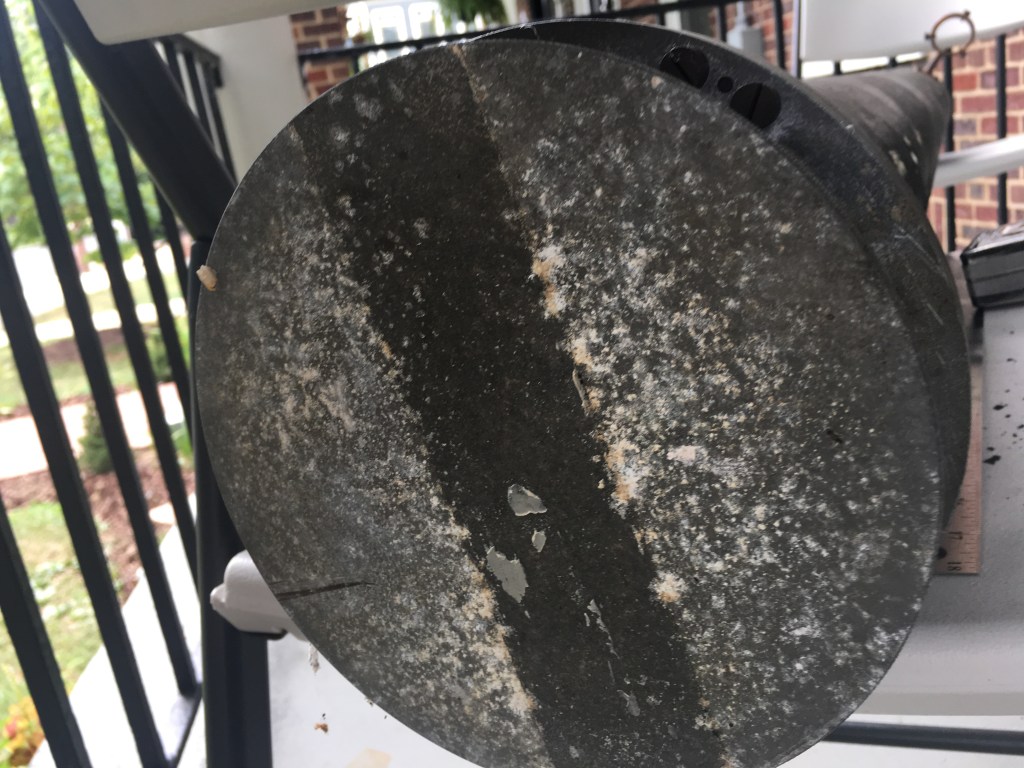
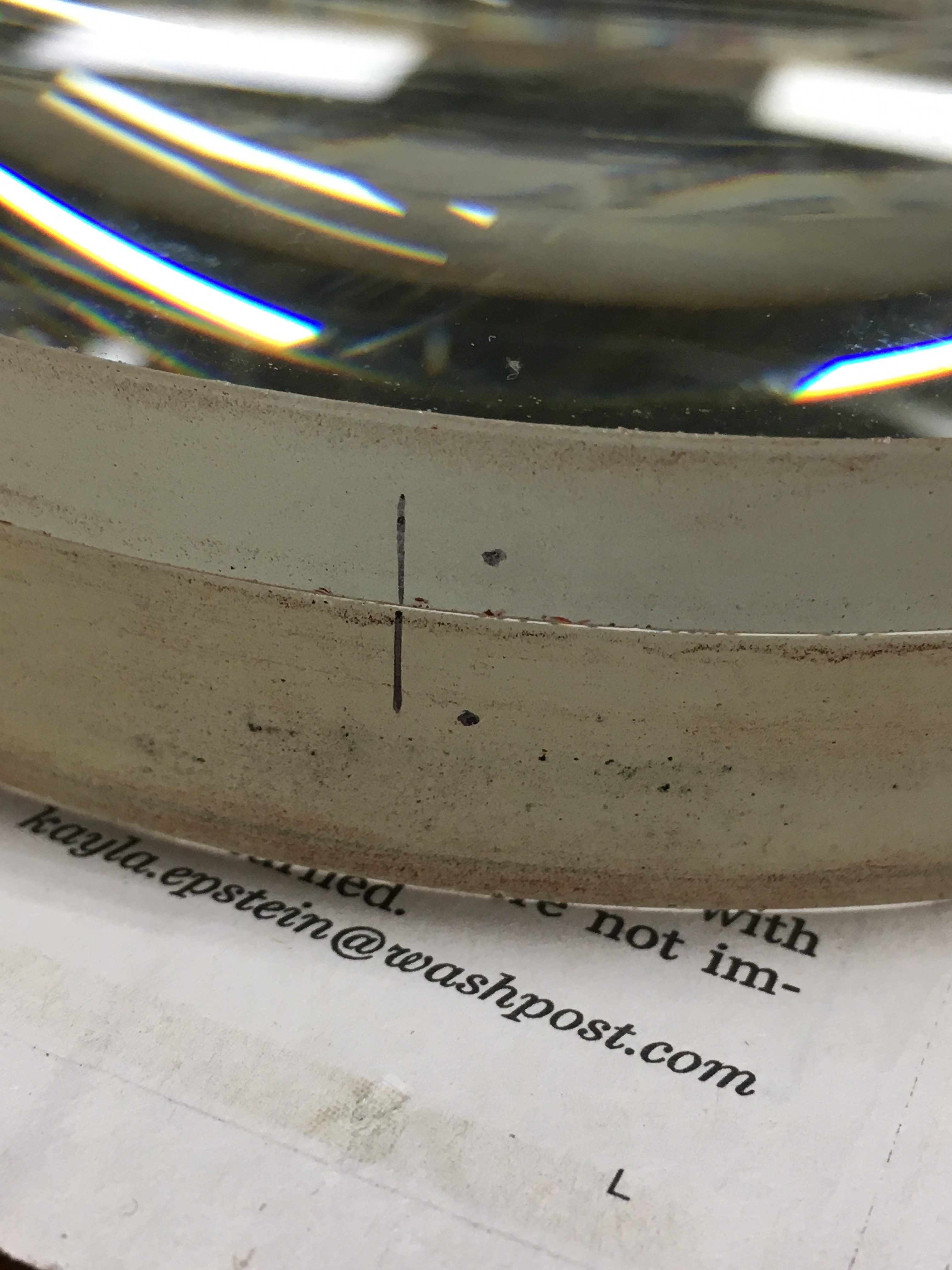
Many years ago, the late Bob Bolster, a founding member of Hopewell Observatory and an amazing amateur telescope maker, got hold of a large piece of glass, perhaps World War Two military surplus left over from the old Bureau of Standards.
I have no idea what it is made out of. If Bob had any clue about its composition, he didn’t tell anyone.
Its diameter is 22 inches, and its thickness is about 3.25″. It has a yellowish tint, and it is very, very heavy.
If you didn’t know, telescope lenses (just like binocular or camera lenses) are made from a wide variety of ingredients, carefully selected to refract the various colors of light just so. Almost all glass contains quartz (SiO2), but they can also contain limestone (CaCO3), Boric oxide (B2O3), phosphates, fluorides, lead oxide, and even rare earth elements like lanthanum or thorium. This linkwill tell you more than you need to know.
If you are making lenses for a large refracting telescope, you need to have two very different types of glass, and you need to know their indices of refraction very precisely, so that you can calculate the the exact curvatures needed so that the color distortions produced by one lens will be mostly canceled out by the other piece(s) of glass. This is not simple! The largest working refractor today is the Yerkes, with a diameter of 40 inches (~1 meter). By comparison, the largest reflecting telescope made with a single piece of glass today is the Subaru on Mauna Kea, with a diameter of 8.2 meters (323 inches).
For a reflecting telescope, one generally doesn’t care very much what the exact composition of the glass might be, as long as it doesn’t expand and contract too much when the temperature rises or falls.
We weren’t quite sure what to do with this heavy disk, but we figured that before either grinding it into a mirror or selling it, we should try to figure out what type of glass it might be.
Several companies that produce optical glass publish catalogs that list all sorts of data, including density and indices of refraction and dispersion.
Some of us Hopewell members used a bathroom scale and tape measures to measure the density. We found that it weighed about 130 pounds. The diameter is 22 inches (55.9 cm) and the thickness is 3 and a quarter inches (8.26 cm). Using the formula for a cylinder, namely V = pi*r2*h, the volume is about 1235 cubic inches or 20,722 cubic centimeters. Using a bathroom scale, we got its weight to be about 130 lbs, or 59 kg (both +/- 1 or 2). It is possible that the scale got confused, since it expects two feet to be placed on it, rather than one large disk of glass.
However, if our measurements are correct, its density is about 2.91 grams per cc, or 1.68 ounces per cubic inches. (We figured that the density might be as low as 2.80 or as high as 3.00 if the scale was a bit off.)
It turns out that there are lots of different types of glass in that range.
Looking through the Schott catalog I saw the following types of glass with densities in that range, but I may have missed a few.
2.86 N-SF5
2.86 M-BAK2
2.89 N-BAF4
2.90 N-SF8
2.90 P-SF8
2.91 N-PSK3
2.92 N-SF15
2.93 P-SF69
2.94 LLF1
2.97 P-SK58A
3.00 N-KZFS5
3.01 P-SK57Q1
By comparison, some of the commonest and cheapest optical glasses are BAK-4 with density 3.05 and BK-7 with density 2.5.
Someone suggested that the glass might contain radioactive thorium. I don’t have a working Geiger counter, but used an iPhone app called GammaPix and it reported no gamma-ray radioactivity at all, and I also found that none of the glasses listed above (as manufactured today by Schott) contain any Uranium, Thorium or Lanthanum (which is used to replace thorium).
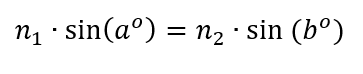
So I then rigged up a fixed laser pointer to measure its index of refraction usingSnell’s Law, which says
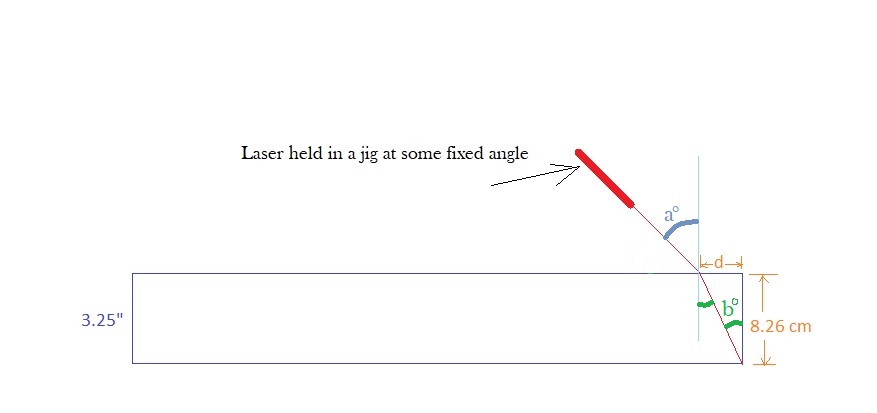
Here is a schematic of my setup:
The fixed angle a I found to be between 50 and 51 degrees by putting my rig on a large mirror and measuring the angle of reflection with a carpentry tool.
And here is what it looked like in practice:
I slid the jig back and forth until I could make it so that the refracted laser beam just barely hit the bottom edge of the glass blank.
I marked where the laser is impinging upon the glass, and I measured the distance d from that spot to the top edge of the glass.
I divided d by the thickness of the glass, in the same units, and found the arc-tangent of that ratio; that is the measure, b, of the angle of refraction.
One generally uses 1.00 for the index of refraction of air (n1). I am calling n2 the index of refraction of the glass. I had never actually done this experiment before; I had only read about doing it.
As you might expect, with such a crude setup, I got a range of answers for the thickness of the glass, and for the distance d. Even angle a was uncertain: somewhere around 49 or 50 degrees. For the angle of refraction, I got answers somewhere between 25.7 and 26.5 degrees.
All of this gave me an index of refraction for this class as being between 1.723 and 1.760.
This gave me a list of quite a few different glasses in several catalogs (two from Schott and one from Bausch & Lomb).
Unfortunately, there is no glass with a density between 2.80 and 3.00 g/cc that has an index of refraction in that range.
None.
So, either we have a disk of unobtanium, or else we did some measurements incorrectly.
I’m guessing it’s not unobtanium.
I’m also guessing the error is probably in our weighing procedure. The bathroom scale we used is not very accurate and probably got confused because the glass doesn’t have two feet.
A suggestion was made that this might be what Bausch and Lomb called Barium Flint, but that has an index of refraction that’s too low, only 1.605.
The Hopewell Observatory had available a finely-machined antique, brass-tube 6″ f./14 achromatic refractor.
The mount and drive were apparently made by John Brashear, but we don’t know for sure who made the tube, lens, focuser or optics.
We removed a lot of accumulated green or black grunge on the outside of the tube, but found no identifying markings of any sort anywhere, except for the degrees and such on the setting circles and some very subtle marks on the sides of the lens elements indicating the proper alignment.
The son of the original owner told me that the scope and mount were built a bit over a century ago for the American professional astronomer Carl Kiess. The latter worked mostly on stellar and solar spectra for the National Bureau of Standards, was for many years on the faculty of Georgetown University, and passed away in 1967. A few decades later, his son later donated this scope and mount to National Capital Astronomers (of DC), who were unable to use it. NCA then later sold it to us (Hopewell Observatory), who cleaned and tested it.
The attribution of the mount to Brashear was by Bart Fried of the Antique Telescope Society, who said that quite often Brashear didn’t initial or stamp his products. Looking at known examples of Brashear’s mounts, I think Fried is probably correct. Kiess’s son said he thought that the optics were made by an optician in California, but he didn’t remember any other details. His father got his PhD at UC Berkeley in 1913, and later worked at the Lick Observatory before settling in the DC area. The company that Brashear became doesn’t have any records going back that far.
When we first looked through the scope, we thought the views were terrible, which surprised us. However, as we were cleaning the lens cell, someone noticed subtle pencil marks on the edges of the two lens elements, indicating how they were supposed to be aligned with each other. Once we fixed that, and replaced the 8 or so paper tabs with three blue tape tabs, we found it produced very nice views indeed!
The focuser accepts standard 1.25″ eyepieces, and the focuser slides very smoothly (once we got the nasty, flaky corrosion off as delicately as possible and sprayed the metal with several coats of clear polyurethane). The workmanship is beautiful!
Top: tiller for hand control of right ascension. Middle: counterweight bar (machined by me to screw into the mount) with clamps to hold weights in place. Bottom: detail of 1.25″ rack-and-pinion focuser.
We have not cleaned the mechanical mount, or tried it out, but it does appear to operate: the user turns a miniature boat tiller at the end of a long lever to keep up with the motions of the stars.
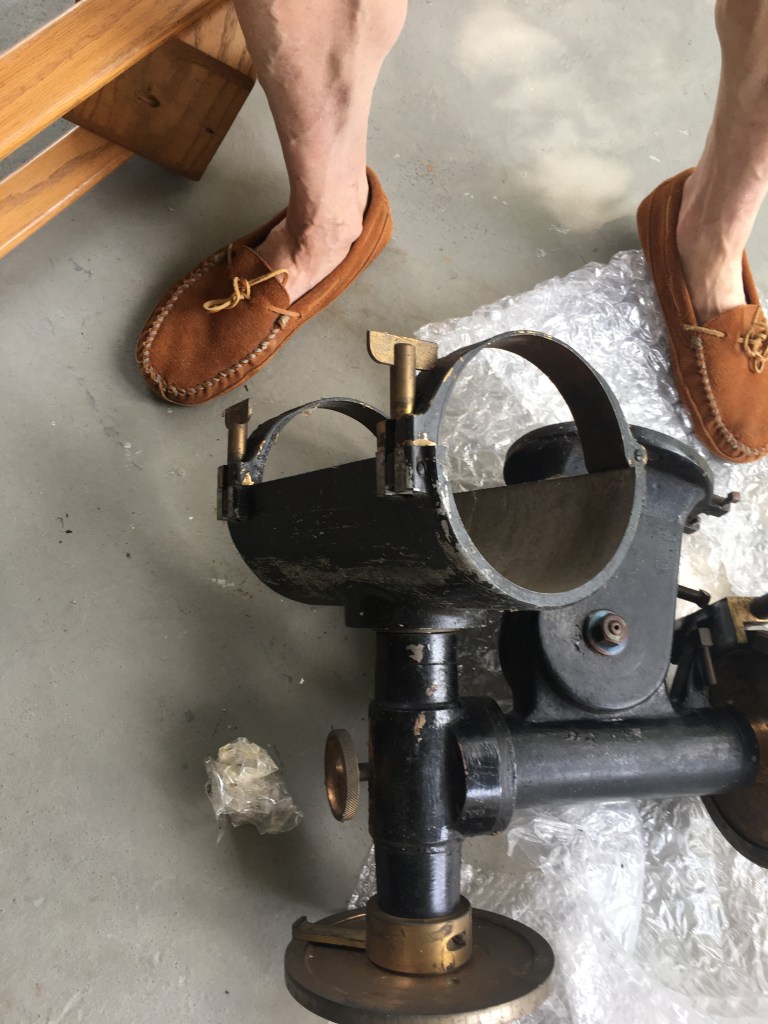
The mount and cradle (with size 12 feet for scale)
The counterweight rod was missing, so I machined a replacement, which has weight holder clamps like you see in gymnasiums. Normal Barbell-type weights with 1 inch holes fit well and can be adjusted with the clamps.
Unfortunately, the whole device is rather heavy, and we already own a nice 6″ f/15 refractor made by Jaegers, as well as some Schmidt-Cassegrain telescopes that also have long focal lengths. Putting this scope on its own pedestal, outside our roll-off roof, with adequate protection from both the elements and from vandals, or figuring out a way to mount it and remove it when needed, are efforts that we don’t see as being wise for us.
Did I mention that it’s heavy? The OTA and the mount together weigh roughly 100 pounds.
However, it’s really a beautiful, historic piece with great optics. Perhaps a collector might be interested in putting this in a dome atop their home or in their office? Or perhaps someone might be interested in trading this towards a nice Ritchey Chretien or Corrected Dal-Kirkham telescope of moderate aperture?
Anybody know what might be a fair price for this?
Guy Brandenburg
President
The Hopewell Observatory
Some more photos of the process and to three previous posts on this telescope.
Partway through cleaning the greenish, peeling, grimy layer and old duct tape residue with a fine wire brush at low speed to reveal the beautiful brass OTA.This shows the universal joint that attaches to the ’tiller’ and drives the RA axisDo you see the secret mark, not aligned with anything?Aluminum lens cover and cell before cleaningLens cell and cover, with adjustment screws highlighted, after cleaningIt works!
Hopewell Observatory has three WW2 or Cold-War aerial spy camera optical tube assemblies, including a relatively famous Fairchild K-38. No film holders, though. And no spy planes. The lenses are in good condition, and the shutters seem to work fine.
We would like to give them away to someone who wants and appreciates them, and can put them to good use. Does anybody know someone who would be interested?
They’ve been sitting unused in our clubhouse for over 20 years. Take one, take two, take all of them, we want them gone.
We are located in the DC / Northern Virginia area. Nearby pickup is best. Anybody who wants them shipped elsewhere would obviously need to pay for packaging and shipping.
Here are some photos.
This one is labeled K-38, has a special, delicate, fluorite lens in front, and is stamped with the label 10-10-57 – perhaps a date. The shoe is for scale.
The next two have tape measures and shoes for scale.
Let me know (a comment will work) if you are interested.
Here is some information that teachers at quite a few different levels could use* for a really interesting geometry lesson involving reflections involving two or more mirrors, placed at various angles!
Certain specific angles have very special effects, including 90, 72, 60, 45 degrees … But WHY?
This could be done with actual mirrors and a protractor, or with geometry software like Geometer’s Sketchpad or Desmos. Students could also end up making their own kaleidoscopes – either with little bits of colored plastic at the end or else with some sort of a wide-angle lens. (You can find many easy directions online for doing just that; some kits are a lot more optically perfect than others, but I don’t think I’ve even seen a kaleidoscope that had its mirrors set at any angle other than 60 degrees!)
I am reproducing a couple of the images and text that Angel Gilding provides on their website(which they set up to sell silvering kits (about which I’ve posted before, and which I am going to attempt using pretty soon)).
At 72º you see 4 complete reflections.
When two mirrors are parallel to each other, the number of reflections is infinite. Placing one mirror at a slight angle causes the reflections to curve.
* assuming that the teacher are still allowed to initiate and carry out interesting projects for their students to use, and aren’t forced to follow a scripted curriculum. It would be a lot better use of computers than forcing kids to painfully walk through (and cheat, and goof off a lot) when an entire class is forced to use one of those very expensive but basically worthless highly-centralized, district-purchased computer-managed-instruction apps. God, what a waste of time – from personal experience attempting to be a volunteer community math tutor at such a school, and also from my experience as a paid or volunteer tutor in helping many many students who have had to use such programs as homework. Also when I was required to use them in my own classes, over a decade ago, I and most of my colleagues found them a waste of time. (Not all – I got officially reprimanded for telling my department chair that ‘Renaissance Math’ was either a ‘pile of crap’ or a ‘pile of shit’ to my then-department head, in the hearing of one of the APs, on a teacher-only day.
Keep in mind: I’m no Luddite! I realized early on that in math, science, and art, computers would be very, very useful. I learned how to write programs in BASIC on one of the very first time-share networks, 45 years ago. For the first ten years that my school system there was almost no decent useful software for math teachers to use with their classes unless you had AppleII computers. We had Commodore-64’s which were totally incompatible and there were very few companies (Sunburst was one) putting out any decent software for the latter. So when I saw some great ideas that would be ideal for kids to use on computers to make thinking about numbers, graphs, and equations actually fun and mentally engaging, often I would have to write them my self during whatever free time I could catch, at nights and weekends. Of course, doing this while being a daddy to 2 kids, and still trying to teach JHS math to a full load of students (100 to 150 different kids a day at Francis Junior High School) and running a school math club and later coaching soccer. (I won’t say I was a perfect person or a perfect teacher. I believe I learned to give better math explanations than most, didn’t believe that you either have a ‘m,ath gene’ or you don’t, at times had some interesting projects, and at times was very patient and clear, but had a terrible temper and often not good at defusing things. Ask my kids or my former students!) Later on, I collaborated with some French math teachers and a computer programmer to try to make an app/program called Geometrix for American geometry classes that was supposed to help kids figure out how to make all sorts of geometric constructions and then develop a proof of some property of that situation. It was a failure. I was the one writing the American version, including constructions and tasks from the text I was currently using. There was no way I could anticipate what sorts of obstacles students would find when using this program, until I had actual guinea pig students to use them with. Turns out the final crunch of writing however many hundreds of exercises took place over the summer, and no students to try them on. Figuring out hints and clues would require watching a whole bunch of kids and seeing what they were getting right or wrong. In other words, a lot of people’s full time job for a long time, maybe paying the kids as well to try it out so as to get good feedback, and so on. Maybe it could work, but it would require a lot more investment of resources that the tiny French and American companies involved could afford. We would have really needed a team of people, not just me and a single checker.
I find that none of these computer-dominated online learning programs (much less the one I worked on) can take the place of a good teacher. Being in class, listening to and communicating logically or emotionally with a number of other students and a knowledgeable adult or two, is in itself an extremely important skill to learn. It’s also the best way to absorb new material in a way that will make sense and be added to one’s store of knowledge. That sort of group interaction is simply IMPOSSIBLE in a class where everybody is completely atomized and is on their own electronic device, engaged or not.
Without a human being trying to make sense out of the material, what I found quite consistently, in all the computerized settings, that most students absorbed nothing at all or else the wrong lessons altogether (such as, ‘if you randomly try all the multiple choice answers, you’ll eventually pick the right one and you can move on to some other stupid screen’; it doesn’t matter that all your prior choices were wrong; sometimes you get lucky and pick the right one first or second! Whee! It’s like a slot machine at a casino!).
By contrast, I found that with programs/apps/languages like Logo, Darts, Green Globs, or Geometer’s Sketchpad, with teacher guidance, students actually got engaged in the process, had fun, and learned something.
I find the canned computer “explanations” are almost always ignored by the students, and are sometimes flat-out wrong. Other times, although they may be mathematically correct, they assume either way too much or way too little, or else are just plain confusing. I have yet to detect much of any learning going on because of those programs.
Here is a batch of articles and links concerning the spray-on process for making astronomical mirrors reflective using protected silver solutions.
Long ago, I translated Foucault’s monograph on making paraboloidal, silvered astronomical mirrors. Part of his article described the process that he and Steinheil developed for silvering, which involved using silver nitrate solutions and various other reagents. It looked quite tricky, and also required further polishing! Plus, our telescope making workshop here in Washington DC had a Navy surplus vacuum chamber that was (and still is) quite effective at putting on good-quality, inexpensive aluminum coatings for any mirror up to 12.5″ diameter.
However, I and a couple of other ATMers (Bill R and Oscar O) are working on mirrors in the 16 to 18 inch range, and they simply won’t fit. So I was quite intrigued to watch how Peter Pekurar and some other folks coated a couple of rather large mirrors right in front of a small crowd of onlookers in a tent at this summer’s Stellafane.
There is also an article on the process in the January 2020 Sky and Telescope, and a webpage (here) on the topic run by Pekurar and Howard Banich and others.
Not to mention a bunch of posts on Cloudy Nights (here) and a nice PDF explaining it all, (here).
What is really, really amazing is that the webpage by Pekurar and Banich also has interferograms showing that the overcoating has absolutely no effect on the sub-microscopic, geometrical figure of the mirror! Unfortunately, it’s only effective against chemical attack, not against dirty fingers or scratches. They also did some careful experiments on reflectivity at various wavelengths with various treatments of the surface.
A couple of local ATMers and at least one professional at Goddard Space Flight Center have told me about their experiments with the process; they found that it is easy to mess up if you aren’t stringently clean and also easy to waste materials.
I found a few things that may have been causing problems:
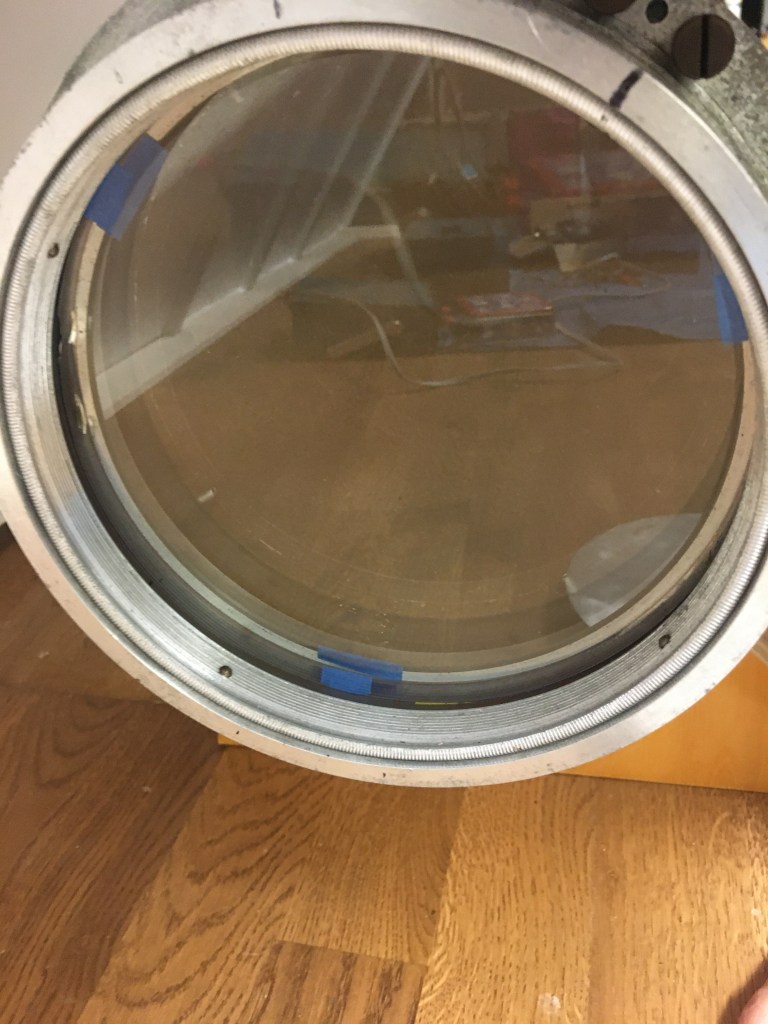
(1) Whoever put the lens cell together last didn’t pay any attention at all to the little registration marks that the maker had carefully placed on the edges of the lenses, to show how they were supposed to be aligned with each other. I fixed that, as you see in the photo below. The reason this is probably important is that the lenses are probably not completely symmetrical around their central axes, and the maker ‘figured’ (polished away small amounts of glass) them so that if you lined them up the way he planned it, the images would be good; otherwise, they would probably not work well at all and could very well be causing the poor star test images we saw.
2. The previous assembler also put eleven little tape spacers around the edges, between the two pieces of glass. More is apparently not better; experts say you should have three spacers, each 120 degrees apart from the other two. Done.
3. The bottom (or ‘flint’) element is slightly smaller than the other one (the ‘crown’), so it probably shifted sideways. That alone would be enough to mess up the star tests in the way that we saw. So I wrapped two thicknesses of blue painter’s tape around the outside of the flint, and put some three cardboard shims between the edges of the ‘crown’ and the aluminum cell.
4. There were no shims at all between the flint and the aluminum ring that holds it in place underneath. This caused some small scratches on the glass, and might have been warping the glass. I put in three small shims of the same type of blue painter’s tape, lined up with the other spacers.
We will see if these improvements help. I really don’t want to haul this all the way out to Hopewell Observatory and struggle with putting it back on the mount for a star test. That was just way too much work, much more than I expected! The next test will be with an optical flat placed in front of the lenses, and a Ronchi grating.
I would like to thank Bart Fried, Dave Groski, and several other people on the Antique Telescope Society website for their advice.
————————————-
By the way, these photos show how we held the refractor on the mounting plate for the Ealing mount at Hopewell Observatory.
I am disassembling the lens cell of the >100 year old 6” f/14 Kiess refractor that produces horrible results on star tests.
There is absolutely no information inscribed anywhere inside the cell, inside the tube or outside it, nor on the edges of the lens elements. I can only guess as to what type of glass they used, and figuring it out won’t be easy. The least destructive method I can think of beginning to do this is by weighing them and calculating out their precise volumes, and from that calculating their densities. A graduate gemologist could probably calculate their indices of refraction, but not me.
Tomorrow I plan to measure the curvatures of the lens elements; perhaps someone familiar with old telescopes will then have clues as to who might have made this particular type of optical prescription.
The shims seem to me to be intact, so I think I can rule out astigmatism from lens elements put in crooked. [OTOH, someone on the Antique Telescopes Facebook group says that the large number of small black spacers in between the lenses may itself be causing the massive astigmatism problem that we found in the star test. I don’t have enough experience to be able to tell whether that’s correct or not.]
The small chips on the edge of the second (meniscus? Flint?) lens element were already there when I got it. I was also surprised to find that the first (biconvex, crown?) lens element has a small bubble very close to the center. It’s probably not significant, but I will check for strain as well.
Gently tapping off the lens cell from the tube
Note that the retaining ring holding the front of the first lens merely slides into the cell; it’s held in place by four screws. The threading is on the inside of the ring, and the outside is smooth
You can see the black tape and tan cardboard spacers
Me looking puzzled
The cardboard spacers around the edges
The two lenses together; note the multiple, small black tape spacers between the pieces of glass
The original chips on the second lens element
The empty lens cell. Note that they didn’t make it black
EDIT: It has now been sold to an ambitious telescope maker in Italy.
We had a 12-inch Casssegrain optical telescope assembly for sale at an extremely attractive price: just two hundred dollars (or any reasonable offer). You pay for shipping.
The full-thickness primary mirror alone is worth much more than that as a raw piece of unfinished Pyrex! (United Lens charges $450 for an equivalent, 12.5″ diameter, roughly 2″ thick, raw, unfigured, disk of Borofloat!)
The telescope was part of a package (mount-cum-telescope) that was purchased from the Ealing company back in the 1960s by the University of Maryland. The scope itself never gave satisfactory images, so the UMd observatory sold it off in the early 1990s, and it ended up at the Hopewell Observatory about a decade before I became a member. Hopewell kept the mount, which still works quite well, but removed the telescope and replaced it with a 14-inch Celestron Schmidt-Cassegrain.
I recently examined the telescope itself (the one we are selling) and found that it indeed has a hyperbolic primary with a focal length of about 4 feet (so it’s f/4). Presumably, the convex secondary is also a matching hyperboloid, to create a Ritchey-Chretien design, but I don’t feel like perforating a large spherical mirror to create a Hindle sphere to test it properly. In any case, using a 12-inch flat, I was unable to produce decent Ronchi images.
As you may know, figuring and collimating a Richey-Chretien require a LOT of patience, more than I have. My suggestion would be to refigure the primary into a paraboloid, procure a standard flat, elliptical diagonal, and repurpose this as a Newtonian. Refiguring this mirror a task that I don’t feel like taking on, since our observatory already has a 14″ Newtonian, a 14″ SCT, and I already have built a 12.5″ Newtonian of my own. Plus, I am finding that figuring a 16.5″ thin mirror is plenty of work already.
So, our loss could be your gain! Make an offer!
I attach a bunch of photos of the OTA from several viewpoints, including a ronchigram. The mirror has been cleaned off since these picture were made; the little electronic motor was for remote focusing of the secondary.
I spent Labor Day weekend at the Almost Heaven Star Party very close to Spruce Knob, the highest ridge in West Virginia. When the skies cleared at night, the stars and Milky Way were magnificent, but that only happened about 1 night out of three. My 12.5″ home-made Dobsonian telescope performed very well; in fact, because its primary and secondary mirror are almost fully enclosed by the light shrouds and upper cage, I was able to keep observing long after all the other refractors and Schmidt-Cassegrains were closed down by the heavy dew. (To keep the dew off of my finder scope and Telrad, I used large rubber bands to wrap chemical hand warmer packs around them, and that crude and cheap arrangement worked very well!)
Here are three photos taken by me:
Exploring the geology of Spruce Knob Mountain Center: Lyle Mars in blue shirt and white hat is in front of the entrance to a cave carved in limestone
Selfie with me in front of three others on the geology hike
This lovely sunset did not portend clear skies
All but the photo with the sextant were taken by Oscar.
Alan Goldberg teaching someone how to use a sextant
Me studying my charts, in front of parallelogram binocular mount
Oscar Olmedo and me at our campsite
Mike Laugherty and me
Mike Laugherty and me
Me fiddling with my 12.5″ home-made dob in the daytime
Me fiddling with the parallelogram binocular mount in the daytime
Mike Laugherty and me fiddling with binocular mount
Left to right: Mike Laugherty, Oscar Olmedo, me
The lottery drawing for a whole bunch of neat prizes. None of us 3 won anything.