Tags
green, led, red, Ronchi, ronchigram
Very weird: on an old Coulter mirror that we tested tonight, a green LED reflected back at us as **red** light instead of the normal green.
We don’t understand! Green LEDs have a wavelength of roughly 525 nanometers, give or take 30 nm. Red LEDs are about 100 nm longer. How can something that otherwise looks like a normal aluminum coating shift green light all the way to red light?
Inquiring minds would like suggestions.
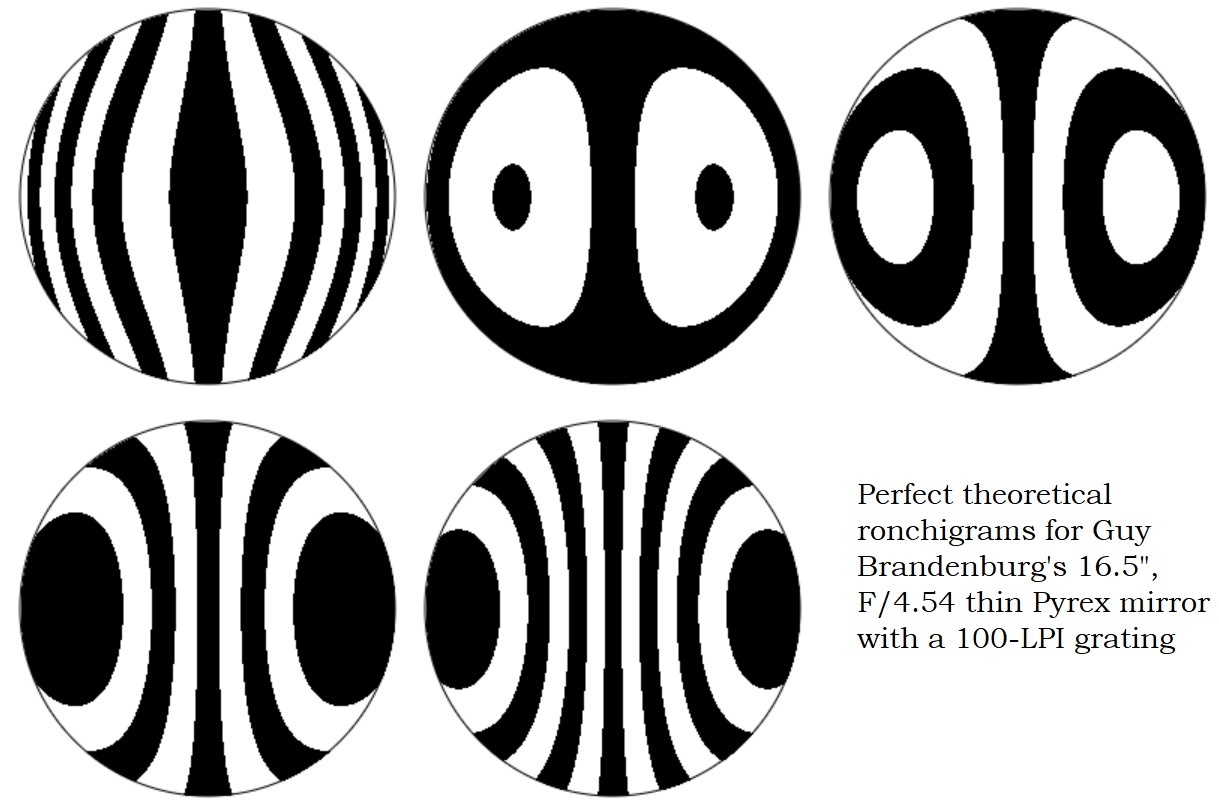
The first two rows of green images are from a different old Coulter mirror that we also tested, that very same evening, with the same focal ratio, and the same apparatus. The last row of red images that we took of the weird Coulter-ish mirror that I wonder about.


UPDATE: July 18, 2026
There may be a solution to this mystery. Preston Engebretson wrote me on Facebook:
“The coating responsible is likely a standard Aluminum coating with a Silicon Monoxide (SiO) or Silicon Dioxide (SiO₂) protective overcoat that has degraded or contains specific impurities, causing it to exhibit fluorescence (photoluminescence). The Phenomenon: When a Green LED (wavelength ~525 nm) is shone onto the mirror (e.g., during a Foucault or Ronchi test), the reflection appears Red instead of green. The Coating: Coulter mirrors typically used Aluminum with a Silicon Monoxide (SiO) overcoat. Silicon Monoxide (or silicon-rich silicon oxide, SiO_{x} is known to exhibit red photoluminescence under certain conditions, particularly if silicon nanocrystals form within the oxide matrix due to aging, annealing, or specific deposition defects.”
A quick search with Bing and Copilot led me to a paper describing how engineers and scientists have recently been able to harness this photoluminescence to produce reflected light in wavelengths ranging all the way from ultraviolet through red! I never knew!
My guess is that this mirror at some point got very, very hot, and the silicon monoxide overcoat changed in part into a mixture of pure silicon crystals and silicon dioxide, causing the red photoluminescence that we saw. A quote from that paper:
“It has been almost 30 years since the discovery of silicon nanocrystals (SiNCs) (Canham, 1990), which carry unique properties distinct from bulk silicon. Since then, SiNCs have gained enormous attention around the world and harvested countless achievements in a myriad of hot fields (Kubby et al., 2006; Liang and Bowers, 2010; Mastronardi et al., 2012a; Bonafos et al., 2012; McVey and Tilley, 2014; Zhai et al., 2014; Sun et al., 2016c; Dasog et al., 2016; Meinardi et al., 2017; Ni et al., 2019). Many of the applications are based on SiNCs’ photoluminescent properties. Consequently, significant progress has been achieved in the performance of their photoluminescence (PL) with the concerted efforts by the numerous nanochemists and physicists: the quantum yield (QY) has risen from a few percentages to more than 70% (Sefannaser et al., 2021), and the photoluminescence window has been expanded to a full range from ultraviolet to infrared (Hessel et al., 2012; Ghosh and Shirahata, 2014).”