• My series on making a Newtonian telescope
  • How Leon Foucault Made Telescopes

Guy's Math & Astro Blog

Guy's Math & Astro Blog

Author Archives: gfbrandenburg

Why Not Show Students the Beauty of Math?

16 Tuesday Oct 2018

Posted by gfbrandenburg in education, Math, teaching

≈ Leave a comment

Tags

algebra 2, algebra two, beauty, benoit mandelbrot, complex numbers, education, imaginary numbers, julia set, mandelbrot set, Math, strange, weird

When I taught math, I tried to get students to see both the usefulness and beauty of whatever topic we were discussing. The most beautiful mathematical objects I know of are the Mandelbrot and Julia sets, which in my opinion should be brought up whenever one is studying imaginary and complex numbers.

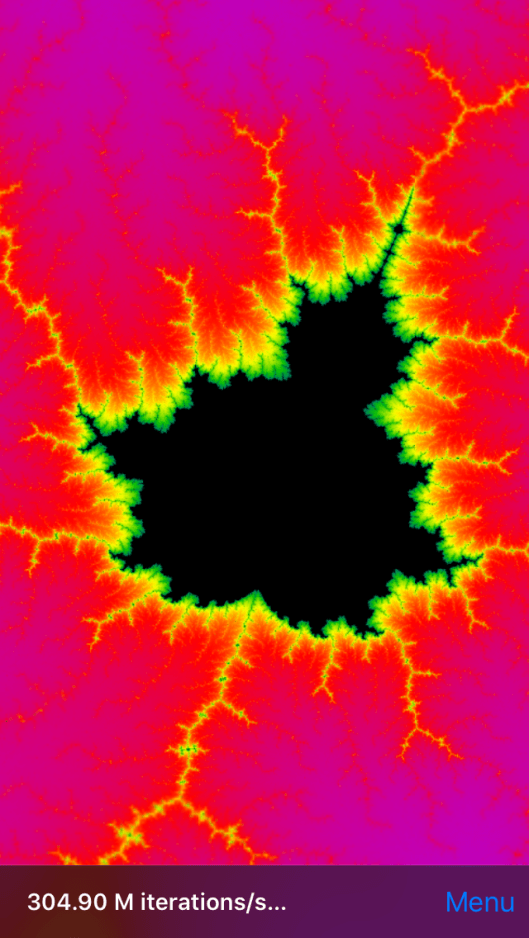
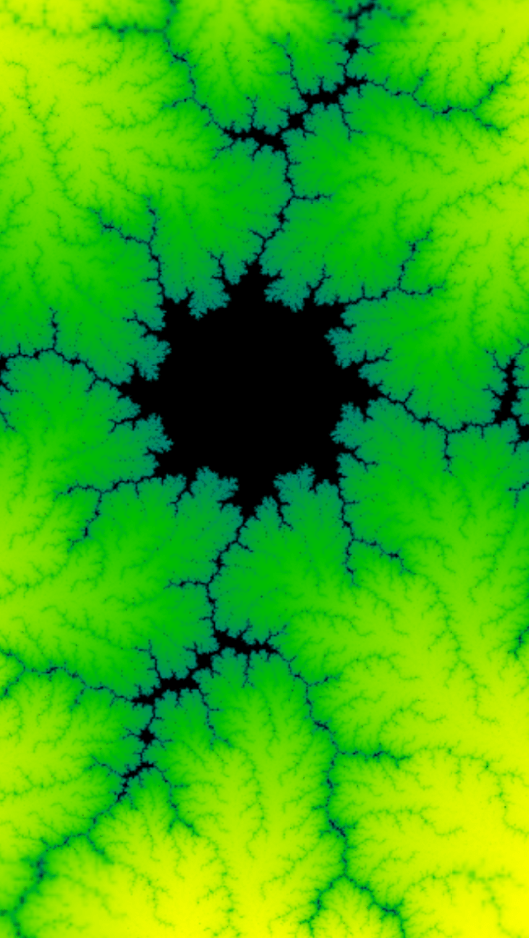
To illustrate what I mean, here are some blown up pieces of the Mandelbrot set. Below,  I’ll explain the very simple algebra that goes into making it.


I made these images using an app called FastFractal on my iPhone. The math goes like this:

Normally, you can’t take the square root of a negative number. But let’s pretend that you can, and that the square root of negative one is the imaginary number i. So the square root of -16 is 4i. Furthermore, we can invent complex numbers that have a real part like 2, or 3.1416, or -25/17, or anything else, and an imaginary part like 3i or -0.25i. So 2-3i is a complex number.

Ok so far?

We can add, subtract, multiply and divide real, imaginary and complex numbers if we want, just remembering that we need to add and subtract like terms, so 4+3i cannot be simplified to 7i; it’s already as simple as it gets. Remember that i multiplied by i gives you negative one!

Interesting fact: if you multiply a complex number (say, 4+3i) by its conjugate (namely 4-3i) you get a strictly REAL answer: 25! (Try it, using FOIL if you need to, and remember that i*i=-1!)

Furthermore, let us now pretend that we can place complex numbers on something that looks just like the familiar x-y coordinate plane, only now the x-axis becomes the real axis and the y-axis becomes the imaginary axis. So our complex number 4+3i is located where the Cartesian point (4, 3) would be.

Ok — but what’s the connection to those pretty pictures?

It’s coming, I promise!

Here’s the connection: take any point on the complex plane, in other words, any complex number you wish. Call it z. Then:

(1) Square it.

(2) Add the original complex number z to that result.

(3) See how far the result is from the origin.

(4) Repeat steps 1 – 3 a whole lot of times, always adding the original z.

One of two things will happen:

(A) your result stays close to the origin, OR

(B) it will go far, far away from the origin.

If it stays close to the origin, color the original point black.

If it gets far away, pick some other color.

Then repeat steps 1-4 for the point “right next” to your original complex point z. (Obviously, the phrase “right next to” depends on the scale you are using for your graph, but you probably want fine coverage.)

When you are done, print your picture!

If we start with 4+3i, after one round I get 11+27i. After two rounds I get -604 + 597i, which is very far from the origin, so I’m going to stop here and color it blue. I’ll also decide that every time a result gets into the hundreds after merely two rounds, that point will also be blue.

Now let’s try a complex point much closer to the origin: how about 0.2+0.4i? I tried that a bunch of times and the result seems to converge on about 0.024+0.420i — so I’ll color that point black.

This whole process would of course be very, very tedious to do by hand, but it’s pretty easy to program a graphing calculator to do this for you.

When Benoit Mandelbrot and others first did this set of computations in 1978-1980, and printed the results, they were amazed at its complexity and strange beauty: the border between the points we color black and those we color otherwise is unbelievably complicated, even when you zoom in really, really close. Who woulda thunk that a simple operation with complex numbers, that any high school student in Algebra 2 can do and perform, could produce something so beautiful and weird?

So, why not take a little time in Algebra 2 and have students explore the Mandelbrot set and it’s sister the Julia set? They might just get the idea that math is beautiful!!!

IMG_1735

National Geographic on Telescope Making

13 Saturday Oct 2018

Posted by gfbrandenburg in Uncategorized

≈ Leave a comment

Nice pix but few details. Here is the link.

Or https://www.nationalgeographic.com/science/2018/10/telescope-festival/?cmpid=org=ngp::mc=social::src=twitter::cmp=editorial::add=twph20181012science-telescopefestival::rid=&sf199912766=1

How Thick Are the Coatings on the Mirrors We Aluminize?

09 Sunday Sep 2018

Posted by gfbrandenburg in Uncategorized

≈ Leave a comment

At the NCA ATM class at the CCCC, we are the fortunate inheritors of a 1960s-era vacuum chamber and aluminizer that was twice given away as surplus (first by the Federal Government or US military, and then later by American University), but which still works.

Much of the credit should be given to Dr. Bill Pala, who snagged it for AU from the US surplus system; the late Bob Bolster and Jerry Schnall, who together ran it for a long time; Dr. John Hryniewicz; Alan Tarica; and several others whose names unforotunately escape me at the moment but who have given excellent advice on repair and maintenance and even provided replacement parts.

Here are four photos of the rig, followed by two of our finished mirrors.

IMG_0069
IMG_0070
IMG_0071
IMG_0072

IMG_0064

032

The question came up: (1) how thick are the coatings we generally put on our mirrors, and (2) how efficient is it — that is, of the aluminum that we vaporize, how much of it actually lands on the mirror?

Thankfully, John H actually measured how thick the coatings are as we coated a mirror. He found that the average thickness is about 93.4 nanometers (billionths of a meter, or thousandths of a micrometer, or millionths of a millimeter), and that the coatings looked like this when blown up sufficiently: ”

 I have attached some scanning electron micrographs of the top of the film.  The grain structure is very fine, you can compare the size with the scale bar at the bottom that shows you the length of the total bar (10 ticks, between each pair of ticks is 1/10 of that number).  There are some particles or perhaps larger grains on top.  They are still very submicron, a couple of tenths at most.

170901_ext__0156_SE(U)
170901_ext__0157_SE(U)

The way the mirrors get coated is basically three steps:

(1) We get the mirror very, very clean, using both with a special detergent (Alconox) bbefore it goes into the vacuum chamber, and high-energy electron bombardment while the pumps are working;

(2) We get the pressure in the chamber very, very low, so that there are relatively few air molecules or atoms between a coiled tungsten filament and the mirror. (We get the pressure down to somewhere in the range of 7*10^-5 to 4*10^-4 Torr, depending on which gauge you believe. This is quite low indeed – roughly the air pressure at the altitude of the International Space Station; this is needed so that the aluminum atoms won’t tend to bounce of the molecules of nitrogen and oxygen and lose their energy.

(3) We melt, and then boil off, a small quantity of pure aluminum from the filament, which goes off in all directions, fairly evenly; the Al atoms that happen to be going in the right direction ashere to the mirror. There, they form a very even, reflective layer.

You may wonder, how do we prevent this layer of aluminum from oxidizing once it comes back into contact with the normal atmosphere? Answer: we don’t. Aluminum oxide is the main component of rubies, sapphires, and corundum, which are very hard. Since the stuff we deposit is relatively pure, it doesn’t have the red or blue color of those pretty and precious gems, and it is transparent, so it forms a hard, transparent, protective layer all by itself. If your coating tarnishes or gets extremely dirty, the aluminum-and-gunk layer is pretty easy to remove with a little bit of hydrochloric acid mixed with copper sulfate. Then you clean it off and re-aluminize.

(Yes, commercial labs do overcoat their mirrors with stuff like Silicon Monoxide and Silicon Dioxide (aka quartz), but we haven’t collectively figured out how to do that with our minimal budget.)

So, again: how efficient is it? What percentage of the atoms of aluminum headed to the mirror, actually adhere to the mirror?

To answer this, it helps to pretend that the filament is at the center of an imaginary sphere, shown below, and that the mirror (facing down, towards the mirror) happens to be at the top of this sphere. Recall that to a good approximation, the aluminum that evaporates off of the coil goes in all directions, i.e., it coats this entire imaginary sphere equally – or it would, if there wasn’t all sorts of pipes and wires and glass bell jars in the way.

The filament and aluminum is located at the center of this sphere.

I measured the distance from the filament to the mirror, and found that it’s just about 20 inches, or roughly 500 millimeters. Archimedes figured out long ago that the surface area of a sphere is equal to four times the area of any circle contained in the sphere, or 4*pi*r^2 in our current notation. So that imaginary sphere, on which the aluminum is deposited, has an area of about 3.1 or 3.2 million square millimeters.

imaginary sphere for aluminization

We currently use slugs of aluminum that are about 15 mm long (give or take a couple of mm) and cut (not at right angles, because the pliers won’t do that) from wire with a diameter of 5 mm (radius 2.5 mm). If we pretend the slugs are cylinders then the math is much easier: we can use the formula pi*r^2*h to get a volume of about 295 cubic millimeters, and we will pretend that all of the aluminum boils off (and none of it sticks like glue to the tungsten) and goes equally in all directions. (Probably not the case, but in practice it doesn’t seem to matter much.)

Now if we divide the 295 mm^3 of aluminum by the total surface area, 3.2 million mm^2, we get the average thickness. I get a result of about 9.1*10^-5 mm, which converts to 91 nanometers. Which is very close to the result that John H found.

On the other hand, most of that aluminum is wasted, because it’s NOT aimed at the mirror. If you have an 8-inch diameter mirror (about 20 cm diameter or 100 mm radius), its area is 10,000*pi square millimeters, or about 31,000 mm^2 – and that’s only one percent of the area of the entire imaginary sphere.

Oh, well, aluminum wire is quite cheap.


Difficulties in Using the Matching Ronchi Test on a 12″ Cassegrain Mirror

08 Saturday Sep 2018

Posted by gfbrandenburg in astronomy, flat, Hopewell Observatorry, optical flat, Optics, Telescope Making

≈ 2 Comments

Tags

Astro Bananas, cassegrain, couder, double pass auto collimation, ealing, foucault, Hopewell Observatory, matching Ronchi, Mel Bartels, Ronchi, ronchigram

The other regulars and I at the DC ATM group at the CCCC have been trying to test a 12 inch Cassegrain mirror and telescope manufactured nearly 50 years ago by a company called Ealing and currently owned by the Hopewell Observatory, of which I am a member. It hasn’t been easy. I discussed this earlier on Cloudy Nights.

Reports from several people, including Gary Hand and the late Bob Bolster, indicated that the optics on this mirror weren’t good at all. Apparently the folks at the University of Maryland’s observatory were sufficiently unhappy with it that they either sold it or gave it to National Capital Astronomers, a local astronomy club, who in turn gave it or sold it to Hopewell Observatory.

With a plain-vanilla Ronchi test, we could see that the mirror was very smooth and continuous, with no turned edge, astigmatism, or bad zones. With the Foucault/Couder zonal test (aka “Foucault” test) , I got results indicating that it was seriously overcorrected: some sort of hyperboloid, rather than the standard paraboloid characteristic of classical Cassegrain telescopes, which have a parabolic primary mirror and a hyperbolic secondary mirror.

However, I have begun losing my faith in my zonal readings, because they often seem to give results that are way out of whack compared to other testing methods.

So we decided to do some additional tests: the Double-Pass Auto-Collimation (DPACT) test used by Dick Parker, as well as the Matching Ronchi test (MRT).

The DPACT is very fiddly and exacting in its setup. We used (and modified) the setup lent to us by Jim Crowley and illustrated by him at his Astro Bananas website. Our results seem to show that the mirror is in fact NOT parabolic, rather, overcorrected, which confirms my Foucault measurements. If it were a perfect paraboloid, then the ronchi lines would be perfectly straight, but they definitely are NOT: they curve one way when inside the focal point, and curve the other when the tester is outside the focal point.

We also tested the entire setup on a radio tower that was about half a mile (~1km) distant. We found that the images were somewhat blurry no matter what we did.

We also attempted the MRT on the same mirror. However, requires very accurate photography and cutting-and-pasting skills in some sort of graphics programs. What you are inspecting is the curvature of the Ronchi lines. Here is the result that Alan T and I got last night:

matching ronchi for 12 inch cass

In black is the ideal ronchigram for this mirror, according to Mel Bartels’ website. The colored picture is the one we made with either my cell phone or the device I finished making earlier this week, shown in my previous post. Here are the two images, separated rather than superimposed:

IMG_1337

ideal ronchigram 12 inch cass ealing

The mirror’s focal length is 47.5″ and the grating has 100 lines per inch, shown somewhat outside of the radius of curvature. The little ‘eyelash’ on the lower left is simply a stray wire that was in the way, and doesn’t affect the image at all. The big hole in the middle is there because the mirror is a cassegrain.

I don’t know about you, but I don’t really see any differences between the real mirror and the theoretical mirror. Do you?

Conclusion

So, what does this all mean?

  • One possibility is that the mirror is in fact perfectly parabolic (as apparently shown by the MRT, but contrary to what I found with Foucault and DPACT) but there is something wrong with the convex, hyperbolic secondary.
  • Another possibility is that the mirror is in fact NOT parabolic, but hyperbolic, as shown by both my Foucault measurements and the DPACT (and contrary to the MRT), which would mean that this telescope was in fact closer to a Ritchey-Chretien; however, since it was marketed as a classical Cassegrain, then the (supposedly) hyperbolic secondary was in fact not tuned correctly to the primary.
  • The answer is left as an exercise for the reader.
  • A star test would be the best answer, but that would require being able to see a star. That hasn’t happened in these parts for quite some time. In addition, it would require an eyepiece holder and a mount of some sort. Or else setting up an indoor star…

Latest Ronchi or Knife-Edge Tester for Mirrors and Other Optics Using a WebCam

07 Friday Sep 2018

Posted by gfbrandenburg in astronomy, Optics, science, Telescope Making

≈ 1 Comment

Tags

brightness, color balance, exposure, focus, foucault, gain, knife edge, Ronchi, testing, webcam

Here is the latest incarnation of my webcam Ronchi and knife edge (or Foucault) tester. It’s taken quite a few iterations to get here, including removing all the unnecessary parts of the webcam. I attach a still photo and a short video. The setup does quite a nice job of allowing everybody to see what is happening. The only problem is setting the gain, focus, exposure, brightness, color balance, contrast, and so on in such a way that what you see on the screen resembles in any way what your eye can see quite easily.

IMG_1335

IMG_1336

IMG_1336

Observe the Stars at Lake Artemisia Natural Area, September 30

30 Thursday Aug 2018

Posted by gfbrandenburg in astronomy, nature, Uncategorized

≈ Leave a comment

Tags

Berwyn Heights, Lake Artemisia, observing, Public

On September 30, members of the public will have the opportunity to observe several planets, the moon, and other heavenly objects through some telescopes to be provided by local amateur astronomers, including members of NCA and NOVAC, at the lovely Lake Artemisia Natural Area in Berwyn Heights, MD.

The location has a wide open southern horizon over the lake, and is surprisingly well-shielded from lights from local highways and shopping centers. The address is

Lake Artemesia Natural Area, Berwyn Road and 55th Avenue, Berwyn Heights, MD 20740

Park Contact numbers are: 301-627-7755  or TTY: 301-699-2544

Normally this park closes at sunset, but it will remain open for this event, which is scheduled for 7:00 (just about sunset) to 11:00 pm (just after moonrise) on Sunday evening, September 30. The event is free. I’ve attached a couple of maps. Please note that Berwyn Road dead-ends at the Metro rail lines.


Lake Artemisia best
lake artemesia 2

We should be able to see Venus, Jupiter, Saturn, Mars, and the rising Moon, if weather permits. Volunteers with telescopes would be appreciated!

Math – How Come We Forget So Much of What We Learned in School?

27 Monday Aug 2018

Posted by gfbrandenburg in astrophysics, education, History, Math, science, teaching, Telescope Making, Uncategorized

≈ Leave a comment

Tags

education, engineering, forgetting, France, mathematics, scientists, USA

This was a question on  Quora. Here is an answer I wrote:

In the US, judging strictly on what I’ve seen from my time in the classroom as both a student, a teacher, and a visiting mentor of other math teachers, I find that math and science was very often taught as sort of cookbook recipes without any real depth of understanding. The recent National Council of Teachers of Mathematics prescriptions have attempted to correct that, but results have been mixed, and the Common Core has ironically fostered a weird mix of conceptual math marred by teachers being *OBLIGATED* to follow a script, word-for-word, if they want to remain employed. Obviously, if students are really trying to understand WHY a certain mathematical or scientific thing/fact/theorem/theory/law is true, they are going to have questions, and it’s obviously the teacher’s job to figure out how best to answer said questions — which are not likely to have pre-formulated scripts to follow in case they come up — and which are going to take time.

Another thing that is true is that not everything in mathematics has real-world applications in every single person’s life. I taught a good bit of computer programming (aka ‘coding’ today), geometry, arithmetic, probability, algebra, statistics, and conic sections, and in fact I use a LOT of that every week fabricating telescope mirrors to amazing levels of precision, by hand, not for a living, but because I find telescope-making to be a lot of fun and good mental, aesthetic, manual, and physical exercise. But I’m a pretty rare exception!

Most people obviously don’t dabble in math and physics and optics like I do, nor should they!

In fact, I have made it a point to ask professional scientists and engineers that I meet if they actually use, on their jobs, all the calculus that they learned back in HS and college. So far, I think my count is several dozen “Noes” and only one definite “Yes” – and the latter was an actual rocket scientist / engineer and MIT grad and pro-am astronomer (and wonderful, funny, smart person) who deals/dealt with orbital rocket trajectories. (IIRC).

In France, when I went to school there 50 years ago and in my experience tutoring some kids at the fully-French Lycee Rochambeau near Washington, DC, is that they go very deeply into various topics in math, and the sequence of topics is very carefully thought out for each year for each kid in the entire nation (with varying levels of depth depending on what sort of track that the students elected to go into (say, languages/literature, pure math, or applied sciences, etc), but the kids were essentially obligated to accept certain ideas as factual givens and then work out more and more difficult problems that dealt with those particular givens. No questions allowed on where the givens came from, except to note the name of the long-dead classical Greek, French, Italian or German savant whose name is associated with it.

As an American kid who was mostly taught in American schools, but who also took 2 full years of the French system (half a year each of neuvieme, septieme, premiere, terminale, and then passed the baccalaureat in what they called at the time mathematiques elementaires, I found the choice of topics [eg ‘casting out nines’ and barycenters and non-orthogonal coordinate systems] in France rather strange. Interesting topics perhaps, but strange. And not necessarily any more related to the real world than what we teach here in the US.

Over in France, however, intellectuals are (mostly) respected, even revered, and of all the various academic strands, pure math has the highest level of respect. So people over there tend to be proud of however far they got in mathematics, and what they remember. Discourse in French tends to be extremely logical and clear in a way that I cannot imagine happening here in the public sphere.

So to sum up:

(a) most people never learned all that much math better than what was required to pass the test;

(b) only a very few geeky students like myself were motivated to ask ‘why’;

(c) most people don’t use all that much math in their real lives in the first place.


Why Math?

25 Friday May 2018

Posted by gfbrandenburg in Uncategorized

≈ Leave a comment

… sharing this from a discussion on learning math on Quora. I agree with the writer on most of it:

=========================

Saleem Rana
Answered Jul 4, 2017

I don’t think it’s actually a question of IQ. Anyone of average intelligence can understand mathematics provided that they learn in a sequential way and they follow a well-developed curriculum. I like to believe that mathematics is logical enough so that even the most difficult concepts can be grasped if it is explained by a patient teacher.

I’d like to posit a different question: why do people of average intelligence dislike (perhaps hate, fear, and despise) mathematics?

Here are 7 possible reasons:

  1. They had horrible teachers when they were little who humiliated them. Mathematics was weaponized by bitter people to bludgeon their student’s budding sense of identity.
  2. They missed learning essential skills in early grades which made it difficult to understand slightly more advanced mathematical steps at a higher grade level.
  3. They never got to a point where they saw the aesthetic nature of math and that nature itself appears to be entirely based on mathematical principles. (Once someone gets to this point, mathematics is as delightful as drawing, painting, or sculpting.)
  4. They resorted to memorizing formulas without understanding the underlying order of any mathematical idea.
  5. They were forced to do mathematics to pass an examination rather than introduced to it as a conceptual tool (probably the best one humans have ever invented or discovered.)
  6. They never wondered if humankind invented mathematics or if mathematics is actually the fabric of reality that astute human beings have observed and reflected on.
  7. They never marveled at the raw genius of someone like Srinivasa Ramanujan or how Issac Newton and and Gottfried Leibniz independently invented calculus during the mid 17th century. The beauty of these romantic stories about mathematics completely escapes them.

Prasad’s Home-Grown Drive Controller

19 Saturday May 2018

Posted by gfbrandenburg in Uncategorized

≈ Leave a comment

Prasad D made a great mirror in our telescope-making workshop here at the Chevy Chase Community Center, and then proceeded to machine a wonderful Crayford focuser, from scratch, after I showed him how to use our 1944-era South Bend lathe. A very friendly fellow, he unfortunately (for us) moved to Philadelphia, which is not really close, but he’s kept up doing excellent ATM work.

As an example, on Tuesday last he brought in a brand new German equatorial drive and controller system that he had cobbled together from various parts. He replaced the original motors in the drive head with stepper motors, and then put together an Arduino board, a wireless communicator, and two stepper-motor controllers. All of the circuit is controlled from an app that he devised, on his Android device. We didn’t have any clear skies to try it out, but I could certainly see the motors slewing to various invisible objects such as the star Procyon and Messier Object 42..

Really first-rate job, and very nicely done! (He said he didn’t want it to look half-baked, and it doesn’t!)

Prasad asked me to “please give credit to the original creator of the electronics – Howard Dutton. He calls the system OnStep. It is based on Arduino Teensy3.2 microcomputer and it can be customized for any type of mount including Dobsonian. It is very easy to work with and your students at CCCC may find it interesting.”
I see a web page with lots of information: http://www.stellarjourney.com/index.php?r=site/equipment_onstep

I’ll post some still photos here and then upload two short videos to Youtube – which I cannot embed on this blog, but can only link to. If you click on the photos, you can see larger images.


IMG_0521 (1)
IMG_0523 (1)
IMG_0525 (1)
IMG_0522


Here is the first video that I took of his device in operation: https://youtu.be/Md06jD35CUg

Here is the link to a shorter video, not as detailed, that I took of the device:  https://youtu.be/bH_i58LhtiY

If you have problems viewing any of this, please let me know by leaving a comment. Thanks.

Quantifying Progress in the Fight Against Turned Down Edge

27 Tuesday Mar 2018

Posted by gfbrandenburg in astronomy, Math, Optics, Telescope Making, Uncategorized

≈ Leave a comment

Tags

Applebaum, Mel Bartels, Ronchi

By Guy Brandenburg

3/27/2017

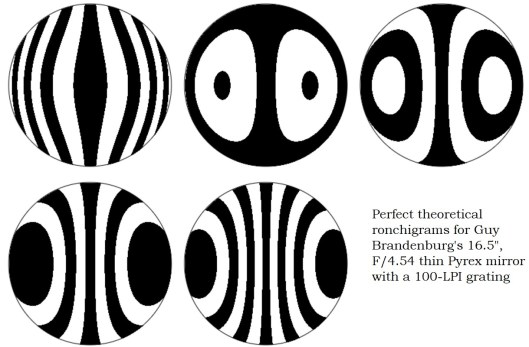
I describe here an attempt to quantify progress (or lack thereof) in the removal of the classic, and dreaded, turned-down edge (TDE) present on a 16.5” Newtonian glass mirror blank that I have been trying to “figure” for some years.  The figuring process means changing a piece of glass that approximates a small section sliced out of a large hollow sphere, into a highly-accurate paraboloid — with the required level of accuracy being measured in nanometers.


Many amateur and professional telescope makers have maintained that you can only fix figuring errors if you can measure them. Not being able to get good, repeatable measurements of the TDE on my mirror, I had been sort of floundering, failing to get rid of the TDE even after YEARS of work (off and on; mostly off). So a decision was made to try to quantify things.


We recently had some success in matching computer-generated Ronchi images of theoretically-perfect mirrors with photos taken of works in progress, simply by cutting and pasting – which has been recommended by Mel Bartels in particular for quite some time. For the first time, I got the hang of it, and we were able to help a first-timer (Mike L) to figure a 10” plate glass f/5.4 mirror only ¾” thick to just about exactly ¼ lambda, according to our combined, repeated, careful measurements on a mirror that was cooled both by immersion in a room-temperature water bath and by sitting in a closet in the very same testing room for an entire weekend.


Prior to this experiment, I had been taking short videos of the entire mirror, moving the ronchi grating back and forth across the center of curvature. These videos reveal and record a lot of qualitative information about the mirror, including vocal commentary, but I found it impossible to transfer the images to my laptop for closer analysis until I got home, across town, which meant that the turn-around time after testing a mirror was much too long to be of any use. I had tried quite a large number of various strokes suggested by others, by our reading various ATM manuals, and by just thinking; but the very serious TDE on this (for me, relatively ambitious) project never seemed to get any better.


I simply gave up on imaging via video clips, since they were too hard to manipulate or measure on my phone, and which required too much bandwidth to send to my laptop until I got home. This time, I took Ronchi still-images on my cell phone, between 0.2 and 0.5 inches outside of the center of curvature.

guys 16 perfect

(My experience has been generally easier to discern defects in a Ronchigram when the lines curve outwards at the top and bottom, which would mean the test grating is  OUTSIDE the COC of a partly-parabolized mirror, as you see on the left in the black-and-white image above. However, when the lines curve inwards at the top and bottom, like the images in the center and to the right, then many serious defects remain hidden. quantify TDE

Procedure:

A standard 100 LPI grating from Willmann-Bell and a yellow LED were used, on an XYZ stage partly fabricated by me and placed exactly twice the focal length from the primary. Images were taken with an iPhone 6, shooting images zoomed in as much as possible. An attempt was made to have matching ronchigrams, i.e., with the same number of vertical lines showing.


(This was a weak point of the experiment. For one, it’s hard to hold cell phone steady enough, and an observer will notice that the images do NOT have exactly the same number of lines. That’s because I did not have a printout of the previous image right in front of me to make comparisons to. All that needs to be fixed in subsequent iterations. Also, other imaging devices need to be tried, as well.)


I was in fact able to email individual photograph frames to my laptop at the lab. After downloading the clearest images to my laptop, I used plain old MS Windows Paint to shrink and crop the useful portion of the picture, and then pasted the result into a Geometry software (Geometer.s Sketchpad, or GSP) that I was already familiar with. GSP was then used to draw a circle around the circumference of the image of the nearly-perfectly-circular glass disk, adjusting this as well as possible. This process automatically generated the center of the disk. Using that center, a second, and smaller, circle was drawn whose circumference was placed at the location along the ronchi lines where they appeared to begin to turn outwards. GSP was then  to measure directly the radii of the two circles and to compute their ratio.


A final ratio of 0.7, just to pick a number that is easy to compute, means that just about half of the area of the mirror is covered by a wide rolled-down edge, since the ratio of areas is equal to the square of the ratio of the respective radii, and 0.7 squared is 0.49, or 49%.


In the diagram above, the images go in chronological order but COUNTER-clockwise, from upper left (labeled #1), which was made in mid- or early March, through the next three images, all taken on March 22. In between each image, various strokes were employed in figuring sessions for anywhere between 15-20 minutes to attempt to fix the TDE. All the figuring sessions involved sub-diameter laps anywhere from 8 to 12 inches in diameter that had been warm-pressed upon the mirror. The strokes were both forward and back and incorporated enough of a ‘W’ stroke to cover the entire mirror, using cerium oxide on either tempered burgundy or Acculap pitch, depending. The edge of the tool was allowed to go up to the edge of the mirror, +/- maybe 5 mm. The goal was simply to wear down the glass in the center until it caught up with the amount that the edge had been worn down. None of the laps seemed to have full contact with the mirror out to the very edge; thus the end of the stroke was NOT at the edge of the mirror.


You will notice that these ratios, circled in green, seem to increase monotonically from 69% to 80%, which is gratifying: if this real, then the fraction of the mirror that is NOT covered by TDE has gone from about 47% to about 67%, as you can see here. (Note: in figure #1, the large circle was denoted circle AB, and the smaller circle was denoted circle CD. I know that points A and C are not identical, but they are rather close; that error will be fixed in subsequent iterations.)

However: the key question is: IS THIS REAL? Or am I merely fooling myself?

I don’t know yet.

I certainly hope it is real.

But it needs to be checked with subsequent investigation.

My attempt at limiting my own subjectivity or wishful thinking was to try to draw the circles at the place where the more-or-less vertical lines began turning outwards. Hopefully that location really corresponded to the place where the turned/rolled edge began. However, it is entirely possible that the precise apparent location of the beginning of the TDE very much depends on exactly how many lines appear in the Ronchigram, thus, precisely how far from the COC the grating is located.

Unfortunately, often times I have to dismantle the entire apparatus, because we have to close up shop for the night, or somebody else needs to use the tester on another mirror. Thus, it is nearly impossible to ensure that the measurement apparatus remains undisturbed.

My next steps, I think, are these:

  1. Have a separate, and very simple ronchi apparatus that just consists of a grating and a light.
  2. Have previous images right in front of me as I prepare to take the next Ronchigrams, so that I can match the number of lines visible.
  3. Perhaps I should take a series of said standardized ronchigrams both inside and outside of COC with, say, 5 lines visible. I should also take some ronchigrams that might accentuate and expose any possible astigmatism; that is, very close to the COC. Any Ronchi lines that resemble the letters S, Z, J, U, or N would be very bad news.
  4. Attempt to attach a cheap video camera with built-in LED, Ronchi grating, and a suitable lens to make steadier images free from hand wobbles.

I would like to thank Isaac and Elias Applebaum for their diligent and noted explorations in solving a similar question relating to fixing or preventing TDE. That STEM project won them a number of well-deserved awards.


← Older posts
Newer posts →

Subscribe

  • Entries (RSS)
  • Comments (RSS)

Archives

  • June 2026
  • May 2026
  • April 2026
  • February 2026
  • December 2025
  • November 2025
  • October 2025
  • September 2025
  • July 2025
  • January 2025
  • November 2024
  • October 2024
  • August 2024
  • July 2024
  • May 2024
  • April 2024
  • January 2024
  • December 2023
  • October 2023
  • August 2023
  • June 2023
  • May 2023
  • April 2023
  • November 2022
  • October 2022
  • August 2022
  • July 2022
  • June 2022
  • May 2022
  • April 2022
  • February 2022
  • January 2022
  • December 2021
  • October 2021
  • September 2021
  • August 2021
  • July 2021
  • June 2021
  • May 2021
  • March 2021
  • December 2020
  • October 2020
  • September 2020
  • August 2020
  • March 2020
  • February 2020
  • January 2020
  • December 2019
  • November 2019
  • September 2019
  • August 2019
  • June 2019
  • May 2019
  • January 2019
  • November 2018
  • October 2018
  • September 2018
  • August 2018
  • May 2018
  • March 2018
  • January 2018
  • November 2017
  • October 2017
  • September 2017
  • August 2017
  • July 2017
  • June 2017
  • May 2017
  • April 2017
  • February 2017
  • December 2016
  • September 2016
  • June 2016
  • May 2016
  • April 2016
  • March 2016
  • February 2016
  • January 2016
  • December 2015
  • November 2015
  • August 2015
  • July 2015
  • April 2015
  • March 2015
  • February 2015
  • January 2015
  • December 2014

Categories

  • astronomy
  • astrophysics
  • education
  • flat
  • History
  • Hopewell Observatorry
  • Math
  • monochromatic
  • nature
  • optical flat
  • Optics
  • Safety
  • science
  • teaching
  • Telescope Making
  • Uncategorized

Meta

  • Create account
  • Log in

Blog at WordPress.com.

  • Subscribe Subscribed
    • Guy's Math & Astro Blog
    • Join 54 other subscribers
    • Already have a WordPress.com account? Log in now.
    • Guy's Math & Astro Blog
    • Subscribe Subscribed
    • Sign up
    • Log in
    • Report this content
    • View site in Reader
    • Manage subscriptions
    • Collapse this bar

Loading Comments...