• My series on making a Newtonian telescope
  • How Leon Foucault Made Telescopes

Guy's Math & Astro Blog

Guy's Math & Astro Blog

Author Archives: gfbrandenburg

The original Mémoire by Foucault, in French, which I apparently was the first to translate into English

08 Thursday Jan 2015

Posted by gfbrandenburg in Uncategorized

≈ Leave a comment

I was given the original Memoire to translate by a now-deceased amateur astronomer (whose name escapes me). When he passed away, I figured I might as well publish it on my old blog.
Here is the link to Leon Foucault’s original article on making parabolic, silvered telescope mirrors from about 1859:

http://books.google.com/books?id=m6Y3AQAAIAAJ&pg=PA197#v=onepage&q&f=false

On Making an Artificial Star for an Indoor Star Tester

04 Sunday Jan 2015

Posted by gfbrandenburg in History, Telescope Making

≈ 2 Comments

Tags

artificial star, ATM, CCCC, couder, foucault, Hubble, NCA, Ronchi, star testing, Telescope

I help run the amateur telescope-making workshop at the Chevy Chase Community Center in Washington, DC, sponsored and under the auspices of the National Capital Astronomers. Both the NCA and its ATM group have been on-going since the 1930’s, well before I was born. In our ATM group, have the somewhat esoteric thrill of manufacturing incredibly accurate scientific devices (telescopes), from scratch, with not much more than our bare hands and a few tools. And then we go and use them to observe the incredible universe we come from.

Since these telescope mirrors are required to be insanely accurate, we need extremely high-precision ways of testing them. However, we don’t have the tens or hundreds of thousands of dollars needed to purchase something like a professional Zygo Interferometer, so we use much cheaper ways of testing our mirror surfaces.

Some of those methods are associated with the names Foucault, Couder, Bath, Ronchi, Ross, Everest, and Mobsby, or are described with words like “knife-edge”, “double-pass” and “wire”. They all require some relatively simple apparatus and skill and practice in measurement and observation.

We are of the opinion that no one single test should be trusted: it’s easy to make some sort of error. (I’ve made plenty.) You may perhaps recall the disaster that happened when the Hubble Space Telescope mirror passed one test with flying colors, and other tests that weren’t so good were ignored. When the HST finally flew in orbit, it was discovered that the mirror was seriously messed up: the test that was trusted was flawed, so the mirror was also flawed.

We don’t want to do that. So, at a minimum, we do the Ronchi and Foucault/Couder knife-edge tests before we say that a mirror is ready to coat.

But the ultimate test of an entire telescope is the star test.

In principle, all you need for that is a steady star, your telescope, a short-focal-length eyepiece, and a copy of Richard Suiter’s book on star-testing optical telescopes.

Unfortunately, around here, it’s often cloudy at night, and if it’s clear, it might be windy, and around the CCCC building there are lots of lights — all of which make star-testing a scope on the two evenings a week that we are open, virtually impossible. We aren’t open in the daytime, and even if we were, I don’t see any ceramic insulators on any telephone poles that are both small enough and far enough away to use as artificial stars in the manner that Suiter describes. (There are a few radio towers visible, but I doubt that their owners would let us climb up one of them and hang up a Christmas tree ornament near the top!)

So, that means we need to make an artificial star.

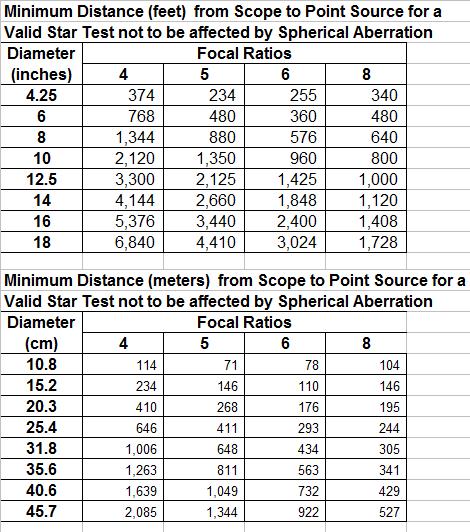
I’ve been reading a few websites written by folks who have done just that, and it seems to be a bit easier than I thought. The key is to get a source of light that acts like a star at astronomical distances — but close enough that we can fit it inside the basement of the CCCC, probably not in the woodshop where we make the scopes, but more likely out in the hallway or in the large activity room next door, both of which are about 40 or 50 feet long.

So here are my preliminary calculations.

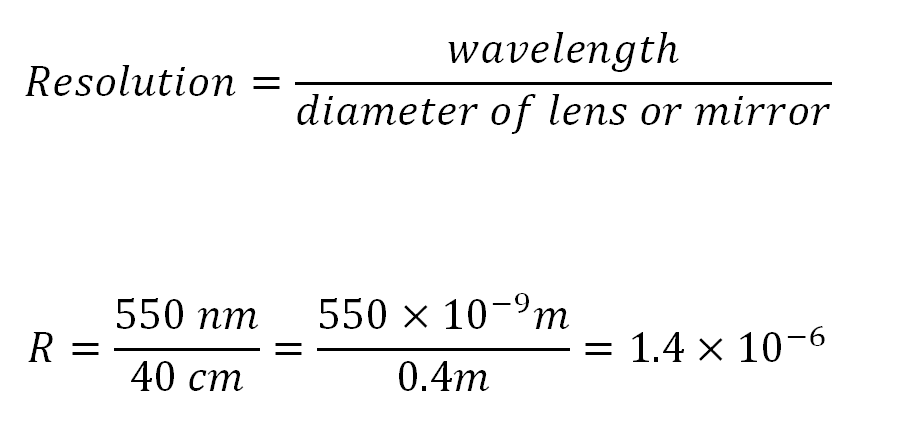
First off, it appears that the resolving power of a telescope equals the wavelength being used, divided by the diameter of the objective lens or mirror, both expressed in the same units. The result is in radians, which you can then turn into degrees, arc-minutes, arc-seconds, or whatever you like, but it’s perhaps easier to leave in radians. In any case, the larger the diameter, the tinier the angle that your telescope can resolve if it’s working properly.

I am going to use a 16-inch mirror diameter, or about 0.4 meters, as an example, and I will use green light at about 560 nanometers (560 x 10^-9 m) because that’s pretty close to the green mercury line we have in our monochromatic light box. I then get that the resolution is 1.4×10^-6 radians.
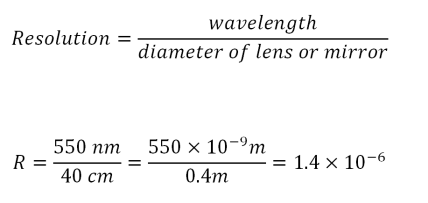
resolution of lens or mirror

(We can convert that into arc-seconds by multiply that by 180 degrees per PI radians  and by 60 arc-minutes per degree  and by 60 arc-seconds per arc-minute; we then get about 0.289 arc-seconds. If we were to use an 8-inch mirror, the resolution would be half as good, meaning the object would need to be twice as big to be resolved, or about 0.578 arc-seconds.)

resolution in arc seconds

I read that one can make an artificial star by using an ordinary eyepiece and a small illuminated hole that is put some distance away from the eyepiece. The entire setup is aimed at the telescope, and then you have an artificial star. Here is the general idea:

artificial star setup

Supposedly, the equations go as follows, with all of the dimensions in the same units. I think I will use millimeters.
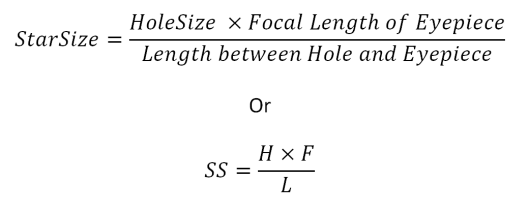
Star Size of artificial rigWe want to make it so that the size of the artificial star will be small enough to be below the limit of resolution of any telescope we are making. I am pretty sure that we can set things up so that there is 40 feet (13 meters) between our telescope rig and the table or tripod on which we sill set up this artificial star.

I also know that I can find an eyepiece with a focal length of 12 mm that I’m willing to use for this purpose, and I also purchased some tiny little holes from “Hubble Optics” that are of the following sizes: 50, 100, 150, 200, and 250 microns, or millionths of a meter. Those holes are TINY!!! So that takes care of H and F. I still need to figure out what SS should be.

A few lines ago, I found that for a 16-inch telescope, I need a resolution of about 1.4×10^-6 radians. The nice thing about radians is that if you want to find the length of the arc at a certain radius, you don’t need to do any conversions at all: the length of the arc is simply the angle (expressed in radians) times the length of the radius, as shown here:

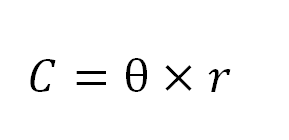
angle arc radius

c=theta times Radius

So if our artificial star is going to be 13 meters away, and we know that the largest angle allowed is roughly 1.4×10^-6 radians, I just multiply and I get 1.82×10^-5 meters, or 1.82 x 10^-2 millimeters, or 18.2 microns.

Which means that I already have holes that are NOT small enough: the 150-micron holes are about 10 times too big at a distance of 13 meters, so my premature rejoicing of a few minutes ago, was, in fact, wrong.  So, when I make the artificial star gizmo, I’ll need to figure out how to make the ‘star size’ to be roughly one-tenth the size of the holes in the Hubble Optics micro-hole flashlight.

Or, if I rearrange the equation with the L, H, F and SS, I get that L = H * F / SS. The only unknown is L, the distance between the hole and the eyepiece/lens. For H, I have several choices (50, 100, 150, 200 and 250 microns), SS is now known to be 18 microns or so (36 if I want to test an 8-incher), and I plan on using a 12.5 mm eyepiece. If I plug in the 150 micron hole, then I get that L needs to be about 104 millimeters, or only about 4 inches. Note that the longer L is, the smaller the artificial star becomes. Also, if I replace the 12.5 mm eyepiece with a shorter one, then the artificial star will become smaller; similarly, the smaller the Hubble Optics hole, the smaller the artificial star. This all sounds quite doable indeed.
One Way to Build an Alt-Az Newtonian Telescope

16 Tuesday Dec 2014

Posted by gfbrandenburg in Telescope Making

≈ 2 Comments

Tags

alt-az, dobsonian

One Way to Build a 6-inch Dobsonian-Newtonian Alt-Az Sonotube Telescope


Instructions written by Guy Brandenburg

February 2007

Acknowledgements and thanks to Mel Bartels, Richard Berry, Bill Blackmore, Jack Booth, John Dobson, David Kriege, Jerry Schnall, Jean Texereau, and many others whom I can’t remember at the moment. I have modified their ideas somewhat, hopefully for the better. However, the typos and errors are all mine.
  1. Cradle and altitude trunnions
    1. The purpose of the cradle is to hold the tube steady but also allow for changing the altitude angle and changing the balance point when additional items are added to the telescope, and to allow the user to put the focuser at a convenient angle by rotating the tube.
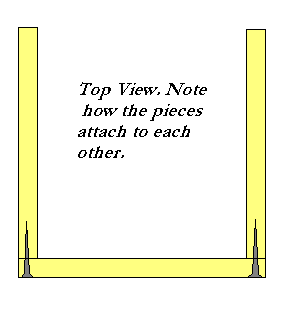
    2. The cradle consists of four rectangular pieces of plywood that are glued and screwed to form a box that the tube fits in, and two altitude trunnions that each consist of a plywood disk and a ring cut from a PVC sewer pipe. The pipe fits onto the plywood disk and is held there by friction. See diagram below.                           make a dob pic 1
    3. Use 2-inch deck screws, and glue, to attach the 9+3/4” by 12” pieces of plywood to the 8+1/4” by 12” pieces of plywood. Three or four screws per edge should be enough. Use plenty of glue, and use a damp paper towel to wipe up the glue that oozes out. It is not necessary to counter-sink the screws. Make sure everything is lined up properly before inserting the first screw. If you want, you can nail in a couple of small nails (say, 2” long) to hold things in place before you put in any screws.
    4. Before attaching the plywood disks that hold the PVC plastic trunnions, it is advisable to draw the diagonals as shown. This will help you make sure that the disk is centered correctly.
    5. When the glue is somewhat dry, this all can be painted, inside and out.
    6. When the paint is dry, then you can attach the handle and fit the PVC trunnions onto the plywood disks. It is supposed to go on with difficulty, so that it won’t come off easily. It should not need to be nailed, glued, or screwed.
  2. Optical Tube
    1. The tube
      1. The tube itself is made of thick cardboard designed for casting cylindrical concrete columns. One brand name for these is Sonotube. When painted, it is strong, relatively rigid and light, and reasonably waterproof, and it’s quite inexpensive: $5 for a 4-foot length of tube. (Carbon fiber composite tubes, which are lighter, stronger, more rigid and much more waterproof, would cost nearly 100 times as much.) The purpose of the tube is to hold the optical components rigidly, in the proper alignment so that the user can look at things.
      2. A 1+1/2” diameter hole will need to be drilled near the front end of the tube for the focuser. Use an ordinary hole saw attached to an electric drill for this. If you are using a 3- or 4-vane spider, measure and drill the holes for this now.            make a dob pic 2
  • It is very important to paint the inside of the tube using flat black paint. I strongly recommend using latex paint so that any drips can be washed off with water, likewise the brush, and so that the fumes are not so bad. Two or more coats are desirable. However, the tube is quite long, and you don’t want to get paint all over your arm. How to reach the middle? One way is to tape your brush to the end of a dowel rod (or other scrap piece of wood) with duct tape, and use that to extend your reach. When you have finished painting the inside, leave the tube to dry in a horizontal position so that air can circulate; or else, if you want to let it dry in a vertical position, make sure that you put it on some little scrap pieces of wood so that air can circulate up and down the tube. Be sure to wash the brush as soon as you are finished painting. Use lots of water and even some hand soap and rinse it very thoroughly.
  1. The outside of the tube also needs to be painted. Any color will do – the wilder the better, in my opinion. See the previous remarks about latex paint. It is a good idea to let the tube dry in a vertical position, propped up on little scraps of wood. Be sure to paint the edges where holes have been cut and the ends of the tube; when the loose cardboard is impregnated with paint, it becomes much harder.
  1. Primary Mirror Holder
    1. The purpose of this item is to hold the mirror rigidly in the correct alignment, at the proper distance from the secondary mirror and the focuser, so that whoever is looking through the telescope can actually see correctly-focused and clear images of whatever it is they are trying to observe. It is not necessary to paint this part, but it won’t hurt, either. However, the parts where the silicone caulk will hold the mirror to the wood must NOT be painted, because the caulk does not stick well at all to painted surfaces.
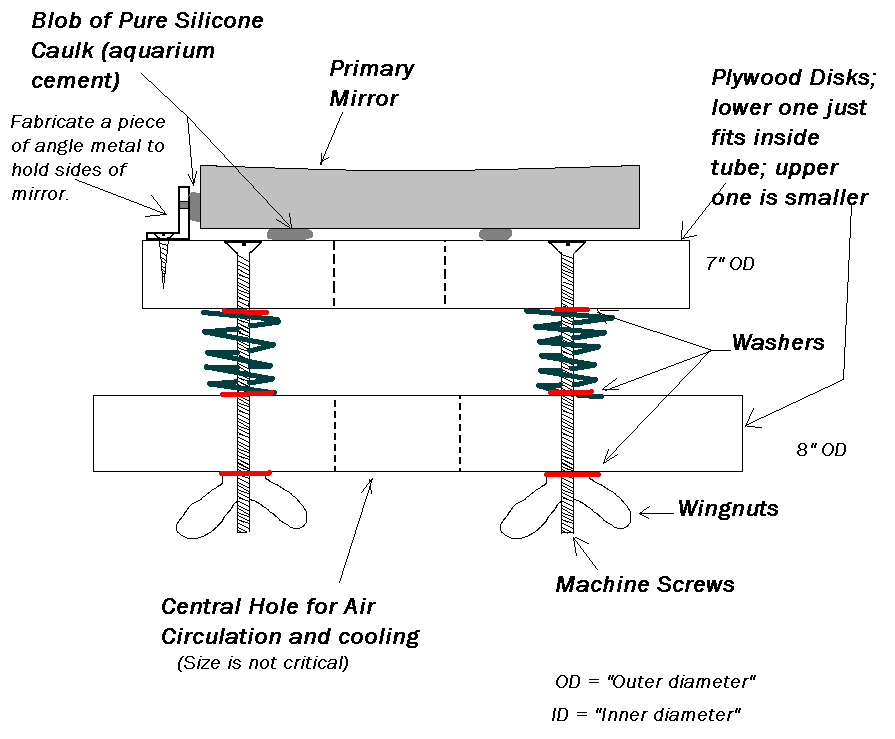
    2. The mount consists of two plywood disks separated by springs and held together by machine screws, washers, and wingnuts. The upper plywood disk has an outer diameter about one-half inch less than the inner diameter of the tube; so that’s about 7+1/2”. The lower plywood disk has an outer diameter that is about the same as the inner diameter of the tube, so that’s just shy of 8”. Each disk should have a good-size hole drilled in the center for ventilation. The size of the hole is not critical – any size that you have a hole saw for will work fine.
  • The two disks also need to have 3 holes drilled in them at 120 degrees from each other so that the machine screws can go through. The hole in the upper disk should be countersunk so that the machine screw head will not protrude. The hole in the lower disk should be considerably larger than the screw itself, so that the entire assembly can be adjusted easily. Be sure to line the two disks up together before drilling the holes, and mark how they are supposed to go.
  1. A small piece of steel (or any other convenient metal) should be fabricated into an L shape, with a hole in both parts. The hole in the horizontal part will hold a single, small screw to attach the L to the upper plywood disk, and the hole in the vertical part will be used to squirt the silicone glue through, to hold the mirror in place.
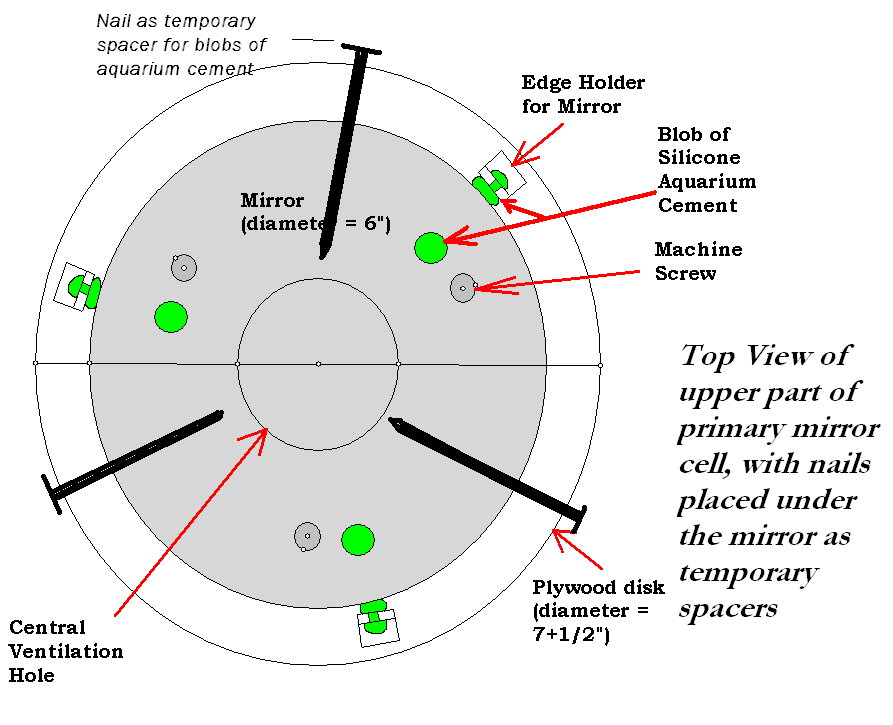
  2. When the entire setup is assembled, except for the glueing of the mirror, then lay three ordinary nails underneath where the mirror will go, as temporary spacers. Squirt nice thick blobs of glue in the three locations previously chosen, then carefully place the mirror in the correct location. Then squirt three more globs of glue, one at each of the three L-shaped edge holders. Then put the entire assembly away somewhere level, safe, and dry, with ventilation and protection from dust, so that it will not be disturbed for a couple of days while the glue sets.
  3. See the diagrams for construction details, and below that for an example by a local ATMer, JCN.                                                                    make a dob pic 3Make a dob pic 4
  • The primary mirror cell is about the last thing to be placed in the telescope. It goes in AFTER the focuser and secondary are put in place, and after everything is assembled, painted, and dried. In my experience, it is not possible to calculate exactly where the mirror should go in the telescope; none of the formulas I’ve seen work exactly. The best one can do is to estimate it, but then the exact location will depend on your eyepieces, the height of your focuser, and your eyes. So, once the rest of the scope is together, you carefully slide the primary mirror cell – with its mirror in place – up into the tube to where you think it should go, and do a very rough alignment of the mirror by looking down the tube. Use shims to get it to stay in place temporarily, and try to focus on as distant an object as possible by daylight. To get it to come into focus will probably require pushing or pulling the entire cell forward or back. Then try the entire process at night, when you can see the moon or a very bright star such as Vega or Sirius. It will not focus the same way, I guarantee! When you have the mirror in such a location that stellar objects come into focus, THEN you can use deck or drywall screws to screw it permanently into place in the tube.

make a dob pic 5cell holder variant by JCN

  1. Focuser
    1. The purpose of the focuser is to hold an eyepiece at the very end of the voyage of all of those photons from outer space so that your eye can detect an image.
    2. Unless you are doing astrophotography, a simple rack-and-pinion focuser with a knob will do just fine. The standard size focuser and eyepiece for decent, smaller telescopes (under 12” diameter) is 1/25”. Plastic-and-metal ones work fine unless seriously abused. There are ones designed for refractors, and ones designed for reflectors. Get the latter type, unless you are building a refractor!
  • Use small nuts and bolts to attach them to the telescope tube.
  1. Unfortunately, some focusers will require a shim to be fabricated underneath so that there will not be a light gap between the focuser and the telescope tube. This all depends on the focuser and the tube you are getting.
  2. As mentioned earlier, you will need to cut a hole in your tube large enough to fit your focuser.
  1. End Ring
    1. The purpose of this is to strengthen the end of the telescope tube that points towards the sky.
    2. Use a decent-quality plywood and a router to cut a ring with a thickness of roughly an inch that will fit tightly onto the end of the tube. Our tubes are 8+1/4” OD, so that should be the ID of the ring. After routing it, sand it to remove burrs and splinters, fit it onto the tube, apply some glue and small nails, and let it dry.
  • Only make an upper end ring; not a bottom end ring, or else you won’t be able to view objects near the zenith.
  1. Mid Ring
    1. The purpose of this is to allow the telescope to stay in place at the chosen balance position, and to allow the user to rotate the tube and to adjust the balance if needed.
    2. The instructions for cutting this are very much like the end ring. The difference is that there should be a small amount of ‘play’ or room for the ring to move over the tube, so that with some force and perhaps a mallet it can be moved when desired. Thus its interior diameter should perhaps be 8+5/16” when cut. Paint will reduce that slightly.
  • The mid ring is NOT glued or nailed to the tube. It should be able to slide, with difficulty.


  1. Secondary Diagonal Mirror, holder, and spider
    1. The purpose of the secondary diagonal mirror is to re-direct the light from the object of interest out the side of the telescope, so that you can see the object without your head getting in the way.
    2. You can build this or make all of these parts. Unless you are very good with your hands and with making small metal parts, I suggest you buy them. The mirror itself is a true optical flat, and is easier to make on a machine than by hand.
  • Before putting this in place, it is necessary to find the exact center of the secondary mirror, and to measure the distance from this to the level of the screws that hold the spider in place against the wall of the tube. Measure and re-measure, then drill the appropriate holes, and fasten it all in place. (Remove the mirror itself while installing the spider vanes, so that dust and fingerprints don’t get on the surface of the mirror.)
  1. Finder Scope
    1. The purpose of the finder scope is to allow the user of the telescope to aim it at an object of interest. It gives the user a wider field of view than the telescope itself, which can have a field of view as small as hundredths of a degree.
    2. I strongly suggest a Telrad or other similar 1-power non-magnifying heads-up finder. These devices allow you to aim your telescope intuitively at familiar objects and then to star-hop to other objects. Then, as your budget permits, you can upgrade to other finders – and there is a wide variety to choose from!


  1. Rocker Box
    1. The purpose of the rocker box is to hold the telescope rigidly upright and to provide a place for the altitude trunnions to fit into, so that the telescope can be aimed up and down, and left and right, just like a cannon.
    2. The rocker box is made out of 4 pieces of ¾-inch plywood. It has a front, two sides, and a bottom, but no back and no top. The front is shorter than the sides, so that the telescope can be aimed at the horizon if desired. The pieces will be glued and screwed together. The two sides will have nearly semi-circular holes cut out of the tops to hold the trunnions bearings.
    3. Need to cut out the following:
  1. Bottom: one piece 11+1/4” by 10+1/2” plywood. A one-half inch diameter hole should be drilled at its exact center.
  2. Sides: Two pieces that are 11+1/4” by 33” plywood (can be a little longer if desired). Make it so that they are left-right symmetrical, so that the good side of the plywood will be facing out. Cut an arc at the top of each side to fit the trunnions.
  • Front: One piece 11+1/4” by 25” (this height can be changed, but should be about 8 inches less than the sides)
    1. Five or six deck screws, 2” long, on each vertical edge, should be enough. Be sure to use glue as well. The bottom edges could use about 3 screws per edge. Clamp the edges for about 30 minutes after glueing, and remove excess glue with a damp rag. Except for the underneath portion, this can be painted. After drying, this will be attached to the base plate.
    2. Two pieces of Teflon will make sliding contact with the PVC trunnions. They will be glued or nailed into place at the tops of the cut-out arcs at the tops of the side pieces.

make a dob pic 6

make a dob pic 7

  1. Base Plate, or Azimuth Disk
    1. The purpose of the base plate is to allow the rocker box to swivel left and right, so that the user can aim the telescope at anything he or she wants to look at, in any part of the sky.
    2. This base plate is the invention of John Dobson, a master scrounger, all-round eccentric amateur astronomer, and former monk who lives in California. It consists of a downward-facing surface of Formica, Wilsonart, or some similar type of counter-top laminate, resting on three Teflon pads attached to an upward-facing surface. Unlike telescopes made from metal parts, this mounting rotates very smoothly and does not have any backlash at all. That is, if you move the telescope to a given position and let it go, it will stay where you leave it.
    3. To cut out:
  1. two 15-inch diameter circular disks from the same ¾” plywood. The precise size is not critical. Using the jig that we have in our shop, you need to drill a ½-inch hole at the exact center of the disks first, and then cut them out, only cutting through half of the plywood at a time, flipping them over for the second cut.
  2. One piece of countertop laminate – any type will do – a square 16” by 16” is fine.
    1. Choose which will be the upper disk, and which part of that disk will be facing up. Use paintbrush to coat the other side of the wooden disk with a smooth layer of latex-based contact cement. Also paint the back side of the countertop laminate. Let the two surfaces dry until no longer gooey to the touch. Then place the laminate on top of the wood and press hard all over (there are special rollers for this, or you can use heavy glass bottles or heavy metal cylinders) so that they make good contact.
    2. Use a trimming router to trim off the excess laminate.
    3. Then use relatively short screws to attach the top disk to the bottom of the rocker box. Make sure the hole in the bottom of the rocker box lines up with the hole in the center of the top disk. Feel free to finish drilling the center hole through the laminate.
    4. The bottom disk will receive three pieces of Teflon pad around the edges at 120-degree intervals.
  1. Legs
    1. The purpose of the legs is to give the entire telescope a bit more stability and to raise the base of the telescope up off the ground by a few inches.
    2. I suggest using a 2×3 or 2×4 and cutting three pieces about 9 to 10 inches long, then cutting them into an L-shape or a shape a bit like a hockey stick, as shown here:    make a dob pic 8
    3. File or sand the legs so that folks won’t get splinters. Make sure there is clearance for the central pivot bolt, the aluminum plate, the nuts, and the lockwasher. Position the 3 legs 120 degrees apart, then screw and glue them into place. Some of the screws will need to be rather long.
    4. Attach the Teflon pads right over the legs themselves, as close to the edge of the disks.
  1. Now paint everything and let it all dry.
  2. Align your optics.
  3. Then go observe!

(<== Link back to the beginning of this series of articles)

Build Your Telescope Tube and Mount

16 Tuesday Dec 2014

Posted by gfbrandenburg in History, Telescope Making

≈ Leave a comment

Tags

alt-az, company 7, equatorial, hands-on-optics, plywood, teflon

7. Build the scope

A. There are many, many books and articles and websites devoted to the many, many ways of building your telescope tube and mount. We have quite a few of these books in our library, and you should definitely study them! In addition, public star parties put on by NOVAC, NCA and other local clubs often have home-made telescopes on the field, and you can ask the makers of those scopes how they did it. Fortunately for us, John Dobson came up with an excellent way of making inexpensive, easy-to-build and easy-to-use telescopes of the Newtonian model, even if he was a nut-case. Willmann-Bell publishes quite a few such books.

B. I strongly recommend an alt-az telescope mount for visual use, rather than an equatorial mount on a pier made of plumbing parts, as people used to make in the 1940s through the 1990s. (As noted earlier, if you want to do astrophotography, you will need a much more complicated and much more expensive mount that tracks the stars precisely. Building such a mount yourself is exceedingly difficult and requires precision machining and electronics!) Most important: plan to make a telescope that is easy to use and not too complicated to build! Using slight modifications of existing plans is much easier than trying something completely novel in design. If you strive for originality, you can be sure that you will need to modify and re-build parts of your invention, perhaps several times, because of problems that you didn’t consider or notice originally. (Think about what a nightmare it would be to drive a Model-T Ford automobile, the first real mass-production car, with all of its nutty and dangerous defects, compared to the comfortable and safe and reliable car that people drive today!)

C. I have a set of plans for a simple 6” Dob on this very blog. (Click for link)

D. At the CCCC, we also have a fairly decent set of hand and power tools for working with wood and metal, so you can make the rest of the telescope here if you like. Be careful, and follow safety directions!

E. We even have a wonderful assortment of ‘oops’ paints from hardware and paint stores, if you don’t mind the ghastly colors.

F. You will need at least half of a sheet of 4’ by 8’ plywood for the scope. The plywood can be any type you like, but don’t get a sheet that is warped or wet or too thin. Nice plywood like Appleply or Baltic Birch can be expensive, but it is strong and looks quite beautiful when varnished. Three-quarter inch thickness is standard, but it’s generally sold as a weird number like 23/32”.

G. You will also need the following commercially available items, some of which we usually have on hand, marked by “UOH”.

  1. Diagonal secondary flat elliptical mirror (we have a few)
  2. Secondary mirror holder
  3. Spider
  4. Focuser
  5. Eyepieces
  6. Finder scope(s) (I recommend a 1-power finder like a Telrad or a Red Dot finder, as well as another finder scope that magnifies about 5 to 10 times)
  7. Possibly a Barlow
  8. A few pieces of Teflon UOH
  9. A few square feet of Formica or the equivalent UOH
  10. Miscellaneous screws, nuts, bolts, screws, glue UOH
  11. Guidance UOH
  12. Paint UOH
  13. Random wood scraps, including a short 2-by-4 UOH
  14. For the mirror holder, you need: Three compression springs; 3 flat-headed machine screws; 9 washers; 3 wingnuts; and a small fresh tube of pure-silicone caulk or aquarium cement

H. We are very fortunate to have a local specialty store that sells telescopes and accessories to the public, called Company 7 . It’s located near Laurel, MD and has an amazing display of rare telescopes. Please shop there! (In other words, don’t talk their ears off getting their advice, and then order an item online because it’s a few dollars cheaper!)

(Link forward to the next section ==>)

(<==Link back to the previous section)

Aluminization

16 Tuesday Dec 2014

Posted by gfbrandenburg in Telescope Making

≈ Leave a comment

Tags

Aluminization

6. Aluminization

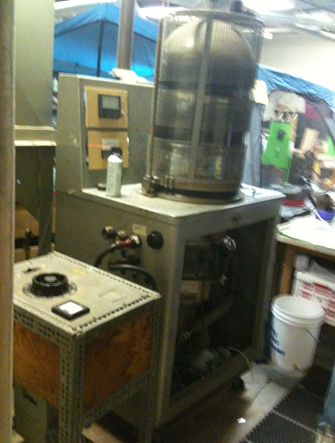
A. Once the mirror is done, you need to put a reflective coating on it. We have a device that does that: a military- and university-surplus vacuum chamber and aluminizer that we have been keeping alive for about 30 years or so, shown below. Briefly, this is what we do: essential atm steps aluminizer

B. We clean the mirror very, very thoroughly.

C. We put it into the vacuum bell jar in a special jig that holds it at the top, facing downwards;

D. Pump out almost all of the air with a mechanical pump. This gets the pressure from 760 mm of mercury (normal pressure, 760 Torr) down to about 0.1 mm of mercury (0.1 Torr).

E. While pumping, we zap the mirror surface with a high-voltage A/C plasma which further cleans and prepares the glass to accept the aluminum coating. This looks like the Aurora Borealis.

F. We then turn on the diffusion pump, which works by somehow capturing individual molecule of air in a condensing mist of expensive silicone oil that was boiled at very low pressure. It sounds like magic, but it works to get the pressure down from 0.1 mm of mercury all the way to 0.00008 mm of mercury, which is what we need for the last step.

G. Then we slowly heat up a special tungsten filament coil that has a slug of pure aluminum wire inside the coil. The coil melts the aluminum, which coats the tungsten coil and then boils off into the vacuum, in all directions. A small part of that aluminum vapor hits the mirror, and sticks to it in a very thin layer.

H. We then close down the diffusion pump, close and open various valves, and wait for the air inside the chamber to equalize with the air outside, so we can open up the chamber and remove your mirror.

I. You should be very gentle with the coating, especially at first. Resist the urge to wipe it clean if dust gets on it. It will be about 85-90% reflective, and will stay that way for years. If there were any nearly-invisible scratches left on your mirror after polishing and figuring, they will be highlighted by the shiny aluminum layer. They won’t have any optical effect, but they will make you feel bad. Keep the mirror protected from fingers, sneezes, dandruff, snot, and dust. Don’t let anything touch the surface, even soft cloths!

(Link forward to next section ==>)

(<== Link back to the previous section)

Figuring (parabolizing) Your Mirror

16 Tuesday Dec 2014

Posted by gfbrandenburg in History, Telescope Making

≈ Leave a comment

Tags

couder, foucault, parabolization, testing

5. Figuring and Testing

 A. Polishing pads do a great job of polishing out the pits, but they tend to leave a rough surface that is not a true paraboloid or even a section of a sphere, unless you are very, very lucky. Most folks will switch to a pitch lap for the figuring process, which involves removing sub-microscopic amounts of glass from various zones on your mirror, in order first to make it into a section of a sphere, and then into the bottom of a paraboloid – the only geometric figure that will reflect all of the rays that come from distant stars onto a single focal point. Many treatises have been written about figuring, and I’m not going to add to that list. “Understanding Foucault” by David Harbour gives an excellent explanation of the figuring process, as does Mel Bartels here. However, here are some of the basics:

B. You will need a pitch lap, made either of Gugolz or Acculap or Tempered Burgundy pitch. The first two are synthetic products whose composition is probably secret; the third one is made from the sap of coniferous trees. I’m not going to describe the process of making a pitch lap here, but I combine some of the methods of Carl Zambuto and John Dobson when I make a new one; you can watch it as we do it for you. It’s much less work if you can use a pitch lap that was made by or for someone else who has finished their own project. Sometimes a previously-used pitch lap will have sat around too long and might need to be scraped off and remelted. We generally use roughly square facets, which allow the pitch to flow better and conform itself to your mirror. Without the facets, any high points on the lap have a hard time being lowered. We also tend to use netting or a single-edge razor blade to make minifacets, which further help the lap to conform to the mirror.

C. Pitch is weird stuff. When it’s warm, it flows and it’s very sticky. When it’s cold, it is fairly hard, and you can shatter it with a hammer. If you leave a pencil or a coin on a pitch lap overnight, the next day you can see all of the details of the pencil or coin reproduced perfectly in the pitch. We want the lap to conform itself to your mirror. Then we use the pitch lap to remove all of the irregularities that were left by the polishing pads. So, we warm up the pitch lap to soften it a bit (using a heat lamp or hot water), spread Cerox or rouge onto your mirror, and then press the two together briefly but firmly. We often use some netting to create micro-facets, which help the pitch conform to your mirror even more.

D. The figuring stage can severely try your patience, especially if the tests show a surface that looks weird. But relax! If you persevere and don’t drop the mirror on the ground, success is guaranteed, since it’s just a matter of removing the correct millionth of an inch or two (much less than a micrometer) of glass from the correct zonal ring to achieve near-perfection. One needs to make sure that the lap actually conforms to the mirror; bad contact between the two can cause trouble, and so can a pitch lap that is too hard, too soft, or too thin. All of those are fairly easily fixed, with remarkable results. And we are here to help.

E. One major problem that can affect mirrors is a Turned-Down Edge (TDE). Opinions vary on what causes this dreaded condition, but the evidence suggests to me that TDE appears when the lap is exactly the same size, or slightly smaller, than the mirror itself. To avoid a TDE, do not chip off the parts of the pitch lap that ‘mushroom’ out past the edge. Let them stay there.

F. You will be instructed in a specific set of strokes which will first make your mirror into a sphere. Then, you will be instructed in a different set of strokes that will make your mirror into a good approximation of a perfect paraboloid. Texereau, LeCleire, and many other books describe those strokes. So did Leon Foucault in his 1859 article, which you can find on this blog/website. In our workshop, we will test your mirror frequently with a combination of tests, many of them invented by Foucault but later modified.

G. A very fast qualitative test is the Ronchi test, which you can look up. It gives you almost instant feedback on the presence or absence of bad features like turned-down edge (TDE), zonal defects (high or low rings), astigmatism (lack of symmetry), roughness, and so on. It will tell you whether your mirror is a sphere or not – if the Ronchi lines are perfectly straight, then you have a sphere. If they are not straight, then the test can tell us if your mirror is on the way towards being an ellipsoid with the long axis perpendicular to the mirror (or parallel to it), or a hyperboloid, or your goal, a paraboloid. There are several computer programs that provide simulations of what a perfect mirror should look like under the Ronchi test, but I’ve found you can’t always trust those simulations. RonWin is one such program, and Mel Bartels has another on one of his web pages.

H. A more time-consuming test that I find is necessary is the Foucault test as modified by Andre Couder, also known as the numerical knife-edge test with zones. If the Ronchigram looks good, and the numbers in the knife-edge zonal test are also within acceptable limits, then the mirror is done. A slight modification of this test is known as the Wire Test, which works well on fast mirrors. David Harbour’s article does an excellent job of explaining this test. One can use a pinstick method for marking the zones, or one could write directly on the mirror with a Sharpie, but we use a version that uses cardboard masks with holes cut out at carefully-measured zones.

I. We have tried a number of other tests, such as the double-pass autocollimation test, the Mobsby Null test, and the Bath Interferometer test, and have had difficulties getting good results with them. Therefore, we are continuing to use the Ronchi and Knife-Edge Zonal tests.

J. However, the best test of any mirror is the Star Test, which is the subject of an entire book by Richard Suiter. Some do this in the daylight, using sunlight reflected from very distant insulators on electrical poles. Most do it at night, but it requires steady air (‘good seeing’) and a clear sky as well. The Star Test is much easier to perform if the mirror is already aluminized and in a working telescope, which brings us to….

(Link forward to next section==>)

(<==Link back to previous section)

Polishing Your Mirror

15 Monday Dec 2014

Posted by gfbrandenburg in Telescope Making

≈ Leave a comment

Tags

barnesite, cerium oxide, Hastillite, pitch, Polishing, polishing pads, rouge

4. Polishing

 A. By the time you are at 9 to 3 microns, you will notice that your mirror is translucent but not transparent. If you wet your mirror, then you can read text through it, but the surface is still not as smooth as, uh, glass. In order to get your mirror optically smooth, you will need to change from fine grinding to polishing with a soft lap which holds the abrasive in place, instead of allowing the abrasive to roll between the two pieces of glass. Leon Foucault describes using paper laps for this purpose; others have used honeycomb foundation, shower curtains, and even road or roofing tar. There are numerous types of optical pitch made by various companies out of of tree sap, petroleum, or some secret proprietary ingredients.

 B. An innovation developed at the Delmarva ATM group is to save time by using ophthalmological polishing pads (links here, or here, or here) for the initial polishing. It cuts the number of hours of polishing roughly in half, which is great, because polishing with a conventional pitch lap can take about one hour per linear inch of diameter, or more. (So, roughly six hours for a six-inch mirror.) The amount of time required to fully polish a mirror is greatly dependent on the amount of force applied by you, the mirror-maker.

C. To use the polishing pads, you clean the tool very thoroughly with isopropyl alcohol or denatured ethanol or acetone to remove all traces of fingerprint oil. Wash your hands thoroughly. Consider using latex gloves and tweezers. Get scissors and a clean, sharp single-edge razor blade. Carefully peel a pad from its roll, trying to touch as little of the adhesive side as possible. Press it down onto your tool slightly off-center. Then continue applying pads with one big caveat: NO PADS MAY OVERLAP OR TOUCH. It is OK to trim the pads before applying them, or afterwards, and it’s OK to be artistic about it. Do NOT strive for symmetry here – it will cause problems with your mirror, believe it or not. Don’t make pieces that are very small; the size of your smallest fingernail is about the smallest piece you would want. Once they are all in place, use a clean artist’s J-roller to press them all down, firmly.

D. You will now need a polishing stand with cleats to hold the mirror in place, because you are going to be pushing quite hard on your mirror or lap. Without the cleats, your project will end up on the floor, broken. In the DC ATM class, we use lazy-Susan turntables that rotate around a fixed pivot point to make it easier for you to rotate mirror and the lap in a regular manner. You should also cut some shelf-liner material to fit underneath your mirror and tool, to prevent irregularities in the wood substrate from deforming your mirror.

E. You will use a slurry of Cerium Oxide (formula CeO2 also known as cerox)* mixed in distilled or purified water. Don’t use tap water because it might contain particles that come from the pipes and thus might scratch your mirror. It is totally non-toxic. Mix it up fairly thick, something like heavy cream. Do not apply very much liquid to the pads; if you do, the petals of your polishing pads will come off of the glass. Do polish hard, and polish long. Rotate everything as usual, and alternate tool on top with mirror on top. Do NOT let the cerox or even individual droplets of water air-dry on your mirror: they will etch the surface somewhat, and then you will have to polish some more!

F. When are you done? Simple: you are done when it’s fully polished out. How can you tell if you are polished out? Here are two simple tests:

G. Use the highest magnification and best illumination you can on your microscope, and carefully inspect the mirror surface for any remaining pits or scratches. If you see anything at all, it’s not done. (If you see something that looks like a white caterpillar, relax: it’s probably a bit of lint from a paper towel! Wipe it off and look again!)

H. The laser test uses a red or green laser shining into and onto the surface of the mirror from about a 45-degree angle. Ideally, the light should pass through the surface leaving behind almost no trace of its passage. If you see a bright spot where the laser hits the surface of the mirror, then you need to keep polishing. Or else the mirror is dirty.

* Note: there are several other commonly-used polishing compounds, such as zirconium oxide, red rouge, black rouge, and even Barnesite. Compounds that are labeled ‘cerium oxide’ often have a fairly substantial proportion of other ‘rare earth’ oxides in, since they are so difficult to separate chemically and probably act in the same way. Thus one cerium oxide preparation might look white as talcum powder, while others will appear pink or brown. Red rouge gives a very fine polish, but it’s slow-acting and extremely messy, staining your hands and clothes — the latter, often permanently. Black rouge is even finer and messier. Zirconium oxide acts faster than red rouge but slower than cerium oxide. I haven’t used Barnesite much, but it’s hard to get, messy, and almost as slow as red rouge. Professionals working on the finest telescopes in the world have abandoned red rouge because of its mess. These professionals can also afford extremely fine proprietary mostly-CeO2 slurries that cost a LOT, such as Hastillite. We can’t afford that. So we tend to use cerium oxide at first and switch to rouge when doing the final figuring.

(Link forward to next section ==>)

(<== Link back to previous section)

Fine and Intermediate Grinding of Your Mirror

15 Monday Dec 2014

Posted by gfbrandenburg in Telescope Making

≈ Leave a comment

Tags

Grinding, Grit, Mirror

3. Grinding (intermediate and fine): Once you have reached your goal for the sagitta, and inspected it, then it’s time to move on to the next smaller grit size and to a more conventional grinding technique. First of all, throw away all of the used newspaper, rinse out the water bucket, wipe off and put away the grit container, and clean off the workbench. Wash or rinse your hands, and make sure that your clothing does not contain the previous grit size. Then get new clean newsprint, clean water, and the next smaller grit size. Again, dampen the newsprint to keep the mirror and tool from sliding around.

 A. You will NOT be using the circular stroke once you are past the hogging-out stage. You will instead be doing a center-over-center stroke, where the mirror or tool that is on top is pushed back and forth in a straight line away and towards your body, such that the top piece of glass will project forwards, and then backwards, by about 1/6 of the diameter of your mirror. You will do this for maybe 8 to 10 times, then rotate both to avoid astigmatism. With 6”, 8”, and 10” mirrors, a decent rule of thumb is to budget an hour of grinding per grit size, or more. Otherwise, the grinding sequence is the same, including the regular rotation process.

 B. Here is one possible sequence of grits for an 8” or 10” mirror, but there are other possibilities. We have lots of different sizes of grits, made by various manufacturers over the past 50 years, and so we use a lot of steps. Other people don’t have as many sizes, and they will use fewer steps, but take longer at each grit size. The 60-400 grit sizes are generally made of silicon carbide (trade name Carborundum, formula SiC, which is also made into jewelry under the chemical name Moissanite or names like “Diamond Aura). Past that, most grits are aluminum oxide. Notice the different methods of measuring the grit – up through 400 grit, the number theoretically means the number of grains that it would take to make one linear inch. The micron sizes are in millionths of a meter, or thousandths of a millimeter. I have collected a number of tables that supposedly show how these sizes are related. Unfortunately, the tables do not agree with each other. We generally prepare slurries with the micron-measured grits; this means that you need to shake up the slurry before applying it to the work, but it also means you have fewer chances to contaminate your work.

 60 grit  (hogging out)

80 grit

120 grit

220 grit

320 grit

400 grit

30 micron

25 micron

17 micron

9 micron

5 micron

3 micron

 C. When you get into the micron sizes, you need to be on guard against the mirror sticking to the tool. If you feel them beginning to ‘catch’ and stick, then immediately separate them and add more slurry. If they do stick together, it’s merely a pain in the tush, not a disaster – we just use bar clamps and pieces of wood to carefully press the tool and mirror past the other. If this happens at home and you don’t have a long bar clamp, you can instead put them both into a clean bucket of warm water with a drop or two of detergent and wait for a while, then push; alternate with a bucket of cool water with some detergent and wait for a while, then push; repeat as necessary until they come apart. Don’t use boiling or near-freezing water because the thermal shock could possibly crack either the tool or the mirror.

 D. Be careful about contamination. It will only take a single grain of 120 grit to make a nasty bunch of scratches in a mirror that you are fine-grinding at 5 microns! Be paranoid! Dust particles can linger anywhere! Wash your hands frequently, don’t re-use paper towels that have dropped on the floor, clean off your work surface after you are done, and use plenty of clean newsprint to cover the workbenches. (However, a few scratches will NOT measurably damage the optical qualities of your telescope. It’s much more important that the overall figure be good.) Also watch out for grit or sawdust or metal chips sticking to your clothes and hair. To help prevent contamination, we have installed a large screened tent canopy. Only work under there for polishing and figuring.

 E. When to move to the next grit? Use your naked eye, and/or an inexpensive illuminated microscope to check for uniformity of wear all over the mirror before proceeding to the next step. With some of those microscopes is possible to use a cell phone to take photos of the texture of the glass. Make sure the texture is the same near the edge of your mirror as it is in the center. If it’s not, keep grinding for a while.

 F. You won’t be able to change the focal length very much once you are past 120 grit, so use your spherometer and a combination of work with tool on top (TOT) and mirror on top (MOT) to get the focal length where you want it to be before you move onto 220 grit. Remember: MOT will make the sagitta deeper, which means a shorter focal length, and TOT does the exact opposite.

(Link forward to the next section ==>)

(<== Link to go back to the previous section)


Rough Grinding of a Telescope Mirror

15 Monday Dec 2014

Posted by gfbrandenburg in History, Telescope Making

≈ Leave a comment

Tags

Hogging, Rough Grinding

(Part two of my description of the essential steps in making a telescope)

essential atm steps calculate sagitta

2. Hogging Out means making your mirror blank have roughly the proper concave shape for the focal length or f-ratio that you want. There are many articles and web pages on this, which you really should look at!

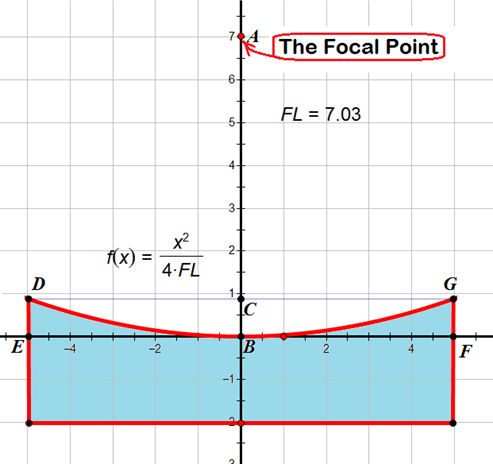
 A. The math is important: you want your mirror to be a parabola, and the equation for the depth (or sagitta) that you must grind into the glass isn’t too difficult. First of all, “f-ratio” means the ratio between the focal length and the diameter of the primary mirror. So if you plan on making an 8” diameter mirror with a 40-inch focal length, 40” divided by 8” gives you an f-ratio of 5. With no units. If you wanted a 10” diameter mirror with the exact same focal length, we would call that f/4. For the sagitta (depth of curve) required, it’s easiest to use the formula for a parabola facing upwards with its vertex at the origin, namely,  . and you will need to do a little math[1]. Here’s a diagram that I hope will help:  It is supposed to show a mirror (blue) with an insanely short focal length of 7.03 inches and a diameter of 10 inches. The sagitta is the depth at the center of the curve, or length CB, which will be the same as DE and GF. Using the formula   , and plugging in 5 for x and 7.03 for F, we get that y (the sagitta) would be about 0.889 inches, a bit more than 7/8” of an inch of glass to remove. And that’s what we see in the diagram, too, if you look carefully. For a more realistic example, let’s suppose we wanted to make a ten-inch mirror with a focal length of 60 inches (which means that the scope would be about 5 feet long, or roughly 1.5 meters). In that case, we would get a sagitta of about 0.104”, a bit more than a tenth of an inch. You will need some way of measuring the sagitta. We use some spherometers that we fabricated from bits of metal and various dial indicators. Some people use a collection of automobile mechanic’s feeler gauges and a straightedge that goes across the entire diameter. Note that a spherometer will typically NOT measure the entire diameter of your mirror, so you need to account for that smaller diameter. You should calculate and record what your numerical goal is for your chosen method of measurement. However: one nice thing about Newtonian reflectors is that the exact focal length isn’t very important – unlike the other telescope designs, where any deviation from the designed model will cause the project to fail catastrophically. A 6” f/8 scope will work just as well as a 6” f/8.15 scope or a 6” f/7.7 scope; the only difference will be that the first scope tube will be about 48 inches long, the second one closer to 49 inches and the last one closer to 46 inches long.

 B, To grind the mirror, we use relatively coarse grit (silicon carbide, which is not toxic at all) mixed with ordinary tap water. The water acts as a lubricant and also to keep down the glass dust – silica dust causes very serious lung problems if it’s dry. So we keep it wet. We begin with either 50, 60, or 80 grit, depending on the size of the mirror. We put the tool (another cylindrical piece of glass or ceramic, or else something we cast from dental plaster and hard ceramic tiles) on many thicknesses of clean newspaper, on top of the workbench. We dampen the newspaper so they won’t slide around. We sprinkle some water onto the tool, and spread it around with a finger. Then we sprinkle some grit onto the water and tool as if we were liberally salting a dish we were cooking or eating. Then using both hands, we carefully place the mirror face down on top of the tool. We use both hands to make the mirror travel in a circular path in either direction for about 6 turns, grinding the center of the mirror mostly against the edge of the tool. (This needs to be demonstrated!) Wide strokes are good, but the center of the mirror must not get too close to the edge of the tool. At first this motion will be very, very noisy, which is fine. However, after perhaps 20-30 seconds, the noise will decrease. This means that the largest grains of grit have quickly been shattered, and they have also created gouges and fractures in the glass. After a minute or so, you need to separate the mirror and the tool and add some more grit and water, and continue the hogging out. After about 30-40 minutes, it is a good idea to rinse off the mirror, dry it thoroughly, and measure the sagitta with a spherometer to see how much progress you have made. It is a good idea to have a plastic bucket available that you can fill with water and use to rinse off the mirror and tool. The ground-up glass and grit will make a muddy slurry, which will eventually slow down the grinding process.                         essential atm steps grinding

 C. Try not to wrap your hands around the edge of the mirror towards the edge, if at all possible. This will heat up the edge of the mirror, making it expand, which can cause bad, unexpected results.

 D. Systematic rotation is super, super important: develop a method of methodically rotating the mirror and the tool with respect to each other, to the table, and to your body, so that you do not develop astigmatism! There are many ways of doing this. If we had barrels, you would be walking around the barrel. We don’t. We have large, heavy work-benches instead. I like to rotate them both in the same direction, like the hands of a clock, with the top piece of glass going a little faster than the bottom one. Do it systematically, NOT randomly. One way: do about 8 circular strokes. Then center the mirror on the tool. Turn the lower piece of glass to the left by about 15 degrees (1 hour on a normal clock face); then turn the upper piece of glass about 10 more degrees. Then grind away for 8 more circular strokes. Then turn the lower piece of glass to the left by about 15 degrees, and the upper piece by about 10 more degrees. And repeat, again and again. If you have a barrel to walk around, you would do this differently.

 E. It is possible to overshoot your goal when you are doing this initial hogging step. In fact, I recommend overshooting it by perhaps 5 thousandths of an inch, since the hogging stroke does not create a strictly spherical shape. But it does remove a lot of glass very quickly. If you end up much deeper than you intended, then put the mirror on the bottom and the tool on top and continue. Alternating tool on top and mirror on top will allow you to reach you goal as closely as you desire.

 F. Beveling the edge: if you have a sharp edge on your mirror or tool, then you will produce little shards of glass, much like making flint arrowheads. These shards will cut your fingers, and they will also scratch your mirror. Therefore, it is necessary to make sure that the edges of your mirror and your tool (front and back) are beveled or chamfered. There are many ways of doing this. You can use sharpening stones or wet-dry sandpaper, or you can put some water and grit into the wok that one of us banged into a smooth curved shape at his blacksmith shop. However you do it, it doesn’t take too long, and it will prevent lots of problems. You may have to renew the bevel after a while. Keep it around 1/8” (a few millimeters).

[1] If you are interested, I could show you how to derive this formula simply by using the Pythagorean Theorem.

(Link forward to the next section ==>)

(<== Link back to the previous section.)

Major Steps in Making A Telescope (Guy’s Version; there are many others!)

15 Monday Dec 2014

Posted by gfbrandenburg in Telescope Making

≈ Leave a comment

Tags

Planning, Telescope

ESSENTIAL STEPS FOR MAKING YOUR OWN TELESCOPE

By Guy Brandenburg

[Guy is the main telescope-making instructor at the amateur telescope-making (ATM) workshop sponsored by the National Capital Astronomers (NCA). This workshop is currently housed in the basement the Chevy Chase Community Center (CCCC) at 5601 Connecticut Avenue, NW, WDC 20015.

[This guide is based on what Guy has gleaned by reading a variety of books on telescope making, as well as instruction by Jerry Schnall (his predecessor in this workshop), watching demonstrations at Stellafane, his own participation in two Delmarva Mirror-Making Marathons, visits from other ATMers to our workshop (including by John Dobson), a tour of a commercial optical factory near Bel-Air MD, a couple of weeks in residence at Mount Wilson (CA) and a few visits to the Chabot telescope-making workshop in Oakland, CA. He has tried to steal good ideas from all of them, incorporating what he has taught for years in his math classes in DC public schools. He tries not to insert too many bad ideas of his own.

[Our current Telescope Making, Modification and Maintenance Workshop (TMMW) meets on Tuesdays and Fridays except for snow and holidays, from 6:00 to about 8:30 pm. You can contact Guy at gfbrandenburg@gmail.com. Since we have dangerous power and hand tools in our workshop, all visitors must sign a release-of-liability form upon arrival and must also register with the DC Department of Parks and Recreation, 

[Guy is also the current president of NCA, which was founded in 1937 in DC by a group of professional and amateur astronomers. Famous astronomers Vera Rubin and Nancy Grace Roman were members. Records show that NCA has continuously sponsored this telescope making workshop, in various locations around DC and suburbs, since World War 2.]

{It is certainly true that you can purchase used telescopes for a fraction of their original price — but what if the telescope you bought doesn’t actually work? You would need to learn to fix it yourself, because repair bills can be quite high, negating any cost savings. If the scope involves electronics that won’t work, the older the device, the less likely that it can be repaired or that anybody actually stocks replacement parts. All hope is not lost! You can replace a fried and non-replaceable commercial electronic drive with stepper motors and an Arduino using a free system called OnStep. However, be prepared to learn a lot about gear ratios, voltages, soldering, and IC boards. Kind of fun, but time-consuming! If you are local, we can help, at our workshop, for free.}

But, if you still want to make a telescope, then …

  1. Plan your project by looking at various home-made and commercial telescopes, either in person or in books or magazines or on-line. Star parties put on by local clubs often will have some home-made telescopes on the field, and their owners/makers will be delighted to tell you what worked well and what they would wish to modify one day. Decide what size and focal length you can afford to make and can actually manage to carry around in your car or your hands, or install somewhere permanently. A Newtonian reflector is by far the easiest type of telescope design to make yourself. If you keep at it and don’t drop the mirror on a hard floor, you are pretty much guaranteed success and a well-performing telescope. All of the other designs (refractors, cassegrains, catadioptrics, etc.) are much, much harder to make and can fail for reasons that are very hard to figure out. Larger-diameter scopes are more expensive, heavier, and take more time to make, but you can see more detail and dimmer objects, too.
    1. Costs: If you are thrifty and crafty, you can definitely make a telescope of a given size for less money than one you purchase, but if you insist on the finest and most expensive components (exotic wood, for example), you can end up spending much more. Fifty years ago, the only way that the average person could afford to own a telescope was if they made it themselves; commercial 6-inch scopes sold in the 1950s for prices that are equivalent to about $2,000 in today’s money. Today, a six-inch commercial telescope and mount costs much less than that, and the prices of Pyrex-equivalent mirror blanks have recently tripled. A recent study in Sky & Telescope found that the biggest potential savings are for large telescopes, but a lot depends on one’s ability to scrounge and find inexpensive, but good-quality, components.

 B. Time: It’s not possible to say exactly how long any project will take. However, I always find that everything that I make, takes longer than I originally estimate, which is known as Hofstadter’s Law. When I made my first telescope, a 6” f/8, I kept notes on how much time I spent on grinding, polishing and figuring, and later added that all up: 30 hours. My second telescope, an 8” f/6, took me 40 hours. But keep in mind, those totals only count the time I spent actually pushing glass, not the time planning things, thinking about things, discussing the project, taking Ronchi and Foucault measurements, setting up the work, and cleaning up after a grit. They also did not include any of the time I spent on making the tubes and mounts or aluminizing the mirrors or learning how to use the telescopes in the first place. Obviously, you might take less time than me, or longer.

C. Longer focal length for a given diameter means sharper images of stars and planets, and usually an easier job of grinding and figuring, and they work well with less-expensive eyepieces, and the scope will work even if not perfectly collimated (aligned internally), and you won’t have problems with coma. However, it also means dimmer images with narrower fields of view, and objects will remain visible for shorter lengths of time, requiring constant adjustment; also the scope will be longer, heavier, and harder to maneuver. A focal ratio of 6 is considered by many ATMers to be an intermediate one.

 D. A shorter focal length for a given diameter means brighter images, a wider field of view, and a shorter, lighter telescope that is easy to carry around. However, the figuring process will be more difficult, collimation will be more critical, and coma will be a problem at the edges of your field of view. You may need to use additional tests to verify that your mirror is in fact well-figured.

 E. The difficulty, cost, weight, and amount of time needed to make a scope is roughly proportional to the cube of the diameter, which means that a scope with a 12-inch diameter mirror will be about 8 times harder, heavier, and more expensive than a 6 inch diameter telescope. On the other hand, its light-gathering power is proportional to the square of the diameter, so the 12-inch mirror will gather four times the amount of light than a 6-inch mirror, which in practice means that you will see stars and other objects a magnitude or two fainter with the larger scopes.

 F. As you can see, in astronomy, there are trade-offs. There is no car, no boat, no garment, no athlete, and no telescope that is BEST for ALL purposes. For example, a scope that is really good at providing a wide-field image of the Pleiades won’t do well at imaging the bands and festoons on Jupiter. Just setting up a huge scope 20” or more in diameter is a major undertaking and probably requires a step-ladder, whereas a 6” Dob can be set up and ready to go in about a minute by a sixth-grader. A large Dob is going to do its best work at a dark-sky location like the Rockies or parts of West Virginia. A computerized go-to scope, which you are probably not going to be able to build yourself unless you have some amazing skills in machining, computer programming, and electrical engineering, can work anywhere. Your goal should be to build a telescope that will be used!

 G. Rather important: a home-made Dobsonian-mounted Newtonian reflector is not really suitable for astrophotography. For that, you will need a very expensive equatorial mount as well as a digital camera of some sort (DSLR or CCD or dedicated web-cam) and, usually, a computer and a power supply. A “Dob” is GREAT for optical viewing with your eyes, and you don’t have to spend the entire night doing polar alignment, taking flats and darks and multiple guided exposures of the same object for hours on end with an expensive DSLR or CCD camera or dedicated web-cam; nor do you have to spend hours and hours learning how to digitally process all those digital images. Instead, you LOOK with your eyes, and you can look at dozens of different objects in a night, without fussing with electronic gadgets…

 H. You will need to decide on the materials for your mirror: plate glass (relatively cheap but usually no more than ¾” thick), Pyrex or its generic equivalents, or a relatively exotic material such as ‘fused silica’ (i.e. quartz) or a really exotic material like Zerodur, Cer-Vit, or BVC. For several decades, ATMers used full-thickness Pyrex mirror blanks produced in massive amounts by Corning Glass. They were relatively inexpensive, durable, and had low thermal coefficients of expansion. Unfortunately, Corning has stopped making Pyrex, and the generic replacements known as Borofloat and other trade names are now made overseas in considerably smaller batches, so the price for a full-thickness borosilicate crown glass equivalent to Pyrex has tripled or quadrupled. It turns out that modern float glass (also called plate glass) works quite well for making telescopes, unlike the wavy window-pane glass of 80 years ago. The term “float” means that the glass is made in a continuous process and is annealed and manufactured to be extremely flat and homogeneous by, yes, floating it on a bed of pure molten tin. You do have to be more careful about preventing astigmatism, and must cool the glass down to ambient room temperature in a bath of cool water whose temperature you have measured, but many excellent mirrors have been made using ¾”-thick plate glass cut into disks by the water-jet method at a local glass fabricator.

 I. Instead of making your own mirror, you could buy a used or new one that someone else made. There are generally several used primary mirrors for sale at any given time, of various sizes and prices, at websites like eBay, Cloudy Nights Classified,  or Astromart. Astromart has the widest selection, but you have to pay a fee (about $10-$20 per year) to post or respond to ads. Cloudy Nights has a lot of forums where people express their opinions on subjects astronomical, and many of them are probably correct. (Definitely worth reading in any case!) Some of the scopes you can find are real bargains, but you don’t know what the quality is unless you or someone you trust tests it. Here at the NCA ATM workshop, we generally have some mirrors of various sizes that were either made by one of us, or which were donated to us, or which we bought through one of those online sources.

 J. Record-keeping: you will be engaging in a scientific project, so you will need to do what scientists do: keep records of what you do. Write down what grit size you are on, what sort of stroke you are using, how long you spent on the various steps, and how you overcame the various problems that arose. If possible, take photographs of your work (especially of the ronchigrams during the figuring process). Also make plenty of diagrams and sketches and calculations, and label them, too! Your notes will let you know what works and what doesn’t, and will save you a tremendous amount of time. At the CCCC, we have a file cabinet and hanging file folders in which you can keep your notes.

 K. If you have decided to make your own mirror for your own telescope, then there are four major steps: Rough grinding or “hogging out”; medium and fine grinding; polishing; and figuring. The hardest part is the figuring, but fortunately by the time you get there, you will have learned a lot about how to treat the glass. Let’s examine all four steps, in my next post. ==>

← Older posts
Newer posts →

Subscribe

  • Entries (RSS)
  • Comments (RSS)

Archives

  • December 2025
  • November 2025
  • October 2025
  • September 2025
  • July 2025
  • January 2025
  • November 2024
  • October 2024
  • August 2024
  • July 2024
  • May 2024
  • April 2024
  • January 2024
  • December 2023
  • October 2023
  • August 2023
  • June 2023
  • May 2023
  • April 2023
  • November 2022
  • October 2022
  • August 2022
  • July 2022
  • June 2022
  • May 2022
  • April 2022
  • February 2022
  • January 2022
  • December 2021
  • October 2021
  • September 2021
  • August 2021
  • July 2021
  • June 2021
  • May 2021
  • March 2021
  • December 2020
  • October 2020
  • September 2020
  • August 2020
  • March 2020
  • February 2020
  • January 2020
  • December 2019
  • November 2019
  • September 2019
  • August 2019
  • June 2019
  • May 2019
  • January 2019
  • November 2018
  • October 2018
  • September 2018
  • August 2018
  • May 2018
  • March 2018
  • January 2018
  • November 2017
  • October 2017
  • September 2017
  • August 2017
  • July 2017
  • June 2017
  • May 2017
  • April 2017
  • February 2017
  • December 2016
  • September 2016
  • June 2016
  • May 2016
  • April 2016
  • March 2016
  • February 2016
  • January 2016
  • December 2015
  • November 2015
  • August 2015
  • July 2015
  • April 2015
  • March 2015
  • February 2015
  • January 2015
  • December 2014

Categories

  • astronomy
  • astrophysics
  • education
  • flat
  • History
  • Hopewell Observatorry
  • Math
  • monochromatic
  • nature
  • optical flat
  • Optics
  • Safety
  • science
  • teaching
  • Telescope Making
  • Uncategorized

Meta

  • Create account
  • Log in

Blog at WordPress.com.

  • Subscribe Subscribed
    • Guy's Math & Astro Blog
    • Join 53 other subscribers
    • Already have a WordPress.com account? Log in now.
    • Guy's Math & Astro Blog
    • Subscribe Subscribed
    • Sign up
    • Log in
    • Report this content
    • View site in Reader
    • Manage subscriptions
    • Collapse this bar
 

Loading Comments...