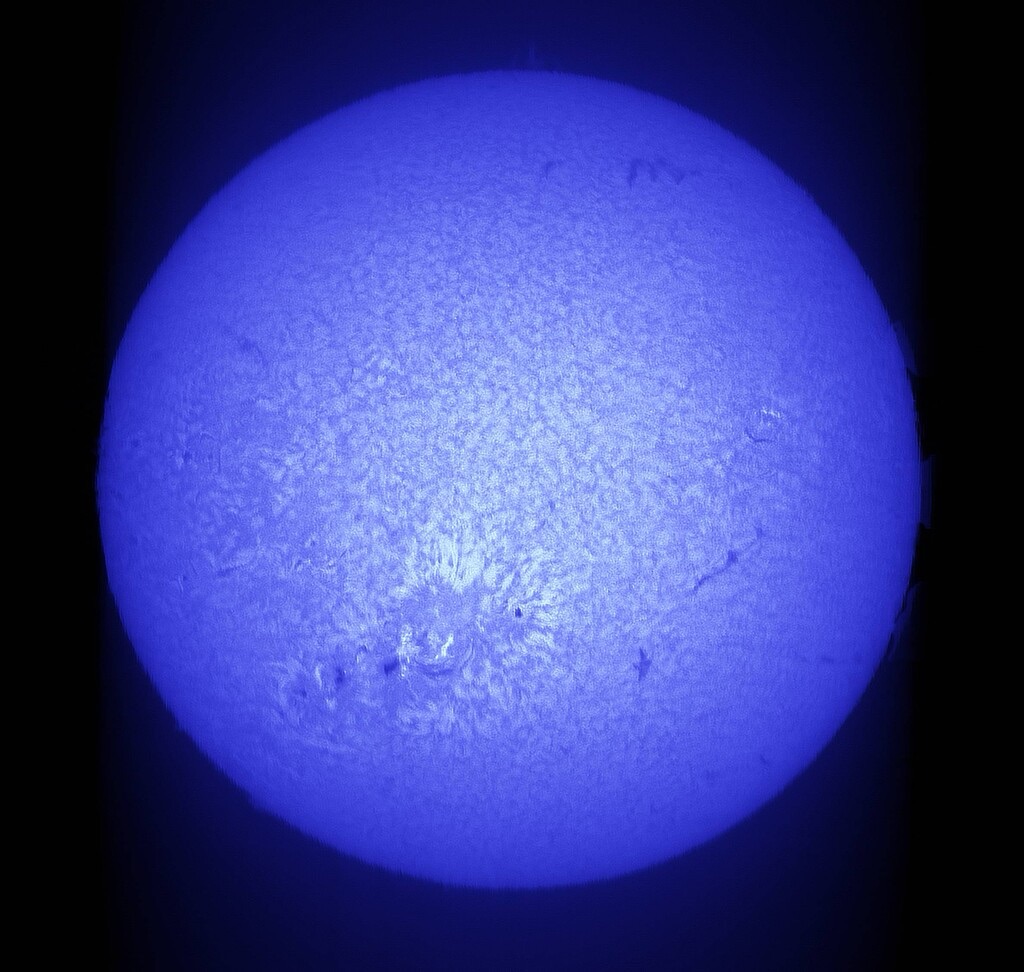
I’d like to share these spectacular images of our Sun, taken by Prasad Agrahar with his home-made spectroheliograph.
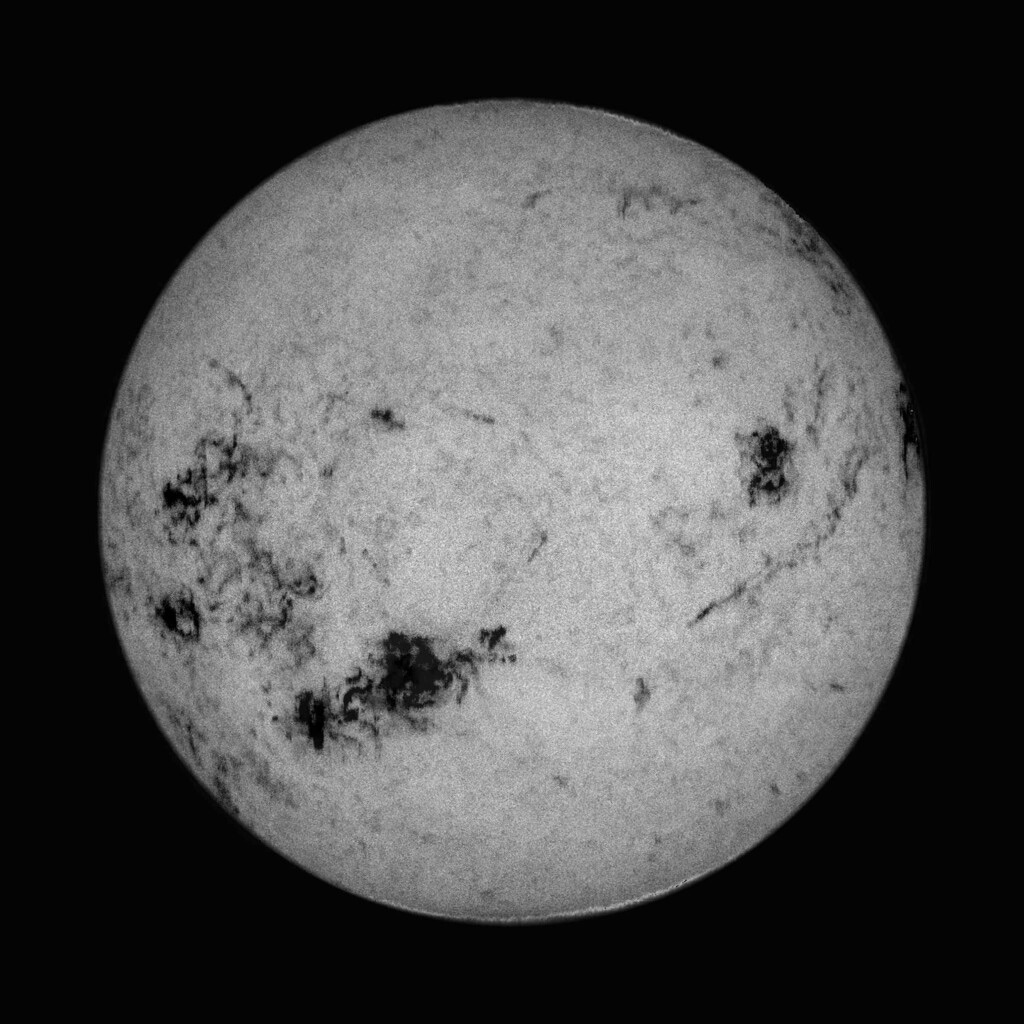
His first image is at H-alpha (656 nm), second is at H-beta (486 nm), and the third is at Helium D3 (585 nm).
With this device, IIUC, he can make an image at just about any wavelength that makes it through the front lens of the optics. He posted this to the NCA email list.
DIY!!
Guy Brandenburg
Prasad wrote:
Here are three images of our Sun, taken on Thursday morning with my DIY spectroheliograph. The weather was quite windy, and the seeing was poor.
The above is H-alpha with [sunspot groups] AR 4294 and 4296 dazzling.
This is H-beta
And finally,
The above image is (…) Helium-D3, the emission line at 5875A.
Come to Bull Run Mountain for a free night under the stars looking at a variety of targets using the telescopes at the Hopewell Observatory on Saturday, October 26, 2024. If it’s cloudy, we will try again on the next evening, Sunday the 27th.
You are invited, but will need to RSVP and, in this litigious age, must agree to a waiver of liability for anything that might happen up there, like tripping over rocks and trees. The waiver also includes detailed driving directions.
But if you take the risk you can view, for free, Venus, Saturn and its rings, Jupiter and its moons, Uranus, Neptune, the current comet Atlas, the Milky Way, and a whole bunch of nebulae, galaxies, Messier objects, and beautiful double stars.
We suggest arriving near sundown, which will happen near 6:15 PM. It will get truly dark about an hour later. You can stay until midnight, if you like.
There are no street lights near our observatory, other than some dimly illuminated temporary signs we put along the path, so you will probably want to bring a flashlight of some sort. In the operations cabin we have a supply of red translucent plastic film and tape and rubber bands so that you can filter out everything but red wavelengths on your flashlight. This will help preserve everybody’s night vision.
Hopewell is located on the first ridge of the Appalachian mountain chain that you see as you drive west from the DC beltway, near Haymarket. Our elevation is about 1100 feet, and we have much less of a problem with dew than other observing spots in northern Virginia. The last two miles of road are dirt and gravel, and you will need to walk about 200 meters/yards from where you park. Some parts of the road are pretty rough, so don’t drive anything with low clearance underneath. Our parking spaces are pretty limited, so consider car-pooling if possible. Handicapped persons or telescopes can be dropped off at the observatory.
We do have electricity, and a heated cabin, but since we have no running water, we use bottled water, hand sanitizer, and a pretty nice outhouse. We will have the makings for tea, coffee, and hot cocoa in that cabin.
If you like, you can bring a picnic dinner and a blanket or folding chairs, and/or your own telescope or binoculars, if you own one and feel like bringing them. We have outside 120VAC power, if you need it for your telescope drive.
At this time of year, the bothersome insects have mostly gone dormant, but feel free to use your favorite bug repellent, (we have some). Remember to check yourself for ticks after you get home.
We have a variety of permanently-mounted and portable telescopes of different designs, some commercial and some made by us. Two of our telescope mounts are permanently installed in the observatory under a roll-off roof. One of the mounts is a high-end Astro-Physics mount with a 14” Schmidt-Cassegrain and a 5” triplet refractor. The other mount was manufactured about 50 years ago by a firm called Ealing, but the motors and guidance system were recently completely re-done by us with modern electronics using a system called OnStep. We didn’t spend much cash on it, but it took us almost a year to solve a bunch of mysteries of involving integrated circuits, soldering, torque, gearing, currents, voltages, resistors, transistors, stepper drivers, and much else. We could not have completed this build without a lot of help from Arlen Raasch, Prasad Agrahar, Ken Hunter, and the online “OnStep” community.
We also have two home-made Dobsonian telescopes (10″ and 14″ apertures) that we roll out onto our lawn, and have been lent a pair of big binoculars on a parallelogram mount.
The location of the observatory is approximately latitude 38°52’12″N, longitude 77°41’54″W.
Click here for the RSVP form to get detailed directions. You must sign the waiver to visit. If we cancel on Saturday the 26th because of bad weather, we will notify you by email and will try again on Sunday the 27th.
When I show people things in the sky with a telescope, I want to help them to realize how lucky we are to live on a nice, warm, wet little planet in a relatively safe part of a medium-large galaxy.
I also want them to realize that if we aren’t careful, we could turn this planet into one of those many varieties of deadly hell that they are viewing in the eyepiece.
We should be very thankful that this planet got formed in a solar system that had sufficient oxygen, silicon, iron, nitrogen, and carbon for life as we know it. We are fortunate that all of those ‘metals’ I just listed (as astronomers call them) got cooked up in cycle after cycle of stars that went boom or whooshed their outer layers into the Milky Way. We are lucky to be alive at the far multicellular side of the timeline of life on Earth*, and that no star has gone supernova in our neighborhood recently or aimed a gamma-ray burst directly at us.
We are exceedingly lucky that a meteorite wiped out the dinosaurs 65 million years and allowed our ancestors, the mammals, to take over. We can rejoice that most of us in the USA can have our physical needs (food, shelter, clean water, clean air, and communication) taken care of by just turning a knob or a key, or pushing a button, instead of hauling the water or firewood on our backs. (There are, obviously, many folks here and abroad who live in tents and who have essentially none of those nice things. We could do something about that, as a society, if we really wanted to.)
I am often asked whether there is life elsewhere. My answer is that I am almost positive that there are lots of planets with some form of life in every single galaxy visible in an amateur telescope. But there is no possible way for us humans to ever visit such a planet. Nor can aliens from any exoplanet ever visit us, whether they be single-celled organisms or something you would see in a Sci-Fi movie.
Yes, it is possible to send a handful of people to Mars, if we are willing to spend enormous sums of money doing so, and if the voyagers are willing to face loss of bone and muscle mass, and the dangers of lethal radiation, meteorites, accidental explosions, and freezing to death. If they do survive the voyage, then by all means, let them pick up some rocks and bring them back for analysis before they die.
But wait: we already have robots that can do that! Plus, robots won’t leave nearly as many germs behind as would a group of human beings. And we already know a lot about how Mars looks, because of all the great photos sent back by ESA, JAXA, NASA and others for some decades now. You can see photos taken by NASA at JMARS, which I highly recommend. (https://jmars.asu.edu/ )
While one can justify sending a few brave folks to Mars for a little while, it is completely insane to think that we can avoid our terrestrial problems by sending large populations there. Mars is often colder than Antarctica, is close to waterless, has poisonous perchlorates in its soil, no vegetation whatsoever, and no atmosphere to speak of. How would millions or billions of exiles from Earth possibly live there? Do you seriously think they can gather enough solar energy to find and melt sufficient water to drink and cook and bathe and grow plants and livestock in the huge, pressurized, aluminum cans they would need to live in? No way.
I wish there was some way to get around the laws of physics, and that we could actually visit other exoplanets. But there isn’t, and we can’t. I’ve seen estimates that accelerating a medium-sized spaceship to a mere 1% of the speed of light would require the entire energy budget of the entire human population of the planet for quite some time. (For example, see https://physics.stackexchange.com/questions/447246/energy-requirements-for-relativistic-acceleration )
Let us assume, for the sake of argument, that you could actually generate enough energy to accelerate that spaceship with nuclear fusion or something else that doesn’t violate the laws of physics as far as we know.
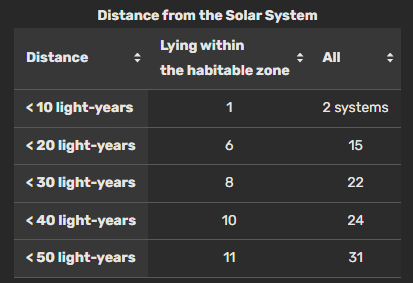
The next problem is the distance. It’s a bit over 4 light years to the nearest known exoplanet in a straight line, (compared with under 2 light-seconds for the Moon or about 35 light minutes for Jupiter). The table below gives the number of planets lying each extra solar system that are thought to be terrestrial (as opposed to gas giants) and to be within their stars’ habitable zones. Nobody knows if there is any life on any of those planets right not, but it is possible that astronomers may one day figure out a very effective way to test for extra-solar life. Let us suppose that a few of the ones in this list do have breathable atmospheres and are neither too cold nor too hot, have a fair amount of liquid water, and are protected from nasty radiation by magnetic fields and belts.
Unfortunately, a one-way trip to Proxima or Alpha Centauri for any possible spaceship, at one percent of the speed of light, (3,000 km per second), in a straight line, and pretending that you don’t need years and years to both accelerate and decelerate, would take over four centuries. And that’s for the very closest one! All the other planetary systems are many multiples of that distance! See this or this table:
Our fastest spacecraft so far, the Parker Solar Probe, reaches the insanely fast speed of 190 km/sec, but that’s still fifteen times slower than my hypothetical 1% of c. At the speed of Parker, it would take around six thousand years to reach the Proxima Cen planetary system! If all goes well!
Do you seriously think that a score or so generations of humans would all agree, century after century, that they, and their descendants — born and raised in a big metal box rushing through space — for the entire 400 years, would consent to live in a large metal box with no gravity to speak of, subject to who knows how many blasts of gamma rays, x-rays, and super-high-energy cosmic particles? What are the chances that each single generation would agree to stay the course and that not a single meteorite going the other direction, over a course of four centuries, would happen to smash into the space ship and instantly disable all the life support systems and kill all the passengers, quickly or slowly?
And how do you keep alive all the animals we would need to feed us upon arrival? I guess you compost all the poop from all the cattle, chickens, and so on. But do you also bring zillions of insects and tons of plant seeds as well, knowing full well that if you do so, then you lose the vast majority of the information you could have learned about an actual, functioning, extra-solar ecosystem like nothing we can possibly imagine.
The argument is made that perhaps the travelers would be put into suspended life. If that were possible, and nothing went wrong, upon arrival, they could take a triumphant group selfie and put it into a radio message back to Earth saying, “Hi, we made it, wish you were here…” That reply will of course take four years to reach Earth. Would people back on Earth still remember the handful of people who began the trip out, made over four centuries earlier? What will the humans back on earth remember about the absolutely prodigious effort expense that their ancestors had made to build and power that rocket, 20 generations or so earlier?
Let us suppose they have the tremendous luck to find, after 4 to 10 centuries of travel, a nice warm exoplanet with water, oxygen-producing life, and air that we can breathe.
Unfortunately, there is an overwhelming chance that there would be no humanoids or any other Sci-Fi characters. The chances are that creatures that look like insects, crustaceans, fish and salamanders are the most highly-organized life forms – at best; after all, for most of the existence of life on earth, it was single-celled organisms! Our travelers would have to have to build an entire urban and agricultural infrastructure *from scratch*, with no help. They could only do that if the plants and animals they brought from Earth are able to flourish.
The return trip, if desired, would of course take another four or more centuries, if the handful of travelers can find a proper power source and if they can figure out how to create, completely from scratch, an entire agricultural and industrial instructure. They would have to figure out where the natural resources of that planet (wood? minerals? energy sources?) are located, and how they can make use of them, to build something like the incredibly precise absolutely enormous rocket-building industries we have here, on a hypothetical planet that has never even had any mammals living on it.
If these voyagers should run into any technical problem while doing trying to build a modern civilization from nothing, fat chance of getting a prompt reply from Earth, since the question would take years to reach its home base back here!
Yes, the very closest exoplanets are a mere 4 LY away, but the others are all much, much farther away, so one-way trips for ones within 10 parsecs, i.e., in our tiny corner of our galaxy, at one percent of the speed of light, would require a thousand to three thousand years to reach. Each way.
Forget it. Just send a radio message, and see if we get a reply. Oh, wait – we’ve been doing that for several decades so far. No reply so far.
Speaking of radio – it’s only 120 years since Marconi first sent a very crude radio message from a ship to a station on land, and now we routinely use enormous parts of the entire electromagnetic spectrum for all sorts of private and public purposes, including sending messages like this one. Astronomers are able to gather amazing amounts of information via the longest radio waves to the very shortest gamma rays and make all sorts of inferences about worlds we have never seen at optical wavelengths. In addition, we have begun detecting gravity waves from extremely distant and powerful events with devices whose accuracy is quite literally unbelievable.
There is no planet B. We must, absolutely must, take care of this one, lest we turn into one of those freezing or burning variations of hell that we see through our eyepieces. Think I’m being alarmist? We now know this nice little planet Earth is more fragile than we once believed. It has been discovered that life was almost completely wiped out on this planet several times. The Chixculub impact I mentioned earlier, the Permian extinction and Snowball Earth are just three such events.
More recently, folks thought it was impossible for people to cause the extinction or near-extinction of the unbelievably huge flocks and herds and schools that once roamed the earth: passenger pigeons, buffaloes, cod, salmon, redwoods, elms, chestnuts, elephants, rhinos, tropical birds, rainforests, and so on, but we did, and continue to do so. The quantities of insects measured at site after site around the world have plummeted by 30 to 70% and more, over just a few decades, and so have the numbers of migratory birds observed on radar feeds. Light pollution, the bane of us amateur and professional astronomers, seems to be partly responsible for both the insect and bird population declines. The rise in the levels of atmospheric carbon dioxide and global temperatures are very scary.
In addition, we are dumping incredible amounts of plastic into the oceans, and rising water temperatures are causing coral reefs around the world to bleach themselves and die, while melting glaciers are causing average sea levels rise and threaten more and more low-lying cities.
What’s more, only a very tiny fraction of our planet’s mass is even habitable by humans: the deepest mine only goes down a few miles, and people die of altitude sickness when they climb just a few miles above sea level. Most of the planet is covered by ocean, deserts, and ice cap. By volume, the livable part of this planet is infinitesimal, and the temperatures on it are rising at an alarming rate.
Will we be able to curb the burning and leaking of fossil fuels sufficiently so as to turn around the parts of global warming caused by increases in carbon dioxide and methane? I am not optimistic, given that the main emitters have kept essentially none of the promises that they have been making to those various international gatherings on climate, and graphs like this one, taken from: https://ourworldindata.org/fossil-fuels
I have been wondering whether we may need to reduce temperatures more directly, by putting enough sulfur compounds into the stratosphere. We have excellent evidence that very violent volcanic eruptions have the power to lower global temperatures with the sulfates they put into the stratosphere. It would not be great for ground-based astronomy if such compounds were artificially lofted high into the atmosphere to lower global temperatures, and we won’t know for sure exactly which areas of the planet would benefit and which would be harmed, but at least it’s an experiment that can be stopped pretty easily, since the high-altitude sulfates would dissipate in a few years. High-altitude sulfur compounds do not seem to cause the obvious harm that SO2 does at the typical altitude of a terrestrial coal-burning power plant.
Adding iron to the oceans to increase the growth of phytoplankton, which then consumes CO2, dies, and settles to the bottom of the ocean, has been tried a number of times, but doesn’t seem to have a very large effect.
I agree that large-scale injection of sulfates into the stratosphere is scary. I also agree that there is a whole lot of unknown unknowns out there and inside of us, and we are being very short-sighted, as usual.
We have mapped the far side of the moon better than we have mapped the floors of Earth’s oceans – yet permits are being filed right now to begin deep-ocean dredging for manganese nodules, which will enrich some folks greatly. Unfortunately, that dredging is bound to utterly destroy those slow-growing ecosystems, before we even know what’s down there in the first place!
We continue to dump unbelievable amounts of plain old trash, fish nets, fishing lines, live ammunition, modern warships and hazardous chemicals into the oceans.
While the waters and atmosphere of the USA are much, much cleaner now than they were when I was a kid in the 50s and 60s, places like Delhi or Beijing are so polluted that folks can barely see the sun on a clear day.
If dark matter and dark energy really do exist, that means that scientists have absolutely no idea what 96% of the universe is made of!
If dark matter and dark energy don’t exist, then that means that astrophysicists don’t understand long-distance gravity and physics nearly as well as they thought. The late Vera Rubin (a past NCA member who should have won a Nobel for her careful measurements of the rotational measurements of galaxies that led to the Dark Matter hypothesis) once told me when we were co-chaperoning a field trip to the Smithsonian for the Carnegie Institution for Science’s Saturday program for middle-schoolers, that she thought that the entire question is perfectly open. I think she’s still correct.
If the Big Bang is real, then how come the Webb is seeing fully-formed galaxies as far back in time as it can see?
Do the alternative theories to the Big Bang (eg, Burbridge’s hypothesis that matter is being created in the centers of active galactic nuclei) make any sense?
But — does anybody have better solutions?
Can we engineer our way out of the mess we are making on this planet – the only home that humans will ever have?
There is cause for optimism:
Our NCA speaker this month, Deborah Shapley, will tell how, almost exactly a century ago, astronomers finally figured out that the Milky Way was just one of many billions of other galaxies. Since that time, the amount of astronomical information gathered has been staggering, as has the efficacy of the instruments!
After scientists figured out what was causing the ozone hole, every single agency and government in the entire world passed and enforced regulations that banned those chlorofluorocarbons that were used in almost everything from air conditioners to hair spray. Since that time, there has been almost complete compliance and agreement, and the ozone hole continues to shrink, as you can see here.
I have vivid memories about how smoggy and stinky the air used to be on a typical summer day in almost any American city of my youth. A fat-rendering plant right here in Georgetown (DC) stank worse than a hundred skunks, and is now gone. I know a paper mill in West Virginia whose fumes had long killed almost all the vegetation downwind of the factory. Nearby, acid drainage from an abandoned coal mine turned a stream so acidic that the rocks (and water) were amazing shades of orange, reds, and yellow. The rivers of this national often flowed with raw sewage, trash, and mine waste. Some, like the Cuyahoga, even caught fire, repeatedly (see https://www.smithsonianmag.com/history/cuyahoga-river-caught-fire-least-dozen-times-no-one-cared-until-1969-180972444/ ). The passage and actual enforcement of the Clean Air and the Clean Water Acts have cleaned up the air and water in this country to an amazing degree in my lifetime (I’m over 70). The cleanup of the Potomac and Anacostia Rivers in that period has also been tremendous. However, my friends who grew up in India and China tell me that the air and water pollution over there is worse than I can possibly imagine and is not improving at all.
When I was young, it appeared that nearly every adult I knew chain-smoked cigarettes and drank a lot of alcohol, and the bars, restaurants, dormitories, private houses, classrooms, buses and airplanes everywhere were filled with tobacco smoke. Despite the lies and obfuscation of the tobacco industry, not only legislation but also public opinion is such that today, I seldom encounter the nasty smell of tobacco smoke anywhere, even on people’s clothing on the bus or subway, and the number of drunk-driving fatalities is way down as well.
During my youth, the various nuclear powers exploded literally hundreds of nuclear weapons in the open air and underwater, spewing Strontium-90 and other radionucleides into things like cow or human milk, and doing untold destruction to the oceans nearby. While the number of world-wide nuclear explosions per year has dropped tremendously since then, they still continue, and may start up again on a larger scale.
Some noteworthy experiments re stopping global warming are listed in this month’s National Geographic. One of them, which has promise but also obvious drawbacks, involves dumping large quantities of finely ground-up alkaline rocks and minerals like olivine counteract the increasing acidification of the seas being caused by the absorption of so much carbon dioxide. Will these experiments work? I don’t know.
But let us not turn this planet – the only home we will ever know – into one of the barren, freezing or boiling versions of hell we see in the eyepieces of a telescope.
I have raised pigs, and I noticed that they never foul their own beds, if they are given any room to move around. Let’s be better than pigs and stop trying to extract riches in the short run while destroying the lovely planet we all love in the long run!
Heaven is not somewhere else.
It’s right here, if we can keep it that way and fix the damage we have done.
* For five-sixths of the roughly 3.7-billion-year time line of life on earth, all living things were single-celled microbes (or microbes living together in colonies). We mammals have only been important for the last 1.7% of that time, (ie since the dinosaurs died out 66 million years ago), the first known writing system was invented a few millennia ago, and Marconi only sent the first ship-to-shore radio message 130 years ago, which is an infinitesimally small fraction of 3.7 billion. Home radios only became popular 100 years ago.
Assuming that planets and stars are created at random times in the history of the universe, and assuming that a certain amount of enrichment of the interstellar medium by many generations of dead stars is necessary before life can begin at all, then it looks to me like the odds are not at all good for intelligent life of any sort to exist right now on any random planet we may study. And, unfortunately, if they do exist, we will never meet them. If there is an incredibly advanced civilization somewhere within 100 light years that can actually detect those first radio signals, then they just received our first messages. If they do respond, we won’t get the answer for another century or two!
For example, take a look at this time line of life on earth at a linear scale. If a hypothetical space traveler should somehow arrive on the 3rd rock from our Sun at a random moment in time over the past 4.5 billion years, then that’s like tossing a dart at this graph while blindfolded, and seeing where it lands. Notice the kind of organisms dominating during most of the past 4 billion years! The chances that they would happen to arrive here in the past few centuries or so, when we humans began to really understand science, are vanishingly small!
My original title began with “Space Travel is Impossible” — which is obviously false, because it is an incontrovertible fact of history that a handful of American astronauts, at enormous expense, did in fact land on the Moon and return. I remember the event well; I was working in a factory in Waltham, Mass that summer as part of the SDS Summer Work-In.
I should have written, “Space Travel to Exoplanets Is Impossible”.
But you could make the case that traveling to the Moon is barely even space travel! The distance to the moon is less than the total mileage on my last two automobiles (a Subaru Forester and a Toyota Prius) added together. Or, at the speed of light, the Moon is about 1.5 light-seconds away, the Sun about 8 light-minutes, Jupiter 34 light-minutes, and Saturn is about 85 light minutes this month. But the very nearest star-planet system to us is over four YEARS away, and the distances to the vast majority of exoplanets are measured in light-decades, light-centuries, or light-millennia.
I remember the Space Race! Both the USA and the Soviets poured incredible sums of cash, labor, raw materials, and brain power into that race, while, frankly, millions of people around the world starved or were killed in proxy wars between those two powers, representing two ideological and political opposing blocks. The incredibly expensive and dangerous race to win global prestige by being the first power bloc to reach the various goals has, so far, at its apogee, carted a handful of men to the near side of our Moon, less than two light-seconds away! And some people think we can easily travel to exoplanets that are light-decades or light-centuries away!
An alarming article about studies of bird deaths due to bright city lighting. A couple of quotes:
Every 11 September at dusk, in memory of the 2001 attacks, New York City mounts the Tribute in Light, an art installation in lower Manhattan. And every year, as twin towers of light bloom skyward, they attract thousands of migrating birds, sucking in warblers, seabirds, and thrushes—along with predators such as peregrine falcons eager to take advantage of the confusion. On each anniversary, bird conservationists wait below, counting and listening to disoriented chirps. If the observers report too many birds circling aimlessly in the beams, organizers flip off the lights.
In recent years, on-site observers have also used a complementary tool to quantify the orbiting birds: weather radar, which bounces off birds as well as raindrops. In 2017, a group led by Cornell University ornithologist Andrew Farnsworth found that during seven previous anniversaries, the once-a-year installation had attracted a total of about 1.1 million birds. Within 20 minutes of lighting up, up to 16,000 birds crammed themselves into a half-kilometer radius. But when the lights flicked off, the dense clouds of birds on the radar screen dissipated just as fast, a finding later confirmed by on-site thermal cameras.’
Later, discussing a single building, the author found that a
‘key factor was how many of the convention center’s windows had been illuminated. Each individual bright window left more dead birds for volunteers to find the next day. The correlation suggests halving the number of lit window bays would halve the number of bird strikes, the team estimated, saving thousands of birds at this one three-story building. “It really does seem that each window makes a difference,” van Doren says.’
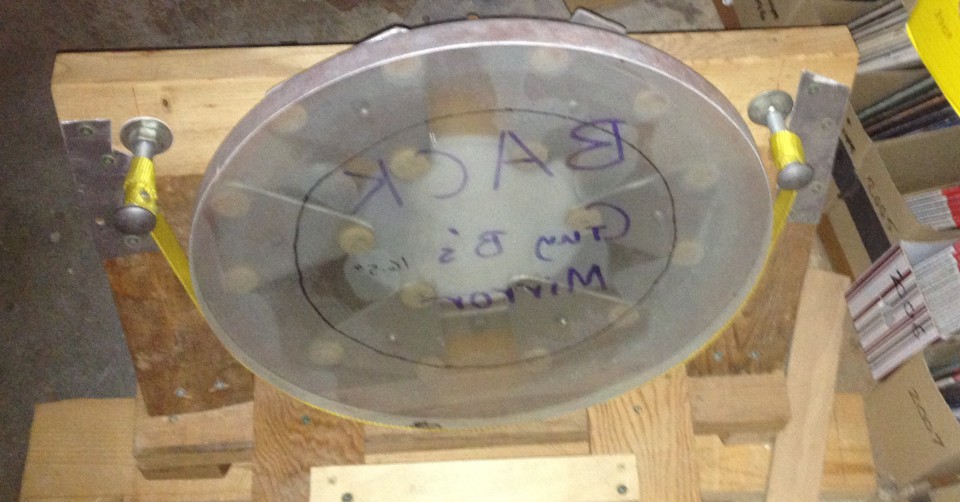
More progress with the 22-inch wide, 4-inch thick mystery glass.
It took four of us old farts- Jim Kaiser, Alan Tarica, Tom Crone, and me – to extract the mirror from its case (which was located under a very heavy Draper-style grinding and polishing machine) roll it onto a little stand we fabricated on a decent gym scale I borrowed from my gym ( http://www.True180.fitness ) and weigh it.
We were very careful when moving that heavy mirror. Nobody got hurt in any way. When putting the mirror back into its sturdy wood carrying box, we used ancient Egyptian technology of little rollers, and it worked like a charm.
The bathroom scale we had used earlier, up at Hopewell was very, very wrong. We found that the weight of the glass was really 212 pounds (about 96 kilograms, or 96,000 grams), not 130 pounds. Its volume was 20,722 cc, so its density is roughly 4.6. Will have to see what types of glass have roughly that density and an index of refraction of about 1.72 to 1.76.
I heard from one veteran telescope maker:
“I’ve been in the Tucson astronomy club for many decades and also in the optics industry there. Most all institutions that had connections to astronomy or optics in the 60s got portions of several semi loads of “glass bank glass”, glasses that at one point in the past were considered strategic materials for certain optical designs/systems. There was a wide variety of materials, but almost all was identified in some way. We’re there any markings ar data scribed in the glass? The largest I saw was about 15”, so yours might be a different source.
“A co-worker of mine has identified several mystery glasses from an accurate determination of density. Seems like you should be able to get better results w/a more accurate scale. Also many glass types made decades ago are obsolete – my friend has some older glass catalogs that might help you determine what it might be with more accurate numbers.”
So these were cast-offs from the Military Industrial Complex, basically: pieces of glass that the military decided it no longer needed for projects that had either been completed or abandoned, and that they didn’t feel like storing any more. So they gave them away to groups like National Capital Astronomers and Hopewell Observatory.
The only markings on the glass are the following: a heavily inscribed (by hand) apparent date of 2-8-56, which probably means either February 8 of 1956 or the 2nd of August 1956. Judging by the handwriting style of the numerals, it was probably Feb. 8 of 1956 (US style). Under that are the numerals 0225, which we have no idea about. In pencil, someone with US-style handwriting wrote what looks like “Low #” in cursive. Again, we have no idea what that means.
Here is a batch of articles and links concerning the spray-on process for making astronomical mirrors reflective using protected silver solutions.
Long ago, I translated Foucault’s monograph on making paraboloidal, silvered astronomical mirrors. Part of his article described the process that he and Steinheil developed for silvering, which involved using silver nitrate solutions and various other reagents. It looked quite tricky, and also required further polishing! Plus, our telescope making workshop here in Washington DC had a Navy surplus vacuum chamber that was (and still is) quite effective at putting on good-quality, inexpensive aluminum coatings for any mirror up to 12.5″ diameter.
However, I and a couple of other ATMers (Bill R and Oscar O) are working on mirrors in the 16 to 18 inch range, and they simply won’t fit. So I was quite intrigued to watch how Peter Pekurar and some other folks coated a couple of rather large mirrors right in front of a small crowd of onlookers in a tent at this summer’s Stellafane.
There is also an article on the process in the January 2020 Sky and Telescope, and a webpage (here) on the topic run by Pekurar and Howard Banich and others.
Not to mention a bunch of posts on Cloudy Nights (here) and a nice PDF explaining it all, (here).
What is really, really amazing is that the webpage by Pekurar and Banich also has interferograms showing that the overcoating has absolutely no effect on the sub-microscopic, geometrical figure of the mirror! Unfortunately, it’s only effective against chemical attack, not against dirty fingers or scratches. They also did some careful experiments on reflectivity at various wavelengths with various treatments of the surface.
A couple of local ATMers and at least one professional at Goddard Space Flight Center have told me about their experiments with the process; they found that it is easy to mess up if you aren’t stringently clean and also easy to waste materials.
I have been wrestling with this mirror for YEARS. It’s not been easy at all. The blank is only about twice the diameter of an 8″ mirror, but the project is easily 10 times as hard as doing an 8-incher. (Yes, it’s the one in the photo heading this blog!)
Recently I’ve been trying to figure it using a polishing/grinding machine fabricated by the late Bob Bolster (who modeled his after the machine that George Ritchey invented for the celebrated 60″ mirror at Mount Wilson over a century ago). That’s been a learning exercise, as I had to learn by trial and error what the machine can and cannot do, and what strokes produce what effects. The texts and videos I have seen on figuring such a large mirror with a machine have not really been very helpful, so it’s mostly been trial and error.
My best results right now seem to come from using an 8″ pitch tool on a metal backing, with a 15 pound lead weight, employing long, somewhat-oval strokes approximately tangential to the 50% zone. The edge of the tool goes about 5 cm over the edge of the blank.
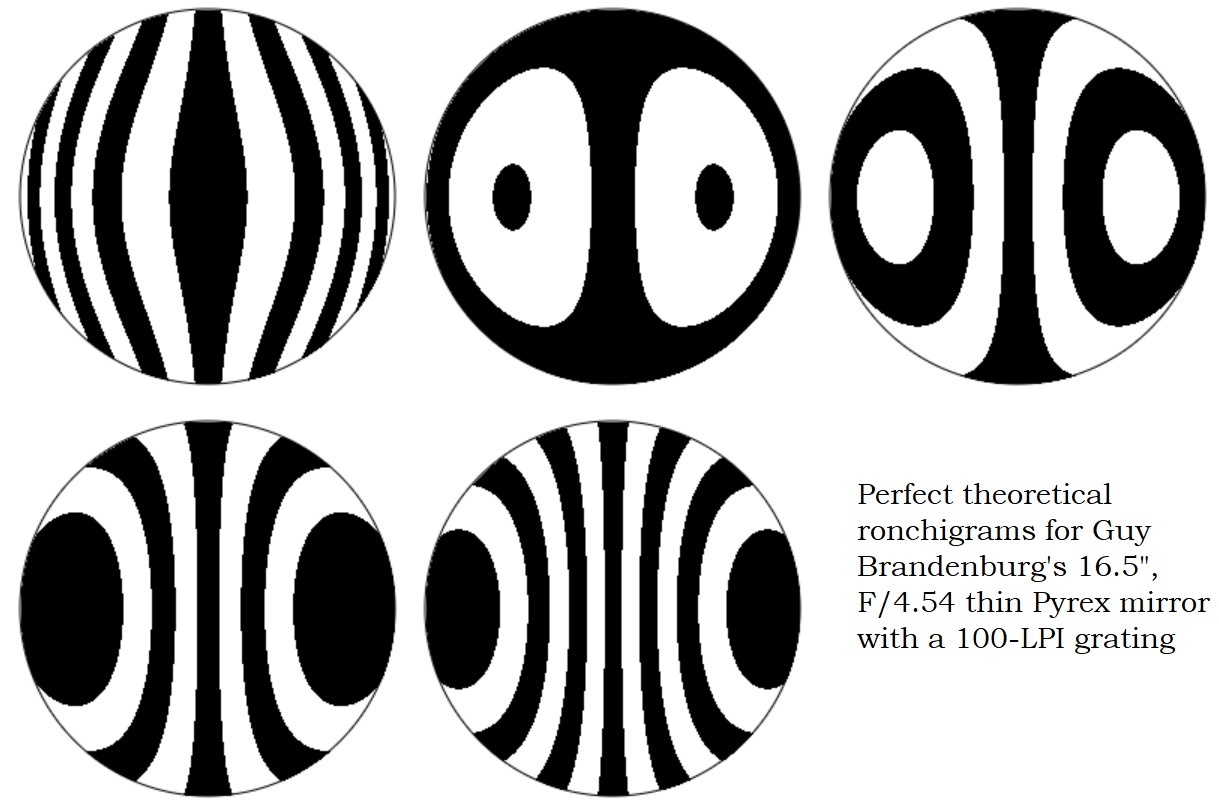
This little movie shows the best ronchigrams I have ever produced with this mirror, after nearly 6 hours of near-continuous work and testing. Take a look:
And compare that to how it used to look back in September:
Also compare that to the theoretically perfect computed ronchigrams from Mel Bartels’ website:
Part of the reason this mirror has taken so long is that after grinding and polishing by hand some years ago, I finally did a proper check for strain, and discovered that it had some pretty serious strain. I ended up shipping it out to someone in Taos, New Mexico who annealed it – but that changed the figure of the mirror so much that I had to go back to fine grinding (all the way back to 120 or 220 grit, I think), and then re-polishing, all by hand. I tried to do all of that, and figuring of the mirror, at one of the Delmarva Mirror Making Marathons. It was just too much for my back — along with digging drainage ditches at Hopewell Observatory, I ended up in a serious amount of pain and required serious physical therapy (but fortunately, no crutches), so this project went back into storage for a long, long time.
Recently I’ve tried more work by hand and by machine. Unfortunately, when I do work by hand, it seems that almost no matter how carefully I polish, I cause astigmatism (which I am defining as the mirror simply not being a figure of rotation) which I can see at the testing stand as Ronchi lines that are not symmetrical around a horizontal line of reflection. (If a Ronchi grating produces lines that look a bit line the capital letters N, S, o Z, you have astigmatism quite badly. If astigmatism is there, those dreaded curves show up best when your grating is very close to the center of curvature (or center of confusion) of the central zone.
Using this machine means controlling or guessing at a LOT of variables:
length of the first crank;
length (positive or negative) of the second crank;
position of the slide;
diameter of the pitch lap;
composition of the pitch;
shape into which the pitch lap has been carved;
amount of time that the lap was pressed against the lap;
whether that was a hot press or a warm press or a cold press;
amount of weight pushing down on the lap;
type of polishing agent being used;
thickness or dilution of polishing agent;
temperature and humidity of the room;
whether the settings are all kept the same or are allowed to blend into one another (eg by moving the slide);
time spent on any one setup with the previous eleven or more variables;
Just got back from an exciting astro expedition to Hopewell Observatory with one of the other members. Great fun!
Anybody living on the East Coast in March 2018 has just lived through a very strong, multi-day gale. The same weather system brought snow and flooding to the northeast, and here in the DC-Mar-Va area, it was cut off power to many (including my mother-in law) and caused almost all local school districts to close — even the Federal Government! Two of my immediate neighbors in DC had serious roof damage.
Today, Sunday, Paul M and I decided the wind had calmed enough, and the sky was clear enough, for an expedition to go up and observe. We both figured there was a good chance the road up to the observatory would be blocked by trees, and it turns out that we were right. My chainsaw was getting repaired – long story, something I couldn’t fix on my own – so I brought along work gloves, a nice sharp axe, loppers, and a 3-foot bowsaw. We used all of them. There were two fairly large dead trees that had fallen across the road, and we were able to cut them up and push them out of the way.
However, there was a large and very dangerous ‘widow-maker’ tree (two images above) that had fallen across the road, but it was NOT on the ground. Instead, was solidly hung up on the thick telecommunications line at about a thirty-degree angle to the ground. The power lines above it didn’t seem to be touched. You could easily walk under the trunk, if you dared (and we did), and you probably could drive under it, but of course the motion of the car just might be enough to make it crack in half and crush some unlucky car and its driver. Or maybe it might make the phone line shake a bit …
No thanks.
So, we didn’t drive under.
I called the emergency phone for the cell phone tower (whose access road we share) to alert them that the road was blocked and could only be cleared by a professional. I also attempted to call a phone company via 611, without much success — after a long wait, the person at the other end eventually asked me for the code to my account before they would forward me to somebody who could take care of it. Very weird and confusing. What account? What code? My bank account? No way. We will both call tomorrow. Paul says he knows some lawyers at Verizon, whose line he thinks it is.
But then: how were we going to turn the cars around? It’s a very narrow road, with rocks and trees on one side. The other side has sort of a ravine and yet more trees. Paul realized before I did that we had to help each other and give directions in the darkness to the other person, or else we would have to back up all the way to the gate! Turning around took about four maneuvers, per car, in the dark, with the other person (armed with astronomer’s headlamp, of course) yelling directions on when to turn, how much to go forward, when to stop backing up, and so on. Success – no injuries! We both got our cars turned around, closed them up, got our cutting tools, gloves and hats, and then hiked the rest of the way up, south and along the ridge and past the big cell phone tower, to the Observatory buildings themselves, moving and cutting trees as we went.
As we were clearing the roadway and walking up the ridge, we peered to the west to try to find Venus and Mercury, which had heard were now evening planets again. It wasn’t easy, because we were looking through LOTS of trees, in the direction of a beautiful multi-color, clear-sky sunset featuring a bright orange line above the ridge to our west. Winter trees might not have any leaves, but they still make the search for sunset planets rather tough. Even if you hold perfectly still, one instant you see a flash that’s maybe a planet, or maybe an airplane, and then the branches (which are moving in the breeze, naturally) hide it again. So what was it? Paul’s planetarium smartphone app confirmed he saw Venus. If the trees weren’t there, I think we also would have seen Mercury, judging by Geoff Chester’s photo put out on the NOVAC email list. I think I saw one planet.
In any case, everything at the observatory was just fine – no tree damage on anything, thanks to our prior pruning efforts. The Ealing mount and its three main telescopes all worked well, and the sky and stars were gorgeous both to the naked eye and through the scopes. Orion the Hunter, along with the Big Dog and the Rabbit were right in front of us (to the south) and Auriga the Charioteer was right above us. Pleiades (or the Subaru) was off high in the west. Definitely the clearest night I’ve had since my visit to Wyoming for the solar eclipse last August, or to Spruce Knob WV for the Almost Heaven Star Party the month after that.
Paul said that he and his daughter had been learning the proper names of all the stars in the constellation Orion, such as Mintaka, Alnilam, and Alnitak. As with many other star names, all those names are Arabic, a language that I’ve been studying for a while now [but am not good at. So complicated!] Mintaka and Alnitak are essentially the same Arabic word.
After we got the scopes working, Paul suggested checking out Rigel, the bright ‘leg’ of Orion, because it supposedly had a companion star. {Rajul means “leg”} We looked, and after changing the various eyepieces and magnifications, we both agreed that Rigel definitely does have a little buddy.
I had just read in Sky & Telescope that Aristotle (from ancient Greece) may have given the first written account of what we now call an “open cluster” in the constellation Canis Major (Big Dog – that’s Latin, which I studied in grades 7 – 12) called Messier-41, only a couple of degrees south of Sirius, the brightest star in the sky. A passage in a book allegedly written by Aristotle (roughly 230 BC) seems to indicate that he could see this object with averted vision. (He was trying to establish that it was a fuzzy patch in the sky that was most definitely NOT a comet, just likeCharles Messier was doing almost exactly two thousand years later!)
M41 was quite attractive. But no, we didn’t then look at M42. Been there, done that many times before. And no, what you see with a telescope does not have all those pretty colors that you see in a photograph.
Instead, we looked on a multi-sheet star atlas (that stays in the observatory) near M41 and found three other open clusters, all really beautiful. We first found M38 and thought that in the C-14 and 6″ Jaegers, it looked very anthropoid or like an angry insect, if you allowed your mind to connect the beautiful dots of light on the black background. In the shorter 5″ refractor made by Jerry Short, it looked like a sprinkling of diamond dust. This cluster must have been formed rather recently. We then found M36, which was much less rich, but still quite pretty. Lastly, we found M37, another open cluster, which has a very bright yellow star near the center, against background of much fainter stars. It seemed to me that those other stars might be partly obscured by a large and somewhat translucent cloud of dust. We saw a web of very opaque dust lanes, which we confirmed by readings on the Web. Really, really beautiful. But I’m glad we don’t live there: too dangerous. Some of the stars are in fact red giants, we read.
Then we looked straight overhead, in the constellation Auriga. We decided to bypass the electronics and have Paul aim the telescope, using the Telrad 1-power finderscope, at one of the fuzzy patches that he saw there. He did, and my notes indicate that we eventually figured out that he found Messier-46 (yet another open cluster) with his naked eye! Very rich cluster, I think, and we even found the fan-shaped planetary nebula inside!
At this point we were getting seriously cold so we moved over just a little, using the instruments, to find M47, again, a very pretty open cluster.
Realizing that the cold and fatigue makes you do really stupid things, and that we were out in the woods with no way to drive up here in case of a problem, we were very careful about making sure we were doing the closing up procedures properly and read the checklist at the door to each other, to make sure we didn’t forget anything.
On the walk back, we saw the Moon coming up all yellowish-orange, with the top of its ‘head’ seemingly cut off. When it got a bit higher, it became more silver-colored and less distorted, but still beautiful.
I really thought all of those open clusters were gorgeous in their own right, and I think it would be an excellent idea to make photographs of them, but perhaps black dots on white paper, and give them to young folks, and ask them to connect the dots, in whatever way they feel like doing. What sorts of interesting drawings would twenty-five students come up with?
I am not sure which of our various telescopes would do the best job at making astro images. I have a CCD camera (SBIG ST-2000XM), with a filter wheel. What about just making it a one-shot monochromatic black and white image? I also have a Canon EOS Revel XSI (aka 450D, I think). Compare and contrast… The CCD is really heavy, the Canon quite light. I also have a telephoto lens for the Canon, which means that I have essentially four telescopes to choose from (but not a big budget!). One problem with the C-14 and my cameras is that the field of view is tiny: you can only take images of very small bits of what you can see in the eyepiece with your naked eye. This means you would need to make a mosaic of numerous pictures.
In any case, no imaging last night! Not only did I not feel like hauling all that equipment for a quarter of a mile, after all that chopping, sawing, and shoving trees, it turns out I had left my laptop home in the first place. D’oh!
I had previously found every single one of these open clusters when I made my way through the entire Messier list of over 100 objects, with my various home-made telescopes, which had apertures up to 12.5 inches. However, I don’t think I had ever seen them look so beautiful before! Was it the amazing clarity of the night, or the adventure, or the company? I don’t know!
But this was a very fun adventure, and this photography project – attempting to make decent images of these six open clusters – promises to be quite interesting!
This weekend, I’m hosting a small workshop at the Community Museum in Gaithersburg, MD, where interested persons from 8 to 88 years of age can make their own telescope in an hour or two. We will be using surplus but high-quality achromatic primary doublet lenses as well as inexpensive eyepieces, along with PVC tubing and some really cool tripods to hold it steady. We will some basic optics experiments to help explain how these gizmos work, and will have spray paint and colored tape to decorate the tubes.
If you are interested, here is the necessary information:
Make your own refracting telescope in just an afternoon! This workshop will be led by veteran DC amateur telescope-maker Guy Brandenburg. He will show you how to make a small functioning telescope that can either be held in your hands or mounted on almost any camera tripod. All of the materials needed will be provided, and no experience is necessary. This workshop is open to anyone from the ages of 9 through 99, but a parent would need to accompany any child from 9 – 11. You might get a little dirty, so don’t wear your best clothing!
You will also see how various types of telescopes such as reflectors, refractors, and catadioptrics are put together and operate, using actual examples, including the type made and used by Galileo around 1609.
Some very nice folks from the Australian Broadcasting Corporation came and interviewed me on film for a bit on folks who make their own telescopes to see the great August 2017 eclipse. Here is the link:






 Guy's Math & Astro Blog