• My series on making a Newtonian telescope
  • How Leon Foucault Made Telescopes

Guy's Math & Astro Blog

Guy's Math & Astro Blog

Tag Archives: Hopewell Observatory

Some Progress – AT LAST! – With Figuring the 16.5″ f/4.5 Thin Mirror That Headlines This Blog

10 Saturday Nov 2018

Posted by gfbrandenburg in astronomy, Hopewell Observatorry, Optics, Safety, Telescope Making

≈ Leave a comment

Tags

Bob Bolster, George Ritchey, Grinding, Hopewell Observatory, matching Ronchi, Mel Bartels, Polishing, Ronchi, ronchigram, Telescope Making, testing

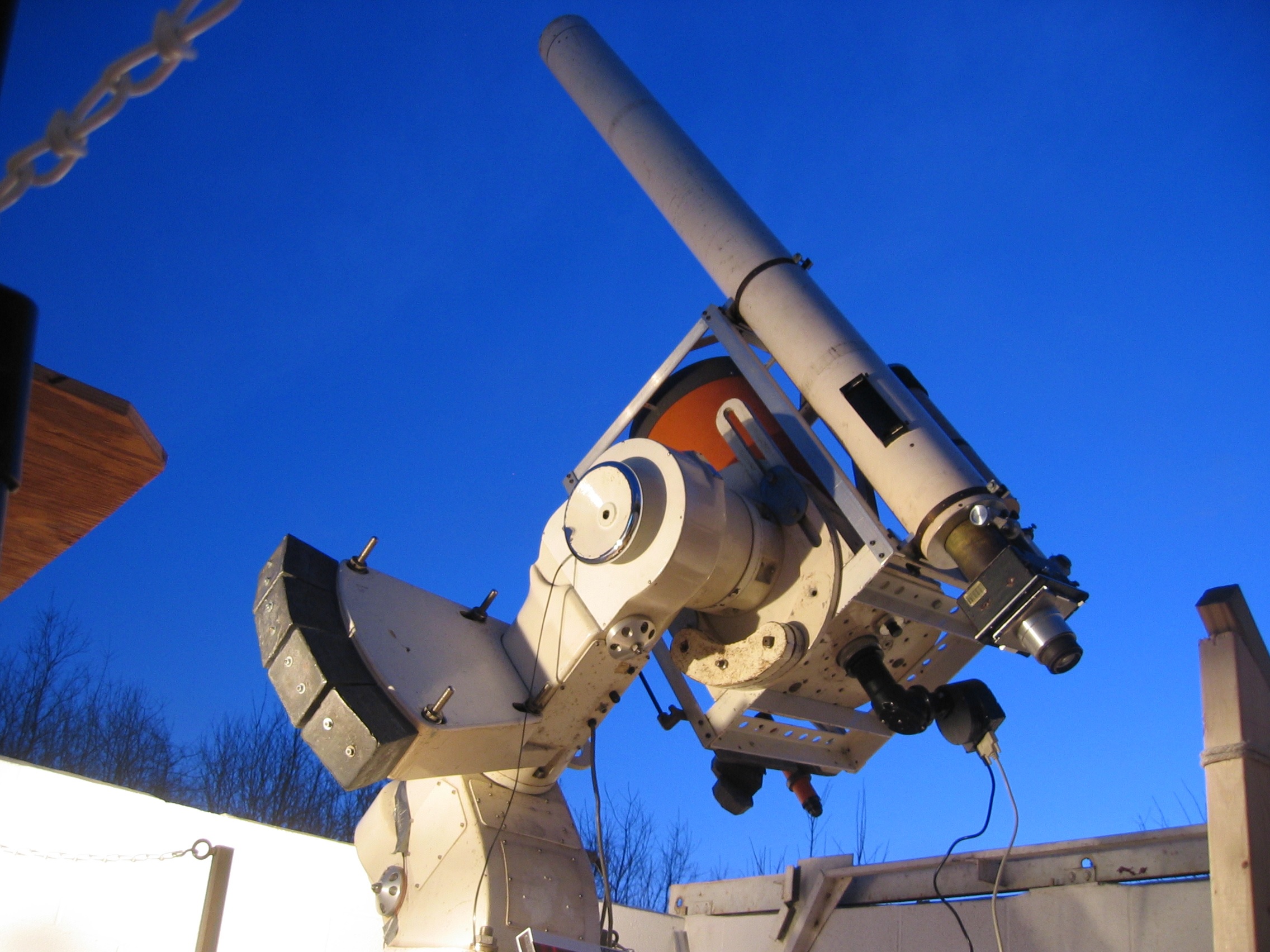
I have been wrestling with this mirror for YEARS. It’s not been easy at all. The blank is only about twice the diameter of an 8″ mirror, but the project is easily 10 times as hard as doing an 8-incher. (Yes, it’s the one in the photo heading this blog!)

Recently I’ve been trying to figure it using a polishing/grinding machine fabricated by the late Bob Bolster (who modeled his after the machine that George Ritchey invented for the celebrated 60″ mirror at Mount Wilson over a century ago). That’s been a learning exercise, as I had to learn by trial and error what the machine can and cannot do, and what strokes produce what effects. The texts and videos I have seen on figuring such a large mirror with a machine have not really been very helpful, so it’s mostly been trial and error.

My best results right now seem to come from using an 8″ pitch tool on a metal backing, with a 15 pound lead weight, employing long, somewhat-oval strokes approximately tangential to the 50% zone. The edge of the tool goes about 5 cm over the edge of the blank.

This little movie shows the best ronchigrams I have ever produced with this mirror, after nearly 6 hours of near-continuous work and testing. Take a look:

Final movie Nov 9

Final movie Nov 9

And compare that to how it used to look back in September:

hill and anomaly on 16

hill and anomaly on 16


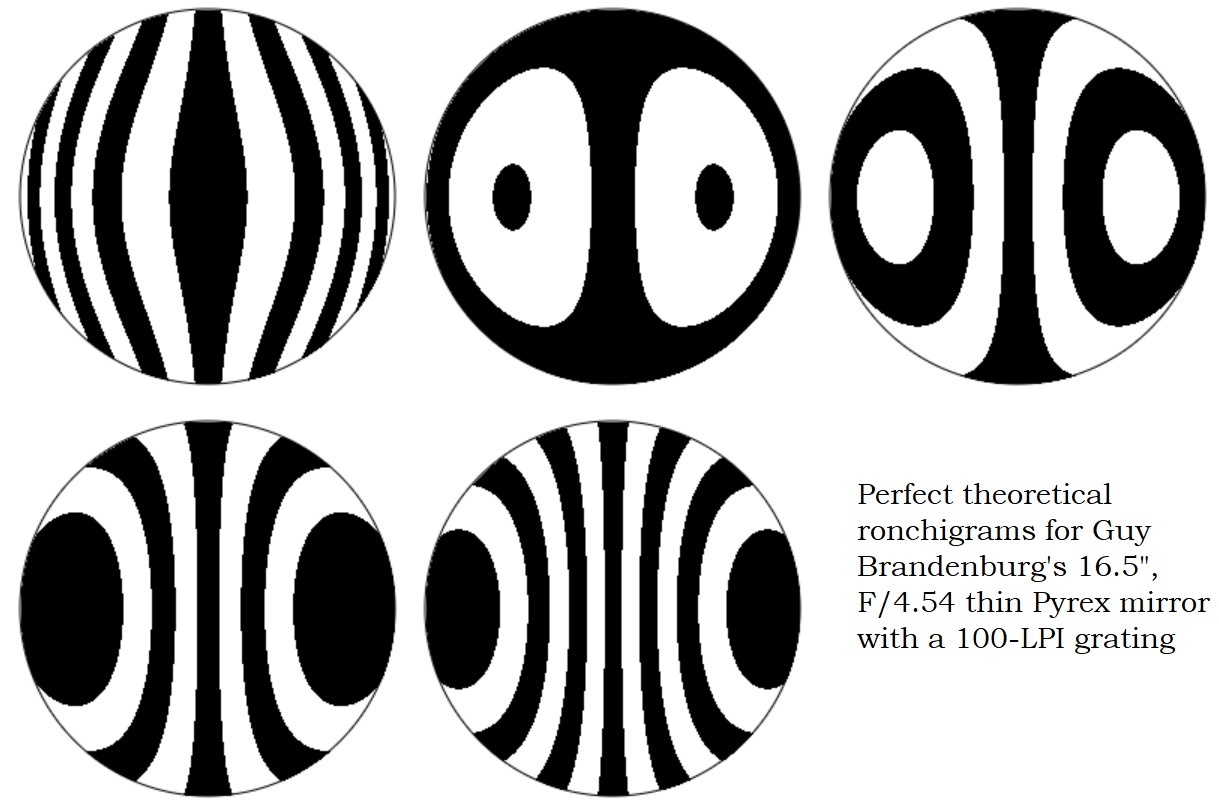
Also compare that to the theoretically perfect computed ronchigrams from Mel Bartels’ website:

perfect theoretical ronchigrams for guy's 42 cm mirror

Part of the reason this mirror has taken so long is that after grinding and polishing by hand some years ago, I finally did a proper check for strain, and discovered that it had some pretty serious strain. I ended up shipping it out to someone in Taos, New Mexico who annealed it – but that changed the figure of the mirror so much that I had to go back to fine grinding (all the way back to 120 or 220 grit, I think), and then re-polishing, all by hand. I tried to do all of that, and figuring of the mirror, at one of the Delmarva Mirror Making Marathons. It was just too much for my back — along with digging drainage ditches at Hopewell Observatory, I ended up in a serious amount of pain and required serious physical therapy (but fortunately, no crutches), so this project went back into storage for a long, long time.

Recently I’ve tried more work by hand and by machine. Unfortunately, when I do work by hand, it seems that almost no matter how carefully I polish, I cause astigmatism (which I am defining as the mirror simply not being a figure of rotation) which I can see at the testing stand as Ronchi lines that are not symmetrical around a horizontal line of reflection. (If a Ronchi grating produces lines that look a bit line the capital letters N, S, o Z, you have astigmatism quite badly. If astigmatism is there, those dreaded curves show up best when your grating is very close to the center of curvature (or center of confusion) of the central zone.

Using this machine means controlling or guessing at a LOT of variables:

  1. length of the first crank;
  2. length (positive or negative) of the second crank;
  3. position of the slide;
  4. diameter of the pitch lap;
  5. composition of the pitch;
  6. shape into which the pitch lap has been carved;
  7. amount of time that the lap was pressed against the lap;
  8. whether that was a hot press or a warm press or a cold press;
  9. amount of weight pushing down on the lap;
  10. type of polishing agent being used;
  11. thickness or dilution of polishing agent;
  12. temperature and humidity of the room;
  13. whether the settings are all kept the same or are allowed to blend into one another (eg by moving the slide);
  14. time spent on any one setup with the previous eleven or more variables;

Here is a sketch of how this works

bolster's ritchey-like machine

Difficulties in Using the Matching Ronchi Test on a 12″ Cassegrain Mirror

08 Saturday Sep 2018

Posted by gfbrandenburg in astronomy, flat, Hopewell Observatorry, optical flat, Optics, Telescope Making

≈ 2 Comments

Tags

Astro Bananas, cassegrain, couder, double pass auto collimation, ealing, foucault, Hopewell Observatory, matching Ronchi, Mel Bartels, Ronchi, ronchigram

The other regulars and I at the DC ATM group at the CCCC have been trying to test a 12 inch Cassegrain mirror and telescope manufactured nearly 50 years ago by a company called Ealing and currently owned by the Hopewell Observatory, of which I am a member. It hasn’t been easy. I discussed this earlier on Cloudy Nights.

Reports from several people, including Gary Hand and the late Bob Bolster, indicated that the optics on this mirror weren’t good at all. Apparently the folks at the University of Maryland’s observatory were sufficiently unhappy with it that they either sold it or gave it to National Capital Astronomers, a local astronomy club, who in turn gave it or sold it to Hopewell Observatory.

With a plain-vanilla Ronchi test, we could see that the mirror was very smooth and continuous, with no turned edge, astigmatism, or bad zones. With the Foucault/Couder zonal test (aka “Foucault” test) , I got results indicating that it was seriously overcorrected: some sort of hyperboloid, rather than the standard paraboloid characteristic of classical Cassegrain telescopes, which have a parabolic primary mirror and a hyperbolic secondary mirror.

However, I have begun losing my faith in my zonal readings, because they often seem to give results that are way out of whack compared to other testing methods.

So we decided to do some additional tests: the Double-Pass Auto-Collimation (DPACT) test used by Dick Parker, as well as the Matching Ronchi test (MRT).

The DPACT is very fiddly and exacting in its setup. We used (and modified) the setup lent to us by Jim Crowley and illustrated by him at his Astro Bananas website. Our results seem to show that the mirror is in fact NOT parabolic, rather, overcorrected, which confirms my Foucault measurements. If it were a perfect paraboloid, then the ronchi lines would be perfectly straight, but they definitely are NOT: they curve one way when inside the focal point, and curve the other when the tester is outside the focal point.

We also tested the entire setup on a radio tower that was about half a mile (~1km) distant. We found that the images were somewhat blurry no matter what we did.

We also attempted the MRT on the same mirror. However, requires very accurate photography and cutting-and-pasting skills in some sort of graphics programs. What you are inspecting is the curvature of the Ronchi lines. Here is the result that Alan T and I got last night:

matching ronchi for 12 inch cass

In black is the ideal ronchigram for this mirror, according to Mel Bartels’ website. The colored picture is the one we made with either my cell phone or the device I finished making earlier this week, shown in my previous post. Here are the two images, separated rather than superimposed:

IMG_1337

ideal ronchigram 12 inch cass ealing

The mirror’s focal length is 47.5″ and the grating has 100 lines per inch, shown somewhat outside of the radius of curvature. The little ‘eyelash’ on the lower left is simply a stray wire that was in the way, and doesn’t affect the image at all. The big hole in the middle is there because the mirror is a cassegrain.

I don’t know about you, but I don’t really see any differences between the real mirror and the theoretical mirror. Do you?

Conclusion

So, what does this all mean?

  • One possibility is that the mirror is in fact perfectly parabolic (as apparently shown by the MRT, but contrary to what I found with Foucault and DPACT) but there is something wrong with the convex, hyperbolic secondary.
  • Another possibility is that the mirror is in fact NOT parabolic, but hyperbolic, as shown by both my Foucault measurements and the DPACT (and contrary to the MRT), which would mean that this telescope was in fact closer to a Ritchey-Chretien; however, since it was marketed as a classical Cassegrain, then the (supposedly) hyperbolic secondary was in fact not tuned correctly to the primary.
  • The answer is left as an exercise for the reader.
  • A star test would be the best answer, but that would require being able to see a star. That hasn’t happened in these parts for quite some time. In addition, it would require an eyepiece holder and a mount of some sort. Or else setting up an indoor star…

Open House at the Hopewell Observatory: Saturday, October 15, 2022

09 Friday Jun 2017

Posted by gfbrandenburg in astronomy, Hopewell Observatorry, science, Telescope Making

≈ 1 Comment

Tags

Haymarket, Hopewell Observatory, invitation, open house, VA

You are all invited, and it’s free. The directions and many other details can be found at a previous post on this blog. 

(Just ignore the date, because it’s no longer 2016! The directions are long, and I didn’t feel like copying and pasting them here.)

Caveat: we do not have running water, so no modern lavatory. We do have bottled water, an outhouse, electricity, and hand sanitizer. This place is really in the middle of the woods, which is where lots of insects and other arthropods live, so keep that in mind. We do have some bug juice you can use, but keep any spray far away from the telescopes!

If you have a telescope of your own, or binoculars, feel free to bring them. A flashlght or headlamp will be useful. We prefer red light at night, since white light makes you night-blind for about 10-20 minutes. If your flashlight(s) put(s) out white light, we have red plastic, tape, scissors, and rubber bands that you can use to shield your light.

When was the last time you spent a night under the stars?

29 Wednesday Jun 2016

Posted by gfbrandenburg in astronomy, astrophysics, Hopewell Observatorry, Telescope Making

≈ Leave a comment

Tags

astronomy, Hopewell Observatory, open house, Telescope

If it’s been a while since you spent time looking up at the heavens with your naked eyes, binoculars and telescopes, looking at planets, stars and galaxies, then this Saturday might be your night.

The Hopewell Observatory is having an open house on Saturday, July 2, 2016, and we have a variety of scopes to look through. Some of the scopes will be under our roll-off roof and some will be rolled out onto the small lawn outside the observatory itself.

Mars, Jupiter and Saturn will be very conveniently placed for viewing right at sundown, and if it’s dry and clear enough, we should be able to see the Milky Way. Many nebulae, open and globular clusters, galaxies, and double or triple stars will be visible as well.

You are invited!  And it’s free!

The location is about an hour due west of Washington DC by way of I-66, near the town of Haymarket, VA. For detailed directions, follow this link, which I posted for one of the dates which got canceled because of bad weather. Ignore the date, but do pay attention to the fact that we have no running water! We have bottled water and a composting toilet and hand sanitizer. Plus makings for coffee, tea, and hot chocolate – all gratis.

picture of hopewell

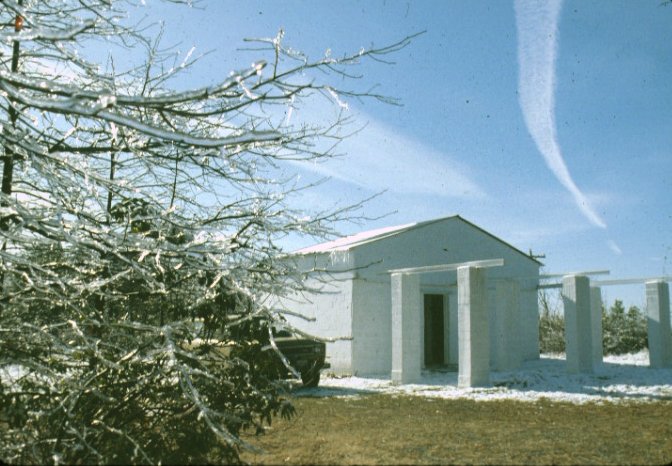
The picture above is of one of our telescope mounts, which carries several telescopes and was set up to take astrophotographs at the time. Below is a picture of the outside of the observatory shortly after a snowstorm.. Notice that there is no dome – instead, the galvanized steel roof rolls back on the rails and columns to the right of the picture when the scopes are in use.

showA13

If you have your own telescope, feel free to bring it. If it needs electricity, we have an outdoor 120VAC outlet, but you should bring your own extension cord and plug strip.  If you want to stay all night, that will be fine, too! If you feel like bringing a cot or a tarpaulin and a sleeping bag, that’s equally OK by us! Show up at or near sunset, and stay until the sun comes up, if you like!

Warning: the area definitely has insects, such as ticks and chiggers, which appear to avoid everybody else and to do their best to attack me. I strongly recommend long pants, shoes/boots, and socks that you can tuck the pants into. Tuck your shirt into your pants as well, and use bug spray, too. I have personally seen plenty of deer, cicadas, moths, wild turkeys, squirrels, and birds, and I have heard from a neighbor that a bear tried to eat his chickens, but other than the insect pests, the wildlife stays out of your way.

Again – for detailed directions, look at this link.

Any Moth Experts Out There?

20 Monday Jun 2016

Posted by gfbrandenburg in nature, science

≈ 1 Comment

Tags

Hopewell Observatory, moth, Telescope, virginia

We found these two beautiful moths that flew into the operations cabin at the Hopewell Observatory a couple of nights ago, and we have no idea what type they are. Never seen them before and can’t find any images identical to them. (One species is similar, though.)

Any suggestions will be welcome.

Ain’t they purty li’l things?

IMG_4996
IMG_5001

And when they opened their wings they were even more spectacular, but I didn’t get a good shot.BTW the yellow-and=red moth is sitting on the struts of a telescope made by Alan Bromborski.

Some sights at or near Hopewell Observatory

25 Monday Apr 2016

Posted by gfbrandenburg in Hopewell Observatorry

≈ Leave a comment

Tags

Hopewell Observatory, Spring

Working on scraping and repainting the observatory roof:

IMG_4532
IMG_4533
IMG_4535


A view to the west:

IMG_4536
IMG_4537

And some nearby pink lady’s slippers:

IMG_4540
IMG_4544

2022 Hopewell Observatory Fall Open House and Star Party, October 15

23 Saturday Apr 2016

Posted by gfbrandenburg in astronomy

≈ 4 Comments

Tags

Hopewell Observatory

2022 Hopewell Observatory

Spring Open House and Star Party

October 15

 
Anybody interested in the night sky, including members of local astro clubs like NCA and NOVAC, are invited to the Fall 2022 astronomical open house and star party at Hopewell Observatory on the night of October 15 (Saturday evening and on into Sunday morning), 2022. Feel free to pass this invitation to friends, neighbors, and family and anybody else you care to notify.

(Note: I am updating this entry, which was originally published in 2016!)

We are located about 30 miles west of the Beltway on Bull Run Mountain – a ridge that overlooks Haymarket VA from an elevation of 1100 feet, near the intersection of I-66 and US-15. Detailed directions are below.

Assuming good weather, you’ll get to see planets, star clusters and nebulae and the Milky Way itself, as well as many other galaxies. If you like, you can bring a picnic dinner and a blanket or folding chairs, and/or your own telescope, if you own one and feel like carrying it. We have outside 120VAC power, if you need it for your telescope drive, but you will need your own extension cord and plug strip. If you want to camp out or otherwise stay until dawn, feel free!

Warning: While we do have bottled drinking water (and will have hot water and the makings for tea, cocoa & coffee) and we do have hand sanitizer, we do not have running water; and, our “toilet” is of the composting variety. Plus, you may want to consider bug spray, since we are completely surrounded and protected by woods. Do check carefully for ticks when you get home. If you do apply insect repellent while visiting, please keep the spray downwind from anybody’s telescopes!!

The road up here is partly paved, and partly gravel or dirt. It’s suitable for any car except those with really low clearance, so leave your fancy sports car (if any) at home. Consider car-pooling, because we don’t have huge parking lots. We will have signs up at various places along the way to help guide you, and will try to have parking spaces denoted.

Two of our telescope mounts are permanently installed in the observatory under a roll-off roof. We have others that we roll out onto the grass in our roughly one-seventh-acre field. We have two 14-inch scopes (one hand-made Dob and one Celestron SCT), 10” f/9 reflecting scope also made by hand. The entire observatory was hand-built, and is maintained, by the labor of its founders and current members.

The drive is about an hour from DC. After parking at a cell-phone tower installation, you will need to hike about 100 yards to our observatory. Physically handicapped people, and any telescopes, can be dropped off at the observatory itself, and then the vehicle will need to go back to park near that tower. To look through some of the various telescopes you will need to climb some stairs or ladders, so keep that in mind when making your plans.

It’s not the inky-scary dark of the Chilean Atacama or the Rockies, but Hopewell Observatory is mostly surrounded by nature preserves maintained by the Bull Run Mountain Conservancy and other such agencies. Also, our Prince William and Fauquier neighbors and officials have done a pretty good job of insisting on smart lighting in the new developments around Haymarket and Gainesville, which benefits everybody. So, while there is a pretty bright eastern horizon because of DC and its VA suburbs, we can still see the Milky Way whenever it’s clear and moonless.

We should also be able to track down and examine many, many deep-sky objects, including the famous Andromeda galaxy and the Orion nebula.

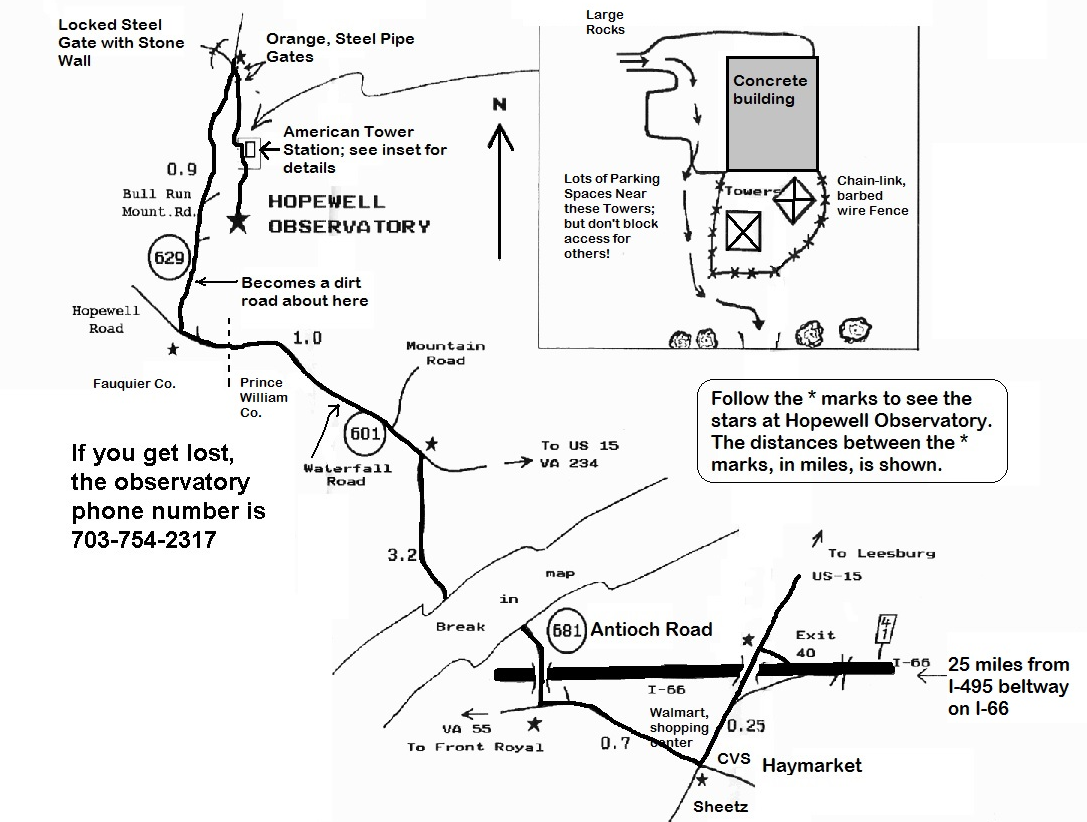
You can find detailed directions and a map to the observatory below:

DIRECTIONS TO HOPEWELL OBSERVATORY:

[Note: if you have a GPS navigation app, then you can simply ask it to take you to 3804 Bull Run Mountain Road, The Plains, VA. That will get you to step 6, below.]

(1) From the Beltway, take I-66 west about 25 miles to US 15 (Exit 40) at Haymarket. At the light at the end of the ramp, turn left/south onto US 15. (Exit is at approximately latitude 38°49’00″N, longitude 77°38’15″W.)

(2) Go 0.25 mi; at the second light turn right/west onto VA Rt. 55. There is a Sheetz gas station & convenience store at this intersection, along with a CVS, a McDonald’s, and a Walmart-anchored shopping center on the NW corner. This is a good place to stop for restrooms or supplies.

(3) After 0.7 mi on Va 55, turn right (north) onto Antioch Rd., Rt. 681. You will pass entrances for Boy Scouts’ Camp Snyder and the Winery at La Grange. (38°49’12″N, 77°39’29″W)

(4) Follow Antioch Rd. to its end (3.2 mi), then turn left (west) onto Waterfall Rd. (Rt. 601), which will become Hopewell Rd. (38°51’32″N, 77°41’10″W)

(5) After 1.0 mi, bear right onto Bull Run Mountain Rd., Rt. 629 (this is beyond Mountain Rd.). This will be the third road on the right, after Mountain Rd. and Donna Marie Ct. (38°52’00″N, 77°42’08″W) Please note that Google Earth and Google Maps show a non-existent road, actually a power line, in between Donna Marie Ct. and Bull Run Mtn. Rd.

(6) In 0.9 mi, enter the driveway on the right, with the orange pipe gate. There is a locked stone and metal gate on the left, opposite our entrance, labeled 3804 Bull Run Mountain Road. Don’t take that road – it goes to an FAA radar dome. Instead, go to the right (east). We’ll have some signs up. This is a very sharp right hand turn. (38°52’36″N, 77°41’55″W)

(7) Follow the narrow paved road up the ridge to the cell phone tower station. You should park around the tower (any side is fine) or in the grassy area before the wooden sawhorse barrier. Then you should walk the remaining hundred meters to the observatory on foot. Be sure NOT to block the right-of-way for automobiles.

(8) If you are dropping off a scope or a handicapped person, move the wooden barrier out of the way temporarily, and drive along the grassy track to the right of the station, into the woods, continuing south, through (or around) a white metal bar gate. The few parking places among the trees near our operations cabin, the small house-like structure in the woods, are reserved for Observatory members. If you are dropping off a handicapped person or a telescope, please do so and then drive your car back and park near the cell phone tower.

Please watch out for pedestrians, especially children! The observatory itself is in the clearing a short distance ahead. We do not have streetlights, and there will not be any Moon to light your way, so a flashlight is a good idea. In the operations cabin we have a supply of red translucent plastic film and tape and rubber bands so that you can filter out everything but red wavelengths on your flashlight. This will help preserve everybody’s night vision. In the cabin we also have a visitor sign-in book; a supply of hot water; the makings of hot cocoa, tea, and instant coffee; hand sanitizer; as well as paper towels, plastic cups and spoons.

The location of the observatory is approximately latitude 38°52’12″N, longitude 77°41’54″W. The drive takes about 45 minutes from the Beltway. A map to the site follows. If you get lost, you can call me on my cell phone at 202 dash 262 dash 4274.

map to hopewell june 2016

Newer posts →

Subscribe

  • Entries (RSS)
  • Comments (RSS)

Archives

  • December 2025
  • November 2025
  • October 2025
  • September 2025
  • July 2025
  • January 2025
  • November 2024
  • October 2024
  • August 2024
  • July 2024
  • May 2024
  • April 2024
  • January 2024
  • December 2023
  • October 2023
  • August 2023
  • June 2023
  • May 2023
  • April 2023
  • November 2022
  • October 2022
  • August 2022
  • July 2022
  • June 2022
  • May 2022
  • April 2022
  • February 2022
  • January 2022
  • December 2021
  • October 2021
  • September 2021
  • August 2021
  • July 2021
  • June 2021
  • May 2021
  • March 2021
  • December 2020
  • October 2020
  • September 2020
  • August 2020
  • March 2020
  • February 2020
  • January 2020
  • December 2019
  • November 2019
  • September 2019
  • August 2019
  • June 2019
  • May 2019
  • January 2019
  • November 2018
  • October 2018
  • September 2018
  • August 2018
  • May 2018
  • March 2018
  • January 2018
  • November 2017
  • October 2017
  • September 2017
  • August 2017
  • July 2017
  • June 2017
  • May 2017
  • April 2017
  • February 2017
  • December 2016
  • September 2016
  • June 2016
  • May 2016
  • April 2016
  • March 2016
  • February 2016
  • January 2016
  • December 2015
  • November 2015
  • August 2015
  • July 2015
  • April 2015
  • March 2015
  • February 2015
  • January 2015
  • December 2014

Categories

  • astronomy
  • astrophysics
  • education
  • flat
  • History
  • Hopewell Observatorry
  • Math
  • monochromatic
  • nature
  • optical flat
  • Optics
  • Safety
  • science
  • teaching
  • Telescope Making
  • Uncategorized

Meta

  • Create account
  • Log in

Blog at WordPress.com.

  • Subscribe Subscribed
    • Guy's Math & Astro Blog
    • Join 53 other subscribers
    • Already have a WordPress.com account? Log in now.
    • Guy's Math & Astro Blog
    • Subscribe Subscribed
    • Sign up
    • Log in
    • Report this content
    • View site in Reader
    • Manage subscriptions
    • Collapse this bar
 

Loading Comments...