For many years now, I have been trying and (mostly) failing at using some sort of digital camera when testing the optics of the mirrors we fabricate and evaluate at the ATM workshop at the Chevy Chase Community Center here in DC.
I can now report that there finally is some useful and non-vignetted light at the end of the testing tunnel!
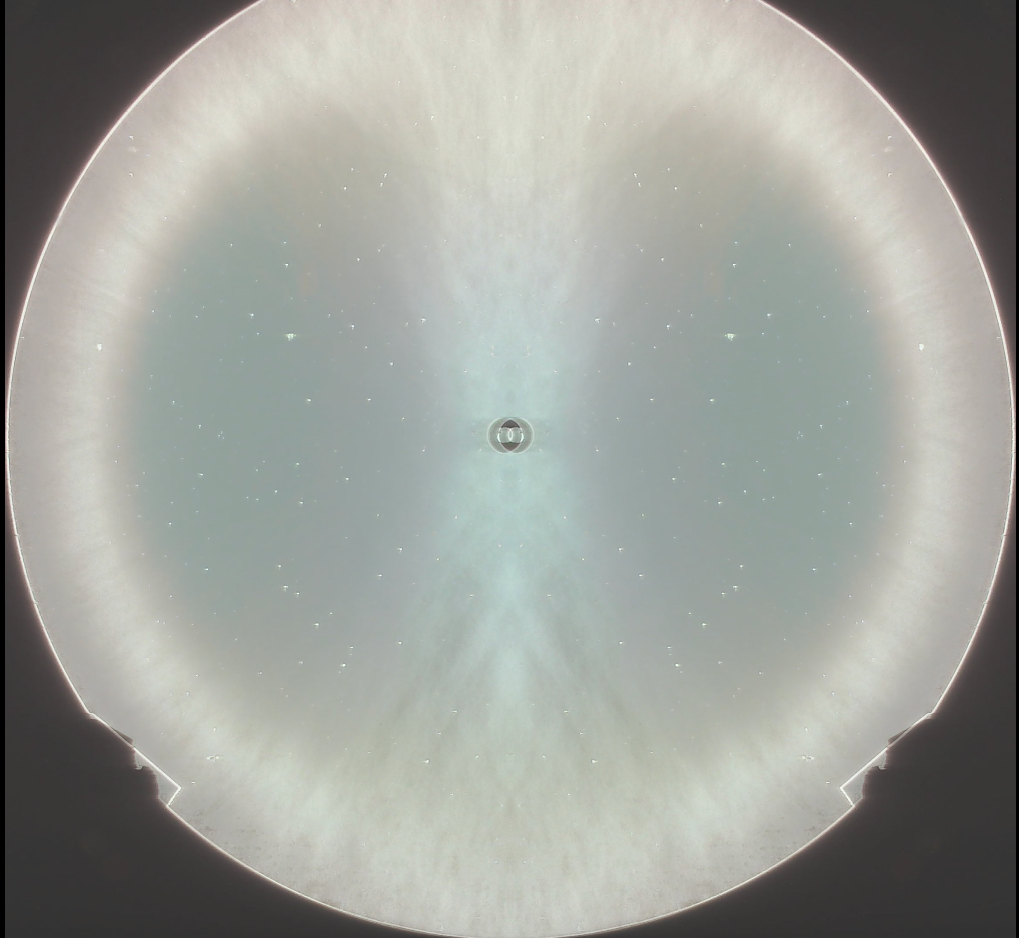
Foucault, knife-edge image, raw
Same mirror, at a different longitudinal location, image flipped right to left (ie across the y-axis), and then pasted onto the original image
Same mirror, same location as the image directly above, with circles and measurements added in Geometer’s Sketchpad
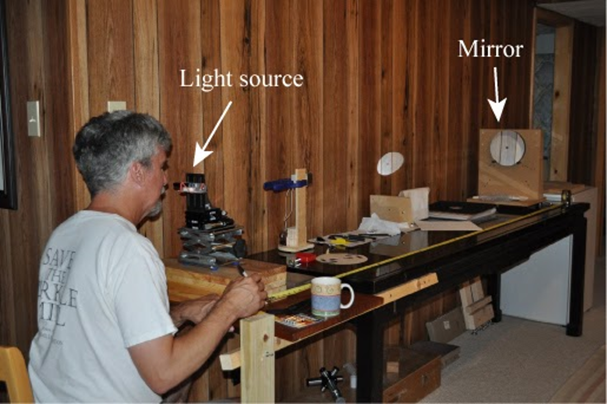
I used an old Canon FD film camera lens (FL=28 mm) that I got about 40 years ago and haven’t used in several decades to get a bunch of really nice knife-edge images of a 16″ Meade mirror, located on a stage that can be moved forward and back in whatever steps I like by a smartphone app and a stepper motor setup that Alan Tarica and Pratik Tambe designed and put together.
Just now, I finally figured out how to use IrfanView to take one of the images, flip it left-to-right (that is, across the y-axis) and superimpose one onto the other with 50% transparency. A bright ring appeared, which shows the circular ring or zone where the light from our LED, located just under the camera lens, goes out to the mirror and bounces directly back to the lens and is captured by the sensor as a bright ring.
I then captured and pasted that image into Geometer’s Sketchpad, which I used to draw and measure the radii of two circles, centered at the doughnut marking the center of the mirror. This is a somewhat crude measurement of the radii, but it appears that this zone is is at 83% of the diameter (or radius) of the original disk, which is 16 inches across.
Now I just need to do the same thing for all of the other images, and then correlate the radii of the bright zones with the longitudinal (z-axis) motion of the camera and stand, and I will know how close this mirror is to a perfect paraboloid.
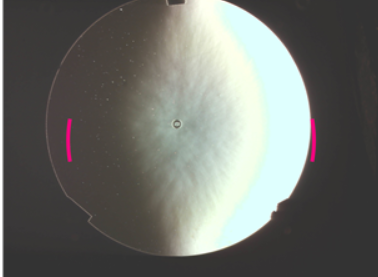
There is an app that supposedly does this for you, called Foucault Unmasked, but it doesn’t seem to work well at all. As you can see from these images, FU is unable to find zones that are symmetrically placed on either side of the center of the mirror. I don’t know what algorithm FU uses, but it sure is f***ed up.
Foucault Unmasked thinks that those two red marks are the zone being measured here. It’s pretty hard to be more wrong than that.
Again, FU at work, badly. Not quite as awful as the previous one, but still quite useless!
Thanks a lot to Tom Crone, Gert Gottschalk, Pratik Tambe, Alan Tarica, and Alin Tolea for their help and suggestions!
Several people have helped me with this applied geometry problem, but the person who actually took the time to check my steps and point out my error was an amazing 7th grade math student I know.
It involves optical testing for the making of telescope mirrors, which is something I find fascinating, as you may have guessed. Towards the end of this very long post, you can see the corrections, if you like.
Optics themselves are amazingly mysterious. Is light a wave, or a particle, or both? Why can nothing go faster than light? We forget that humans have only very recently discovered and made use of the vast majority of the electromagnetic spectrum that is invisible to our eyes.
But enough on that. At the telescope-making workshop here in DC, I want folks to be able to make the best ordinary, parabolized, and coated mirrors possible with the least amount of hassle possible and at the lowest possible cost. Purchasing high-precision, very expensive commercial interferometers to measure the surface of the mirror is out of the question, but it turns out that very inexpensive methods have been developed for doing that – at least on Newtonian telescopes.
Tom Crone, a friend of mine who is also a fellow amateur astronomer and telescope maker, wondered how on earth we can report mirror profiles as being within a few tens of nanometers of a perfect paraboloid with such simple devices as a classic Foucault knife-edge test.
He told me his computations suggested to him that the best we could do is get it to within a few tenths of a millimeter at best, which is four orders of magnitude less precise!
I assured him that there was something in the Foucault test which produced this ten-thousand-fold increase in accuracy, but allowed that I had never tried to do the complete calculation myself. I do not recall the exact words of our several short conversations on this, but I felt that I needed to accept this as a challenge.
When I did the calculations which follow, I found, to my surprise, that one of the formulas I had been taught and had read about in many telescope-making manuals, was actually not exact, and that the one I had been told was inherently less accurate, was, in fact, perfectly correct! Alan Tarica sent me an article from 1902supposedly explaining the derivation of a nice Foucault formula, but the author skipped a few bunch of important steps, and I don’t get anything like his results. it took me a lot of work, and help from this rising 8th grader, to find and fix my algebra errors. I now agree with the results of the author , T.H.Hussey.
I am embarrassed glad to say that even after several weeks of pretty hard work, an exact, correct formula for one of the commonly used methods for measuring ‘longitudinal aberration’ still eludes me. was pointed out to me by a student who took the time to Let’s see if anybody can follow my work and helped me out on the second method.
But first, a little background information.
Isaac Newton and Leon Foucault were right: a parabolic mirror is the easiest and cheapest way to make a high-quality telescope.
If you build or buy a Newtonian scope, especially on an easy-to-build Dobsonian mount, you will get the most high-quality photons for the money and effort spent, if you compare this type with any other type of optics at the same diameter. (Optical designs like 8-inch triplet apochromats or Ritchey-Chrétiens, or Maksutovs, or modern Schmidt-Cassegrains can cost many thousands of dollars, versus a few hundred at most for a decent 8″ diameter Newtonian).
With a Newtonian, you don’t need special types of optical glass whose indices of refraction and dispersion, and even chemical composition, must be known to many decimal places. The glass can even have bubbles and striations, or not even be transparent at all! Any telescope that only has mirrors, like a Newtonian, will have no chromatic aberration (ie, you don’t see rainbows around bright stars) because there is no refraction – except for inside your eyepieces and in your eyeball. All wavelengths of light reflect exactly the same –but they bend (refract) through glass or other materials at different angles depending on the wavelength.
Another advantage for Newtonians: you don’t need to grind and polish the radii of curvature of your two or three pieces of exotic glass to exceedingly strict tolerances. As long as you end up with a nice parabolic figure, it really doesn’t matter if your focal length ends up being a few centimeters or inches longer or shorter than you had originally planned. Also: there is only one curved mirror surface and one flat one, so you don’t need to make certain that the four or more optical axes of your mirrors and/or lenses are all perfectly parallel and perfectly concentric. Good collimation of the primary and secondary mirrors to the eyepiece helps with any scope, but it’s not nearly as critical in a Newtonian, and getting them to line up if they get knocked out of whack is also much easier to perform.
With a Newtonian, you only need to get one surface correct. That surface needs to be a paraboloid, not a section of a sphere. (Some telescopes require elliptical surfaces, or hyperbolic or spherical ones, or even more exotic geometries. A perfect sphere is the easiest surface to make, by the way.)
In the 1850’s, Leon Foucault showed how to ‘figure’ a curved piece of glass into a sufficiently perfect paraboloid and then to cover it with a thin, removable layer of extremely reflective silver. The methods that telescope makers use today to make sure that the surface is indeed a paraboloid are variations and improvements on Foucault’s methods, which you can read for yourself in my translation.
Jim Crowley performing a Foucault test
It turns out that the parabolic shape does need to be very, very accurate. In fact, over the entire surface of the mirror, other than scratches and particles of dust, there should be no areas that differ from each other and from the prescribed geometric shape by more than about one-tenth of a wavelength of green light (which I will call lambda for short), because otherwise, instead of a sharp image, you just receive a blur, because the high points on the sine waves of the light coming to you would tend to get canceled out by the low points.
Huh?
Let me try to explain. In my illustrations below, I draw two sine waves (one red, one green) that have the same exact frequency and wavelength (namely, two times pi) and the same amplitude, namely 3. They are almost perfectly in phase. Their sum is the dark blue wave. In diagram A, notice that the dark blue wave has an amplitude of six – twice as much as either the red or green sine wave. This means the blue and green waves added constructively.
Next, in diagram B, I draw the red and green waves being out of phase by one-tenth of a wave (0.10 lambda) , and then in diagram C they are ‘off’ by ¼ of a wave (0.25 lambda). You will notice that in the diagrams B and C, the dark blue wave (the sum of the other two) isn’t as tall as it was in diagram A, but it’s still taller than either the red or green one.
One-quarter wave ‘off’ is considered the maximum amount of offset allowed. Here is what happens if the amount of offset gets larger than 1/4:
In diagram D, the red and green curves differ by 1/3 of a wave (~0.33 lambda), and you notice that the blue wave (which is the sum of the other two) is exactly as tall as the red and green waves, which is not good.
Diagram E shows what happens is what happens when the waves are 2/5 (0.40 lambda) out of phase – the blue curve, the sum of the other two, now has a smaller amplitude than its components!
And finally, if the two curves differ by ½ of a wave (0.5 lambda) as in diagram F, then the green and red sine curves cancel out completely – the dark blue curve has become the x-axis, which means that you would only see a blur instead of a star or a planet. This is known as destructive interference, and it’s not what you want in your telescope!
But how on earth do we achieve such accuracy — one-tenth of the wavelength of visible light (λ/10) over an entire surface? And if we do, what does it mean, physically? And why one-tenth λ on the surface of the mirror, when ¼ λ looked pretty decent? For that last question, the reason is that when light bounces off a mirror, any deviations are multiplied by 2. So lambda – about 55 nanometers or 5.5×10^(-8) m- is the maximum allowable depth or height of a bump or a hollow across the entire width of the mirror. That’s really small! How small? Really insanely small.
Let’s try to visualize this by enlarging the mirror. At our mirror shop, we generally help folks work on mirrors whose diameters are anywhere from 11 cm (4 ¼ inches) to 45 cm (18 inches) across. Suppose we could magically enlarge an 8” (20 cm) mirror and blow it up so that it has the same diameter as the original 10-mile (16 km) square surveyed in 1790 by the Ellicott brothers and Benjamin Banneker for the 1790 Federal City. (If you didn’t know, the part on the eastern bank of the Potomac became the District of Columbia, and the part on the western bank was given back to Virginia back in 1847. That explains why Washington DC is no longer shaped like a nice rhombus/diamond/square.)
So imagine a whole lot of earth-moving equipment making a large parabolic dish where DC used to be, a bit like the Arecibo radio telescope, but about 50 times the diameter, and with a parabolic shape, unlike the spherical one that Arecibo was built with.
(Technical detail: since Arecibo was so big, there was no way to physically steer it around at desired targets in the sky. Since they couldn’t steer it, then a parabolic mirror would be useless except for directly overhead. However, a spherical mirror does NOT have a single focal point. So the scope has a movable antenna (or ‘horn’) which can move around to a variety of more-or-less focal points, which enabled them to aim the whole device a bit off to the side, so they can ‘track’ an object for about 40 minutes, which means that it can aim at targets around 5 degrees in any direction from directly overhead, but the resolution was probably not as good as it would have been if it had a fully steerable, parabolic dish. See the following diagrams comparing focal locations for spherical mirrors vs parabolic mirrors. Note that the spherical mirror has a wide range of focal locations, but the parabolic mirror has exactly one focal point.)
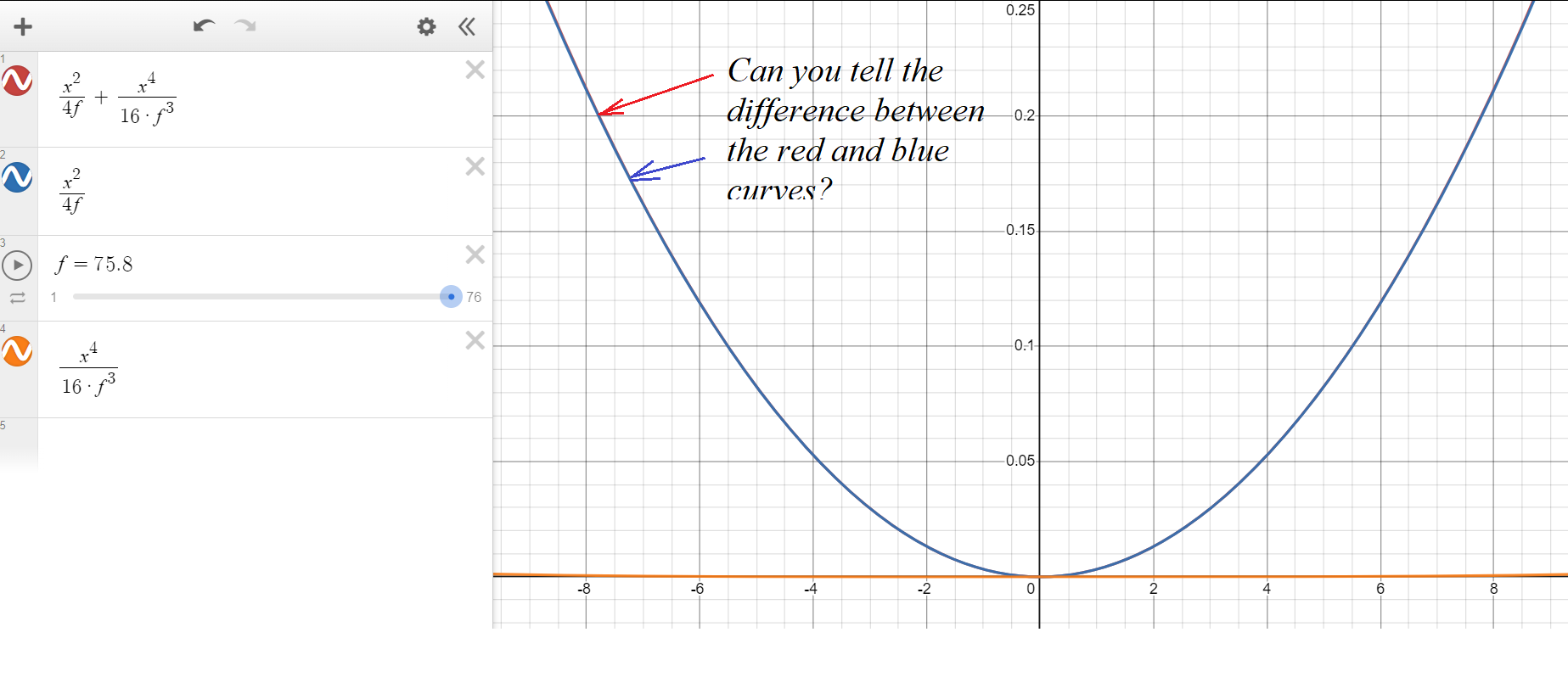
I’ll use the metric system because the math is easier. In enlarging a 20 cm (or 0.20 m) mirror all the way to 16 km (which is 16 000 m), one is multiplying 80,000. So if we take the 5.5×10⁻⁸ m accuracy and multiply it by eighty thousand you get 44 x 10-4 m, which means 4.4 millimeters. So, if our imaginary, ginormous 16-kilometer-wide dish was as accurate, to scale, as any ordinary home-made or commercial Newtonian mirror, then none of the bumps or valleys would be more than 4.4 millimeters too deep or too high. For comparison, an ordinary pencil is about 6.8 millimeters thick.
Wow!
So that’s the claim, but now let’s verify this mathematically.
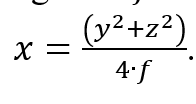
I claim that such a 3-dimensional paraboloid, like the radio dish in the picture below, can be represented by the equation
where f represents the focal length. (For simplicity, I have put the vertex of the paraboloid at the origin, which I have called A. I have decided to make the x-axis (green, pointing to our right) be the optical and geometric axis of the mirror. The positive z-axis (also green) is pointed towards our lower left, and the y-axis (again, green) is the vertical one. The focal point is somewhere on the x-axis, near the detector; let’s pretend it’s at the red dot that I labeled as Focus.)
You may be wondering where that immediately previous formula came from. Here is an explanation:
Let us define a paraboloid as the set (or locus) of all points in 3-D space that are equidistant from a given plane and a given focal point, whose coordinates I will arbitrarily call (f, 0, 0). (When deciding on a mirror or radio dish or reflector on a searchlight, you can make the focal length anything you want.)
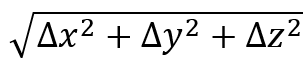
To make it simple, the plane in question will be on the opposite side of the origin; its equation is x = -f. We will pick some random point G anywhere on the surface of the parabolic dish antenna and call its coordinates (x, y, z). We will see what equation these conditions create. We then drop a perpendicular from G towards the plane with equation x = -f. Where this perpendicular hits the plane, we will call point H, whose coordinates are (-f, y, z). We need for distance GH (from the point to the plane) to equal distance from G to the Focus. Distance GH is easy: it’s just f + x. To find distance between G and Focus, I will use the 3-D distance formula:
Which, after substituting, becomes
To get rid of the radical sign, I will equate those two quantities, because FG = GH, omit the zeroes, and square both sides. I then get
Multiplying out both sides, we get
Canceling equal stuff on both sides, I get
Adding 2fx to both sides, and dividing both sides by 4f, I then get
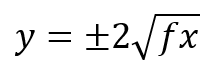
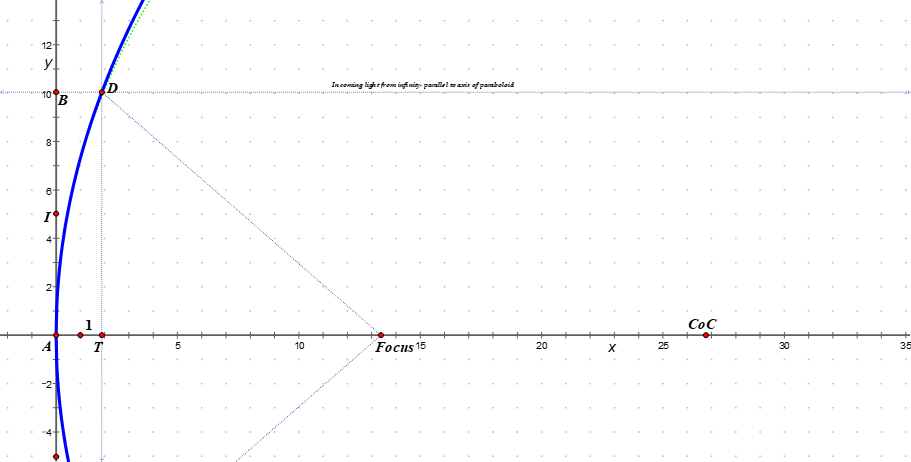
However, 3 dimensions is harder than 2 dimensions, and two dimensions will work just fine for right now. Let us just consider a slice through this paraboloid via the x-y plane, as you see below: a 2-dimensional cross-section of the 3-dimensional paraboloid, sliced through the vertex of the paraboloid, which you recall is at the origin. We can ignore the z values, because they will all be zero, so the equation for the blue parabola is
or, if you solve it for y, you get
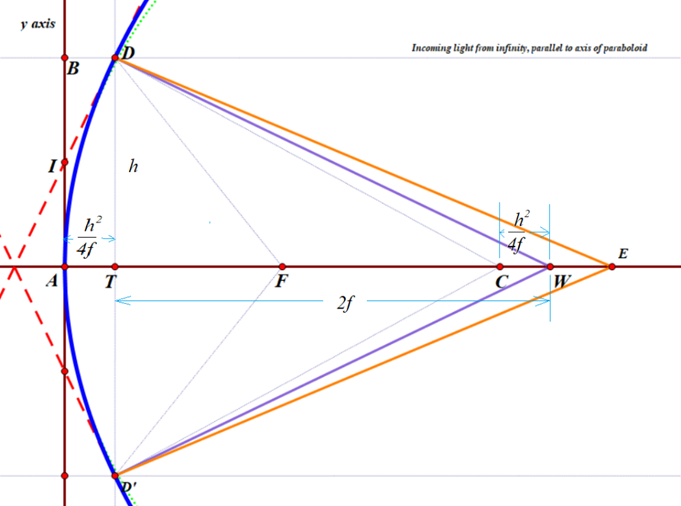
There is a circle with almost the same curvature as the paraboloid; its center, labeled CoC (for ‘Center of Curvature’) is exactly twice as far from the origin as the focal point. You can just barely see a green dotted curve representing that circle, towards the top of the diagram, just to the right of the blue paraboloid. center of the circle (and sphere). Its radius is 2f, which obviously depends on the location of the Focus.
D is a random point on that parabola, much like point G was earlier, and D’ being precisely on the opposite side of the optical axis. The great thing about parabolic mirrors is that every single incoming light ray coming into the paraboloid that is parallel to the axis will reflect towards the Focus, as we saw earlier. Or else, if you want to make a lamp or searchlight, and you place a light source at the focus, then all of the light that comes from it that bounces off of the mirror will be reflected out in a parallel beam that does not spread out.
In my diagram, you can see a very thin line, parallel to the x-axis, coming in from a distant star (meaning, effectively at infinity), bouncing off the parabola, and then hitting the Focus.
I also drew two red, dashed lines that are tangent to the paraboloid at point D and D’. I am calling the y-coordinate of point D as h (D has y-coordinate -h)and the x-coordinate of either one is
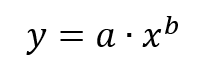
I used basic calculus to work out the slope of the red, dashed tangent line ID. (Quick reminder, if you forgot: in the very first part of most calculus classes, students learn that the derivative, or slope, of any function such as this:
is given by this:
So for the parabola with equation
the slope can be found for any value of x by plugging that value into the equation
Since
the exponent b is one-half. Therefore, the slope is going to be
which simplifies to
Now we need to plug in the x coordinate of point D, namely
we then get that the slope is
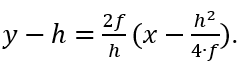
To find the equation of the tangent line, I used the point-slope formula y – y1=m(x – x1). ; plugging in my known values, I got the result
To find where this hits the y-axis, I substituted 0 for x, and got the result that the tangent line hits the y-axis at the point (0, h/2) — which I labeled as I — or one-half of the distance from the vertex (or origin) to the ‘height’ of the zone, or ring, being measured.
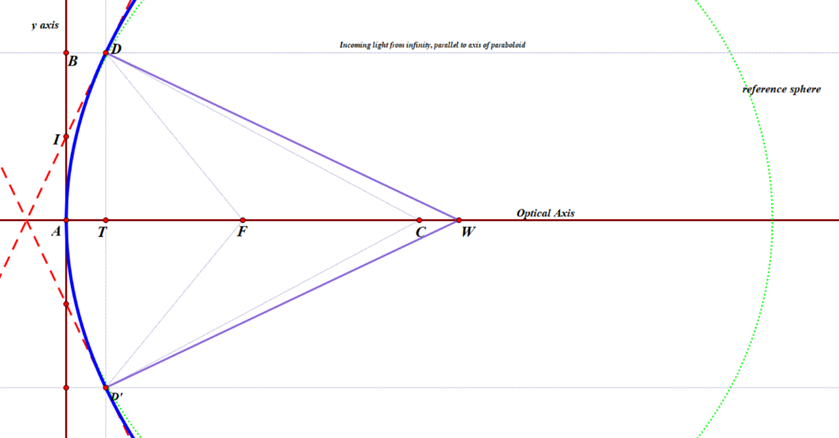
Line DW is constructed to be perpendicular to that tangent, so any beam of light coming from W that hits the parabola at point D will be reflected back upon itself. Perpendicular lines have slopes equal to the negative reciprocal of the other. Since the tangent has slope 2f/h, then line DW has slope -h/(2f).
Plugging in the known values into the point-slope formula, the equation for DW is therefore
Here, I am interested in the value of x when y = 0. Substituting, re-arranging, and solving for x, I get
Recall that point C is precisely 2f units from the origin, which means that the perpendicular line DW hits the x axis at a point that is the same distance from the center of curvature CoC as the point D is from the y-axis!
Or, in other words, CW = AT = DE. This means: if you are testing a parabolic mirror with a moving light source at point W, then a beam of light from W that is aimed at point D on the paraboloid will come right back to W, and the longitudinal readings of distance will follow the rule h2/(4f), where h is the radius of the zone, or ring, that you are measuring. Other locations on the mirror which do not lie in that ring will not have that property. This then is the derivation of the formula I was taught over 30 years ago by Jerry Schnall, and found in many books on telescope making – namely that for a moving light source, since R=2f,
where LA means ‘longitudinal aberration and the capital R is the radius of curvature of the mirror, or twice the focal length. So that’s exactly the same as what I computed.
HOWEVER, this formula [ LA=h^2/(2R) ] does not work at all if your light source is fixed at point C, the center of curvature of the green, reference sphere. In the old days, before the invention of LEDs, the light sources were fairly large and rather hot, so it was easier to make them stationary, and the user would move the knife-edge back and forth, but not the light source. The formula I was given for this arrangement by my mentor Jerry Schnall, and which is also given in numerous sources on telescope making was this:
that is, exactly twice as much as for a moving light source. I discovered to my surprise that this is not correct, but it took me a while to figure this out. I originally wrote the following:
But now I can confirm this, thanks in part to two of my very mathematically inclined 8th grade geometry students. Here goes, as corrected:
If one is using a fixed light source located at the center of curvature C, and a moving knife-edge, located at point E, the the rays of light that hit the same point D will NOT bounce straight back, because they don’t hit the tangent line at precisely 90 degrees. Instead, the angle of incidence CDW will equal the angle of reflection, namely WDE. I used Geometer’s sketchpad to construct line DE by asking the software to reflect line CD over the line DW.
However, calculating an algebraic expression for the x-coordinate of point E was surprisingly complicated. See if you can follow along!
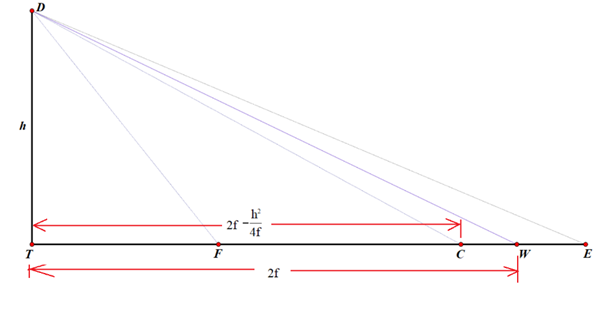
To find the x-coordinate of E, I will employ the tangent of angle TDE.
To make the computations easier, I will draw a couple of simplified diagrams that keep the essentials.
I also tried other approaches, and also got answers that made no sense. It looks like the formula in the 1902 article is correct, but I have not been able to confirm it.
I suspect I made a very stupid and obvious algebra mistake that anybody who has made it through pre-calculus can easily find and point out to me, but I have had no luck in finding it so far. I would love for someone did to point it out to me.
A decade or so ago, I bought a brand-new Personal Solar Telescope from Hands On Optics. It was great! Not only could you see sunspots safely, but you could also make out prominences around the circumference of the sun, and if sky conditions were OK, you could make out plages, striations, and all sorts of other features on the Sun’s surface. If you were patient, you could tune the filters so that with the Doppler effect and the fact that many of the filaments and prominences are moving very quickly, you could make them appear and disappear as you changed the H-alpha frequency ever so slightly to one end of the spectrum to the other.
However, as the years went on, the Sun’s image got harder and harder to see. Finally I couldn’t see anything at all. And the Sun got quiet, so my PST just sat in its case, unused, for over a year. I was hoping it wasn’t my eyes!
I later found some information at Starry Nights on fixing the problem: one of the several filters (a ‘blocking’ or ‘ITF’ filter) not far in front of the eyepiece tends to get oxidized, and hence, opaque. I ordered a replacement from Meier at about $80, but was frankly rather apprehensive about figuring out how to do the actual deed. (Unfortunately they are now out of stock: https://maierphotonics.com/656bandpassfilter-1.aspx )
I finally found some threads on Starry Nights that explained more clearly what one was supposed to do ( https://www.cloudynights.com/topic/530890-newbie-trouble-with-coronado-pst/page-4 ) and with a pair of taped-up channel lock pliers and an old 3/4″ chisel that I ground down so that it would turn the threads on the retaining ring, I was able to remove the old filter and put in the new one. Here is a photo of the old filter (to the right, yellowish – blue) and the new one, which is so reflective you can see my red-and-blue cell phone with a fuzzy shiny Apple logo in the middle.
This afternoon, since for a change it wasn’t raining, I got to take it out and use it.
About a week week ago, the right ascension (or RA) drive on a vintage mount at the Hopewell Observatory stopped working. Instead of its usual hum, it began making scraping noises, and then ground to a halt. (This drive is the one that allows one to track the stars perfectly as the earth slowly rotates.)
Another member and I carefully removed the drive mechanism, and I took it home. At first, I thought it was the motor itself, but after examining it carefully, I noticed that some clutch pads inside the gearbox had come unglued, causing the clutch plates to be cockeyed. The motor itself worked just fine when disconnected from the gear box.
I recalled that the pads and the clutch had been very problematic, and that our resident but now-deceased electro-mechanical-optical wizard Bob Bolster had had to modify the gearbox quite a bit. I carefully disassembled the gearbox and used acetone to remove all the old glue that he had used to glue the pads on. After doing some research to find some equivalent pad material, I yesterday ordered some new gasket material with adhesive backing from McMaster-Carr. Lo and behold, I received it TODAY! Wow!
I cut out new pads, re-assembled everything, and the gears and worm drive work just fine. Not only that: there were no screws or nuts left over!
In addition, I now see how we can replace the extremely complicated partially-analog clutch-and-drive mechanism, in both RA and in Declination with a much simpler stepper-motor system using something called OnStep.
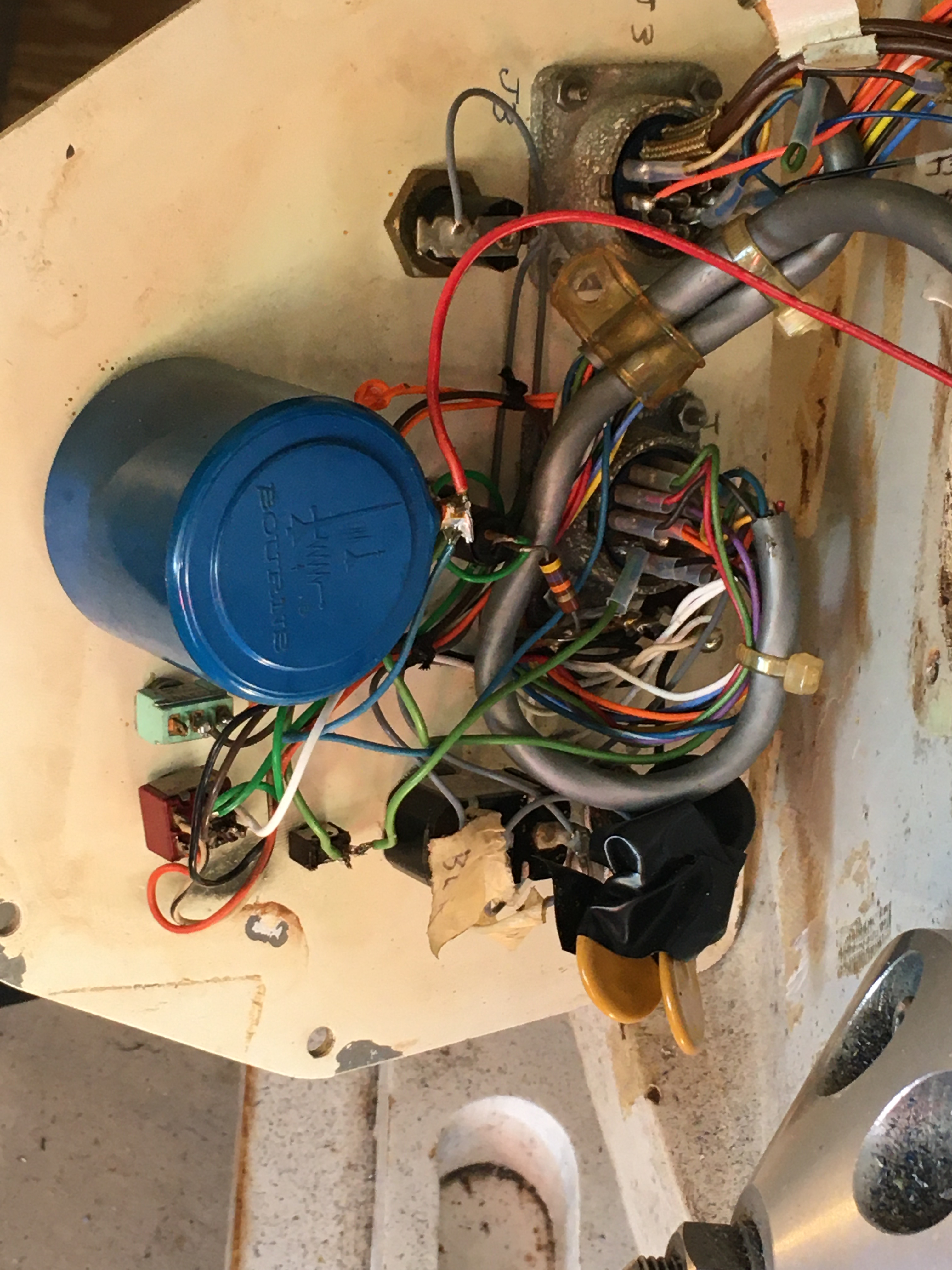
Here is a photo of the some of the innards of the scope:
A bit complicated, no?
In the next photo, my pencil is pointing to the clutch pads inside the gear box that had come loose, causing the clutch plates to become cockeyed, jamming the gears. The clutch is so that the observer can ever-so-slightly tweak the telescope forward or backwards in RA, in order to center the target. There is another gearbox for the declination, but it’s still working OK, so we left it alone.
The synchronous gear-motor in the background. My pencil is pointing to the problem.
Of course, we still have to re-install the gearbox back in the scope.
Bob Bolster, mentioned above, was one of the founding members of the Hopewell Observatory. He was an absolute wizard at fixing things and keeping this telescope mount going, but he is no longer alive. I was afraid that I would not be able to fix this problem, but it looks like I’ve been successful.
I append an image of a very beautifully-refurbished Ealing telescope and mount – similar to the one owned by Hopewell – that belongs to the Austin Astronomical Society. Ours is so much more beat up than this one that it’s embarrassing! Plus, both we and the University of Maryland were unable to get the telescope itself, which is a Ritchey-Chretien design, ever to work properly. So we sold the mirror and cell to a collector in Italy for a pittance, and installed four other, smaller scopes on the mount instead.
Many years ago, the late Bob Bolster, a founding member of Hopewell Observatory and an amazing amateur telescope maker, got hold of a large piece of glass, perhaps World War Two military surplus left over from the old Bureau of Standards.
I have no idea what it is made out of. If Bob had any clue about its composition, he didn’t tell anyone.
Its diameter is 22 inches, and its thickness is about 3.25″. It has a yellowish tint, and it is very, very heavy.
If you didn’t know, telescope lenses (just like binocular or camera lenses) are made from a wide variety of ingredients, carefully selected to refract the various colors of light just so. Almost all glass contains quartz (SiO2), but they can also contain limestone (CaCO3), Boric oxide (B2O3), phosphates, fluorides, lead oxide, and even rare earth elements like lanthanum or thorium. This linkwill tell you more than you need to know.
If you are making lenses for a large refracting telescope, you need to have two very different types of glass, and you need to know their indices of refraction very precisely, so that you can calculate the the exact curvatures needed so that the color distortions produced by one lens will be mostly canceled out by the other piece(s) of glass. This is not simple! The largest working refractor today is the Yerkes, with a diameter of 40 inches (~1 meter). By comparison, the largest reflecting telescope made with a single piece of glass today is the Subaru on Mauna Kea, with a diameter of 8.2 meters (323 inches).
For a reflecting telescope, one generally doesn’t care very much what the exact composition of the glass might be, as long as it doesn’t expand and contract too much when the temperature rises or falls.
We weren’t quite sure what to do with this heavy disk, but we figured that before either grinding it into a mirror or selling it, we should try to figure out what type of glass it might be.
Several companies that produce optical glass publish catalogs that list all sorts of data, including density and indices of refraction and dispersion.
Some of us Hopewell members used a bathroom scale and tape measures to measure the density. We found that it weighed about 130 pounds. The diameter is 22 inches (55.9 cm) and the thickness is 3 and a quarter inches (8.26 cm). Using the formula for a cylinder, namely V = pi*r2*h, the volume is about 1235 cubic inches or 20,722 cubic centimeters. Using a bathroom scale, we got its weight to be about 130 lbs, or 59 kg (both +/- 1 or 2). It is possible that the scale got confused, since it expects two feet to be placed on it, rather than one large disk of glass.
However, if our measurements are correct, its density is about 2.91 grams per cc, or 1.68 ounces per cubic inches. (We figured that the density might be as low as 2.80 or as high as 3.00 if the scale was a bit off.)
It turns out that there are lots of different types of glass in that range.
Looking through the Schott catalog I saw the following types of glass with densities in that range, but I may have missed a few.
2.86 N-SF5
2.86 M-BAK2
2.89 N-BAF4
2.90 N-SF8
2.90 P-SF8
2.91 N-PSK3
2.92 N-SF15
2.93 P-SF69
2.94 LLF1
2.97 P-SK58A
3.00 N-KZFS5
3.01 P-SK57Q1
By comparison, some of the commonest and cheapest optical glasses are BAK-4 with density 3.05 and BK-7 with density 2.5.
Someone suggested that the glass might contain radioactive thorium. I don’t have a working Geiger counter, but used an iPhone app called GammaPix and it reported no gamma-ray radioactivity at all, and I also found that none of the glasses listed above (as manufactured today by Schott) contain any Uranium, Thorium or Lanthanum (which is used to replace thorium).
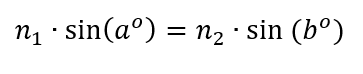
So I then rigged up a fixed laser pointer to measure its index of refraction usingSnell’s Law, which says
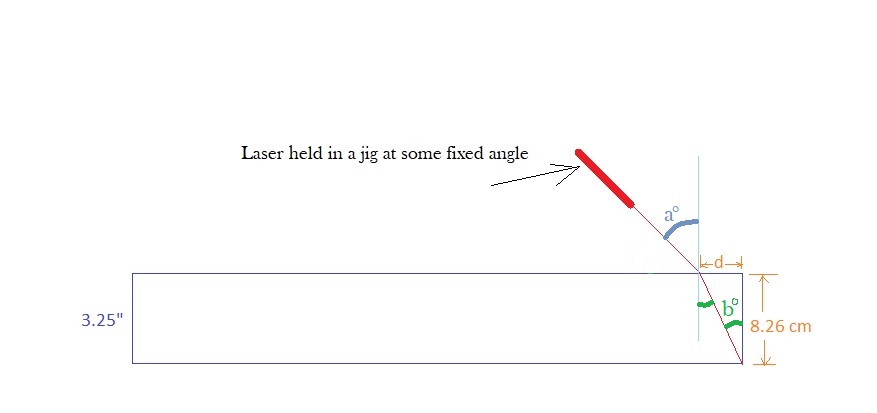
Here is a schematic of my setup:
The fixed angle a I found to be between 50 and 51 degrees by putting my rig on a large mirror and measuring the angle of reflection with a carpentry tool.
And here is what it looked like in practice:
I slid the jig back and forth until I could make it so that the refracted laser beam just barely hit the bottom edge of the glass blank.
I marked where the laser is impinging upon the glass, and I measured the distance d from that spot to the top edge of the glass.
I divided d by the thickness of the glass, in the same units, and found the arc-tangent of that ratio; that is the measure, b, of the angle of refraction.
One generally uses 1.00 for the index of refraction of air (n1). I am calling n2 the index of refraction of the glass. I had never actually done this experiment before; I had only read about doing it.
As you might expect, with such a crude setup, I got a range of answers for the thickness of the glass, and for the distance d. Even angle a was uncertain: somewhere around 49 or 50 degrees. For the angle of refraction, I got answers somewhere between 25.7 and 26.5 degrees.
All of this gave me an index of refraction for this class as being between 1.723 and 1.760.
This gave me a list of quite a few different glasses in several catalogs (two from Schott and one from Bausch & Lomb).
Unfortunately, there is no glass with a density between 2.80 and 3.00 g/cc that has an index of refraction in that range.
None.
So, either we have a disk of unobtanium, or else we did some measurements incorrectly.
I’m guessing it’s not unobtanium.
I’m also guessing the error is probably in our weighing procedure. The bathroom scale we used is not very accurate and probably got confused because the glass doesn’t have two feet.
A suggestion was made that this might be what Bausch and Lomb called Barium Flint, but that has an index of refraction that’s too low, only 1.605.
Gordon Waite is a commercial telescope maker who has made a number of very useful YouTube videos on his grinding, polishing, parabolizing, and testing procedures. I thought some of my readers might be interested in viewing them. The link is here, or else you can copy and paste this:
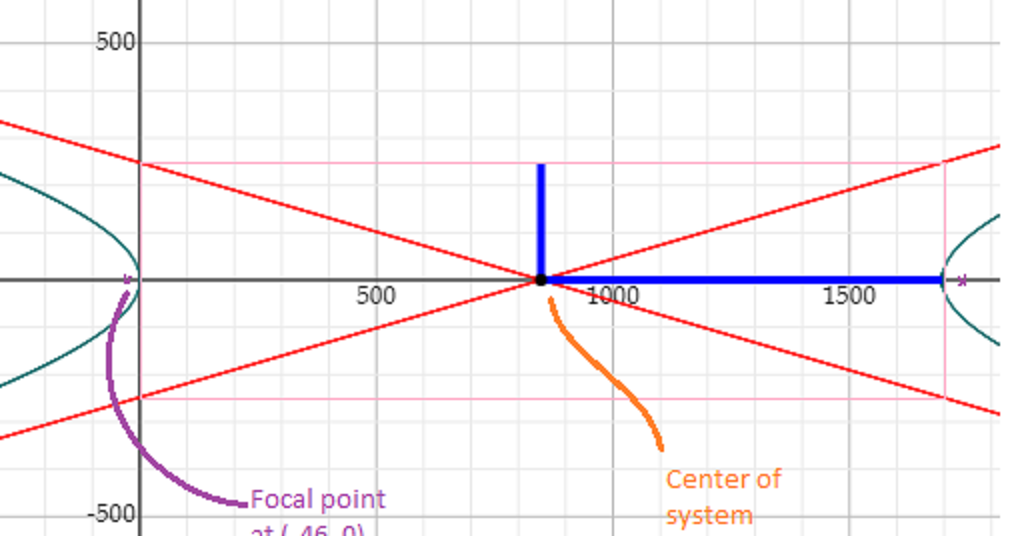
I continue to try to determine the foci of the apparent hyperbolic primary on the Hopewell Ealing 12inch cassegrain, which has serious optical problems.
My two given pieces of information are that the mirror has a radius of curvature (R) of 95 inches by my direct measurement, and its Schwarzschild constant of best fit,(generally indicated by the letter K) according to FigureXP using my six sets of Couder-mask Foucault readings, is -1.112.
I prefer to use the letter p, which equals K + 1. Thus, p = -0.112. I decided R should be negative, that is, off to the left (I think), though I get the same results, essentially, if R is positive, just flipped left-and-right.
One can obtain the equation of any conic by using the formula
Y^2 – 2Rx + px^2 = 0.
When I plug in my values, I get
Y^2 + 190x -0.112x^2 = 0.
I then used ordinary completing-the-square techniques to find the values of a, b, and c when putting this equation in standard form, that is something like y^2/a^2 – x^2/b^2 = 1
Omitting some of the steps because they are a pain to type, and rounding large values on this paper to the nearest integer (but not in my calculator), I get
I got
y^2 – 0.112(x – 848)^2 = – 80540
and eventually
(x – 848)^2 / 848^2 – y^2 / 248^2 = 1
Which means that a is 848 inches, which is over 70 feet, and b is 284 inches, or almost 24 feet. Since a^2 + b^2 = c^2, then c is about 894. And the focal points are 894 inches from the center of the double-knapped hyperboloid, which is located at (848, 0), so it looks a lot like this:
Which of the two naps of this conic section is the location of the actual mirror? I suppose it doesn’t make a big difference.
Making that assumption that means that the foci of this hyperbolic mirror are about 894 – 848 = 46 inches from the center of the primary mirror. I don’t have the exact measurement from the center of the primary to the center of the secondary, but this at least gives me a start. That measurement will need to be made very, very carefully and the location of the secondary checked in three dimensions so that the ronchi lines are as straight as possible.
It certainly does not look like the common focal point for the primary and secondary will be very far behind the front of the secondary!
Bob Bolster gave me an EXTREMELY fast spherical mirror that is about f/0.9 and has diameter 6 inches. I didn’t think at first that would be useful for doing a Hindle sphere test, since I thought that the focal point in back of the secondary would be farther away. But now I think it will probably work after all. (Excellent job as usual, Bob!) (I think)
Inspired by a Canadian amateur astronomer who visited the place, I’ve been in recent contact by email with some potential amateur telescope makers in Cuba.
.
I proposed bringing the optics for some completed 4″ to 8″ Newtonian telescopes in my luggage (ie parabolized & aluminized mirrors, diagonals, and eyepieces) and then giving them ideas and assistance on making the rest of the scopes. I have a number of already-completed primaries and diagonals at our DC telescope making workshop, but would have to scrounge around for eyepieces.
.
(If mechanics in Cuba can keep 1958-model cars running for over 50 years, I bet that they can probably improvise other stuff a la John Dobson, if they have any raw materials at all, which I am not sure about). I am also not sure whether I should bring focusers and spiders, or whether they should make them there themselves…
.
I understand from the Cubans that there are almost no telescopes in the entire country except for one no-longer-operational telescope at the University of Havana’s observatory, and certainly no Dobsonians. They sound quite interested in the idea, and also were suggesting that I might stay long enough to demonstrate how to grind and polish and figure a mirror. If I follow up on that idea, it would probably require me bringing in abrasives and pitch in addition to the finished mirrors, which might cause further luggage problems. Explaining finished mirrors carefully wrapped up is one thing, but containers of, say, 15-micron WAO microgrit? They might cut open the bag and test to see if it’s really cocaine…. thus contaminating it…
.
Both the Canadian and the Cubans said that bringing in materials officially labeled as ‘gifts’ would entail lots of red tape and delays.
.
For me, the payback would be the chance to practice my crappy Spanish in an exotic place that I’ve never visited, and to observe from Tropical skies that suffer relatively low light pollution, as well as doing some good in a country that seems to have a low violent crime rate…. I was planning on flying to Mexico or the Bahamas and then getting a flight to Havana, which seems cheaper than an official direct flight. I suspect that since this would be a scientific exchange, I might even be able to get both governments to sign off and issue an official visa or whatever.
Definition of optical power Determining its numerical value
The method we have just described, and which has been carried out a great number of times, always results in bringing optical surfaces fairly quickly to a degree of perfection which can not be surpassed. When one arrives at that point, one needs to ask whether the impossibility of making any more progress lies in the imperfection of our procedure, or whether it lies in the fact that one has reached the goal of creating a perfect surface. For us the question is not in doubt, and we will not hesitate to consider as perfect a surface which acts as far as we can tell upon light as would a mirror that corresponds precisely to the figure required by optical theory.
.
When a surface approaches this degree of relative perfection, one can watch an ensemble of characteristics intervene which, once understood, can serve as a guide for the worker and give notice that the work can be considered finished. At the same time as the defects disappear that are revealed by the various optical testing methods, the image, as seen under a microscope, produced by such a surface takes on a particular appearance that pleases the eye and does not disappear even when uses great enlarging powers. This remarkable appearance comes from the fact that the image is being formed by a grouping of correctly circular elements. Each of these elementary disks is in fact surrounded by a certain number of rings; but since the latter have rapidly decreasing intensities, the central disk has so much more brightness that it has the preponderance of the precise outline of the contours of light. Of the various rings that surround this disk, one can normally only see the first one. And since a dark interval separates them, the result is that this first bright ring does not bring any appreciable confusion to the image. Also, since it is superimposed on itself, it merely draws a pale belt that runs around, and is parallel to, the brightest contours of the image.
.
The theory of diffraction explains this phenomenon, which implies that all the rays of the convergent light come to its vertex almost completely in phase vibrationally. If we could substitute a surface that is rigorously exact for the approximate surface obtained via our experimental methods, the rays would arrive at the vertex in perfect accord. But the point of light – or rather, the narrow disk – formed by their coming together would still be surrounded by no less rings than before. Therefore there is no practical point in trying to push surfaces beyond the degree needed for the appearance of diffraction phenomena.
.
When these phenomena become apparent at the focus, or in other words, when the image of a point formed by the entire uncovered mirror appears in the form of a disk surrounded by rings whose brightness decreases rapidly, then we can be assured that such a mirror, aimed at any sort of object, whether on earth or in the heavens, will produce good images, and will give optical results corresponding to its diameter.
. To judge the result with certainty, and to express those results in a form less vague than one normally uses in ordinary language, we should mount the mirror in a Newtonian telescope and aim it at a distant target. We should arrange this target is as to provide details placed at the limit of visibility. We construct these test targets by inscribing on a sheet of ivory a series of divisions arranged into successive groups, where the millimeter is divided into smaller and smaller parts. The thickness of the lines engraved should vary from one group to the next in such a way that the darkened portion has the same area as the interval that separates them (figure 18). If one views such a target placed at a distance, or if one observes it with too weak an optical instrument, then the different groups appear merely to have a uniform light gray color. But if one decreases the distance or uses more powerful optics, one sees that the groups that are the farthest apart resolve themselves into distinct lines, while the rest remain blurred.
.
When we increase the enlargement and illuminate the target sufficiently, we can conclude that in the groups that uniformly gray, the blurriness of the lines cannot be attributed to the weakness of the eye. It must be entirely because the instrument resolves one of the groups and does not resolve the next one. In verifying in this way which of the groups is so close together as to be located at the limit of visibility, we obtain positive proof that the instrument can separate the parts that are separated by a certain angle, and cannot separate those that are closer together than that. It then follows that the ability of the instrument to penetrate the details of observed objects, or what we could call its optical power, is inversely proportional to the angular limit of separability of the adjacent divisions. The definitive expression of this optical power is the quotient of the distance to the target, divided by the mean interval between the finest visible divisions.
.
To this sort of test we have submitted a great number of mirrors of all sizes and of all focal lengths. These experiments have led us to a general expression of optical powers which is remarkably simple. We have found that this optical power is independent of focal length, that it varies only with the diameter of the mirror, and that it works out to about 150,000 units per centimeter of diameter. Without having done as many experiments on achromatic objectives, we have nonetheless discovered that, when we reduce them to their active surface diameter, they obey the same law, and that if the diameters are equal, then both lens and mirror are capable of having the same optical power.
.
This fact, which appears to be henceforth well-established, naturally leads one to search in the physical make up of light, and not in the imperfections of our instruments, for the obstacle which limits the extension of the effects already obtained. No matter how the optics are constructed, these instruments, as long as they approach perfection, tend to display optical powers that are in a constant ratio with the respective diameters of the ray bundles that are transmitted. One can not refrain from considering this ratio as a physical constant whose value expresses the aptitude of light for forming detailed images. In taking a millimeter as our unit of length, to which we normally relates the wavelength of light, we find, according to our experiments on optical powers, that this this constant has a value of 1500.
.
This optical constant of light is intimately linked to the wavelength of light and is inversely proportional to it, so that it varies for light of different colors. This means that rays that are more easily refracted [i.e., shorter wave length light, such as blue light – trans.] produce the greatest power of definition. Experiments have confirmed this numerous times, especially via the clarity of microphotographs taken with ultraviolet light.
.
In general, physical constants have a reason for their existence which flows directly from the nature of the agent whose physical properties are being defined. Evidently this number 1500, which expresses in some way the separability of points of light, proceeds from the number of light waves contained in a unit of length, and multiplied by a coefficient that depends both on the procedure used to determine optical power and also on the physiological aptitude of the retina to perceive different impressions.
.
It may be feared that while trying to give rise to the notion of optical power, will unwillingly provoke optical workers to announce impossible powers. But anything is liable to be distorted. To help put other observers on guard against illusory observations, we have taken care to explain precisely the way to obtain comparable measurements. We also maintain that there is an absolute limit to how high the magnification can be raised in practice by any optical instrument.
.
Nonetheless, we need to reserve the case where our instruments will be tested on the sky.
.
When the weather is very fine, it can happen that the observation of double stars with equal magnitude reveals an optical power that is higher, even up to twice the result that one would conclude from terrestrial targets. Here is an explanation for this possible anomaly. With our terrestrial target, the details we are trying to distinguish are equal spaces, alternately black and white. That was a necessary arrangement so that we could always fall back on identical conditions of lighting and observation. But this equality of black and white is far from being the best arrangement as far as one’s ability to resolve detail is concerned. In the image of such an arrangement, the width of the white areas equals their geometric area increased by the apparent diameter inherent in the width of the elementary [Airy? — trans.] disks, so that at the moment that these white areas begin to merge, they have a width that is twice the one they would present if the white parts were infinitely small in comparison to the black parts. However, in the sky the real dimensions of double stars are infinitely small in relation tot he space between them. Thus, the width of the image of these stars is reduced to these elementary disks, which makes it so that their angular separation, with a homogeneous atmosphere, is easier than with the ivory target. We are not yet able to state how much higher the optical power determined via double stars is than that obtained by viewing the ivory target, but we are sure that the difference is considerable. A 33-cm telescope, which gave us our first opportunity to witness the fact that the blue companion star of Gamma Andromedae is a double, only had a computed optical power of 400,000, which indicated that it should theoretically only have been able to resolve one half arc-second. However, it is estimated that the angle of separation between the blue binary stars of Gamma Andromedae is 4/10 of an arc-second.
.
We have stated, in a general way, that in a perfect instrument the optical power is independent of the focal length. If we want to understand this fully, then we should analyze the constitution of the images of objects by following the theoretical deductions step by step. In a perfect image, the number of distinct points clearly depends on the size of the elementary disks that represent the different points of the object. Since these disks are surrounded by a dark circle which is the geometric locus of all of the points where one-half of the bundle of light rays is out of phase with the other half, it follows that the size of these disks depends both on the wave length of light and the angle of convergence of the rays at the extremities. For a fixed wave length, and for a constant diameter of the base of the bundle of rays, the width of the image varies with the focal length. But since the size of the elementary disks varies noticeably in the same ratio, the result is that the number of different parts does not change. Because of this sort of logic, we have been led to construct short-focal-length telescopes without fear of affecting their optical power.
.
But if this optical power only depends on the useful surface of the objective, then one should expect that in reducing the active surface of a good mirror by using a diaphragm or stop, one should reduce the optical effects of the mirror in proportion. This result, which was foreseen, seemed to be so contrary to what ordinarily occurs that it seemed wise to us to check it directly.
.
This experiment has been repeated several times on telescopes of all sizes, and it has now been confirmed that by local refiguring one can bring mirrors to such a degree of perfection that they cannot be subjected to any diaphragm or stop without losing some of their optical power. From this flows a new character and a very simple test that can be used to check the quality of a telescope; for depending on whether they gain or lose in optical quality as they are stopped down, we can judge in a decisive manner how nearly they approach perfection.
.
All of these facts are additional confirmations in favor of the wave theory of light. In the former theory, the focus is simply the point where independent rays cross each other; the more rays, the brighter it is, but the smaller the probability that this crossing will occur at a unique point. But according to wave theory, the focus that forms in a homogeneous medium is the center of spherical waves with the same phase; the longer the wave length, the better this center is determined. The rays we consider geometrically have no individual existence; they are simply the direction of propagation of waves. Among these supposed rays that a surface is supposed to regroup at a focus, all are special: those that vibrate in phase constitute a limited focus; those that because of a surface imperfection have undergone a difference in travel path that incapable of putting them out of phase, are pushed a certain distance away from the others without ever being able to come closer to them than a certain limit. There is a discontinuity between the waves that are in phase and those that are out of phase, and this discontinuity reveals itself by the presence of a black circle that stands like a rampart around the large center of the effective rays. However, if by refiguring one is able to bring back those deviated rays, one will find that they will never penetrate that dark space; they avoid it and cross it as the effect of an unstable equilibrium, only to reunite themselves by pressing themselves against the group of in-phase rays.
.
This discontinuity in the path of the rays that are called upon to become effective, explains a phenomenon whose singularity has often struck us. When a surface, even a very incorrect one, is merely one of revolution, the phenomenon that one notices during the various focusing maneuvers consists in the fact that, in a greater or smaller area on either side of the point of best focus, one notices the presence of an image that remains clear, while still detaching itself on a background of ambient light. Assuredly, if the deviated rays could approach the focus closer and closer, this phenomenon would not appear, given that the successive foci formed by the different zones are continuously linked one to the next. But since in reality every focus is limited and essentially preserved from the confusion by a black annulus, whatever zone forms an image in the plane being observed in, is bounded on either side by inactive zones which assure to their own images the ability to dominate over the lighted background formed by the brusque dissemination of other rays.
.
The same explanation accounts for the phenomenon of doubling which occurs so frequently with large instruments. Opticians assume that doubling of images is due to an accident in their work which divides the surface of the objective into two discontinuous regions separated by a “parting” ridge. This explanation has no foundation, because one never finds an intersection between two regions, nor any surface discontinuity. In reality, image doubling is a result of the superposition in the converging apparatus of two distinct defects. It happens every time that the objective is marred with a positive or negative general aberration and also presents two central rectangular sections with unequal curvatures. We have discovered, when discussing the paths that have been followed, that in such a case there are formed in the converting ray pencil to excentric groups of active rays, and that the central rays that remain out of phase become inactive in their perpendicular direction. We can produce, at will, the phenomenon of image doubling by choosing a mirror affected by aberration and then compressing it along one of its diameters. When the aberration is positive, the doubling occurs perpendicular to the compressed diameter; if the aberration is negative, the doubling is parallel to that same diameter.
.
If we consider now that this ring surrounding the focal image of each point of light, and which works so powerfully to give definition to images, also has the effect of rejecting the rays that would harm the useful rays at a noticeable distance, then we can judge how much its presence must favor the application of our third method of examining optical surfaces. That method is precisely designed to establish how much those rays depart from one another, by the interposition of an opaque knife-edge screen.
.
When after doing refiguring all the harmful rays have returned into order, one can still not conclude, as we have already stated, that the reflecting surface has attained geometric perfection in all its rigor. However, the result is that the remaining defects are contained within limits which one can determine by very simple calculations. The formation of an exact focus implies the rigorous concordance or the absolute equality of the paths traveled by all of the rays. If a focus forms that appears perfect, it is not exaggerating to say that all the rays are in phase to at most one-half wave length, because those that were out of phase by any more than that would be rejected outside the first black ring, and would end up reinforcing the exterior rings. Now the average wave-length of light is about half of a thousandth of a millimeter, and a half-wavelength is a quarter of a thousandth [ of a millimeter]. But if any part of the surface is in error by a certain amount, then this error will act upon the paths traveled, whereupon it will be doubled by reflection. And since we have assumed that all of the rays are in step by less than one-half wavelength, it results that all the points on the actual physical surface of the mirror approach the theoretical surface by less than one eight-thousandth of a millimeter, or roughly one ten-thousandth of a millimeter.
.
Independent of the size of the surfaces, that is the degree of perfection which comprises local refiguring pushed to the point where we realize foci that are physically perfect. If we use the spherometer to test quantities of this order, it can only respond with uncertainty; how then can any machine working the glass attain them? We must therefore work by hand. But even the human hand cannot work alone; it must constantly be guided by the hints from the light itself.
.
To sum up, in this section, devoted specially to optical power, we have established that there is a group of characters by which one can tell that a surface approaches perfection. When such surfaces are subjected to examination, they cease to show any perceptible defects. The images they give take on a good appearance that is maintained under very strong enlargement, the contours are clear and can be seen accompanied by pale diffraction fringes. Also, when one applies a diaphragm stop, one notices that no portion of the objective can be masked off without a comparable weakening of the optical effects.
.
In order to give a numerical value to the concept of optical power, we consider it to be inversely proportional to the smallest angle under which one can observe the separation of the smallest details visible in the focus of an instrument. We took as our test subject a distant target formed by contiguous, alternating black and white spaces, placed at the limit of visibility on account of its distance from the telescope and the distances between the black and white areas. We expressed the optical power as the quotient of the distance from the target to the focal point of the telescope, divided by the mean separation between homologous sections in the target.
.
After a large number of experiments performed on mirrors and lenses of all sizes and focal lengths, we have determined that the optical power depends only on the diameter of the effective surface. Consequently, this power and this diameter are in a constant ratio characteristic of white light, and which expresses in a general way the delicacy of the agent or its virtual power of separation.
.
If we take the millimeter as our unit of length, to which the wavelength of light is normally linked, we find that this optical power is a number approximately equal to 1500. From this, we can deduce by a simple proportion the maximum optical power of any objective of any size.
.
We insist that there does really exist an absolute limiting power, so as to establish that which one should be able to expect from a telescope of any given size, and also to deter manufacturers from claiming to have obtained or trying to obtain optical results that are simply impossible.





























 To judge the result with certainty, and to express those results in a form less vague than one normally uses in ordinary language, we should mount the mirror in a Newtonian telescope and aim it at a distant target. We should arrange this target is as to provide details placed at the limit of visibility. We construct these test targets by inscribing on a sheet of ivory a series of divisions arranged into successive groups, where the millimeter is divided into smaller and smaller parts. The thickness of the lines engraved should vary from one group to the next in such a way that the darkened portion has the same area as the interval that separates them (figure 18). If one views such a target placed at a distance, or if one observes it with too weak an optical instrument, then the different groups appear merely to have a uniform light gray color. But if one decreases the distance or uses more powerful optics, one sees that the groups that are the farthest apart resolve themselves into distinct lines, while the rest remain blurred.
